
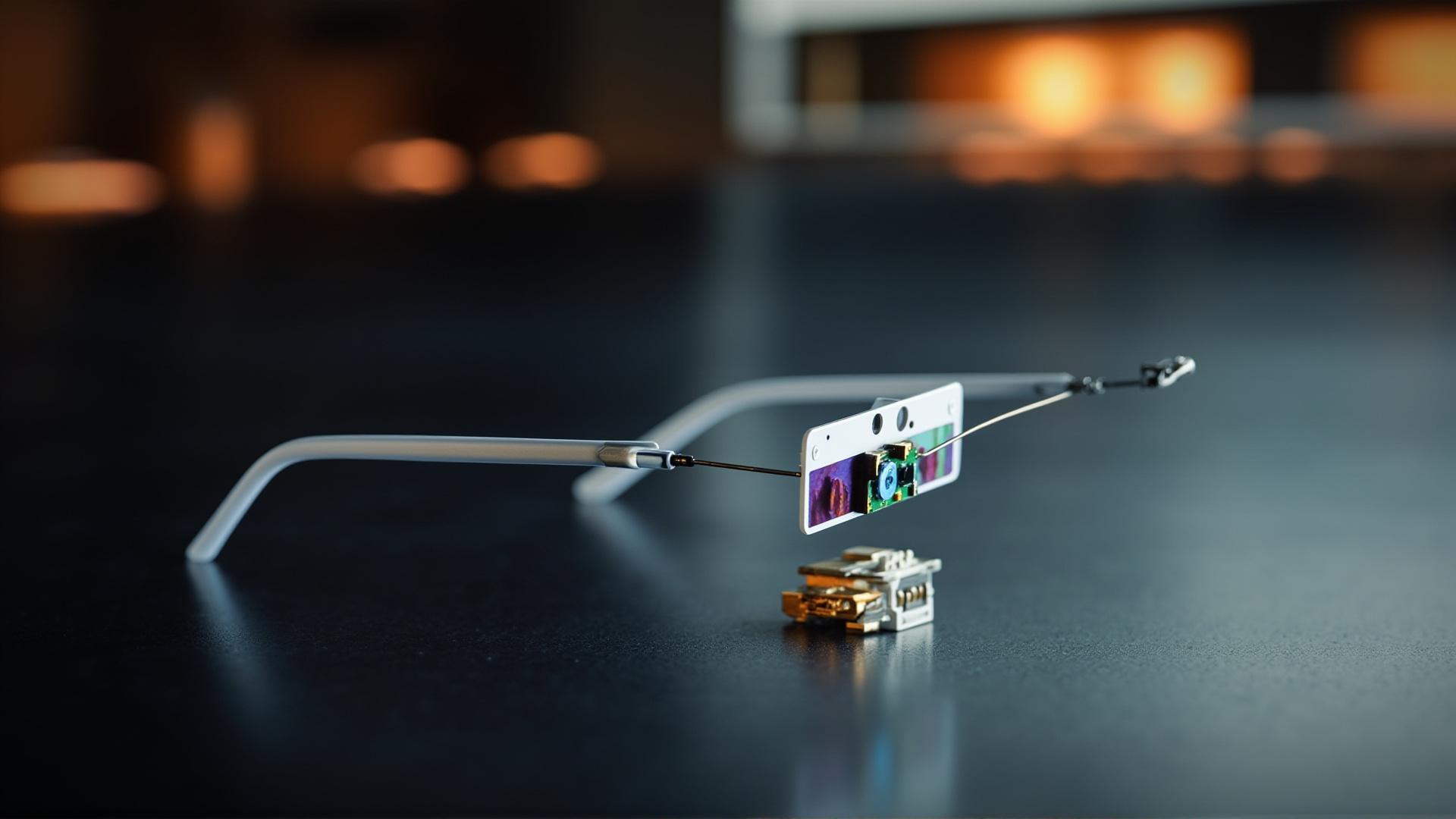
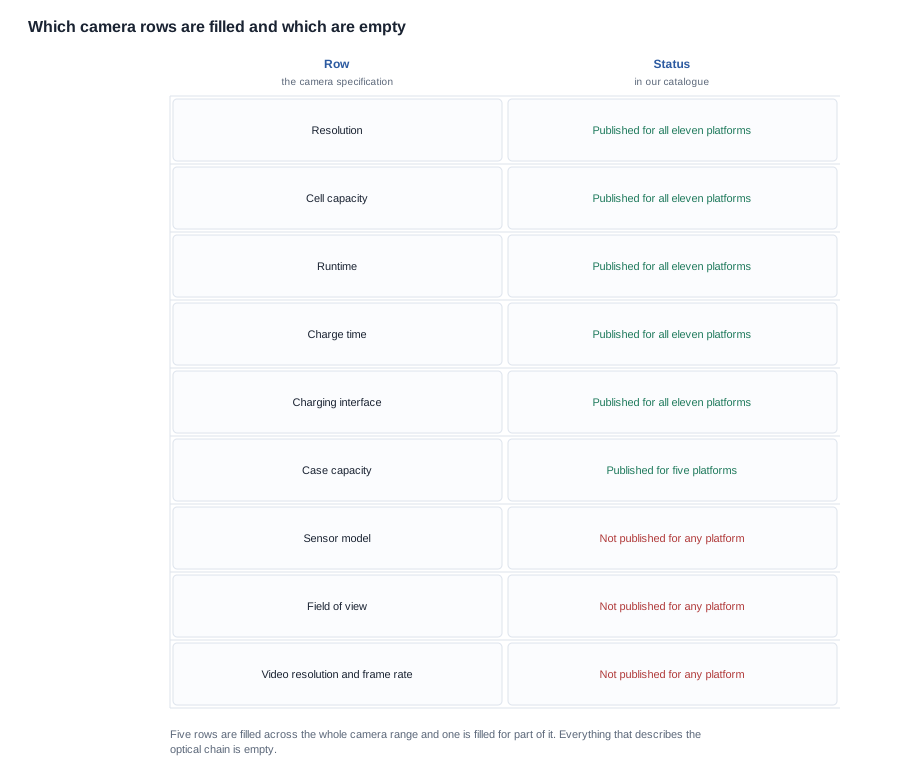
The smart glasses camera technology smart glasses faq has an answer our own catalogue makes unusually easy to give, because the published set is small and the gaps are consistent across every model. We publish the resolution, the cell capacity, the charge time, the rated runtime and the charging method. We do not publish the sensor model, the field of view, the video format, the frame rate, the aperture, the stabilisation method, the low-light behaviour or the storage capacity for any camera platform in the range. That is a statement about our source document, not about the hardware.
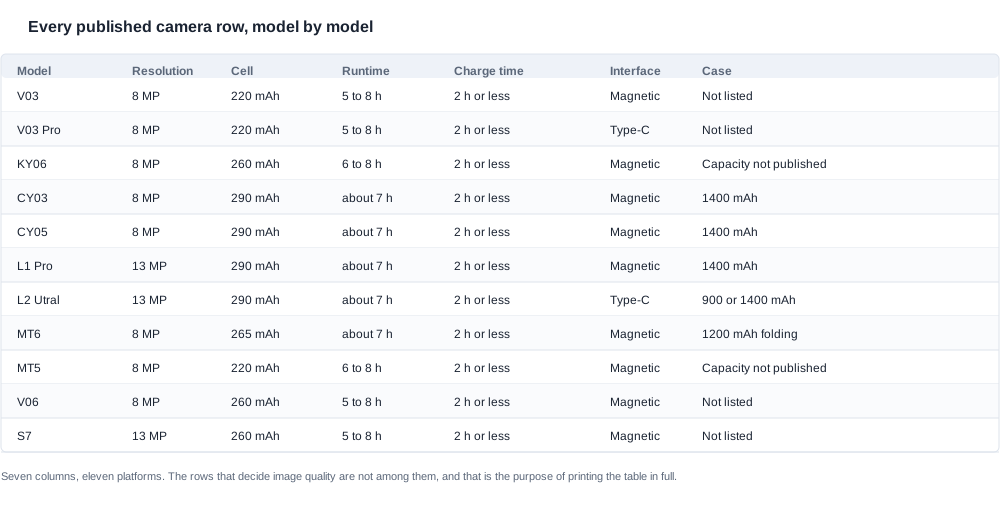
The most useful thing a buyer can take from this page is a complete printout: the filled rows for all eleven camera platforms, the empty rows beside them, and an honest account of who controls each one. Everything below is drawn from our published material, and nothing below is inferred.
Smart glasses camera technology: the published set, model by model
Eleven platforms in the catalogue carry a camera. Eight of them state 8 MP and three state 13 MP. Every one publishes a cell capacity, a runtime and a charge time, and seven of them publish a charging interface. Five publish a case capacity, two publish an ingress marking, and exactly one publishes a unit weight.
Reading the table in rows rather than in models is more informative, because the rows are what a buyer has to write into a specification. On resolution, the 8 MP group is the V03 Pro and the CY03, the MT5 and the V03, and the KY06 and the MT6, and the V06 and the CY05, and the 13 MP group is the L1 Pro and the S7, and the L2 Utral. On cell capacity, the values run from 220 mAh on the V03 and the V03 Pro, and the MT5, through 260 mAh on the S7 and the V06, and the KY06, to 265 mAh on the MT6 and 290 mAh on the L2 Utral and the CY05, and the CY03 and the L1 Pro. On runtime, the V03 and the V03 Pro, and the S7 and the V06 publish five to eight hours, the KY06 and the MT5 publish six to eight hours, and the five 290 mAh platforms plus the MT6 publish about seven hours. On charge time, every camera platform publishes two hours or less. On interface, the V03 Pro and the L2 Utral are Type-C, five more are magnetic, and the MT6 and the L1 Pro, and the CY03 and the CY05 publish no interface row at all.
The rows that apply to only part of the range
Three rows are not universal across the camera tier, and each of them has a commercial consequence that is worth knowing before the shortlist is built rather than after.
Case capacity is published for five of the eleven. The CY05 and the CY03, and the L1 Pro each carry a 1400 mAh case, the L2 Utral carries either a 900 mAh or a 1400 mAh case depending on configuration, and the MT6 carries a foldable 1200 mAh case. The KY06 and the MT5 are described with a charging case but publish no capacity for it, and the S7 and the V06, and the V03 Pro and the V03 list no case at all. A buyer who assumes a case is standard across the camera range is wrong in both directions at once: it exists without a published figure for two platforms, and it is absent for four.
Ingress marking appears twice. Only the V06 and the S7 carry the IP54 marking, and both of them also carry the detachable inner frame and the ergonomic design line in the catalogue. The marking is therefore a property of two sport platforms rather than a property of the camera tier, and a buyer quoting IP54 for a camera platform is quoting a model-specific fact as a family-level one.
Unit weight appears exactly once in the whole catalogue. The MT6 is published at 158 g for the glasses themselves, with its 265 mAh cell and its 8 MP camera included and the foldable charging case listed separately at 1200 mAh with no weight given for the case. No bare frame weight is published for any model in the range, and a buyer who wants to quote a frame weight has to request it for the specific model rather than infer it from the one figure that exists.
What the eleven camera platforms have in common
Two patterns run through the set, and both of them save a buyer time.
The first is that the charge time is uniform. Two hours or less on all eleven, with no exceptions. A buyer planning a charging rotation does not have to model the platform, only the shift, and a supplier offering a faster charge on one model is offering something outside the published set rather than something faster within it.
The second is that the runtime tracks the cell rather than the resolution. The platforms on 290 mAh publish about seven hours, the 220 mAh platforms publish ranges that begin at five or six hours, and the resolution tier does not appear in that relationship at all. The S7 is the clearest case: it is a 13 MP platform on 260 mAh publishing five to eight hours, which places it with the shorter-runtime group rather than with the other two 13 MP platforms.
A third pattern is worth noting because it is easy to assume otherwise. The camera tier publishes no radio version. None of the eleven camera rows carries a Bluetooth version, while the audio and sport models in the same catalogue do carry one. A buyer assembling a specification sheet will search for that row and find it empty, and the row is empty because the information is not published for these products rather than because it was overlooked.
The three sport models that publish no resolution
Three of the sport models in the catalogue publish no megapixel figure at all, and the reason they are worth naming is that the gap is not a rule about the category.
The D17 publishes a 115 mAh cell, roughly seven hours of runtime, a charge time of about one hour, a Type-C interface and a Bluetooth version of V5.4, and it lists a remote-control photo feature with surround sound. The ZH12 publishes a 100 mAh cell, roughly eight hours of runtime, the same charge time of about one hour, a Type-C interface, V5.4, and a remote shutter with surround sound. The YKC02 publishes a 70 mAh cell in a two-cell configuration, roughly eight hours, a charge time of two hours or less, a magnetic interface, V5.4, and surround sound with a long battery life — and no camera feature of any kind.
The D17 and the ZH12 therefore mention a camera-related function without publishing a resolution, and the YKC02 mentions no camera at all. The S7, in the same sport family, publishes 13 MP. So the gap is a gap in three product entries rather than a rule, and it has a practical consequence for a buyer comparing the sport range on imaging: one model in that family has a published tier and the other three do not, which means a requirement expressed as a resolution cannot be checked against most of the range.
That the D17 and the ZH12 also publish the two fastest charge times in the catalogue is a coincidence worth noticing and not worth reading into. Their charge time of about one hour is genuinely shorter than the two hours or less published everywhere else, and it is published without a starting state or a completion criterion, so it cannot be turned into a shift-rotation figure any more than the other twenty-six entries can.
The consequence for a buyer comparing the sport range
A buyer who shortlists across the sport family has to make the requirement work without a resolution row for three of the four candidates, and there are two honest ways to do it.
The first is to express the requirement as a function rather than a number: continuous recording of a stated duration, capture without an interruption, operation in the conditions the customer works in. Those requirements can be tested on every candidate regardless of what the sheet says, and they are what a customer experiences anyway.
The second is to accept that the resolution requirement applies to a subset of the range and to state that explicitly in the specification, so that a supplier quoting a sport model without a resolution is answering a question that was asked about a different product. The failure mode here is quiet: a buyer who asks for "at least 8 MP" across a family and receives three models with no figure will usually get an answer, and the answer will usually be an estimate rather than a refusal. Estimates are the thing this catalogue is built to avoid.
What the rest of the catalogue publishes, for contrast
The gaps in the camera tier are easier to judge once they are set against the rows that the rest of the catalogue does carry, because the difference is not about how much documentation a product gets. It is about which layer of the product the documentation describes.
The catalogue holds twenty-eight entries in total. The audio and sport models publish their radio version, with V5.3 on the K01 and the K02 and V5.4 on the rest, and they publish their cell configuration in the same way as the camera models, including the two-cell notation on the K02 and the LC-105-1, the G07 and the YKC02, the K01 and the YK12, and the LC-105-2. The children's models publish a 40 mAh cell on the A05 and the A06 and a 70 mAh cell on the A07, each with roughly twenty hours of runtime. The photochromic model and the bone conduction model complete the set, the first on a 100 mAh cell at about seven hours and the second at 200 mAh with a stated amplification gain.
So the electrical rows are consistent and complete across the catalogue, and the radio row is published everywhere except on the camera tier. What is missing everywhere on the camera side is not a set of rows that somebody forgot; it is the set of rows that describe the optical chain, and the reason is that the optical chain is where the product configuration lives.
Why none of the open rows can be answered from a datasheet
The reason the empty rows cannot be closed by asking for a datasheet is that a datasheet does not exist for these configurations. The rows are empty because the information sits with the manufacturer of the module rather than with the product configuration, and it has to be requested per model.
This is a structural point rather than a complaint about documentation quality. A camera platform is a product configuration: a module, a lens, a housing, a firmware build and a set of options. The sensor model, the field of view and the video format belong to the module as it is supplied. Whether that module's configuration in this product matches the configuration the buyer was shown in a comparison is exactly the question that cannot be answered from a generic datasheet, because the generic datasheet does not describe this product.
The practical consequence for a buyer is that the four camera requests have to be addressed to the manufacturer of the specific model, with the model designation stated, and they have to be answered with a document rather than a summary. A buyer who requests them once, for the whole shortlist, in a single message, gets one answer per model in a comparable form. A buyer who requests them model by model over six weeks gets six answers in six forms, and spends the time reconciling them instead of using them.
The layers also explain a buying habit that is worth avoiding. Buyers tend to treat the bottom of the stack as more reliable than the top of it, because the lower layers are visible and the upper layers are documents. In this category it is the other way round: the published sheet is the most reliable layer in the file because it is the one we have checked against our own source, and the module-level claims are the ones that arrive verbally and are hardest to trace.
That reversal is the practical argument for working from the sheet outwards. Start from the rows we publish, add the configuration rows that are specific to the model being ordered, and then request the module-level rows last, once the shortlist is short enough to make each request worth writing properly.
Who controls each published row
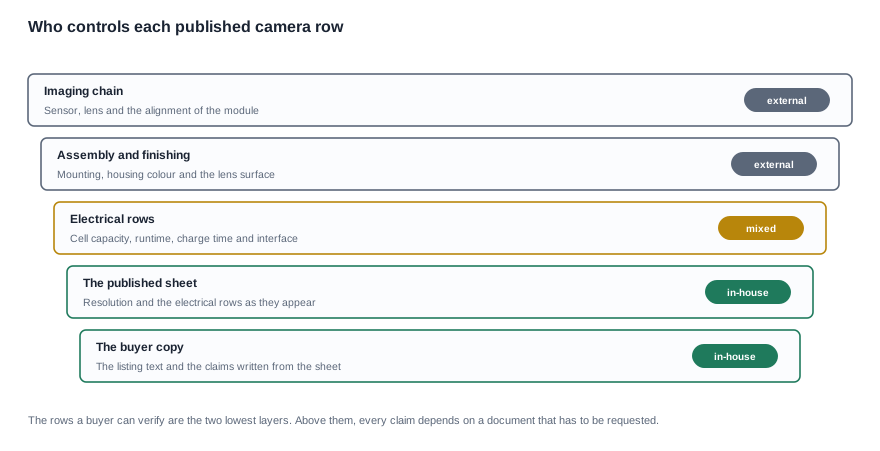
The layers chart is the honest picture of where a camera row comes from, and it explains why the two halves of the sheet behave so differently. The imaging chain and the assembly and finishing are entirely the manufacturer's. The electrical rows are mixed, because the cell and the runtime are configuration decisions while the charge time and the interface are often inherited from the module. The published sheet and the buyer copy are ours.
That means a buyer can verify the bottom two layers themselves and can only request the top ones. It also means the practical check on a supplier is simpler than it appears: ask whether the claim is about the module or about the product. A claim that describes the module — the sensor family, a generic field of view, a format list — is probably a family-level figure rather than a configuration-level one. A claim that describes the product — the runtime with a condition, the case capacity, the resolution for a named model — is the one that can be relied upon.
The six questions that close the empty rows
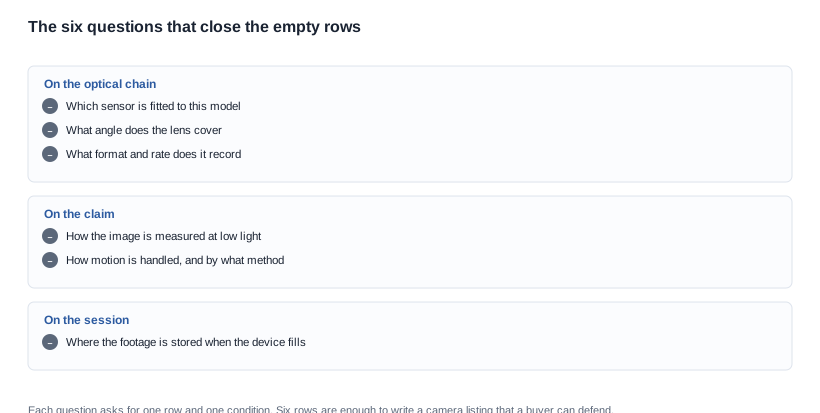
These six questions, asked together for a shortlist, cover everything the catalogue leaves open about the camera tier. They are phrased so that each answer is either a number with a condition or an explicit refusal, because a refusal is a usable answer and a vague affirmation is not.
Two of them are worth a note. How the image is measured at low light is a question about method rather than about a figure, and it is the one most often answered with a figure anyway, which is usually a rendering or a comparison against another product rather than a measurement. Where the footage is stored when the device fills is a question about behaviour rather than about capacity, and the answer determines whether a long session can be recorded end to end — which is the same question the published runtime row raises and does not answer.
The four camera requests, the two method requests and the sample protocol together are the complete verification set for this category. Everything else in the published range is already on the sheet, and a buyer who has these six answers plus the published rows has everything that can be known about a camera platform before the first unit is manufactured.
The answers are worth more if they are kept in a single place rather than scattered across the correspondence. A short table with one row per model and one column per question turns the process from a chase into a comparison, and it makes the two outcomes that matter visible immediately: the models where a row has been answered with a condition, and the models where a row is still open. The second group is the shortlist, because those are the platforms where the sample has to carry the whole argument.
It is also worth deciding in advance what happens to a model with an open row. The decision is cheaper before the shortlist has been costed, because once the model is in the pricing plan the gap has already been paid for in the effort that went into evaluating it.
The three realistic options are to carry it with the gap written into the copy, to carry it with a narrowed claim, or to drop it. A buyer who has not decided will discover the decision being made by whoever writes the listing, which is usually too late to be a commercial decision.
Everything else in the published range is already on the sheet.
We print the empty rows beside the filled ones
We publish the resolution tiers because they are in our catalogue, and we publish the empty rows next to them rather than filling them with typical values from the industry. We will not infer a sensor class from a megapixel figure, and we will not present the 13 MP tier as an imaging advantage over the 8 MP tier, because the published data does not support that comparison.
The same rule applies to the ranges we publish outside the camera tier, and it is the reason this page can be printed and handed to a buyer without a footnote. The audio rows are published where the manufacturer published them, the sport rows are published where they exist, and the two children's rows are published as they stand. Where a value is absent it is marked absent, and where a configuration has more than one published variant — the L2 Utral case at 900 or 1400 mAh, the V03 Pro lens and colour options, the V06 and S7 colour lists — the variant is stated rather than resolved to a default.
— and for the rest, to say plainly that it has to be established on a sample. The imaging detail is covered under ai camera glasses imaging, the models themselves are on the ai camera glasses range page, and the protocol that closes the remaining rows is in how to test camera technology.
Related reading
- The six questions as a buying checklist — camera technology buying checklist
- What the specification sheet leaves out — camera technology myths
- Verifying the supplier behind the figures — camera technology supplier verification
Send us the model you are evaluating and we will tell you which of these six rows our documentation can answer and which need a sample.


