

Maintenance for a sports or outdoor product is where a distributor's return rate is actually decided, and the reason is that the routine in this category has a step most people do not expect — the charging interface — and that step is also the one most likely to fail quietly. A unit that charges intermittently is returned as a defective product, the customer has done nothing wrong, and the distributor absorbs the cost of the unit, the freight and the handling.
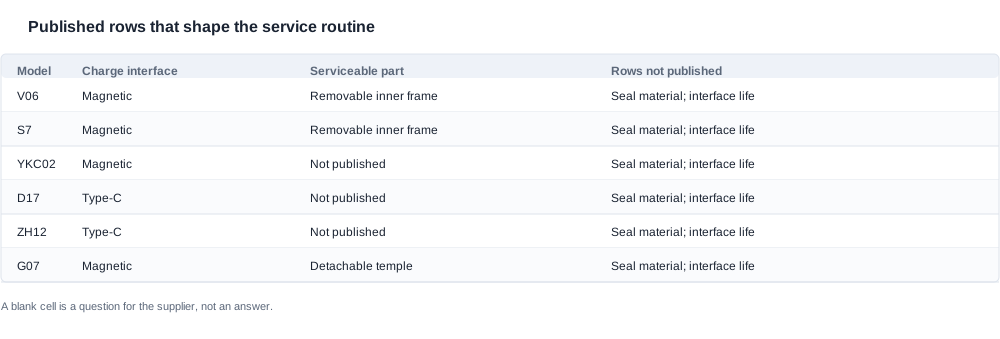
The published position in the sport and outdoor range shapes the routine in four ways. The charging interfaces are magnetic on the YKC02, the V06 and the S7 and Type-C on the D17 and the ZH12, so a range that spans both needs two cable types in the service kit. The ingress marking appears on the V06 and the S7 as a catalogue annotation with no third-party test report number published, and the seal material is not published for any model in the range. The V06 publishes four colourways and a removable inner frame, and the S7 publishes the removable inner frame, which means the inner frame is a serviceable part on the sport camera models. And exactly one model in the whole catalogue states any mass at all, the MT6 glasses body at 158 g counted without its foldable case, which matters for maintenance because the reason a unit comes back is usually an adjustment problem rather than an electronic one.
Who is running this routine, and what it protects
A distributor's service lead is deciding what to stock and what to tell a customer, and both decisions come from the same five questions.
A brand's support manager is deciding which returns are in scope, and that decision has to be argued from evidence rather than quoted from a policy.
A product developer is deciding which failures are designable-out, and the durability engineering article covers that side of the same problem.
Smart glasses for sports and outdoor maintenance: the routine that decides the return rate
A service routine for this category has five tasks, and they are not the five a buyer expects. The lens is not the problem; the lens is where a complaint is visible. The charging interface is the problem, and it is the one task that most people never perform because the symptom does not resemble a charging fault.
Task one: the charging interface
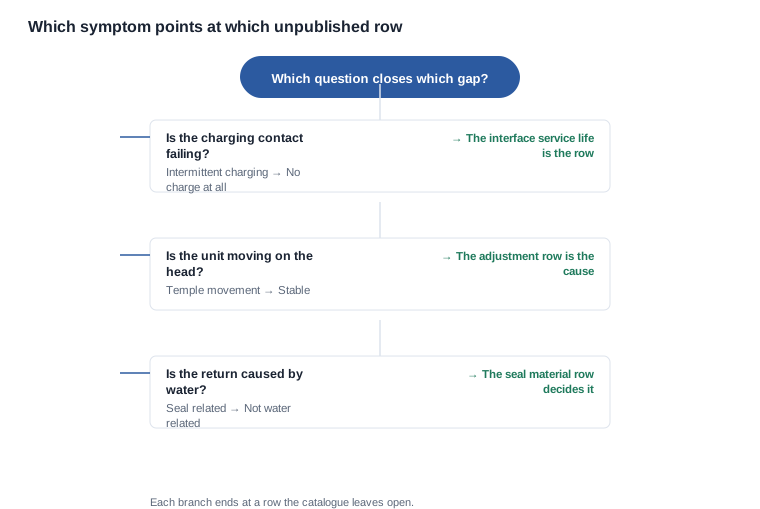
The routine is to charge after use and the failure point is the contact. A magnetic contact living in a temple that sees sweat, dust and repeated insertion develops a film, and the symptom is intermittent charging, which presents as a product fault rather than as a maintenance issue. The remedy is a wipe, and the reason it works is that the contact is a contact and not a sealed port. A Type-C product fails at a different point and responds to a different instruction, which is why the interface has to be stated rather than implied.
The frequency of the routine is what a distributor should agree with the customer, and the useful instruction is the one that specifies a number of wipes rather than a general reminder. A customer who is told to check the contact once a week will do it once a month.
Task two: the surface
The lens, the front and the temple. The lens is the most exposed surface and the one where a scratched coating is most visible. A microfibre cloth and a non-abrasive treatment are the whole of it; solvent-based products and alcohol on a coating are how a lens gets damaged. No coating specification and no scratch figure is published for any model in our range, so the safest instruction is the least aggressive one, and that is an argument for stating a method rather than a product.
Task three: the seal and the interface covers
The ingress marking on the sport camera models is a catalogue marking with no test report number published, and the seal material is not published for any model. A customer who knows the seal is replaceable keeps the product in service; a customer who does not, replaces it. Where the seal is not field-replaceable, that fact belongs in the product documentation rather than in a support reply, because it changes the economics of the second failure.
Task four: the adjustment
The maintenance task that does not resemble one. A frame that is too loose moves, and a frame that moves abrades at the temple and the hinge, and the resulting complaint is a durability complaint when the cause is an adjustment complaint. The G07 publishes a detachable temple and the V06 and the S7 publish a removable inner frame, so on those models the abrasion point is a replaceable part rather than a scrap unit.
Task five: storage
Away from heat, away from direct sun and — for a product with a lithium cell — away from a hot vehicle. Storage at partial charge over a long period is a cell question that a distributor holding inventory will eventually ask about, and the published rows do not answer it for any model.

Building the routine into the product documentation
A service routine that lives in a support article is a routine that arrives after the failure. The version that reduces returns is the one written into the product documentation at the point of purchase, and it has a different shape: it is short, it is specific, and it names the part rather than the behaviour.
Three attributes make the difference. The routine has to name a frequency, because "keep the contacts clean" is not an instruction a customer can act on and "check the charging contact weekly" is. It has to name the part, because a customer who knows the charging contact is a separate surface will wipe it, and a customer who knows only that the glasses need attention will not. And it has to say what not to use, because the most common avoidable damage in this category comes from a well-meaning customer applying a solvent-based product to a coating that no specification in the range describes.
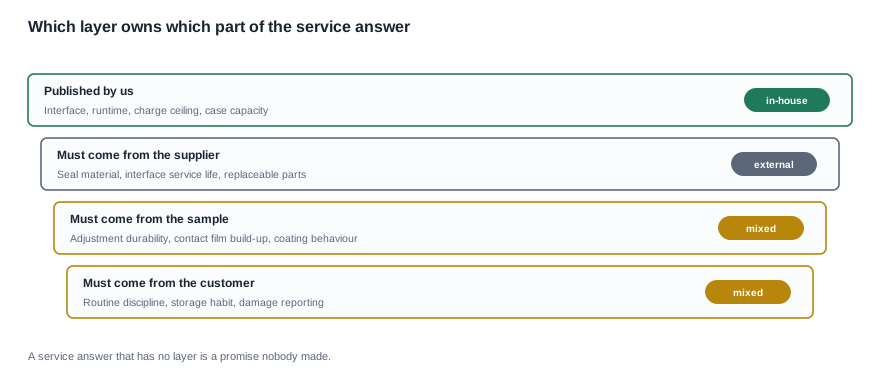
The same three attributes apply to the service kit instructions that a distributor sends with a spare part, and they are the reason the supplier's answers to the seven questions below determine the quality of the routine a distributor can publish. A supplier that states the seal material and the recommended wiping method has made the routine writable; one that does not has left the distributor to invent it, and an invented routine becomes a return.
The criteria a service programme is judged against
Three measures decide whether a service programme is working, and all three are the buyer's to collect. The return rate by cause, separated into interface, adjustment, cell and other, because a blended rate hides which of the five tasks is failing. The cost per return, which includes the unit, the freight, the handling and the time, and which is the number that decides whether a replaceable part is worth stocking. The share of returns that are resolved without a return shipment, which is the direct measure of how well the routine was communicated.
The questions that follow from those three measures are the ones a distributor should put to a supplier before the first order, and they are the same questions that a brand should put into the agreement, because the supplier controls the interface and the seal and therefore controls most of the return causes.

The parts a distributor should hold in stock
A service kit is a small number of items, and getting the list right removes a large share of the avoidable returns.
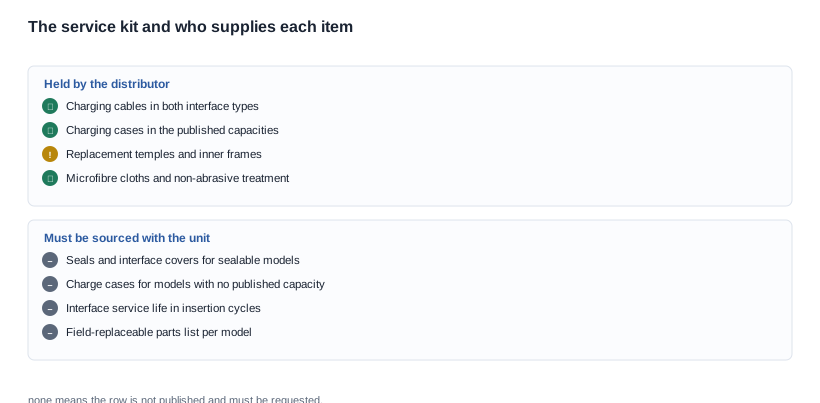
Charging cables in both interface types. The published split is real — magnetic on the YKC02, the V06 and the S7, Type-C on the D17 and the ZH12 — and a range that spans both means two cable types in the kit, with the magnetic units also needing a case to charge into.
Charging cases, in the published capacities of 900, 1200 and 1400 mAh, plus a case for any model where the catalogue publishes a case without a capacity. The case is the most common single item in a service kit in this category, and it is also the item most often returned with a broken charging contact, because the two are related.
Replacement temples and inner frames, where the model offers them. The G07 publishes a detachable temple, and the V06 and the S7 publish a removable inner frame, so on those models a spare part is far cheaper than a replacement unit and it is also the part that resolves the adjustment complaint rather than a symptom.
Microfibre cloths and a non-abrasive treatment, in quantity. This is the item that determines whether a customer wipes the lens or scrapes it, and the quantity decides whether the instruction is followed at all.
Seals and interface covers, where the model is sealable. The seal material is not published in our range, so the part has to be sourced with the unit and the replacement basis has to be established with the supplier rather than assumed.
The stocking decision for each item is made against three criteria, and they do not always agree. The replacement cost of the unit, which is the ceiling on what a part can be worth. The time to replace, which decides whether a customer waits or buys a second unit. And the probability that the part is needed, which is where the published rows help: the G07's detachable temple and the V06 and the S7's removable inner frame are the only parts in the catalogue whose availability is documented, so they are the only ones that can be stocked on a published basis rather than on a verbal assurance. How to choose between the two criteria when they disagree is a channel decision, and it should be recorded rather than left to the person who happens to be ordering the parts.

Questions to put to a supplier about the service proposition
- What is the expected service life of the charging interface, expressed in insertion cycles?
- What is the seal material, and is the seal user-replaceable?
- What is the recommended wiping method, and what must not be used on the lens or the temple?
- Which parts are field-replaceable, and which require the unit to be returned?
- What is the storage position and the storage temperature range?
- Which production checks are performed, against which written standard, and what happens to a batch that falls short?
- What is the warranty period, and what response time applies to an interface-related claim?
The first five are the published gaps in our documentation expressed as questions, and the sixth and seventh are the commercial questions that determine the total cost of the support operation. A supplier that answers the seventh with a number rather than a policy sentence has given the buyer something that can be put in the agreement.
The three questions a service lead asks a supplier every quarter
A distributor does not need a long questionnaire. Three questions, asked on a schedule, produce most of the information a service operation needs.
Which failure causes are rising, and what changed? The causes are stable over a quarter, and a change in the mix points at something specific: a new production batch, a change of accessory, a change of packaging, or a new customer segment with different habits. The question is worth asking because the causes in this category are almost never random, and a rising cause is the earliest signal a brand gets about a routine that has stopped being followed.
Which spare part moved, and is that a demand signal or a defect signal? A temple or an inner frame moving steadily is usually a demand signal, because the part is cheap and the unit is not, so the right response is to stock more. The same part moving suddenly is a defect signal, and the right response is to stop shipping until the cause is found. The two require opposite responses, and a red flag that is read as the other one is expensive.
What did the returns that reached the end of the warranty cost? Those returns are the ones the channel absorbs, and the trend line is the only early warning a brand gets about a design or a routine that has stopped working. It is also the number a supplier will answer with a written standard rather than with a policy sentence, which is the point of asking it in that form.
Five things a service page should never say
"Waterproof," for a product with an IP54 catalogue marking and no test report. The second digit of a 4 speaks only to water splashed from any direction, and to nothing beyond that.
"Submersible" or "splash-proof," because neither is the marked behaviour.
"Alcohol-safe" or any named solvent, because no coating specification is published anywhere in the range and the least aggressive instruction is the safe one.
"Will not scratch" or any coating durability claim, because no scratch figure is published for any model.
A "warranty void if" clause about the charging contacts, which in practice teaches customers not to report the most common fault and converts a serviceable product into a return.

Where a service programme costs money
The cost of a service programme is concentrated in three places, and all three are decided before the first order rather than after the first hundred returns.
What a service programme costs per unit
The number that decides whether a service programme is viable is the cost of service per unit sold, and it is assembled from four items. The parts themselves, which are known for the models that publish a serviceable part and unknown for the rest. The freight and handling on a return, which is usually the largest single item and the one most sensitive to the accessory set. The desk time, which scales with the size of the channel rather than with the number of defects. And the write-off, which is the unit itself when the fault is not repairable.
Two of those four items are controlled by the supplier and two by the distributor, which is why the questions in this article are written for the supplier. A supplier that commits to the interface service life, the seal material and the field-replaceable parts list converts the first two items from unknown to known. A distributor that stocks the right spare parts converts the third. Neither converts the write-off, which is the cost of designing a fault into the product rather than out of it, and the durability engineering article covers that side.
The comparison that matters between two suppliers is therefore not the unit price and it is not the warranty length. It is the total cost of service per unit over a season, which is the sum of the four items above divided by the volume, and which is the only figure that reflects the difference between a product with a documented serviceable part and one without.
The return itself
A returned unit carries the unit, the freight in both directions, the handling and the desk time, and in this category it carries the customer relationship as well, because the customer is often right and the product is only partly to blame. The cheapest reduction available is the routine itself, communicated at the point of purchase rather than at the point of failure.
The spare-parts stocking decision
A serviceable part is cheap to stock and expensive not to have. A unit that has to be replaced because a temple or an inner frame is unavailable costs several times what the part costs. The published removable temple on the G07 and the published removable inner frame on the V06 and the S7 are the only serviceability rows in the catalogue, so on every other model the stocking decision has to be made against a supplier commitment rather than against a published row.
The warranty scope
The scope conversation is where a return rate turns into a cost. A warranty that covers the unit but not the interface, the seal or the adjustment produces returns that are technically in scope and are actually caused by the routine. A warranty that names the routine as the buyer's responsibility, with a stated response time and a stated remedy, produces a number that can be planned against.
What a service programme can still move
A service programme is bought twice: once for the unit and once for the part. The second purchase is where the money is saved or lost, because a spare part costs a fraction of a replacement unit, and a channel that cannot obtain the part will replace the whole unit instead.
- Price and the volume breaks — negotiable.
- The spare-parts set — its own order quantities, and the most valuable line in the kit.
- The case treated as a service item — its own order quantity.
- Payment — against a passed inspection.
- Cover — the period and the response time.
- Returns for an outdoor channel — how a returned unit reaches the supplier.
- The terms of a first purchase.
- Certification and tooling — fixed by the process rather than by the parties: what the body charges and how long the route takes both follow the testing body, tooling is often amortised over an opening tranche, and certification is charged for each family the factory holds. Confirm which of those the quoted line refers to.
A service contract for this range should name: the published rows for the configuration ordered, the interface together with the service life stated for it, the seal material and whether it can be replaced by the user, the list of parts that can be replaced in the field, the recommended wiping method, the storage conditions, and the warranty period with its stated response.
Left out: a coating durability claim, a waterproof or immersion claim, and any clause that would stop a customer reporting an interface fault.
We publish the service-relevant rows as our documentation states them and we do not describe a routine for a coating, a seal or an interface whose specification is not published. Smart glasses for sports and outdoor maintenance is decided by how early the routine is communicated, and the routine is only as good as the rows the supplier has committed to in writing.
The sport smart glasses range lists the models this routine applies to, and the after-sales page covers what happens when a unit comes back.


