

Troubleshooting a sports or outdoor product is a diagnostic discipline, and the reason it feels like guesswork is that the published specification does not describe most of the things that actually fail. This page is written for the distributor's technician or the brand's support team who have to answer a customer, and it sets out a diagnostic sequence built on what a technician can actually observe — because the published rows will not tell them what is wrong.
The published position in the sport and outdoor range is what a technician works from. An ingress marking appears against the V06 and the S7 in the catalogue; no third-party test report number is published behind either of them. Charging runs magnetically on the YKC02, the V06 and the S7 and over Type-C on the D17 and the ZH12, while four camera models publish no charging method row at all. The cell configurations are 260 mAh in the V06 and the S7, two 70 mAh cells in the YKC02, 115 mAh in the D17 and 100 mAh in the ZH12. Only one model anywhere in the catalogue states a weight, and it is the MT6 glasses body counted without its foldable case; nothing else in the range says anything about mass.
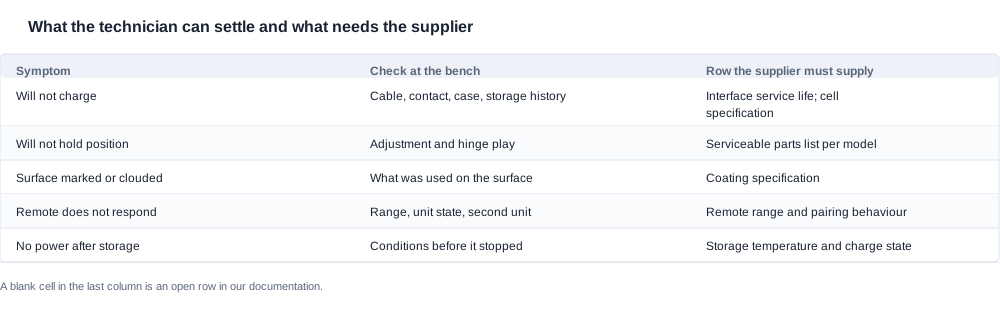
Who is doing the diagnosis, and what they are defending
A distributor's technician is triaging a return and needs to know what to check first, in what order, and what evidence to capture before the unit goes back.
A brand's support lead is deciding whether a case is in or out of scope, and that call has to be evidenced rather than defended with a policy sentence.
A procurement manager is deciding which of the open rows has to be closed before the support cost becomes manageable, and which can stay open for the first order.
Smart glasses for sports and outdoor troubleshooting: the triage order
The order matters more than the content, because most of the time spent on a return in this category is spent on the wrong check. Three rules make the sequence work.
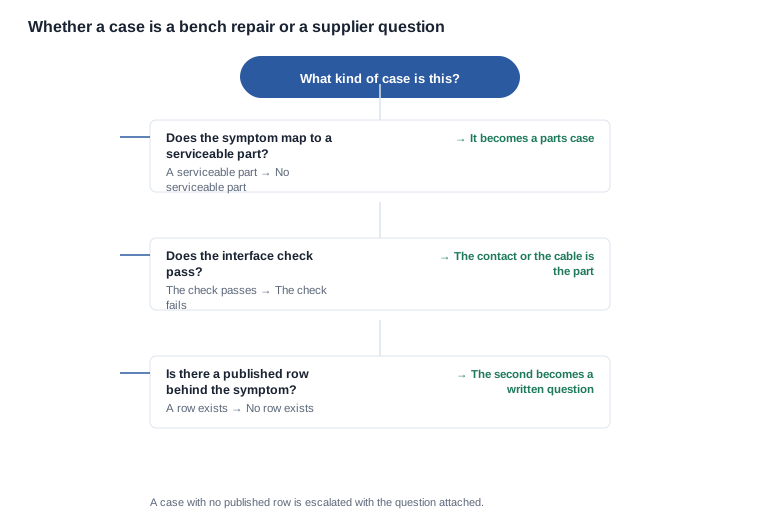
Check the power path before anything else. The charging path is the failure that presents as a dead unit, and it is also the failure with the largest number of false causes behind it: a cable, a contact, a case, a cell that has been stored flat, or a unit that is actually fine.
Check the interface the model publishes, and nothing else. The interface split is published for every model in the sport and outdoor range except the four camera models that publish no charging method row at all, and a technician who assumes a magnetic contact on a Type-C model will spend an hour on the wrong surface. On a model whose interface row is absent, the first task is to establish what the interface is, not to guess.
Separate the symptom from the cause. A unit that will not hold its position and a unit whose temple has worked loose produce the same complaint from the customer. The second is a service item on the three models that publish an adjustable part, and the first is an adjustment instruction. Diagnosing them as one produces a replacement that does not fix anything.

The criteria a diagnosis has to meet
A diagnosis is usable when it can be handed to somebody else. Three criteria decide whether it is.
It identifies the part, not the symptom. "Does not charge" is a symptom. "Does not charge with the case closed, does charge with a cable" is a part. A diagnosis that names the part can be turned into a spare-parts order, a supplier question or a warranty claim, and one that names the symptom can only be turned into a replacement.
It records the configuration. The published rows describe configurations, and a diagnosis recorded against the wrong configuration cannot be compared with a supplier's answer about the right one. The model, the interface, the case position and whether the unit has been used with a case all belong in the record.
It separates what was observed from what was concluded. Those two are different kinds of statement and they get mixed together in every support note. The observation is what the technician saw; the conclusion is what they believe it means; the second one is what gets challenged by the supplier, and separating them makes the exchange possible.

The five failures that arrive most often
One: the unit will not charge
The first question is whether it charges with anything other than the normal method, because that single observation separates almost every case. If it charges over a cable but not with the case closed, the case or its contact is the part. If it does not charge either way, the next question is what happened before it stopped, because a unit that was stored flat in a cold vehicle and a unit that was left in a wet bag are different problems.
The published rows help here and only here. The charge time is published for every model, at two hours or less for twenty-six of the twenty-eight and roughly one hour for the D17 and the ZH12, so a technician can tell whether the unit was given enough time. What the rows do not provide is a start-of-charge state, a completion criterion or a rest-voltage figure, so a unit that charges slowly cannot be judged against a published specification.
Two: the unit will not stay in position
On the three models that publish an adjustable part — the removable inner frame on the V06 and the S7, and the detachable temple on the G07 — this symptom is a service case, and the part is known. On every other model it is an instruction case, and the correct response is the adjustment guidance rather than a replacement. The published frame weight does not exist for any of the candidates, so the argument about why the unit moved cannot be settled with a catalogue figure.
Three: the lens or the temple surface is marked or clouded
The coating specification is not published for any model in the range, and no scratch figure is published either, so there is no published standard against which a mark can be judged. What the technician can establish is what was used on the surface, which is the question worth asking, and whether the mark is in the coating or in the substrate. The recommended wiping method, set out in the maintenance guide is the reference for that question, and the durable-design side is covered in the durability engineering article.
Four: the remote does not respond
Only the D17 and the ZH12 publish a remote shutter, and its behaviour is not published: not the range, not the connection method, not what it does in the presence of rain, and not whether it responds at all through a wet glove. A technician therefore has nothing to compare against and can only establish three things — whether the remote is in range, whether the unit is in a state that receives it, and whether the same remote operates another unit of the same model.
Five: the unit will not power on after storage
This is the case where the published rows are least helpful and the questions are most valuable. No storage temperature range, no storage charge state and no cell specification beyond the capacity are published for any model. The technician's job is to establish the conditions the unit was stored in and to pass them on, because a cell that has been stored outside its range produces exactly this symptom and it is a supplier question rather than a bench question.

What the published rows can and cannot settle
The diagnostic value of a catalogue is limited, and knowing the boundary is worth more than the catalogue itself.
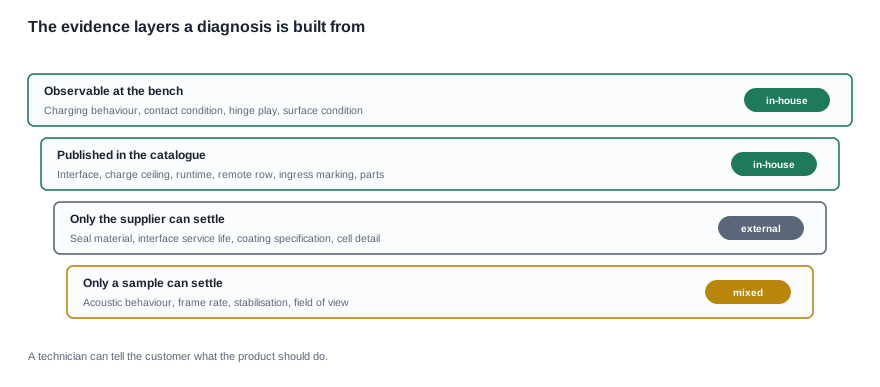
The rows that settle a diagnosis. The charging interface, for every model in the sport and outdoor range except the four camera models that publish no charging method row. The existence of an ingress marking, which exists on the V06 and the S7 and on nothing else, so a report of water damage on another model is a question about an unrated product rather than a failed test. The existence of a remote, which exists on the D17 and the ZH12 only. The existence of a serviceable part, which exists on three models. The published charge time, which bounds how long to wait before calling the unit dead.
The rows that cannot settle a diagnosis. The sensor, the microphone, the viewing angle, the capture rate and the file format on the camera models. The seal material and the interface service life on every model. The coating specification. The frame weight on every model in the sport and outdoor range. The operating temperature range. A technician working from the catalogue can tell a customer what the product is supposed to do; a technician working from a supplier can tell them what broke.
What a technician should not conclude from a single symptom
Three conclusions are tempting in this category and wrong often enough to be worth naming.
That a unit which will not charge has a dead cell. The charging path includes a cable, a contact, a case and its contact, and a cell that has been stored in poor conditions. The cell is the last thing to suspect and the first thing to replace, and reversing that order turns a parts case into a warranty case.
That a unit which has slipped has been damaged. The slippage may be an adjustment, a worn temple or a weakened frame, and the three have different remedies. On the three models that publish an adjustable part the remedy is known; everywhere else the symptom has to be separated from the cause before anything is replaced.
That a unit which does not respond to the remote is faulty. The remote's range, connection behaviour and response to wet conditions are not published for the D17 or the ZH12, so a technician has no specification against which to judge it. Establishing that the remote operates another unit of the same model is the fastest way to convert an open question into a fact.
The four models whose charging interface is not published
Four camera models in the range publish no charging method row at all: the L1 Pro, the CY05 and the MT6, and the CY03, each of which publishes a cell, a charge time, a runtime and a case capacity and nothing more about how it is charged. Three of them publish a 1400 mAh case and the MT6 publishes a foldable 1200 mAh case, so all four of these models clearly ship with a case, and in each case the case is the charging route.
That combination is the source of a recurring diagnosis error, because a technician who sees a case assumes a magnetic contact and starts working on a surface that may not exist. The first task on one of these four models is to establish the interface from the unit itself and from the supplier, and to record it, because the catalogue does not record it. This is also a good example of why the blank rows in our documentation are not a rounding detail: an unpublished interface costs a technician an hour every time a unit comes back with the wrong contact treated as the fault.

Building a diagnostic record that a supplier can act on
A return that arrives without a record is a return that arrives with nothing to act on, and the exchange becomes a loop of questions and answers that nobody closes.
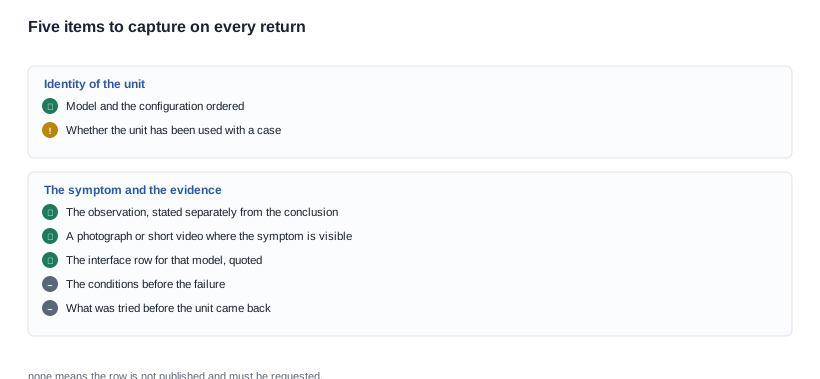
Five items to capture every time
- The model and the configuration, including whether the unit has ever been used with a case, because the case is a second power source and a second contact.
- The observation before the conclusion, stated separately, with a photograph or a short video where the symptom is visible.
- The interface row for that model, quoted, so the supplier knows the assumption being made about how the unit is charged.
- The conditions before the failure, covering moisture, temperature, storage and whether the unit was dropped.
- What was tried, because a supplier will ask what was done before the unit came back, and a technician who has already tried the contact and the cable has saved both sides a round.
What the supplier does with the record
A record is written for a reader who has never seen the unit, and that changes what goes into it. The supplier's engineer will start with the configuration, because an answer about the wrong configuration is worse than no answer. They will look for the observation next, because a conclusion without an observation is not reproducible. And they will look for what was tried, because the first thing they will suggest is usually something the technician has already done, and a record that shows it has already been done saves a week.
That last point is worth more attention than it usually gets. In this category the supplier's first three suggestions are almost always the interface, the contact and the case, because those three cause most of the returns that arrive. A record that shows those three have been checked lets the conversation start at the actual fault, and the difference between that and starting at the beginning is typically the difference between one week and one day.
There is a second reason to write the record in this shape. When the same cause appears on units from several batches, the record is what turns an individual return into a pattern, and a pattern is what a supplier can act on and a customer complaint cannot.
When to escalate, and when to replace
The decision to escalate is a decision about evidence, and the threshold is worth setting in advance. A unit whose symptom maps to a published serviceable part is a parts case. A unit whose symptom maps to a published interface and that has not responded to the contact and cable checks is a supplier case. A unit with no published row behind any of its symptoms is a supplier case with a written question attached, and the question should ask for the missing row rather than for a replacement, because the replacement will produce the same symptom in the next unit.
Where troubleshooting costs money
Three costs make the support operation expensive in this category, and all three are visible in the diagnosis sequence above.
The screening cost. Every avoidable return costs the handling twice, because the unit travels back and then travels out again if it is replaced rather than repaired. A diagnostic record that resolves the case at the bench saves the second movement.
The wrong replacement. Replacing a unit whose actual fault is a contact or a worn temple produces a second return on the same cause, and the second one usually arrives with less goodwill attached. The published serviceable parts on three models are the cases where the cheaper repair is also the correct one.
The unanswered question. A supplier question that is not asked, or is asked without the configuration attached, produces no answer, and the case stays open until somebody gives up on it. That is why the record matters more than the diagnosis.
There is a fourth cost that is easier to miss, which is the cost of the unit that is replaced and then fails again for the same reason. It appears in the accounts as a second return rather than as a warranty cost, and it is the reason the published serviceable parts on the V06, the S7 and the G07 are worth as much commercially as they are technically. Where a part can be swapped for a fraction of the unit's value, the total cost of the return falls and the second failure never happens.
A related question worth putting into the agreement is what the replacement unit is accompanied by. A swap that arrives without the accessory set that was missing from the original unit produces a second contact in a week, and the same contact appears again in the return data.
What a support operation can still move
A support operation is bought twice as well, and the second purchase is the logistics of the return: the freight in both directions, the handling, and the desk time, which tracks the size of the channel instead of the number of defects.
- Price per unit and the quantity breaks — negotiable.
- The spare-parts set — order quantities of its own.
- The case as a service item — its own order quantity.
- A swap or advance-replacement policy — its terms.
- Settlement terms — payable once the inspection clears.
- Cover — the length of it and the reply it commits to.
- Returns for a service channel — the policy that applies.
- Terms of an opening order.
- Certification and tooling — the testing body sets the amount and the schedule, and the factory spreads tooling over a second consignment while raising the certification charge per product family.
An order for this range needs a written record of: the published rows for the configuration ordered, together with the interface and the service life stated for it, the storage conditions, the recommended wiping method, the list of parts that can be replaced in the field, the warranty period with its stated response, and the agreed escalation threshold.
Left out: any expectation of a diagnosis without a record, any service commitment that depends on a published row that does not exist, and any warranty wording that discourages a customer from reporting a contact fault.
We publish the diagnostic-relevant rows as the catalogue states them and we do not describe a component behaviour that no published row covers. Smart glasses for sports and outdoor troubleshooting is decided by the triage order and by the record, and a supplier can only answer a question that arrived with the configuration attached.
The after-sales page explains what happens once a unit is on its way back, and the wider catalogue position of the segment appears on the sport and outdoor solution hub.


