

Once the basic material questions are settled, a handful of harder ones remain, and they are the ones that decide whether a product is merely acceptable or genuinely well made. None of them is visible in a specification sheet, most of them are properties of a system rather than of a substance, and all of them are judged years later rather than on the day a programme launches.
We should say up front where our own documentation stands: we do not publish the frame, temple or lens material for any model, and the frame dimensions, the temple length and the temple curve are not published either. What follows is therefore a set of questions to put to a supplier, written so that each one has a document behind it, rather than a set of rows we can fill in for you.
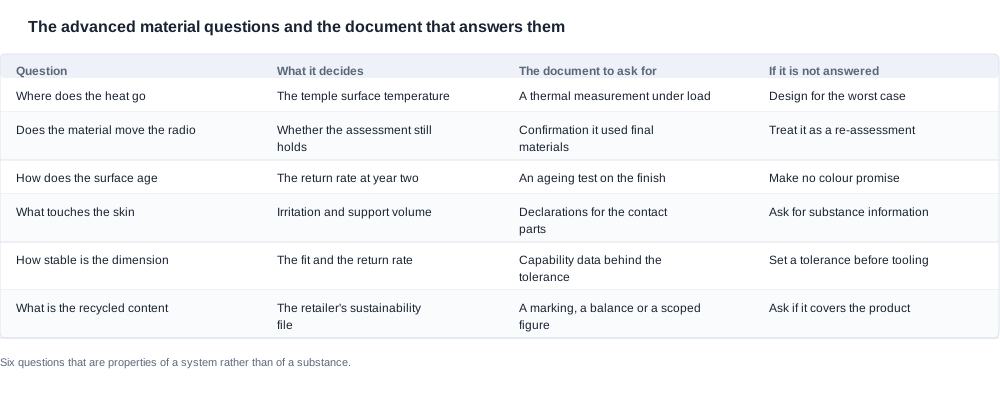
Smart glasses frame materials: a thermal path, not only structure
In this product form factor the housing is not only structure. It is the thermal path from the cell, the driver circuit and the radio to the surface the temple rests against. A conductive frame helps move heat away from the electronics and into the air; an insulating one traps it. The design question is where the equilibrium temperature sits, and the answer has a limit that arrives well before there is any safety concern.
Ask for the thermal design and the measured surface temperature under the worst realistic workload, not under standby. The number that matters is the one from a full session of active use, and a figure measured at rest is close to meaningless.
There is a second reason the thermal question belongs in a procurement file rather than in an engineering discussion, and it is a commercial one. The surface that reaches the highest temperature on a long working session is the surface a channel's returns will concentrate on, because the complaint that generates a return is the one that appears after three hours of use rather than after three minutes. A supplier who has measured the thermal path has already looked at the product the way the customer will.
The three ways a material decision turns into a commercial one
A buyer who asks for a thermal measurement usually wants to know whether the product is good. A procurement team needs three other things from the same answer, and all three are commercial.
The first is the cost of the answer. A thermal measurement on one build is a test-day cost. A thermal measurement with the capability data behind it is an engineering programme with a price and a lead time, and that lead time sits in the programme schedule whether or not anyone calls it a material decision. Ask what it costs, how long it takes, and whether it has been done for the current build or for an earlier one. The third part of that question is where the value is: a supplier who already has the measurement for your configuration has saved you a quarter, and a supplier who has it for an earlier revision has not.
The second is the tooling consequence. A material change that alters the moulding is a tooling conversation, and tooling is a non-recurring cost amortised across the programme volume. That makes it a quantity question as much as a specification question. A frame material that can be changed on an existing tool is worth a great deal more to a buyer planning a first order of five thousand units than a marginally better material that requires a new tool. Ask which materials can run on the existing tooling and which cannot, because that single answer moves the landed cost more than the material does.
The third is the certification consequence. If the material carries a declaration that has to be re-issued, there is a laboratory queue and a fee attached to the change, and the queue belongs to the laboratory rather than to your order size. Pressing on either the fee or the queue does not make the product arrive faster. The question to ask is which declaration is affected and whether the re-issue can be scoped to the specific configuration you are buying rather than to a family.
None of these three is a reason to skip the question. They are the reason to ask it early, because all three of them cost calendar time and only one of them can be recovered with money.

The material and the radio environment move together
The frame is part of the antenna environment, and this is the interaction that surprises people. The same frame in a different material, with a different hinge arrangement and different metal content, can behave differently in the radio assessment even when no component on the bill of materials has changed. A material chosen for its finish or its light weight can therefore move the radio position, and the radio position is a compliance question rather than an engineering preference.
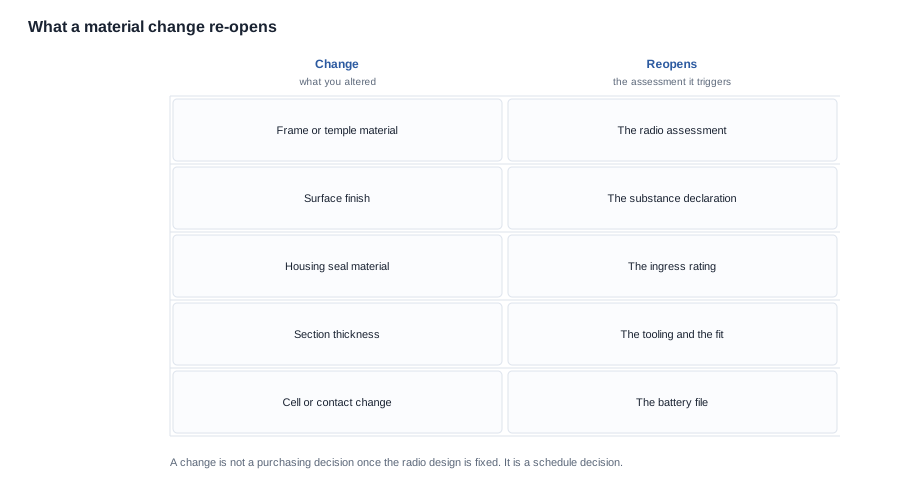
The practical consequence is that a material change after the radio design is fixed is not a purchasing decision. It is a re-assessment, with the schedule that implies.
Ask a supplier to confirm that the radio assessment was performed on the final material and the final structure, and not on an earlier revision of either. That confirmation is a line in a technical file, and it costs nothing to request and a great deal to reconstruct later.
What a change control rule has to cover
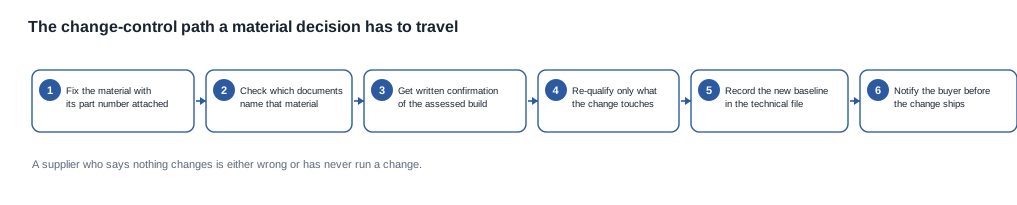
A supplier with a working change-control procedure can answer four questions about any material change without hesitation. A supplier without one will need a week and a supplier auditor to answer them.
Which documents name this material? The substance declaration is written for a specific material, and so is any file that quotes a material grade. A change that touches the frame material can therefore invalidate a document that had nothing to do with the radio.
Which assessments were performed on the current build? The radio assessment, the ingress test where the housing is sealed, and any thermal measurement all attach to a configuration.
What triggers a re-assessment? A threshold has to exist, and it should be written as a change of part number rather than as a judgement call, because a judgement call is made by whoever is in the room on the day.
Who is notified? A change that is communicated after the goods have shipped is a quality incident, not a change.
Ageing, ultraviolet and the failure that shows up in photographs
A colour that fades is a customer-visible failure, and it is one of the few material problems that shows up clearly in photographs of returned product, which means it is also one of the few that reaches a brand team rather than staying with a support inbox.
Ultraviolet exposure, heat, humidity and sweat each attack a surface differently, and the combination is worse than any of them. Ask for the ageing test and the change in appearance, and ask whether the colour sits in the surface or in the bulk of the material, because a surface colour wears differently from a through-colour and the two look identical on a fresh sample.
The same question applies to the temple tips and the nose pads, which are the parts that carry the wear and the load. A flexible temple element is a structural answer to a fatigue problem, and the material behind it is what determines how long the answer lasts.
There is a commercial dimension to ageing that a buyer should raise early. The published colour options in our range are three for the V03 Pro and four for the V06, and each of those colourways is a moulding or a finishing operation with its own ageing behaviour. A colour range that is chosen for the launch photograph rather than for its two-year appearance will produce a returns curve that is invisible in the first quarter and expensive in the third.

Skin contact surfaces and the parts nobody writes a row for
Everything that touches skin, for hours, in a warm and wet environment, deserves a specification: the temple tips, the nose pads, the inner face of the front, and the surface of any accessory worn against the body. The questions are what the material is, what coating or treatment it carries, and whether any irritation data exists.
The commercial reason to ask is that skin problems are diagnosed by the customer as an allergy to the product rather than as a materials issue, which makes them very hard to resolve through support. A customer who believes the product is causing a reaction does not become a loyal user, and a brand that cannot explain the cause cannot close the case.
We publish no skin-contact material declarations for any model, and we would rather say that plainly than present a generic compliance statement as though it covered a specific temple tip.
The compliance consequences, which are not optional
A material change reaches the substance declaration, because the declaration is written for a specific material. It may also reach the radio assessment, as above, and the ingress rating if the housing is sealed, because the seal interacts with the housing material and the surface finish.
In our catalogue the ingress marking appears on two models, the V06 and the S7, and no charging case in the range carries a published ingress marking. The glasses' marking does not extend to a case, a cradle or an accessory, and a change to a frame material on a sealed housing is a change to a configuration the marking was attached to.
The two questions to ask are therefore: which documents name the material, and what triggers a re-assessment. A supplier with a documented change-control rule can answer both. A supplier who says nothing changes is either wrong or has never run a change.
The question buyers are starting to ask
Recyclability and lower-carbon content have moved from a brand position to a procurement question, particularly for European buyers working with retailer sustainability requirements. The useful answer is a material marking, a mass balance or a percentage with a defined scope, and the question that exposes a weak answer is whether the figure covers the whole product or only the packaging.
There is a second version of the same question that is harder: what happens to the product at end of life. The frame material determines whether the product can be repaired, whether the battery can be separated, and therefore whether the unit can enter a take-back scheme or has to be treated as waste electronics. A brand that has asked the question early can put the answer into its own documentation requirements.

Dimensional stability and the tolerance stack behind a fit
A moulded plastic part changes dimension with temperature and with time, and a product assembled from a stack of such parts accumulates the deviations. In a frame, the two dimensions that matter most are the temple length and the bridge, because they decide whether the product is usable on a head and therefore whether it is returned.
Ask for the tolerance band the factory actually holds, and ask for the capability data behind it rather than the nominal drawing. A capability figure tells you what the process can hold repeatedly; a nominal drawing tells you what somebody intended once.
This is also the point at which the moulding process becomes visible to a buyer. A tight tolerance on a part with a thin section is a different moulding problem from a loose one on a thick part, and a supplier who has not thought about the tolerance stack has not thought about the problem. The commercial consequence appears at first article, where a section thickness that was open becomes a tooling conversation.
How to evaluate the answer you get back
The answers to the six questions in this article arrive in a range of qualities, and the criteria for telling them apart are simple enough to apply to any material question from any supplier.
A part number is a better answer than a name. "Acetate" describes a family of compounds; "cellulose acetate, grade X, from supplier Y" identifies something that can be ordered again next year. A material name without a grade answers nothing, and a supplier who is asked for the grade and cannot produce it has told you that the material was never specified in the first place.
A measurement is a better answer than an expectation. "The surface stays within a comfortable range" is a claim about a feeling; "the surface reaches 41 degrees after 90 minutes at 25 degrees ambient" is a claim that can be repeated by somebody else. The criteria to apply is whether the answer has a condition attached, and that is the same criterion that applies to a charge time or a runtime figure, which is why it applies here.
A date is a better answer than an estimate. A supplier who says the ageing test will be complete in four weeks has given you something you can schedule. A supplier who says it is being looked at has given you nothing.
A written answer is a better answer than a spoken one. Every question in this article should be asked in writing, because the answers will be used in a technical file, in a purchase order or in a retailer's compliance review, and a verbal answer cannot be filed.
The three warning signs to watch for are consistent across suppliers: a material name with no grade, a measurement with no condition, and a change-control answer of "nothing changes". Each of those three is a gap in the specification rather than a gap in the answer, and each of them is cheap to close at the quotation stage and expensive to close after tooling.
A hypothetical material qualification, worked through
The worked example here is a constructed scenario rather than a client project; it sets out the decision order rather than describing an outcome.
Assume an industrial distributor evaluating a camera model for a safety-equipment channel. The channel's customers wear the product for full working shifts in a warm environment, and the distributor's previous supplier had a returns problem concentrated in one complaint: the product became uncomfortable after several hours in a warm vehicle.
Step one: the questions. The distributor sends the six questions with the specification request rather than as a separate enquiry, which is the cheapest way to get them answered rather than deferred. The answers come back within a week because they are answered by the engineering team rather than by the sales team.
Step two: the thermal answer. The supplier returns a surface temperature measured at 41 degrees after 90 minutes, with the ambient condition and the workload attached. That is a measurement rather than an expectation, and it is the answer the distributor needs. It is also measured on a specific configuration, which the supplier states, so the distributor can ask the obvious follow-up about whether that configuration is the one being quoted.
Step three: the tooling question. The distributor asks which materials can run on existing tooling. The answer identifies a change that would require a new tool, and the supplier prices it as a non-recurring cost. That single answer lets the distributor compare two configurations on landed cost including the amortised tooling rather than on unit price alone.
Step four: the change-control answer. The supplier describes a rule keyed to a part-number change with a named approver. The distributor asks for it in writing and files it, because it is the document that determines what happens when the material is switched in year two.
Step five: the decision. The distributor does not shortlist on the thermal figure alone. The thermal figure rules one configuration out for the warm-vehicle use case, and the tooling answer rules out a second one on cost. The shortlist is one configuration, and the qualification file that supports it is a document the distributor can hand to its own compliance team without reconstructing anything.
The decisive step was the second one, because it took a supplier who had already done the measurement and turned an open question into a filter.
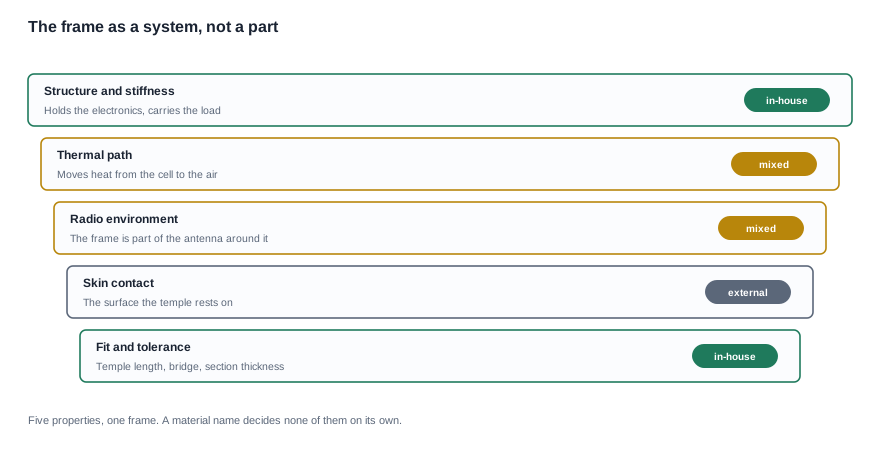
What to ask a supplier about materials you cannot see
Five questions, in the order that produces the most useful answer first. Ask which material and in what form, with a part number. Ask what the change-control trigger is and who signs it. Ask for the capability data on the two dimensions that decide the return rate. Ask what the thermal measurement was under load and what the skin-contact declarations cover. And ask which document the change would re-open, because a supplier who can answer that has a change-control procedure rather than a habit.
The last question is the one that distinguishes a supplier who has made frames from a supplier who has made electronics with a frame attached. It is also the one that is cheapest to ask and easiest to check afterwards: ask it twice, in different words, and compare the answers.
The questions our own documentation cannot answer
Stated plainly: the advanced material questions are the ones a serious buyer should expect to ask, and we are not currently able to answer most of them for our own models, because we do not publish the frame, temple or lens material.
What we do publish is the structural and configuration data. The V03 Pro is published with flexible temples and a photochromic lens configuration. The G07 is published with ultra-thin and detachable temples. The V06 and the S7 are published with detachable inner frames and with an ingress marking. The MT6 is published with a foldable charging case, and it is the only model in the catalogue with a published weight: 158 g for the glasses unit, which includes the battery and the camera module and excludes the foldable case. The weight of the case itself is not published. The colour options are published for the V03 Pro and the V06. The cell configurations run from 40 mAh up to 290 mAh.
We will not convert a structural capability into a materials certification, we will not publish a material row that we have not measured, and we will not present a unit weight as a frame weight. A whole-unit figure that includes the electronics tells you about the product and tells you nothing about the frame, and the frame is the part a materials question is about.
We will also say plainly that most of these questions are asked late, by which time they are expensive. A thermal measurement, a capability study and an ageing test all take calendar time that runs in parallel with the programme rather than inside it. The order in which a buyer asks them changes the cost, and the order that changes the cost is the one that puts the material question in front of the artwork.
What we will do is take a specific model and a specific concern from the six above, and tell you what we can evidence, what we would need to obtain, and which of the questions is the one that would change your decision. The basics of reading a material sheet are in reading a frame materials datasheet, the approaches to compare are in frame materials and their alternatives, the compliance side of a material change is in frame materials and industry standards, and the physical limits behind a long working day are in materials and ergonomics.
Related reading
- The basics of reading a material sheet — reading a frame materials datasheet
- The approaches a buyer should evaluate — frame materials and their alternatives
- The compliance side of a material change — frame materials and industry standards
- The physical limits that decide a long-wear product — materials and ergonomics
Send us the concern and the model, and we will tell you what we can evidence today and what would have to come from the tooling and testing programme.


