

Smart glasses frame materials: comparison, not a catalogue
A frame in this category is not a piece of jewellery. It is a structural bracket that has to hold a battery, a radio, a control board, and on some platforms a camera module, while sitting on a head for hours and while keeping a radio antenna in a predictable electrical environment. That is why the useful comparison is not a list of finishes and resin names; it is a set of engineering trade-offs, each of which lands on a different line in your quotation and a different date in your launch schedule.
The awkward part is that we cannot supply the first column of that comparison for our own models. Our catalogue does not publish frame material, temple material or lens material for any model in the range, and it publishes a unit weight for exactly one model: the MT6, at 158 g for the glasses unit itself, which carries the 265 mAh cell and the camera and excludes the foldable charging case. The case holds 1200 mAh and its own weight is not published. Every other figure in this article is therefore about method rather than about our products, and we would rather be explicit about that than dress a convention up as a specification.
What this article does is give you a comparison structure you can apply to any supplier's quotation, in the order a buyer actually needs it: what each family buys you, where it fails first, what to demand in writing, and how to choose between two quotes that appear to be describing the same thing.
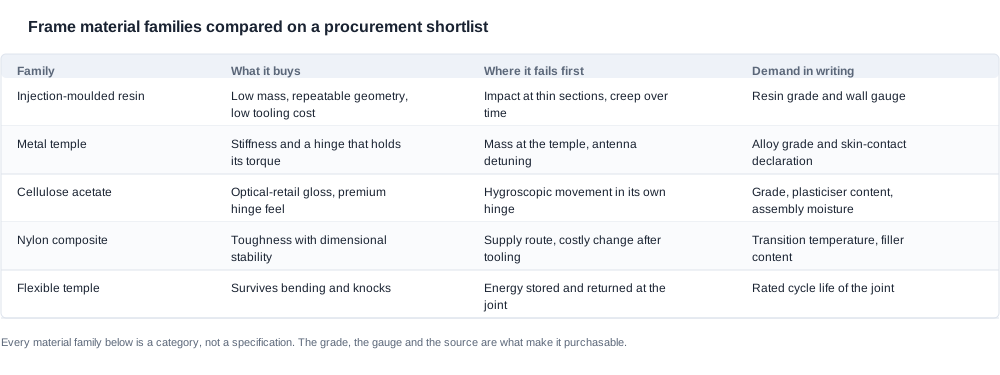

The frame families a buyer can actually order against
There are six approaches worth putting side by side, and each of them answers a different part of the requirement. A buyer who treats them as a shopping list ends up with a frame that is light in the wrong place and stiff in the wrong place; a buyer who treats them as a shortlist of engineering options can start from the load and work backwards.
Injection-moulded resin. The default for this category, and for defensible reasons. It is inexpensive, it is repeatable, a single tool produces complex geometry, and it is light, which matters more in a wearable than in almost any other product line. Its weaknesses are impact at thin sections and long-term creep. Both are graded rather than inherent, which is exactly why the grade matters more than the family name, and why two suppliers quoting the same family can be quoting products with different service lives.
Metal frames and metal temples. Stiffness, a hinge that holds its torque, and a premium appearance that reads as quality on a shelf. The costs are mass, which a buyer discovers at the temple within an hour of use, and a change to the radio environment, because a metal structure changes how the antenna behaves. A metal temple in a resin front is a compromise that is very often the right one, and it is worth asking which parts are metal rather than assuming the whole frame is.
Cellulose acetate. Warmer in the hand, a more traditional optical appearance, and the material the optical channel already understands. It is heavier than resin and more constrained in shape. Because acetate fronts and acetate temples are frequently different materials, it also introduces a second material to specify and a second thing to age, which is where the moisture-related failure originates.
Nylon composites and hybrid structures. Tuned stiffness at lower mass, and what a serious engineering team reaches for when a product has to be light and stiff at once. The practical drawback is supply: a composite is harder to source, and much harder to change once the tooling is cut. The other drawback is that composites age differently from cellulosics, so the acceptable storage conditions have to be stated rather than assumed.
A flexible or detachable temple element. Published as a feature rather than as a material, and it is a real structural choice. It survives bending and knocks that would break a rigid temple, and it changes the hinge, the tolerance stack around it and the service model. Our range publishes a detachable temple as a configuration option on the G07 and ultra-thin temple options on the same model, and publishes no cycle life, release mechanism or failure behaviour for either.
A folding case construction. The case is a product in its own right, and a folding one is published on the MT6 in our range. A folding case adds a hinge to the item, and a hinge is a failure mode. It also adds a second cell to the transport paperwork, which is a scheduling item before it is a logistics item.
Where each family breaks first, and what the break costs
Every family in the table above has a characteristic first failure, and a buyer who knows the failure in advance can price it. The reason the same complaint comes back three times in a programme is that the complaint is filed as a material problem when it is actually a specification problem.
Resin breaks at the joint, not in the bulk. A temple carrying an electronics module is under structural load in a way a plain optical temple is not. When a moulder holds the wall gauge down to protect the unit cost, the flex stress at the hinge end rises faster than the section modulus falls, and the crack starts at the hinge boss. The cheapest available correction is a steel threaded insert in a reinforced boss, which requires no tooling and no silhouette change.
Metal fails at the finish, rarely at the alloy. When a metal temple breaks, the cause is usually a dissimilar-metal joint, a plating line running outside its own adhesion window, or a bend point that was never given a stress relief radius. The complaint buyers actually see is a skin reaction appearing months after delivery, and it usually comes from a changed plating pre-treatment rather than a changed alloy, which is why the declaration has to come from the plating house.
Acetate moves in its own hinge. It is hygroscopic, it takes on moisture in humid conditions and releases it in dry ones, and a frame assembled at the wrong moisture content moves over a season. The grade and the assembly conditions determine whether that was controlled; a material name determines neither.
Composite hides design errors. A temple that would crack in acetate will simply bend in a nylon composite, run long and return to a shape that is no longer square. The complaint then arrives as "the glasses go crooked", and the response is to blame the material, when in fact the hinge geometry or the size block is at fault.
A flexible temple stores energy. A joint that flexes is a joint that accumulates and returns energy, and the cycle failure begins at the catch, the bonding line or the release mechanism. None of the three is characterised in any published row of our catalogue.
A folding case is a second hinge and a second cell. Both belong in the schedule and in the transport file, and neither is visible in a product photograph.
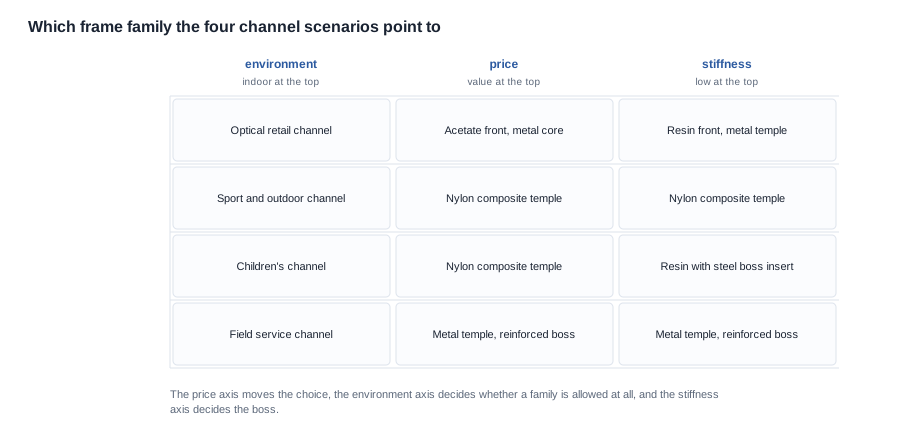
The three cost centres a family choice moves
A family decision does not stay inside the frame. It moves three separate lines, and a buyer who watches only the first one will be surprised by the other two.
The tooling line is the largest single discretionary cost in the programme, and it is set by the family and the silhouette together. A resin front and a metal temple are normally two tools rather than one; an acetate front with a metal core is two materials and two ageing behaviours; a nylon composite with a foldable case is two tools and a hinge. Tooling is also the line that decides whether a late change is even possible, because the amortisation basis for the tool is usually tied to the first order and to the volume you committed.
The documentation line is the one that arrives with the family rather than with the tooling. A new resin means a new substance declaration, and for the EU that reaches coatings, plating and adhesives as well as the base polymer. It also means a radio assessment, because a frame is part of the antenna environment, and a change of material or hinge arrangement can move radio behaviour even when every component on the bill of materials is identical. None of that is expensive per document and all of it sits on the critical path, because a document is a queue at a test laboratory rather than a factory slot.
The service line is the one that appears after launch. A metal temple raises the skin-contact question, an acetate front raises the seasonal movement question, a flexible or detachable temple raises the spare-parts question, and a foldable case raises a second warranty line. The total cost of ownership of a frame is decided by these four questions rather than by the unit price, which is why a landed-cost comparison that stops at the unit price is not a landed-cost comparison at all.
The practical instruction is to put all three lines on the request list before the quotation is accepted, so that the number you are comparing is a programme cost and not a unit cost with a schedule attached to it.

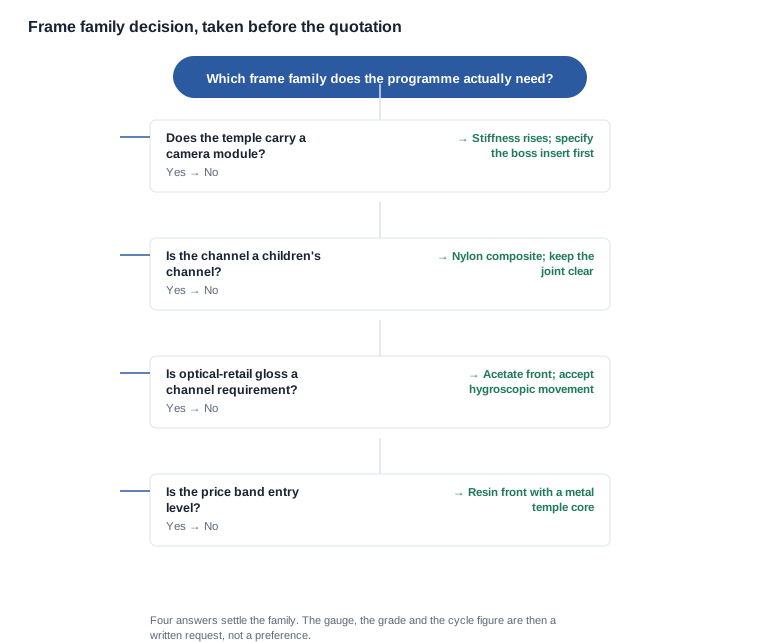
Four questions that settle the family before the quotation
Two quotations that appear to describe the same product can differ by a factor of two on the programme once setup, minimums and re-validation are counted. That gap is usually created before the unit price is discussed, at the point where the family is chosen.
Does the temple carry a camera module? If it does, the stiffness demand rises and the joint is the first thing to specify. The camera module adds mass at the end of a lever and adds a bay that has to be housed, so a reinforced boss stops being optional. If it does not, you have more freedom on the joint and more constraint on the bay volume.
Is the channel a children's channel? If it is, the obligations differ in kind rather than in degree, the joint has to stay clear of small parts, and the family moves towards a nylon composite. Our catalogue includes the A05, A06 and A07 children's entries and publishes no certification status for any of them, so this is a compliance project with a schedule attached rather than a checkbox.
Is optical-retail appearance a channel requirement? If it is, acetate moves onto the shortlist and you inherit the hygroscopic movement, so the assembly conditions have to be specified. If it is not, acetate is buying you an appearance problem rather than solving one.
Is the price band entry level? If it is, a resin front with a metal temple core is almost always the right answer, because it puts the stiffness where the load is without paying for a full metal structure. If it is not, the comparison should move to the acoustic and the antenna consequences, not to the appearance.
What the family decision does not settle
Choosing a family is the beginning of the specification, not the end of it. Three things remain open after the family is fixed, and each of them is a separate request to the factory.
The grade decides the service life, the transition behaviour and the permissible storage conditions. The gauge decides whether the section can carry the electronics bay and the joint torque at the same time. The source decides whether the figures were characterised on production tooling or copied from a resin supplier's datasheet, and this is the difference between a specification and a rumour.
A buyer who closes the family question and leaves these three open has not finished the specification; they have started it.

Turning a family into a specification you can enforce
Enforcement is a contractual matter, not a technical one. A row that exists only in an email is a preference; a row that exists in the purchase order is an acceptance standard, and a lot that fails it is a lot you can refuse.
The seven requests below are the ones that consistently separate a supplier with a real process from one who has never run a change. They are ordered by how much they cost to get and how much they protect.
- The material and the grade, for the front and the temple separately. Grade and source, not a family name. "Acetate frame" is not a stack, and a front and a temple in the same family can be different polymers.
- The weight, with the scope stated. Grams, and whether the figure covers the glasses unit alone, the unit with the cell installed, or the unit with the case. Our own published figure is the glasses unit of one model, and we state the exclusion because the alternative reading is physically impossible.
- The hinge construction, and a cycle figure if one exists. Steel insert into a reinforced boss, or a screw into unreinforced plastic. This is the cheapest strength improvement in the class and almost nobody asks for it.
- The lens material and any impact rating. The lens and the frame travel together and age differently, and a lens rating is often the only published mechanical figure available for the assembly.
- What touches skin, and its coating. Including the plating house's nickel-release declaration, which is a different document from the frame supplier's alloy declaration.
- Confirmation of whether the material was verified on production tooling or taken from a supplier's datasheet. A datasheet figure is a starting point for a sample, not an acceptance criterion.
- The change-control rule. Which material changes trigger which re-assessment. This is the one that separates a factory with a process from one that has never run a change, and it should be written as a clause rather than agreed verbally.
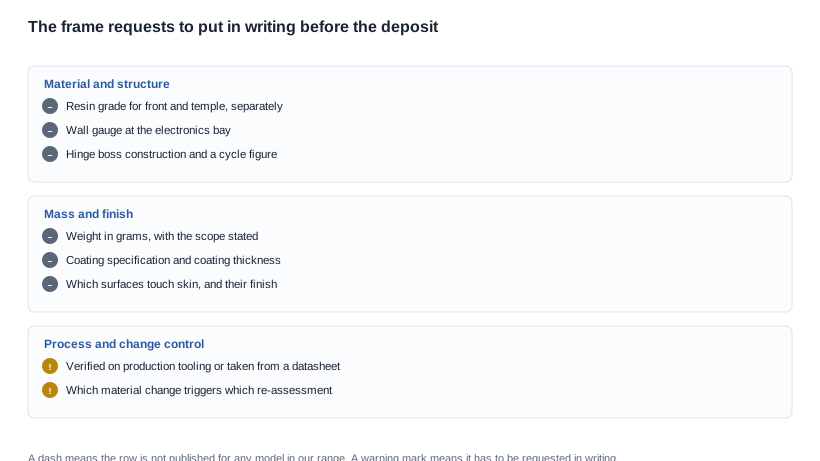
The seven requests, ranked by what they cost to obtain
The first three cost nothing but an email and carry most of the value, because they determine whether the joint and the bay can do their jobs at all. The fourth is cheap and protects the lens claim, which is usually the claim a retail listing leads on. The fifth is the one buyers defer and then discover at the compliance stage, when the plating house has changed and there is no declaration. The sixth is the one that determines whether the whole exercise is real. The seventh is the one that costs a negotiation and saves a programme, because it converts "nothing changes" into a named list of documents.
A useful discipline here is to attach each request to the gate it protects. The material and the gauge protect the first article. The cycle figure protects the warranty. The change-control rule protects the re-run.
What our own catalogue supports and what it does not
Here, a frame material in this category is a system decision rather than a finish decision, and a supplier who names a material without naming the grade has not answered the question at all. We will publish the material rows we have measured and mark the rest as not published. We will not convert a structural capability such as a flexible temple into a materials certification, and we will not treat a catalogue ingress marking as a tested specification.
Here is what we can evidence today. The V03 Pro has flexible temples and lists orange, off-white and black. The G07 carries ultra-thin and detachable temples as configuration options. The MT6 has a foldable charging case and is the only model in the range with a published weight figure, at 158 g for the glasses unit including the cell and the camera and excluding the case. The V06 lists four colours. Two models in the range, the V06 and the S7, carry an IP54 catalogue marking. Every model in the catalogue publishes a battery capacity and a charge time, and twenty-four of them also publish a charging method; the charge time is published for all twenty-eight models, twenty-six of them at two hours or less and two at about one hour.
What we do not publish, for any model: the frame material, the temple material, the lens material, the wall gauge, the hinge construction, the alloy grade, the temple length, the section thickness at the electronics bay, and any test report number behind the IP54 marking. No model in the range publishes a bare frame weight, and we would rather tell you that than quote a typical figure you cannot verify.
| Published row | Where it applies | What it settles for a buyer | What it does not settle |
|---|---|---|---|
| Battery capacity | Every model in the catalogue | The power budget and, indirectly, the bay volume the frame has to house | Runtime, which depends on the workload |
| Charge time | Every model, twenty-six at two hours or less and two at about one hour | An upper bound on replenishment time | The starting state, the temperature, the charger, and the case turnround |
| Charging method | Per model, magnetic or Type-C | The cable, the cradle and the packaging geometry | The contact condition and the thermal behaviour |
| Colour options | The V03 Pro lists three, the V06 lists four | The number of combinations you have to fund and stock | The material or the finish behind the colour |
| Structural features | Flexible temples on the V03 Pro, ultra-thin and detachable temples on the G07, a foldable charging case on the MT6 | What the assembly has to achieve and what the service model looks like | Cycle life, release mechanism and failure behaviour |
| IP54 marking | The V06 and the S7 only | That the catalogue states an ingress position | A test method, a report number, or what a material change does to it |
| Unit weight | The MT6 glasses unit only, at 158 g, excluding the foldable case | One comparison point on one model | Frame weight for any other model, and the balance on this one |
The gap is not a failure. It is the reason this article compares approaches rather than telling you which one we use, and the reason our answer to a comparison question is always in the same shape: here are the rows we hold, here are the rows you have to establish yourself, and here is the order in which closing them will cost you the least.
Related reading
- The rows a material specification should carry — materials and ergonomics
- How to read a material sheet properly — reading a frame materials datasheet
- The compliance consequences of a material change — frame materials and industry standards
- The models and the structural facts we publish — AI camera glasses range
Tell us the environment, the price band and the weight you need to hit, and we will say which material approach the product requires and which rows we can evidence today.


