

Smart glasses frame materials: rows the catalogue omits
Frame specifications are the least published part of a smart glasses datasheet and the most consequential. Every model in our range carries electronics, a battery and, on the camera models, a camera; the structure that holds all of that together is described by nothing more specific than a photograph and a colour swatch.
The reason this matters is not that the rows are difficult. It is that a frame comparison made without them is not a comparison of frames; it is a comparison of photographs, and the two products in the photographs may differ in every load-bearing way. A buyer who compares two quotations without the material, the gauge, the joint construction and the total weight is comparing the marketing and the packaging.
This is the honest position on smart glasses frame materials smart glasses key specifications: the rows a buyer should compare, how each one is measured, what an acceptable value appears as, what a distorted version of it appears as, and the fact that almost none of them appear in any published data — including ours. We publish the electrical rows completely, because the catalogue holds them. We publish one mechanical weight figure, for one model. Everything else on this page is a method rather than a number, because we will not write a number we cannot stand behind.
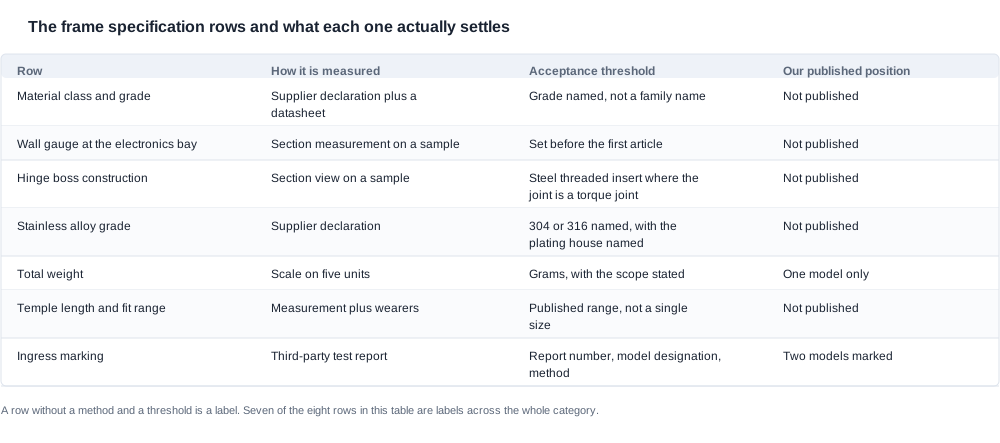

The eight rows, and what each one settles
Material class. Cellulose acetate for optical retail aesthetics and gloss; TR90 or nylon for sport and heat tolerance; metal for strength and thin sections. The class determines the flex behaviour, how the material ages, and which finishes are achievable. Not published by us for any model.
Wall thickness or gauge. This is the row buyers skip and engineering teams do not. A temple that is structurally carrying an electronics module needs more material than a plain optical temple. Hold the gauge down to save grams and the flex stress at the hinge end rises faster than the section modulus falls, which produces a crack that starts at the hinge boss.
Hinge boss construction. Steel driven into unreinforced plastic under repeated torque will strip, loosen and eventually let the hinge pull free. A steel threaded insert is the cheapest strength improvement available in this product class, and almost no buyer asks for it. Ask first and change materials second.
Stainless grade. 304 against 316 is a real difference in nickel release and corrosion behaviour at skin contact. The alloy is often identical across a batch while the plating house is not, which is why the failure appears three months later rather than at the factory gate.
Total weight. The parameter that most affects whether a customer keeps a wearable in service, and the parameter that is published for exactly one model in our range: the MT6 glasses unit, at 158 g, including the 265 mAh cell and the camera and excluding the foldable charging case. The charging case holds 1200 mAh and its own weight is not published. No model publishes a bare frame weight.
Temple dimension and size range. A frame that does not match your market's head sizes generates returns that are never classified as a defect, because each individual return is a normal fit complaint and the aggregate is invisible in a defect report.
Ingress marking. The V06 and the S7 are marked IP54 in our catalogue, with no third-party report number published. Treat that as a label rather than a tested result.
The lens row. The lens and the frame travel together, age differently and fail differently, and a lens impact rating is frequently the only published mechanical figure available for the assembly.
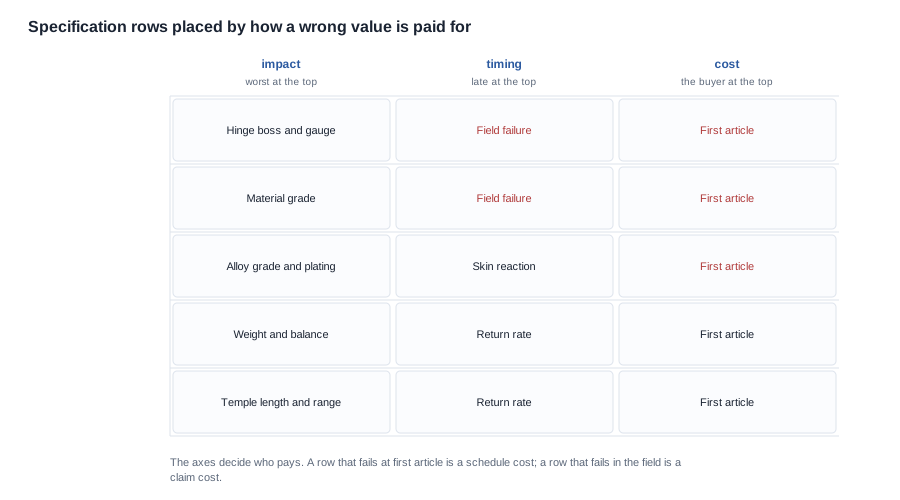
How to read a distorted value
Every one of these rows has a standard distortion, and a buyer who knows them can read a supplier's data sheet without a laboratory.
A gauge stated without a location is a gauge measured in the easy place. The temple section at the electronics bay is the thinnest part of a smart glasses temple, not the thickest, because that is where the bay is cut away. Ask for the location.
A grade stated as a range is a grade that has not been characterised. TR90 and nylon are families with different transition temperatures and different ageing behaviour, and a range across the family tells you nothing about the resin in your frame.
An alloy stated without the plating house is an alloy declaration that does not cover the plating. The nickel-release behaviour is set at the plating step, and the plating house is frequently a different company from the frame supplier.
A weight stated without a scope is a weight that cannot be compared. A glasses-unit figure and a unit-with-case figure are frequently quoted in the same document, and a 158 g unit with a case in the box is not 158 g.
An ingress marking without a report number is an assertion by the supplier that the product matches a standard, rather than evidence that it does.
A size range without a measurement method is a design intent, and it is the row most often quoted from a competitor's listing rather than from a product.
Weight, size and ingress: the rows that reach the customer
Three rows in this list behave differently from the others, because they are the ones a customer experiences without any equipment. They are also the three rows most likely to drive a return rate, which makes them the three rows with the highest commercial leverage on a programme.
Weight is the row that determines whether the product stays in service. Our published position is one figure on one model, and the figure has to be read with its scope: 158 g for the MT6 glasses unit, including the cell and the camera, excluding the foldable charging case. The catalogue does not publish a bare frame weight for any model, and a bare frame weight is the number a buyer would actually want for a comparative table.
Size range is the row that determines the return rate, and it is the row where the data gap and the commercial consequence meet. A frame covering one head size produces a stream of returns that never appear in a defect report, because no individual unit is faulty. They appear in a logistics cost, in a channel margin calculation and eventually in a review of the programme itself. The way to handle it is to sample across the head sizes your channel actually sells to, and to measure the temple length on each sample, because a size row that has not been measured cannot be quoted.
Ingress is the row where the catalogue position is clearest: two models carry an IP54 marking, with no test report number published behind either. That does not make the marking wrong; it makes it an annotation. For a buyer whose channel specification requires a report number, the marking does not discharge the requirement, and the request has to go to the factory.


Establishing the missing rows on a sample instead
When a specification is not published, it can still be established — by measurement rather than by request. Five steps, each with a completion condition.
- Weight it. A scale and five units gives a figure and a spread. Compare against whatever the channel's premium reference product weighs, and record the sample size next to the number, because a single unit is not a specification.
- Flex test. Repeated temple flex, listening for creaking as well as visible damage. Creaking at low cycle counts precedes cracking, and it is the earliest warning a buyer gets that the gauge is marginal.
- Hinge torque. Open and close repeatedly and note the cycle at which looseness appears, then repeat the cycle a second time on a second unit to check whether the figure is repeatable or is one unit's behaviour.
- Size range. Have several people with your market's typical head sizes try it. Note where the temples pinch, and measure the temple length on the unit rather than trusting the listing.
- Skin contact observation. After a long session, inspect the skin-contact surfaces. Any marking is a plating or material question and it should be photographed under the same lighting each time so that a sequence can be compared.
Record all of these against a retained unit, so that subsequent deliveries can be compared to a standard rather than to an argument. This is the cheapest quality control mechanism available in this category and it is the one most often skipped, because nothing asks for it and no certificate covers it.
The written protocol matters more than the measurement. Write the protocol down before the first reading, and fix the sample size, the conditions and the failure criteria, because a protocol designed after the readings is a description of what you found rather than a standard you can enforce on a later lot.
Turning the measurements into acceptance criteria
Once the protocol has been run, the readings have to become something enforceable, and that conversion is where most quality control effort is lost. A protocol that produces a number on one lot and a paragraph in a report is a measurement exercise. A protocol that produces a number, a tolerance and a remedy is a quality control system.
Four lines of conversion, one per measurable row. The measured value, with the sample size and the spread. The acceptance band, usually the measured spread widened by a stated margin, because a tolerance set at the measured value rejects a normal lot. The test method, so that a later lot can be measured the same way by someone who was not there. The remedy, which is what makes the tolerance binding — replacement, rework, credit or acceptance under concession, agreed before the first shipment rather than after the first dispute.
There is one more decision that is easy to defer and expensive to defer: which party runs the protocol on production lots. A buyer who runs it on every lot is paying for a quality control operation. A buyer who has the supplier run it gets a report and no independent evidence. The middle position that most programmes end up at is to have the supplier run the protocol on every lot, to receive the raw readings rather than a pass or fail summary, and to run it independently on a sample of lots as an audit. That arrangement catches a supplier who has improved the process and one who has not, and it costs a fraction of the value of the defect it prevents.
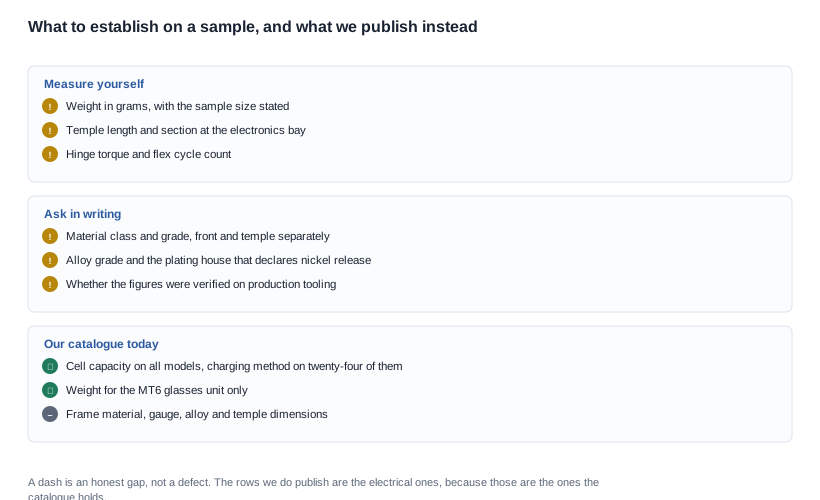

The questions to ask a supplier, and what to do with the answer
Seven questions, in the order that produces the most information per unit of effort.
- What is the material and grade for the front and for the temple, stated separately? If the answer is one material for both, ask why.
- What is the wall gauge at the electronics bay, and at what location was it measured? A location means the answer was taken deliberately.
- What is the hinge boss construction, and has a cycle count been run? The count, not the adjective.
- What stainless grade, and which house applies the plating? Then ask for the nickel-release declaration from that house.
- What is the unit weight in grams, with the scope stated, and over how many units? Three parts to one answer.
- What is the temple length and the size range, and how was it established? A method is more valuable than the number.
- For the ingress marking, what is the test report number and which method was used? If the answer is that there is no report, that is an answer, and it tells you what you have to request.
Two questions decide what to do with the answers. Which rows can you verify yourself on a sample? Those rows become your measurement protocol. Which rows will you have to accept on the supplier's word? Those rows become acceptance criteria in the purchase order, with a defect remedy attached, because a row you cannot verify and have not written down is a row you will pay for.
How to compare two frame specifications without a laboratory
The practical method for comparing two quotations in this category is to build the same row list for both and mark each row in one of three states: published and comparable, published but not comparable, or not published. That last state is the interesting one, because it is where the comparison usually turns.
A row that is published and comparable simply goes into the table. A row that is published but not comparable — two weights with different scopes, two charge times with different starting states, two runtimes measured under different loads — is marked and then excluded from the comparison, because including it is worse than excluding it. A row that is not published is where the money is, and the three questions to ask about each of them are the same three: does the supplier hold this row, can I verify it myself on a sample, and if not, what will I write into the purchase order?
That third question is the one that decides the commercial position. A row you can verify becomes a measurement. A row you cannot verify and have not written down becomes an assumption you will pay for. A row you cannot verify but have written down as an acceptance criterion with a remedy attached is a risk you have transferred. This is the practical meaning of a specification: not a description of the product, but a decision about who carries the risk when the description is wrong.
The order of work also matters. Rows that determine the joint and the bay should be closed first, because a unit that fails on them fails at the first article and costs a schedule. Rows that determine the return rate should be closed before the launch, because they cost margin and they are slow to detect. Rows that determine a compliance position should be closed before the first order, because a reopening costs more than the row was ever worth.
Why our catalogue leaves these rows open
We are not withholding them. Our manufacturer has not provided frame material composition, weight or temple dimensions for any model in the catalogue except the MT6 weight, and we will not fill them from industry convention.
That reasoning matters commercially rather than philosophically. A material composition written from convention rather than from the actual product is a number you will be held to when a customer returns a cracked temple. If the specification was invented, it cannot be defended, and a supplier who invents one for you will not be the supplier who answers the phone when the claim arrives.
So the practical route is: use the published data for the electrical side, use your own retained golden sample for the mechanical side, and ask the manufacturer for the mechanical specification in writing. If they cannot produce it, that tells you something important about how the product was specified in the first place, and it tells you before the deposit rather than after the launch.
What we can publish today for every model in the catalogue is the battery capacity, the charge time, the Bluetooth version where the model has one, the colour options, the structural features and the ingress marking where it exists. The charging method is published on the twenty-four models whose catalogue row carries one. What we cannot publish for any model is the frame material, the temple material, the lens material, the wall gauge, the hinge construction, the alloy grade, the temple length and the section thickness at the electronics bay.
| Row we publish | Scope across the catalogue | What it lets a buyer fix | What it does not settle |
|---|---|---|---|
| Battery capacity | Every model | The bay volume and the power budget | Runtime, which depends on the workload |
| Charge time | Every model, twenty-six at two hours or less and two at about one hour | An upper bound on replenishment | The starting state, the temperature, the charger |
| Charging method | Twenty-four models, magnetic or Type-C | The cable, the cradle and the packaging geometry | Contact condition and thermal behaviour |
| Bluetooth version | Audio and sport models only | The radio generation in the unit | Radio behaviour in a specific frame |
| Colour options | The V03 Pro lists three, the V06 lists four | The number of combinations to fund and stock | The material or finish behind the colour |
| Structural features | Flexible temples on the V03 Pro, detachable and ultra-thin temples on the G07, a foldable case on the MT6 | What the assembly must achieve | Cycle life and failure behaviour |
| Ingress marking | The V06 and the S7 only, IP54 | That the catalogue states an ingress position | A method, a report number, or the effect of a material change |
| Unit weight | The MT6 glasses unit only, 158 g, excluding the foldable case | One comparison point on one model | Frame weight elsewhere, and the balance on this one |
Our own position is that the frame should be specified with a material class, a gauge, a hinge construction and a torque figure rather than a name, and we will publish the mechanical specification when the manufacturer provides it, and we will not invent a composition, a weight or a dimension in the meantime.
If you are comparing frame options, tell us the channel and the failure you are trying to fix and we will tell you which of these rows we can help you close. The rows a material specification should carry in full are set out under materials and ergonomics, the failure modes behind several of them are covered in frame materials problems and fixes, and the ingress row is dealt with separately under IP ratings and durability.
Related reading
Tell us the channel and the failure you want to fix and we will say which specification rows we can help you close.


