

Smart glasses frame materials: claims are not specifications
Manufacturer frame claims in this category are almost always category names rather than specifications, and the gap is easy to close because each claim has a corresponding number that would confirm it. The difficulty is not finding the number. It is recognising, in a quotation or a listing, that a claim has been made in place of one.
That pattern has a commercial cause. A frame specification that names a grade, a gauge, an alloy and a cycle count commits the supplier to a measurable position, and a measurable position is a position that can be held to when a unit fails. A claim such as "premium finish" commits nobody to anything. In a category where the mechanical rows are almost entirely unpublished, the claim is often the only thing in the document, and a buyer who treats it as a specification ends up holding a sentence.
The arrangement of what follows is deliberately mechanical. For each claim: the figure that would substantiate it, why the claim is not that figure, and where our own published position sits. Then the decision procedure for handling a claim in a quotation, the questions to ask, and the mechanism that moves an unverifiable claim from a marketing sentence into a contractual criterion.
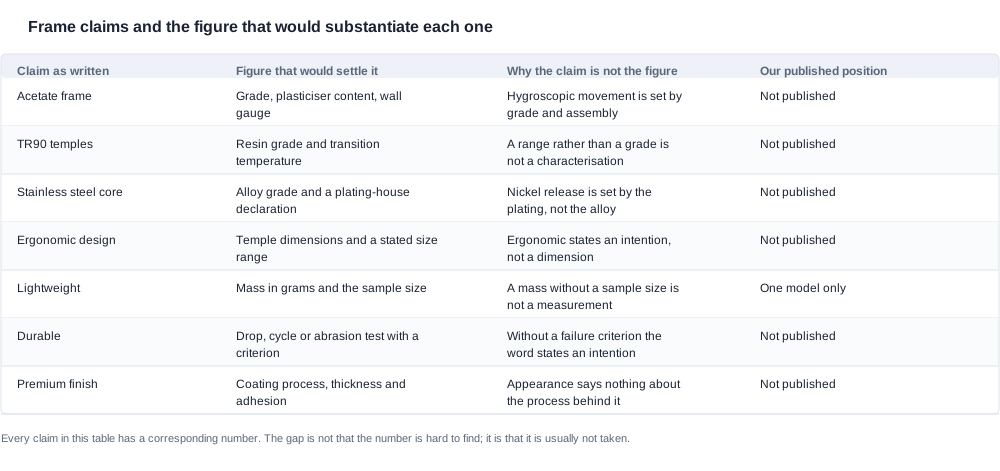

The claims that recur, and the figure behind each one
"Acetate frame." Would be confirmed by the grade, the plasticiser content, and the wall gauge of the temple section. Acetate is hygroscopic, and a frame assembled at the wrong moisture content moves in its own hinge over a season. The grade and the assembly conditions determine whether that was controlled, and a material name determines neither. Not published by us for any model.
"TR90 temples." Would be confirmed by the resin grade and its transition temperature. TR90 is a nylon-based thermoplastic elastomer, correct for sport and for heat tolerance. The grade sets the transition point, which is the parameter that tells you whether a temple softens in a parked vehicle. Suppliers who quote a range rather than a grade have not characterised the resin. Not published by us.
"Stainless steel core." Would be confirmed by the alloy grade — 304 or 316 — and by a nickel-release declaration from the plating house rather than from the frame supplier. The grade matters because it determines nickel release and corrosion behaviour at skin contact. But the failure mode buyers actually see, a skin reaction after three months, usually comes from a changed plating pre-treatment rather than a changed alloy, which is why the declaration has to come from whoever applied the plating. Not published by us.
"Ergonomic design." Would be confirmed by temple dimensions and a stated size range. "Ergonomic" describes an intention. What a customer experiences is whether the frame matches, and that depends on dimensions nobody in this category publishes. A frame covering one head size generates returns that are never classified as defects, because each individual return is an ordinary sizing complaint and the aggregate never reaches a defect report. Not published by us.
"Lightweight." Would be confirmed by a mass in grams, and by the number of units it was measured on. This is the emptiest claim in frame specifications and it usually indicates that nobody weighed the product. Mass is the parameter that most determines whether a product stays in service, and it is unavailable across almost the whole category. We publish one figure: 158 g for the MT6 glasses unit, including the 265 mAh cell and the camera and excluding the foldable charging case, whose 1200 mAh capacity is published and whose own mass is not. Every other model in our range is unpublished, and we would rather say so than estimate.
"Durable." Would be confirmed by a drop test, a cycle test, or an abrasion test with the method stated and a criterion for what counts as a failure. Absent a method and a criterion, the word describes an intention.
"Premium finish." Would be confirmed by the plating or coating process, the coating thickness and the adhesion method. The claim describes appearance and says nothing about where the visible failures originate — abrasion at the temple, discolouration, and skin-contact reactions from the plating chemistry. Not published by us.
Two claims that read like specifications and are not
Two patterns are worth separating out, because they pass the surface test of reading as a specification and are the two most common ways a buyer ends up holding a sentence rather than a number.
The figure with no scope. A mass, a gauge or a cycle count that is correct about something other than the product being ordered. The mass case is the most frequent: a unit mass quoted for the glasses alone, or for the unit with the case, or for a prototype, is quoted in the same tables without any indication of which. The gauge case is the second: a temple gauge quoted at the front section rather than at the electronics bay is a materially different number, because the bay is where material is removed. Both are easy to detect by asking one additional question — what does the figure include, and where was it measured — and both are impossible to detect from the document alone.
The cycle count with no failure criterion. "Tested to 10,000 cycles" or "tested to 500 flexes" reads like evidence and is not, because a cycle count without a criterion for what counts as a failure is a quantity rather than a result. The same joint can pass ten thousand cycles and be fit for service, or fail at two thousand, depending entirely on whether the criterion is a visible crack, a measured torque drop, or a subjective judgement by the person doing the counting. This is the claim that most often ends up as a warranty line, because the warranty will be set against the cycle count while the test was set against a judgement.
There is a third pattern, less frequent but more expensive: the claim that has been promoted from a component to the product. A supplier who has tested a hinge insert, a plating process or a resin grade to a standard will sometimes describe the result in product terms, because the product is what the customer buys. The underlying work may be perfectly good; the error is in the scope of the claim. The correction is the same in every case — ask for the component the evidence applies to, and ask whether the product as assembled inherits it.
Where claims are made, and where they are lost
Claims in this category are usually made once, at the start of a chain, and then degrade at each handover. That matters because it explains why the claim a buyer finally reads is often narrower than the claim the factory actually stands behind — and why asking the factory directly often produces a better answer than asking the distributor.
The chain typically runs from the factory, to the ODM or the trading company, to the distributor, to the channel, to the listing. At each step the claim is shortened. A factory statement like "the hinge boss uses a steel threaded insert, cycle-tested to 20,000 flexes" becomes "steel core" in the distributor's sheet, becomes "metal hinge" in the channel brief, and becomes "premium build" on the listing. Nothing in that sequence is a lie; each step simply drops the qualifier, and the qualifier was the entire substance.
There are two practical consequences for a buyer.
Ask the party that can answer. If the claim originated at the factory, the factory is the only party that can state the scope, the method and the sample size. A distributor will generally restate what it was given, which is useful for establishing what was communicated and not useful for establishing what is true.
Ask what was dropped. A productive question to put to an intermediary is: "what did the factory say that is not in this document?" It reframes the conversation from a search for a number to an audit of a chain, and it is often answered faster than a request for documentation.

Reading a claim that carries a number
Not every claim arrives without a number, and the claims that do arrive with one need a different treatment: the question becomes whether the number is a measurement, and if so, of what.
Four checks apply to any figure attached to a frame claim.
Is it a measurement or a typical value? A typical value is a convention and a measurement is a record. The wording that distinguishes them is short — "measured on", "average of", "typical" — and it is worth asking for the sentence that sits behind the number rather than the number alone.
How many units, and on which lot? A figure measured on three engineering units is a design intention. A figure measured on a production lot is a process result, and it is the one a buyer can hold a supplier to. Our own published figure for the MT6 is a catalogue value for a single model, and we would treat a figure of the same kind from a supplier with the same caution.
Does the scope match the product you are buying? This is the most common error and it is almost always accidental. A mass quoted for the glasses unit and a mass quoted for the unit with the case are both correct numbers about different objects. A gauge quoted at the front and a gauge quoted at the electronics bay are both correct numbers about different places. Ask for the location and the scope in the same sentence as the number, because a supplier answering "158 grams" without being asked has not been asked a question they can answer.
Was it verified on production tooling, on a sample, or copied from a datasheet? The third of these is the dangerous one, because a datasheet value describes a material in a laboratory and not the product in the assembly. A claim sourced from a resin supplier's datasheet is not a claim about your frame.
Moving an unverifiable claim into the purchase order
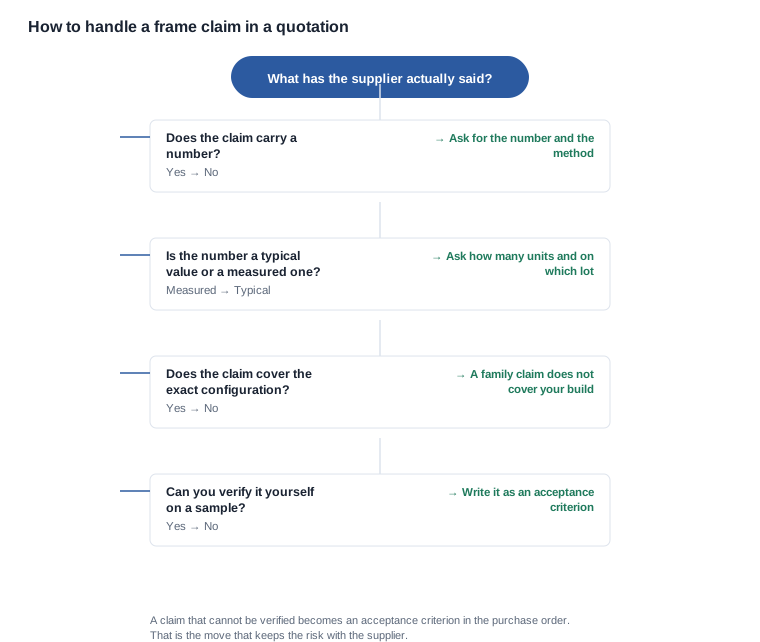
There is a procedure here, and it is the same procedure every time, which is what makes it useful.

Step one: pull the claim out of the quotation or the listing and write it down verbatim. Not paraphrased. The wording is the evidence, and a paraphrase is where a qualifier gets lost. "Durable for daily use" and "durable" are different claims with different obligations, and only the first one can be tested.
Step two: ask for the figure that would substantiate it, together with the measurement method. A number without a method is a claim in numerical clothing.
Step three: ask how many units were measured and on which production lot. This separates a measurement from a design intent, and it is the cheapest question on the list.
Step four: check whether the figure covers the exact configuration you are ordering. Configuration coverage is where family-level claims fail, and it is checked by comparing the model designation on the document against the designation on the units you receive.
Step five: verify the verifiable rows yourself on a sample, against a written protocol. Weight, temple length, section at the electronics bay, hinge cycle count. These four cost an afternoon and close most of the gaps in the mechanical rows.
Step six: move every row you cannot verify into the purchase order as an acceptance criterion. This is the step that changes who carries the risk. A claim that stays in a quotation is a hope. A claim that becomes an acceptance criterion with a remedy attached is a contractual position, and a lot that fails it is a lot you can refuse or claim against.
The questions to ask, and how to read the answers
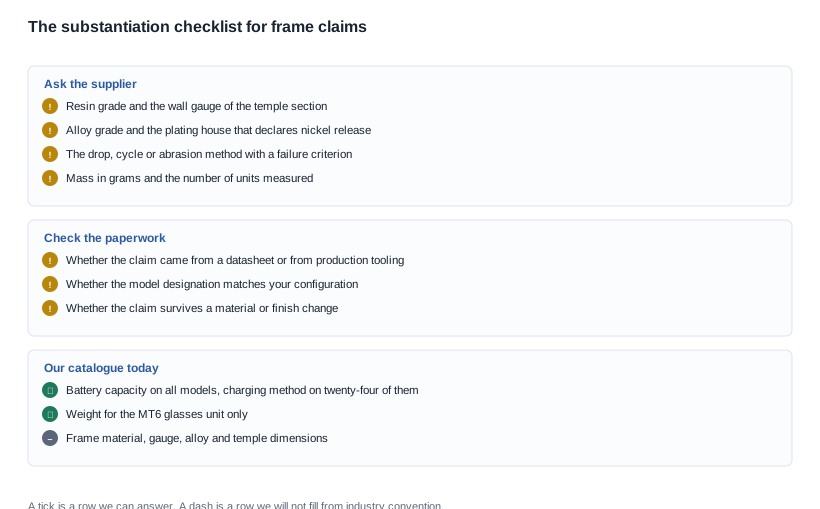
Seven questions, in an order that produces the most information per unit of effort, and a reading of what each answer tells you.
- What is the frame material and grade, for the front and for the temple separately? A single material for both is a signal that one of them was never characterised.
- What is the wall gauge at the electronics bay, and where was it measured? A location means the measurement was deliberate; no location means the easy place was measured.
- What is the hinge boss construction, and has a cycle count been run on it? The count is what matters, and a joint cycle figure is rarer than a material figure.
- Which stainless grade, and who applies the plating? Then ask for the nickel-release declaration from that house.
- What is the mass in grams, what does the figure include, and over how many units? Three parts to one answer, and the third part is the one that reveals whether the number is real.
- What is the temple length and the size range, and how was it established? A method is worth more than the number.
- For the ingress marking, what is the test report number and which method was used? We publish an IP54 catalogue marking on the V06 and the S7 and no report number behind either, so this is a question we would ask too.
How to read the answers is simpler than it appears. A supplier who answers all seven has a documentation habit; a supplier who answers two is telling a buyer something they need to know before the deposit, and the something is not about this supplier's competence but about the state of their file.
The commercial cost of accepting a claim as written
Accepting a claim without a figure is not a neutral act; it has a cost, and the cost is usually invisible at the moment it is taken.
The first cost is the defect remedy you gave up. An acceptance criterion with a stated tolerance carries a remedy; a claim in a quotation carries none, because there is nothing to measure against. When the claim fails in the field — a temple that cracks, a finish that abrades, a joint that loosens — the buyer's options are a goodwill credit or a dispute, and both are worse than a rejected lot.
The second cost is the price premium for the claim. A supplier that has measured its product can defend a unit price. A supplier that is relying on a claim can sometimes charge more for the same object, because the claim does the work that a specification would otherwise do. This is why comparing two quotations on unit price alone is unsafe: one of them may be selling a claim.
The third cost is the propagation cost. A claim that survives into your own listing becomes your claim. If the claim is later found to be unsubstantiated, the exposure is your listing, your channel relationship and your own compliance position rather than your supplier's. Buyers who take an unsubstantiated frame claim into a consumer listing frequently find that they cannot remove it without damaging the listing history.
None of these costs can be avoided by asking the supplier to be more careful. They can only be avoided by converting the claim into a figure, and where that is impossible, into an acceptance criterion that carries a remedy.
What our own catalogue publishes, and what it does not
Our answer on every row in this article, except one, is the same: not published. We have not been given frame material composition, wall gauge, alloy grade or temple dimensions for any model, and we will not fill them with typical industry values — because a composition written from convention rather than from the product is a number you will be held to when a customer returns a cracked temple.
What we do publish, for every model in the catalogue, is the battery capacity, the charge time and the Bluetooth version where the model has one, plus the charging method on the twenty-four models whose catalogue row carries one. We publish the structural and configuration facts: flexible temples on the V03 Pro with three listed colours, ultra-thin and detachable temples as configuration options on the G07, a foldable charging case on the MT6, four listed colours on the V06, and an IP54 catalogue marking on the V06 and the S7. And we publish one mass figure, 158 g for the MT6 glasses unit, excluding the foldable charging case.
| What we publish | Scope | What it settles | What it does not settle |
|---|---|---|---|
| Battery capacity | Every model | The bay volume and the power budget | Runtime, which depends on the workload |
| Charge time | Every model, twenty-six at two hours or less and two at about one hour | An upper bound on replenishment | The starting state, the temperature, the charger |
| Charging method | Twenty-four models, magnetic or Type-C | The cable, the cradle and the packaging geometry | Contact condition and thermal behaviour |
| Bluetooth version | Audio and sport models only | The radio generation in the unit | Radio behaviour in a given frame |
| Colour options | Three on the V03 Pro, four on the V06 | The number of combinations to fund and stock | The material or finish behind the colour |
| Structural features | Flexible temples on the V03 Pro, detachable and ultra-thin temples on the G07, a foldable case on the MT6 | What the assembly must achieve | Cycle life, release mechanism, failure behaviour |
| Ingress marking | The V06 and the S7 only, IP54 | That the catalogue states an ingress position | A method, a report number, or the effect of a material change |
| Unit mass | The MT6 glasses unit only, 158 g, excluding the foldable case | One comparison point on one model | Frame mass elsewhere, and the balance on this one |
The boundary we hold: a frame specification should carry a material class, a gauge, a hinge construction and a torque figure rather than a material name, and a buyer should treat "acetate frame" and "premium finish" as questions rather than answers. We will publish the mechanical specification when the manufacturer provides it, and we will say plainly which rows we hold and which we do not, because the alternative is a catalogue that looks complete and cannot defend any of its rows.
Tell us the claim you have been given and we will tell you what would substantiate it, and whether our documentation answers it today. The rows a frame specification should carry in full are set out under materials and ergonomics, and the failure modes behind several of them are covered in frame materials problems and fixes.
Related reading
- frame materials problems and fixes
- frame specification red flags
- frame material specifications to compare
Tell me the claim and I will say what would substantiate it.


