

Smart glasses frame materials: why the complaint returns
A buyer sends back the same complaint three times: the temples snapped, then a different batch creaked, then the bridge went. Each time the supplier says the material is fine. All three can be true at once, because "the material" is not one thing — it is a resin grade, a wall thickness, a hinge boss design, a plating line and a packing method, and each of those fails differently.
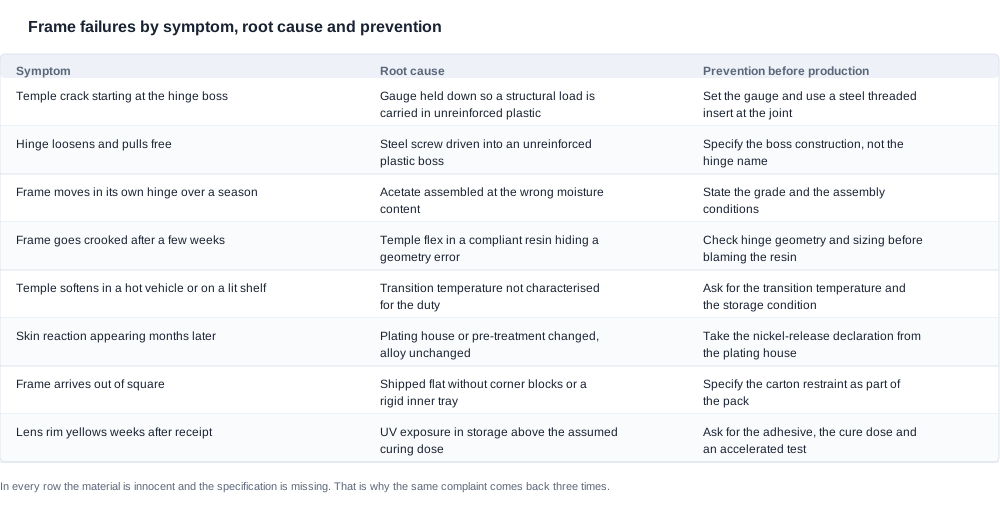
This is where smart glasses frame materials problems usually originate. Not from a bad material in the chemical sense, but from a good material specified at the wrong gauge, specified correctly and then cut, moulded or packed in a way that spends its margin. Below is the failure list we work through when a project comes back with complaints, organised by symptom rather than by material name, because a buyer recognises symptoms and not resin classes.
The organising idea is simple enough to apply to a complaint you have never seen before. A material is rarely the root cause; a material specification is. The four things that decide whether a complaint ends the programme or closes a row are: the grade, the gauge, the joint, and the packing. Those four are the subject of this article, and each of them is a specification decision that was made before the first unit shipped.

Acetate: the material that fails by drying out
Acetate frames dominate optical retail because they polish to a deep gloss and hold a hinge tension that feels expensive. The failure mode is well known in the optics trade: acetate is hygroscopic, it takes on moisture in humid conditions and releases it in dry ones, and a frame that was assembled at the wrong moisture content will move in its own hinge over a season.
Two specific things go wrong in smart glasses. The first is wall thickness. A temple that is structurally carrying an electronics module needs more material than a plain optical temple, and if the moulder holds the gauge down to protect the unit cost, the flex stress at the hinge end rises faster than the section modulus falls. You get a crack that starts at the hinge boss and runs along the temple. The second is the plastic boss that receives the hinge screw: steel driven into unreinforced plastic under repeated torque will strip, loosen and eventually let the hinge pull free.
The fix is specific rather than general. Either thin the acetate gauge and let a metal temple core take the load, or thicken it and change the boss to a steel threaded insert. Which one to pick depends on the channel — the retail buyer wants the acetate appearance and will accept the risk, the sports buyer wants the metal core and will not notice the difference. What you must not do is specify "acetate temples" and leave it there.
There is a third acetate failure that is frequently misfiled: the frame goes crooked without breaking. A compliant temple takes a permanent set, and the frame returns with a geometry that no longer matches. The root cause is usually a hinge geometry or a size block issue that the compliance of the material concealed rather than caused. It looks like a material complaint and it is a design complaint.
TR90 and nylon: forgiving enough to hide a design error
TR90, a nylon-based thermoplastic elastomer, is the opposite problem. It is tough, it flexes rather than cracks, and it tolerates heat far better than acetate. Buyers pick it for sport and for children's products because the failure mode is a bent temple rather than a broken one.
The trap is that TR90 hides design errors. A temple that would snap in acetate will simply bend in TR90, run long, and return to a shape that is no longer square. Buyers then report "the glasses go crooked after a few weeks" and assume the material is at fault, when in fact the hinge geometry or the size block is. The other trap is heat: TR90 softens at its transition temperature, and while that is well above normal service conditions, it is relevant if the product ships in a hot container or sits on a retail shelf under lighting.
Nylon is similar in behaviour and better again on impact. The reason to specify it over TR90 is usually dimensional stability across a wider humidity range, not raw toughness.
There is a fourth failure specific to this category, and it is the one most often blamed on the material when it is actually a packaging problem. A compliant temple that is shipped flat in a carton without restraint will take a set in transit, and the buyer opens a shipment of units that no longer match each other. A compliant material makes this more likely rather than less, because it tolerates the deformation instead of resisting it, and it means the packing specification has to be written for the compliant material rather than for the rigid one.
Metal: when the failure is the finish and not the alloy
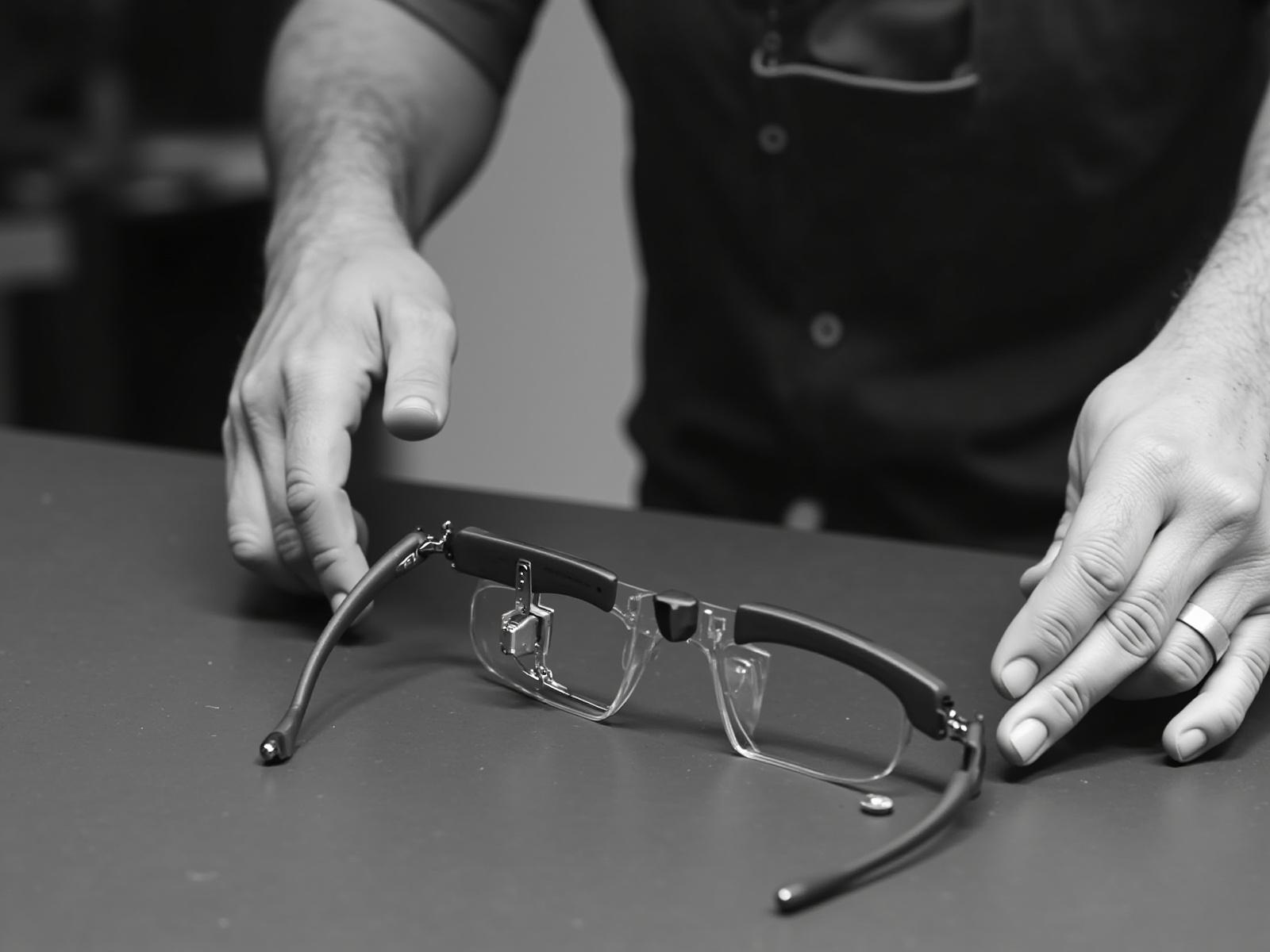
Steel and titanium temple cores are the strongest option and the one most often blamed unfairly. When a metal temple fails, the alloy is rarely the cause. The usual causes are a galvanic or hydrogen issue at a dissimilar-metal joint, an electroplating line running outside its own adhesion window, or a bend point that was never given a stress relief radius.
The most common complaint we are asked about is a skin reaction at the point of contact, appearing months after delivery. A buyer orders a stainless frame, the sample is fine, the production batch uses a different plating house with a different pre-treatment, and three months later the wearer has a rash. The alloy was identical the whole time. The finish was not.
Ask for the stainless grade as a number — 304 against 316 is a real difference in nickel release and corrosion behaviour at skin contact — and ask for a nickel-release declaration from the plating house, not from the frame supplier who may not have seen the plating chemistry. This is the same point as the one above and it is worth stating twice, because it is the single most expensive frame failure in this category and it is entirely avoidable at the documentation stage.
Triage: which of the four things actually failed
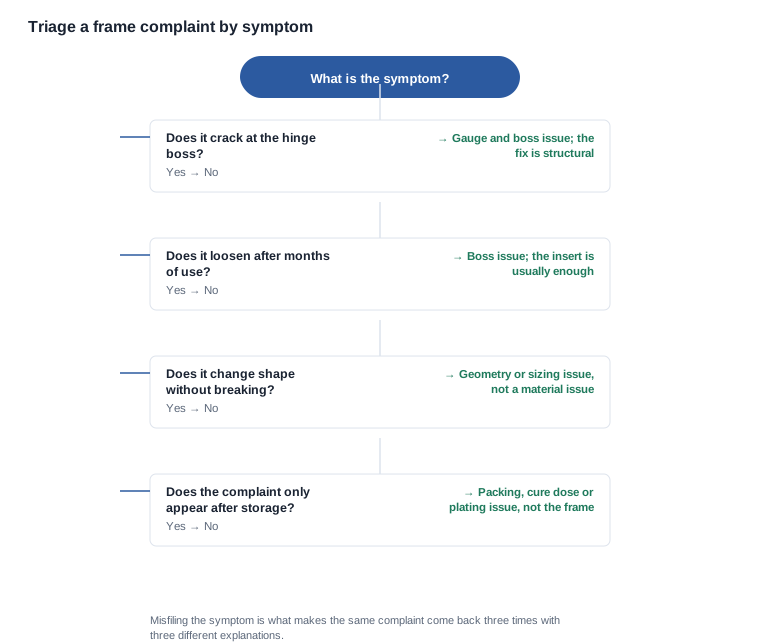
Before any investigation begins, a complaint can usually be sorted into one of four buckets, and the bucket determines the investigation and the recovery.
- The material row. The grade or the gauge was wrong for the duty. The recovery is a specification change plus a supplier discussion about who bears the cost.
- The joint row. The boss, the insert or the bonding line failed. The recovery is usually a design change that is cheap now and expensive later, which is why it should be specified before the first article.
- The geometry row. The hinge geometry or the size block was wrong, and the material concealed it. The recovery is a design change, and the investigation needs the hinge history.
- The packing row. The unit was undamaged at the factory and damaged in transit. The recovery is a packing change, and it is the cheapest of the four to correct.
The triage question is: does the unit show the damage in the same way every time? Consistent damage points to a material or a joint row. Damage that varies between units points to geometry or packing, because a specification error is consistent and a process variation is not.
How to choose which failure you are buying a fix for
Once a complaint has been triaged, the buyer faces a choice between a documentation fix, a design fix and a supplier conversation, and the trade-offs between them are not obvious from the cost of the fix alone.
A documentation fix costs a specification clause and a confirmation from the factory. It is right when the row was written incorrectly or was left ambiguous and the factory was building to an assumption. It is the cheapest recovery in this list and it is available in days rather than weeks.
A design fix costs tooling, a schedule and a re-qualification. It is right when the geometry, the gauge or the joint was wrong. The test is whether the same failure would recur on the next lot if nothing changed — if it would, the fix has to be structural, whatever the unit cost of the replacement parts.
A supplier conversation costs nothing and produces a commitment. It is right when the failure is a process variation rather than a specification error, and the supplier already has the measurement to act on. It is also the wrong route when the row was never specified, because in that case the supplier has nothing to act on and the commitment will be a general assurance rather than a fix.
The general rule for how to choose is that the fix has to be at the level where the error was made. A gap in the specification is closed with a specification. A gap in the drawing is closed with a drawing change. A gap in the process is closed with a process control. Buying a fix at the wrong level is the most common reason a frame complaint recurs, and it is also the most expensive because each recurrence adds a shipment, a customer conversation and a second unit that fails in a different place.
The red flags that a recurrence is coming are worth naming. A complaint pattern that changes location between units suggests a process variation rather than a specification error. A complaint that follows a specific production lot suggests a change of material, a change of tooling or a change of plating house. A complaint that appears only at volume, and not on the sample, suggests a specification error that the sample did not exercise.
Packaging failures that arrive with the frame in a box
Two of the failure modes we are asked about most often happen with the frame sitting in a box, and both of them are booked as material problems because the frame was fine when it left the factory.
Out-of-square arrival is a packing problem. Frames shipped flat without corner blocks or a rigid inner tray will twist in transit, and the buyer blames the material because the material was sound when the carton was closed. The correction is a packing specification with a named restraint, and it is far cheaper than a material change and it does not reopen the tooling.
Lens rim glazing is a chemistry-plus-time problem. The adhesive at the rim is usually UV-cured, and a rim that passed at the factory can yellow weeks later if the UV exposure in storage or on a retail shelf is higher than the curing dose assumed. If rim yellowing is appearing in returns, ask for the adhesive name, the cure dose, and whether anyone ran an accelerated UV panel on the cured joint. If nobody has, the claim was never tested.
There is a third packaging issue that is specific to this category and belongs in the same list. The charging interface is an opening in the enclosure, and a unit that ships with a magnetic contact exposed collects handling debris and arrives with a contact fault that is diagnosed as an electronics problem. The interface protection is a packaging item as much as a design item, and it is routinely omitted from the packing specification because it is a small part.


Turning a complaint into a specification row
The path from a returned frame to a closed root cause has six steps, and the fourth is the one most investigations never reach.
- Photograph the failure and record the batch identifier on the unit. Without the batch identifier the unit cannot be tied to a lot, and without a lot there is nothing to compare against.
- Separate a material failure from a joint, geometry or packing failure, using the triage above.
- Open the unit and inspect the boss, the gauge and the plating at the failure point. The three inspection points correspond to the three most common root causes, and they can all be seen.
- Check whether the failing row was ever written into the specification. This is the step that decides whether the claim can be charged to the supplier. A failure that was never specified cannot be a defect against a standard, because there is no standard.
- Decide whether the row is closable now or only by a change to the design. A closable row is a documentation fix; a design row is a tooling and schedule item.
- Write the corrected row into the purchase order as an acceptance criterion, with a tolerance and a remedy, so that the same complaint does not come back on the next lot.
The commercial lesson of step four is worth stating plainly, because it is the point that buyers most often resist. A complaint about an unspecified property is not a supplier defect. It is a gap in the buyer's own specification, and the cost of closing it belongs on the buyer's side of the ledger. The supplier's obligation is to meet the specification and to notify changes to it; the buyer's obligation is to have a specification at all.
That is an uncomfortable conclusion in the middle of a claim, and it is cheaper to reach it at the start of a programme than in the middle of a dispute. The preventive version of this article is one line long: the complaint you do not receive is the one whose specification row you wrote. Every row added before the first article removes a failure mode from the field, and every row omitted puts one back there.
The four material questions to put in writing
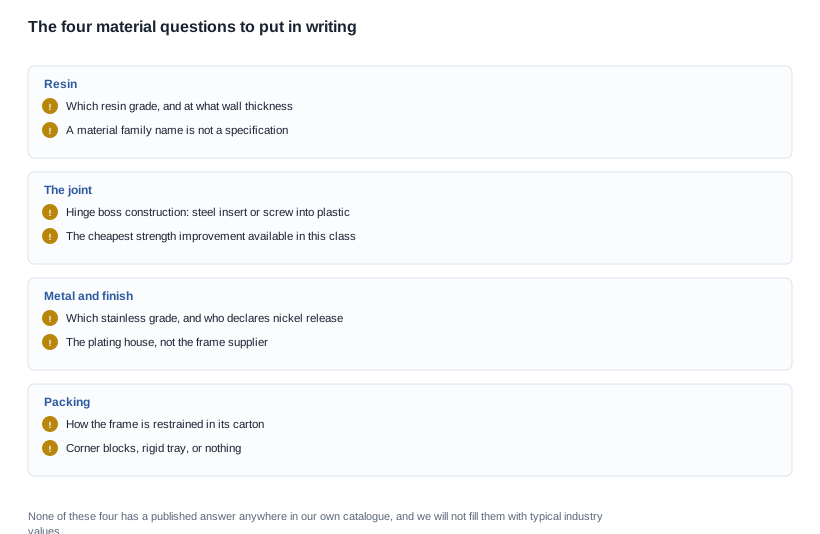
None of these four has a published answer anywhere in our own catalogue, and we will not fill them with typical industry values.
These are the questions to ask before you order rather than after the first complaint, because the answers change the design rather than the paperwork. Once a tool has been cut against a drawing, the answers become a change request; before the tool, they are an input.
- What resin grade, at what wall thickness? "Acetate" and "TR90" are not specifications. Ask for grade and section, and ask where the section was measured.
- What is the hinge boss construction? Steel insert, or a screw into plastic. This is the cheapest strength improvement available in this class and almost nobody asks for it.
- What stainless grade, and who declares nickel release? Not the frame supplier — the plating house.
- How is the frame restrained in its carton? Corner blocks, rigid tray, or nothing.
Add a fifth to close the loop on the whole series: what is the packing and inspection specification for the unit, and where does the batch identifier live? A packing specification that does not name the restraint, the interface protection and the traceability label is not a specification, it is a box.
The checklist that follows from the four questions is short enough to attach to a purchase order, and that is the point. A checklist that lives in an email is a request; a checklist that lives in the purchase order is an acceptance standard, and the difference between the two is the difference between a claim you can make and a claim you can enforce.
Where our own frame compositions stay unpublished
Stated plainly: frame material is a structural decision, not a cosmetic one, and it should be written into the specification with a gauge, a grade and a torque figure rather than a material name. We do not publish our own frame compositions because we have not been given them to publish, and an invented acetate percentage in a spec sheet is exactly the kind of number that becomes a dispute eighteen months later.
The published position across our range is that every model carries a battery capacity and a charge time, that twenty-four of them carry a charging method, and that the camera models all publish a rated runtime — five to eight hours for the V06 and the S7, and the V03 and the V03 Pro, six to eight hours for the KY06 and the MT5, and about seven hours for the CY03 and the CY05, and the L2 Utral and the L1 Pro, and the MT6. The V06 and the S7 carry an IP54 catalogue marking. One model publishes a unit mass, the MT6 glasses unit at 158 g including the 265 mAh cell and the camera and excluding the foldable charging case. Nothing else mechanical is published for any model.
That is a thin mechanical file for a category with this many failure modes, and it means that a buyer who wants to prevent the failures in this article has to write the specification themselves. Our guide to frame materials and ergonomics sets out the sizing and mass questions that sit next to this one, what a first production sample should prove covers the sample protocol, and the OEM-ready configurations are the starting points for a programme that wants to fix the mechanical rows once rather than per order.
If you are choosing a frame material for a programme, send us the use case, the target retail price and the channel. We will tell you which material classes are workable for it and which ones we cannot support — and we will say plainly when the question is one we cannot answer without information the factory has not yet provided.
Related reading
- frame materials and ergonomics for smart glasses
- what a first production sample should prove
- OEM-ready smart glasses configurations
Send the use case, target quantity and channel, and we will tell you which frame material classes are workable for it.


