
A frame behaves differently after six months than it does on the day it is moulded, and the rows that describe the six-month behaviour are the ones a catalogue does not carry. This article is about the gap between a material specification and a product in a rucksack in August, and about the only mechanism that closes it: a field trial you run yourself, on your own units, against a protocol you wrote down first. We publish no frame material composition for any model, so everything here is a method rather than a specification — which is the honest position, and the useful one, because a method transfers between suppliers in a way that a material name does not.
Smart glasses frame materials: eight field stresses a datasheet never describes
A datasheet describes a material in a controlled condition. A frame spends its life in nine of the eight conditions below, usually simultaneously, and the gap between those two descriptions is where returns come from.
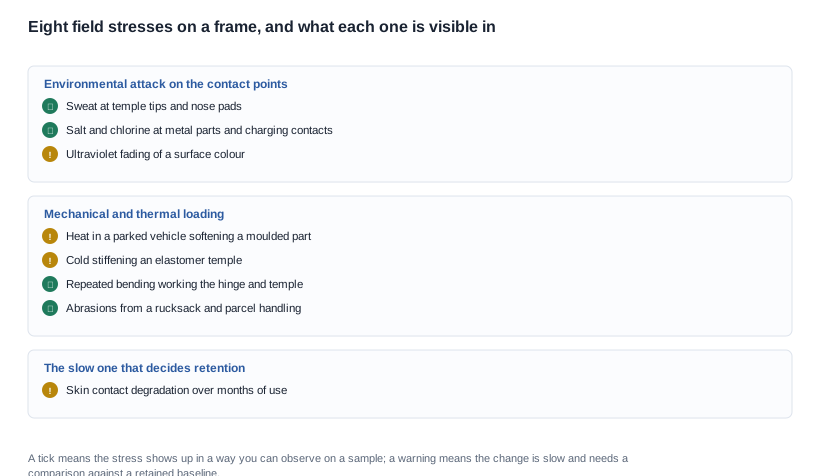
Sweat. It attacks the skin contact points and the finish at the same time, because the temple tips and the nose pads are both the parts that take the abrasion and the parts that carry the moisture. A coating that behaves well on a dry desktop fails first where the body is. This is why contact-point materials deserve a separate criterion from the frame material rather than being assumed to inherit it.
Salt and chlorine. They corrode the metal parts and the charging contacts, and they do it faster than a buyer expects. A product used near the coast or in a pool is in a different service life from a dry indoor one, and the difference does not present as an outright failure — it presents as an intermittent fault, which is harder to diagnose, more expensive to troubleshoot and much easier to misattribute to the wrong component.
Ultraviolet. It fades a colour that sits in the surface, and a surface fade is the most visible material failure in this category because the product appears in photographs on the listing page. The decisive question is whether the colour runs through the material or sits on it as a coating. Only the through-coloured version can be corrected at service; a surface coating that has faded cannot.
Heat in a parked vehicle. It softens a moulded part and it moves a seal, and both of those change the geometry of the product and therefore the result of the product. A car in summer in a hot market is a legitimate operating condition, and no specification sheet mentions it. The parameter that matters is not the maximum temperature the material survives but the temperature at which it starts to move measurably.
Cold. It stiffens a polymer and it makes an elastomer brittle, and a brittle temple in a cold market is a cracked temple in a customer's hand. The low end of the operating range is a more useful row than the high end, and it is the end that is almost never published.
Repeated bending. It works a hinge and a temple, and it is the failure mode that produces a cracked frame rather than a dead one. A cycle figure with a defined failure criterion would be the most useful durability row in the whole material set, and it is missing from almost every specification in the category.
A rucksack and a parcel network. It abrades the frame and it drops it on a corner, repeatedly and without ceremony. The packaging protects the box and the box protects the product, and how much of the journey happens inside a box is a packaging question rather than a material question — which is why the two get confused at returns analysis and why the fix is often the cheaper one.
Skin contact over months. This is the row that decides whether the product is still in use in month six, and it is the one a buyer is least likely to be given. A frame that a person removes by February is a frame in a drawer by March, and the camera, the audio and every other feature on it were never exercised.
The three that arrive fastest, and the one that decides whether the product stays in use
The eight fall into two very different timescales, and mixing them up is what makes field claims useless.
Sweat, salt and ultraviolet act inside a single season. They need a product that lives outdoors or near water, and they produce visible change within weeks to months. A unit used indoors in a temperate office will not show them, which is precisely why a short trial cannot reproduce them and why the trial has to include an accelerated condition rather than simply run longer.
Heat, cold, bending and abrasion act on the structure, and they are cumulative rather than sudden. A product that survives one cold night and one hot afternoon tells you very little, because the mechanism is fatigue — the material tolerates a large number of small excursions and a small number of large ones.
Skin contact is the slow one, and it decides everything else. It is the only one of the eight that decides whether the features get used at all. A product with an excellent camera that people take off after two hours has failed commercially while passing every structural test, and no test regime catches it unless the protocol asks directly.

Building a field trial that produces evidence instead of impressions
The useful output of a field trial is not a feeling that the product is fine. It is a set of observations against a baseline, with a date attached, that can be produced eighteen months later when a complaint arrives from a channel you cannot visit. Knowing how to verify a claim about a frame is therefore a procurement skill, not a laboratory one, and it is worth learning before you order rather than after the first return arrives.

The baseline, and why it has to come first
Take one unit from the first production lot, before any distribution, and record it properly: the weight on a scale with the battery fitted, the finish photographed under a fixed light, the hinge play measured, the charging contact seating checked, the temple length and the temple curve measured directly. Write it down as a baseline with a date and a serial or batch reference.
This baseline is the single most valuable object in the whole procedure, and it is the one most often skipped. Without it, a later observation is an opinion, because there is nothing to compare it against; with it, "the finish has dulled" becomes "the finish has dulled by a measurable amount since the first lot, and the change correlates with the exposure condition". That is a finding. The rest is commentary.
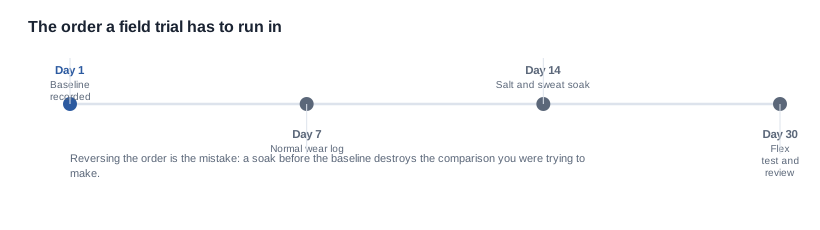
The sequence in the timeline above is not a suggestion. A soak before the baseline destroys the comparison you were trying to make, and it is the most common sequencing error because the soak is the part that feels like work.
The tests that need no laboratory
Four of the tests cost nothing but time and a stopwatch, and between them they cover most of the eight stresses.
The daily in-use log. Use the unit through normal working days for a week without adjustment, and record the adjustment behaviour rather than the sensation. What you are watching for is the point at which the product is moved, pushed up or taken off, and what the reason is. A unit that is adjusted at hour two on day one and not adjusted at all by day seven has told you something that no datasheet would have.
The controlled soak. Put the unit in a warm, damp place for a week, then examine the contact points and the finish. Salt water on a cloth, wiped across the charging contacts, followed by a charge attempt, is the version that produces the most useful finding, because it separates corrosion from contamination — the symptom appears identical and the causes are not the same.
The flex test. Bend the temple to the point where a customer would, not to the point where it breaks, and check the hinge and the temple fixing afterwards for play. The number of repetitions matters and it has to be written down, because a single bend proves nothing about a fatigue mechanism.
The interface cycle. Mate and unmate the charging interface a stated number of times and re-check the seating. This is the test that most often exposes a real product defect, because the interface is an opening in the frame and openings are where tolerances move.
None of this is a laboratory test, and all of it is closer to the customer's experience than a material datasheet. It also produces something a buyer can put beside a claim, which is what a material row is for.
Which of the eight a catalogue row can actually answer
Before running a trial, it is worth knowing which of the eight you can answer from documentation and which you have to generate. That prevents spending a week generating evidence you could have asked for.
The catalogue row that exists. Our range publishes one complete-unit weight — the MT6 AI camera glasses at 158 g, which is the glasses unit including the 265 mAh cell and the camera, and excluding the foldable 1200 mAh charging case. No other model in the range has a published weight, and no model has a published frame material, temple material, frame dimension, temple length or hinge construction. So the answer for most of the eight is not published.
The structural rows that exist. Temple architecture is published on a small number of models: the G07 carries an ultra-slim, detachable temple, the V03 Pro carries flexible temples, and the V06 and S7 carry a removable inner frame with an ergonomic frame design statement across the sport class. The V03 Pro lists three colour options and the V06 lists four. Those are facts, and two of them — the removable inner frame on the sport platforms and the detachable temple on the G07 — are directly relevant to the abrasion and skin-contact stresses, because they change what the buyer replaces rather than replaces entirely.
The marking that is not a test result. The V06 and the S7 carry an IP54 marking. The second digit covers splashing water, not immersion and not jets, and a marking on a catalogue page is a claim rather than a tested conclusion until a report number is attached to it. That distinction matters more for salt and chlorine than for any of the other stresses, because IP54 tells a buyer nothing about a marine atmosphere or a chlorinated pool.
The published rows that are about the electronics rather than the frame. Charge time is published across the range, and the row is consistent: twenty-six of the twenty-eight catalogue entries state a charge time of two hours or less, and the D17 and the ZH12 state roughly one hour. What that row cannot do is settle the salt and corrosion question, because it carries no starting state, no termination criterion and no temperature condition — so it cannot be compared against the time you actually lose when a unit fails to charge in the field.
The practical conclusion is that the frame evidence you need has to be generated, and the only efficient way to generate it is a written protocol applied to a controlled sample set rather than an informal opinion collected from a sales conversation.
Due diligence for a field trial, when to run it, and the red flags in the answers
A field trial is cheap relative to a production lot, which is exactly why it is easy to run one against the wrong baseline. The due diligence for the trial is short, and it happens before a single unit ships.
- Which lot will the trial units come from, and how will they be linked to the shipment? If the answer is that the units are a sample from an earlier build, the trial measures a product you are not buying.
- What changed between the trial units and the first production lot? The answer should name the cell, the board revision and the plating batch. An answer of "nothing" is not a reassurance — it means the supplier is not tracking its own changes.
- Can you supply the unit weight for the exact configuration? In our range that figure exists for one model only, the MT6 at 158 g for the glasses unit including the 265 mAh cell and excluding the foldable 1200 mAh case, and is not published for anything else, so treat it as a request to be answered.
- What is the material class and the wall section at the electronics bay? A material name without a section at a named location is a category description.
- What charge time does the configuration state, and against what termination criterion? Every entry in our range publishes a charge time — twenty-six of twenty-eight at two hours or less, the D17 and the ZH12 at roughly one hour — but none publishes the starting state or the point at which the charge counts as complete, so the figure cannot be compared against your own lost operating time.
- What documentation covers the battery in this configuration, and can I see the transport summary? An UN 38.3 test summary is the document to ask for, and it should name the cell, not the finished product.
- Which conformity documents cover this exact model, and what are the numbers and validity dates? A family-level statement is not coverage for a branded configuration.
- Who signs the acceptance record, and in what format? The format decides whether the record can be used for incoming inspection on every later lot.
- What is the total cost of the trial programme, including units, shipping and the time of the people running it? The unit cost is the smallest line. The schedule cost is usually the largest.
The red flags in the answers are consistent: a weight offered as a range, a material offered as a family name, a charge time with no termination criterion, a certificate offered without a model list, and a supplier who asks you to define the acceptance criteria after the samples have shipped. Each of those is not a reason to stop, but each is a reason to slow down and put the question in writing before you commit the balance of the order.
Four field failures and the commercial question behind each
Field failures are not evenly distributed, and the four below generate most of the returned units in this product class. Each one has a symptom that reaches the customer and a root cause that sits somewhere else entirely.
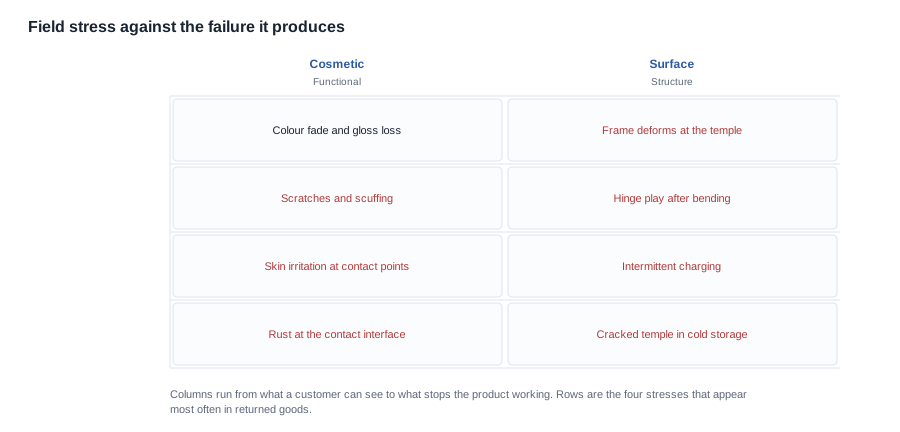
A frame that arrives scratched. The symptom is a cosmetic complaint in the first week. The root cause is usually transit handling rather than the material, because the finish in the box was correct when it was packed. The prevention is packaging: corner protection and a rigid tray cost less than a material upgrade and fix more of it, and the complaint is invisible to any test that starts with an unwrapped unit.
A temple that cracks in a cold market. The symptom is a broken unit in a customer photograph. The root cause is a material selected for its room-temperature properties and never characterised at the cold end. The prevention is to obtain the low-temperature behaviour of the actual candidate material, or to accept the risk explicitly in the warranty terms, because the alternative is discovering it in one channel at once.
An intermittent charge that appears after a few weeks. The symptom is a unit that intermittently fails to charge and is reported as a defective product. The root cause is a contact interface that is an opening in the frame, combined with a mating-cycle count nobody set. The prevention is the interface cycle test and a stated cycle criterion.
A product that is taken off after two hours. The symptom is no complaint at all — the features on the product are simply never used, and the channel data shows it rather than the customer. The root cause is the interaction between weight, temple geometry and skin contact over time, none of which is captured by any of the eight stresses individually. The prevention is the daily in-use log, and the acceptance criterion is about continued use rather than about condition.
The distinction that keeps the returns data usable
The fourth failure is the one that destroys returns analysis, because a unit that is never used never fails and never generates a ticket. Any defect rate computed from ticket volume alone will understate the real failure rate for this product class, because the denominator is wrong. If you want the returns rate of a frame to mean something, you need a usage denominator — units shipped, and estimated days of use — rather than tickets per unit shipped. This is a measurement-design point rather than a materials point, and it applies to the camera, audio and firmware decisions as much as to the frame.

What a field trial can be negotiated on, and what it cannot
The trial itself is something you own, and there is not much to negotiate about it. The supplier's contribution is the units, the batch information and the access, and three things are worth settling in the quotation rather than afterwards.
The units and their lot. A field trial needs units from the first production lot, not from a sample lot that may differ. Requesting them alongside the first shipment rather than as a separate favour removes a delay from the schedule and removes the risk that the tested units were built under different conditions from the ones you will ship.
The batch linkage. The supplier should be able to tell you which lot each unit came from and what changed between lots. A supplier who cannot answer that is telling you something about their own traceability, which is a finding in itself.
The cost of a failure. A defect rate threshold written into the purchase order is the only thing that makes a trial commercially meaningful. Without it, the trial produces knowledge and no lever, and the knowledge is worth having but it does not change what happens when a lot fails.
What cannot be negotiated is the sequence: baseline, daily in-use logging, controlled exposure, interface cycle, flex test. A trial that skips the baseline or runs the soak first has no comparison to make, and shortening it to meet a launch date produces a conclusion that cannot be defended later.
A worked scenario for a coastal inspection channel, and where our own documentation stops
What follows is a hypothetical case, included to show the order of the checks rather than the performance a client recorded.
Assume a brand selling camera glasses to a channel of outdoor workers in a coastal market, where units are used in daylight, in salt air and in a rucksack, and where the customer expectation is that the product lasts a working season. The brand has no published frame weight to compare against and no supplier material specification to argue with, so it starts by writing the protocol rather than by requesting numbers.
Step one: the baseline. Two units from the first lot are pulled before distribution. Each is weighed with the fitted cell, photographed under a fixed light, measured for temple length and hinge play, and checked for contact seating. The record is signed and dated, and the two units are retained rather than returned.
Step two: the exposure plan. Rather than waiting for salt air to find the units, the brand runs a controlled soak in the first week — salt water on the contacts, a warm damp week, and a stated number of interface cycles — because the natural environment is slow and the controlled version is not.
Step three: the flex test. The temple is bent to the customer-plausible limit for a stated number of repetitions, and the hinge play is re-measured against the baseline. The comparison is the output; the raw number is not.
Step four: the daily in-use log. A small panel of the brand's own staff uses the units through ordinary working days for a fortnight and records the adjustment points. The acceptance criterion is continued use at day fourteen, not a comfort score.
Step five: the contractual threshold. The brand writes a defect rate against the recorded acceptance criteria into the purchase order, and asks for the certificate numbers per model rather than a family-level statement, because the coastal channel is exactly where a marketplace listing review is most likely to be triggered by an incomplete document.
The result is not a new material. It is a file that says which of the eight field stresses the product is actually exposed to, what the baseline was, and what the supplier is accountable for — which is the only version of the answer that survives a return claim.
What the range publishes about frames, and what it does not
It is worth being precise: the frame is a system decision rather than a substance decision, because it carries the electronics, the heat and the radio environment at the same time, and a material name alone will never settle a durability question.
We will publish the rows we hold, and we will mark the ones we do not. What we publish for the range is structural and configuration data: flexible temples on the V03 Pro, ultra-slim and detachable temples on the G07, a slim temple on the YK12, a removable inner frame on the V06 and the S7, colour options on the V03 Pro and the V06, and a complete-unit weight of 158 g on the MT6, which is the only model in the range with a published weight figure.
We do not publish the frame material, the temple material or the lens material for any model, and we do not publish a material test report for any model, because the company has not confirmed them to us. We will also not convert a structural capability such as a flexible temple into a durability rating, and we will not describe a catalogue marking such as an ingress rating as a tested specification. The broader treatment sits under materials and ergonomics, and the platform detail for the OEM-ready models is on the OEM ready platforms page.
The environment your product will live in, and what to send us
Send us the model, the environment it will live in and the exposure conditions you expect, and we will tell you which of the eight factors your product will actually meet, which of them our documentation can answer and which have to come from the tooling and test programme. If the trial needs a protocol written before the units exist, we will draft it with you rather than after.
Related reading
- The basics of a material specification — materials and ergonomics
- The advanced considerations — frame materials in depth
- How to read a supplier's sheet — reading a frame materials datasheet
- The models and their structure — OEM ready platforms
Send the model and the environment it will live in, and we will say which of the eight factors matter for it.


