

Frame specifications are where a supplier can be technically truthful and practically unhelpful with very little effort, because "acetate" and "stainless steel" are both true words that describe a category rather than a product. Nothing on the page is a lie. Every claim on it would survive a casual reading. And a buyer who compares two suppliers on the strength of those pages will make a confident comparison built on nothing at all.
That is the real risk of smart glasses frame materials smart glasses red flags, and it is not that the document is wrong — it is that the document is written to be unread. This article is a decoding method rather than a list of complaints: seven phrases that carry no decision-relevant information, the quantity each one fails to state, the question that replaces it, and what a good answer tells you about the factory behind it.
Smart glasses frame materials: seven phrases that assert without describing
Each phrase below is common, each is usually true, and each leaves out the one number a buyer needs in order to compare two products.
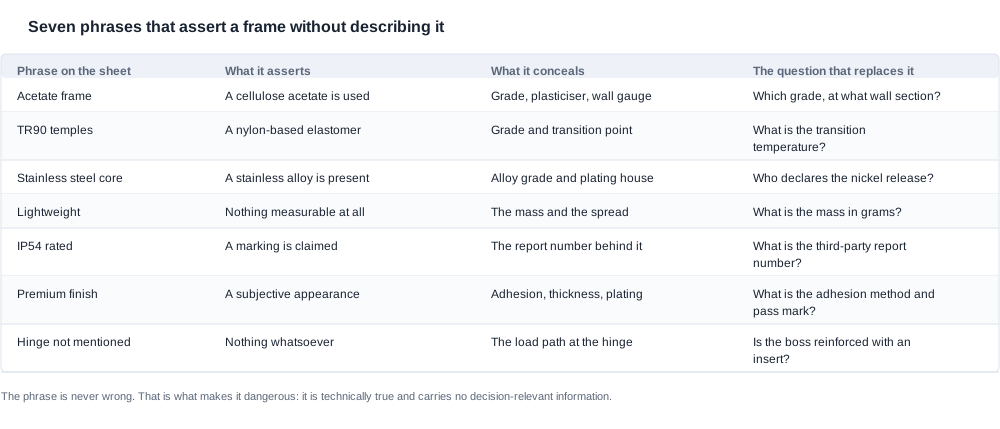
"Acetate frame." This asserts that a cellulose acetate is used. It says nothing about the grade, the plasticiser loading, the wall gauge, or how the assembly behaves after a season in humidity. Acetate is hygroscopic — it takes on moisture in humid conditions and releases it in dry ones — and a frame assembled at the wrong moisture content moves inside its own hinge. The material name cannot tell you whether that was controlled, because it does not specify the grade or the storage conditions during assembly. The replacement question is: which grade, and at what wall section?
"TR90 temples." TR90 is a nylon-based thermoplastic elastomer and it is the correct family for sport and for heat tolerance. Naming it establishes the family and nothing else. The grade determines the transition temperature, and that is the parameter which tells you whether a temple softens in a parked vehicle. Published TR90 data usually gives a range rather than a figure, and a supplier who quotes a range rather than a grade has not characterised the resin. The replacement question is: what is the transition temperature?
"Stainless steel core." 304 and 316 are both stainless steel and they behave differently at skin contact, with 316 generally showing lower nickel release and better corrosion behaviour. The more common failure is not a different alloy at all: it is a different plating house or a different pre-treatment while the alloy stayed the same. That is why the useful question is not what the alloy is but who declares the nickel release, and why the answer should come from the plating house rather than the frame supplier. The replacement question is: who declares the nickel release for this skin-contact surface?
"Lightweight." This is the emptiest phrase in frame specifications and it is usually the sign of a product nobody weighed. Weight is the parameter that most affects whether a product stays in use, and it is unavailable across almost the entire category. We publish a complete-unit weight for one model in our whole range — the MT6 at 158 g, which is the glasses unit including the 265 mAh cell and the camera and excluding the foldable 1200 mAh charging case — and nothing for the rest. The replacement question is: what is the mass in grams, measured on how many units, and with what spread?
"IP54 rated" used as a frame attribute. An ingress rating on a product page is a label, and the digits mean less than buyers assume: the second digit covers splashing water, not immersion and not jets. In our own catalogue the V06 and the S7 carry IP54 markings, and we publish them as markings rather than as tested results because no third-party report number is attached to them. A supplier who writes "IP54 waterproof" has converted a partial marking into a stronger claim than the marking supports. The replacement question is: what is the third-party report number?
"Premium finish." It describes appearance and nothing else — not adhesion, not coating thickness, not the plating process, and not what happens after six months of skin contact and daily handling. The finish is where several of the most common failures originate: wear at the temple, discolouration, and the skin-contact reactions that come from plating chemistry rather than from the base alloy. The replacement question is: what is the adhesion method and the pass mark?
No hinge construction detail at all. Here the absence is more informative than a phrase would be. Most frame specifications say nothing about how the hinge attaches, and the default in cost-driven designs is a screw into unreinforced plastic. A steel threaded insert into a reinforced boss is the cheapest structural improvement available in this product class, requires no tooling profile change and no silhouette change, and is almost never requested. Its absence from a specification is the clearest sign that nobody has examined the frame for strength. The replacement question is: is the boss reinforced with an insert?
Why every one of these phrases is technically true
The pattern is what makes this category difficult. A flag is not a false statement, and a supplier who uses all seven has not lied to you. They have simply written a document that can be copied from any other frame document in the category without changing a word — which is, in practice, what it was.
That is why the remedy is not scepticism. Scepticism applied to all suppliers wastes the relationship; scepticism applied selectively, to the seven phrases above, is simply reading. The distinction to hold is between a supplier who has characterised a product and writes in numbers — gauge, grade, temperature, mass, report number — and a supplier who is describing a category and writes in adjectives. Both are legitimate; only one of them can be compared.

The three-part test that separates a specified product from a described category
Every useful frame specification carries three things, and a document missing any one of them cannot be used to compare two products. The test is quick, it works on any supplier's document, and it takes about four minutes.
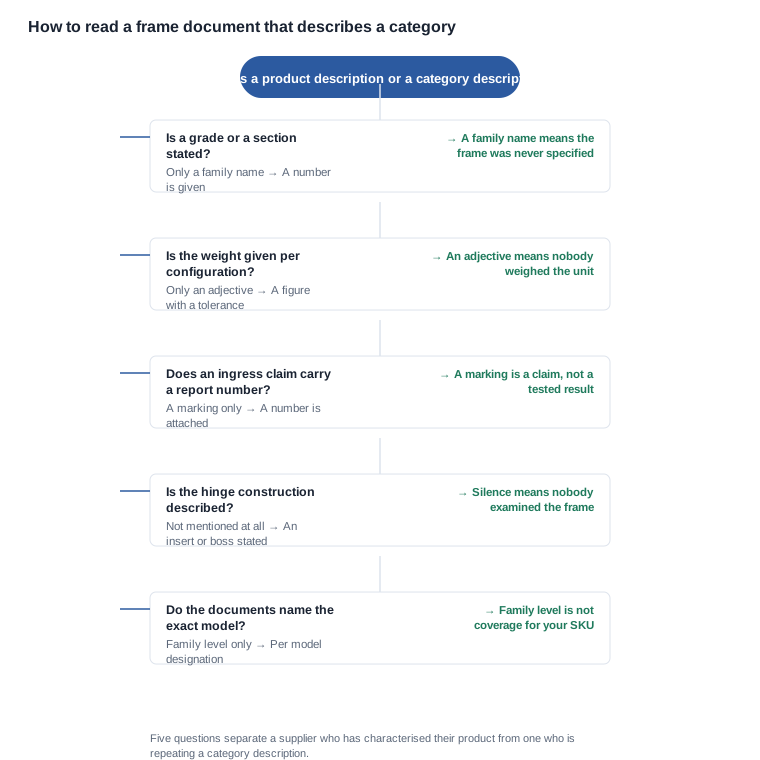
The first part is a name at a specific grade. Not a family. "TR90" is a family; a named grade with a transition temperature is a specification. "Acetate" is a family; a cellulose acetate grade with a stated plasticiser loading is a specification. The practical version of this test is simply: does the document give me something I could write into a purchase order without adding a word of my own?
The second part is a number with a unit. Grams, millimetres, degrees, cycles, hours. A document that never contains a number is a description. This is the single most reliable signal, and it is the one most often missed because a document can look technical while containing nothing measurable — the IP54 example is exactly that case, since the digits are a classification and not a measurement of your product.
The third part is a method. A number without a method is not comparable with anything, because it might have been obtained under different conditions. Weight measured on one unit and generalised across a range is the classic example. A charge time with no starting state and no termination criterion is another: our range publishes charge times for all twenty-eight entries — twenty-six at two hours or less, the D17 and the ZH12 at roughly one hour — but none of them states the starting state or the point at which the charge counts as complete, so the figure cannot be compared against the operating time you actually lose.
The fourth test: does the document name your model?
There is a test above and above it, and it is the one that matters most for a branded programme. Ask whether the document names the exact model designation you are ordering, not the platform and not the family.
In our own range this test has a sharp edge. Twenty-two of the twenty-eight entries carry a formal model designation — V03 Pro and D11, YK12 and KY06, CY03 and G07, MT5 and D17, YKC02 and V03, S7 and L2 Utral, LC-105-1 and MT6, LC-105-2 and L1 Pro, CY05 and D12, ZH12 and V06, and K01 and K02 — while three entries have no model designation at all: the AR glasses entry, the AI electrochromic glasses entry and the bone-conduction entry. An entry with no SKU cannot be listed correctly on a certificate, correctly packaged, or correctly described at customs. If your requirement lands on one of those three rows, that is a procurement constraint you need to know about before the artwork is approved, not after.
What the answer tells you about the factory behind the document
The value of asking the replacement question is not only the number. It is what a good answer reveals about the operation that produced the product, because a factory that can answer a dimensional question has an engineering function and a factory that cannot has a buying function.
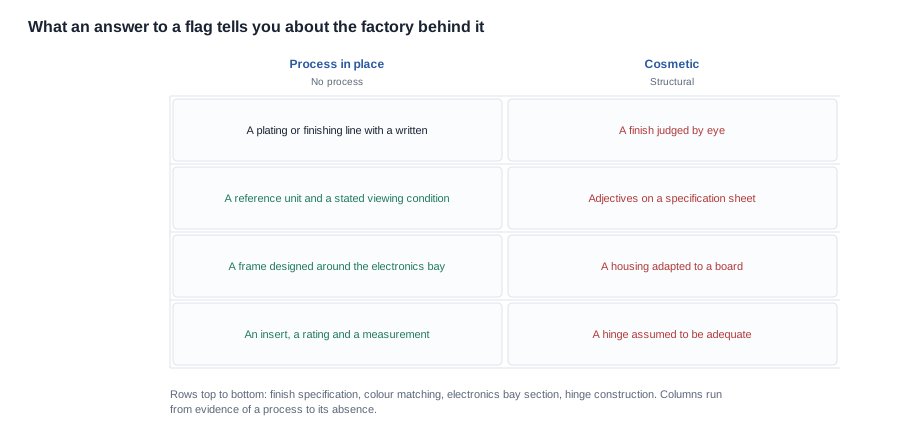
A plating specification with an adhesion method and a pass mark means there is a finishing line and an inspection behind it. A physical reference unit and a stated viewing condition mean there is a standard and somebody owns it. A section thickness given at the electronics bay for the exact cell configuration means the frame was designed around the electronics rather than adapted to a board afterwards. An insert, a rating and a measurement method at the hinge mean the load path was considered.
Against those, the negatives are equally informative. A finish judged by eye means the inspection is an opinion. A sheet with only adjectives means the document was written for a buyer who will not ask. A frame adapted to a board means the electrical design came first and the structure was made to fit it, which is the normal outcome and is not a criticism — but it does mean the frame is not the source of any strength figure. And a hinge assumed to be adequate means the warranty exposure sits with you, because nothing in the documentation covers it.
Four answers that deserve a second question
A weight offered as a range. "Around one hundred and fifty to one hundred and sixty grams" across a range of models is not a specification, and it almost always means the weight was measured on one configuration and generalised. The second question is how many units were measured and what the spread was, because a spread across units is a manufacturing capability statement and an average is a marketing number.
A certificate offered without model coverage. "We have CE" is not a position; the model list on the document is. In our range the catalogue's export-certification page carries ten patent certificates — eight appearance-design patents and two utility-model patents — and names no CE, FCC or RoHS marking, per-model certificate numbers are not published at all, and the certification position for the children's models is not published to us. A family-level statement is not coverage for a branded configuration.
A material certificate offered as the product's evidence. A material certificate covers a material. The product's declaration covers the product, and the two are different documents — the material certificate will not tell you what was assembled, and the product declaration will not tell you the section thickness at the bay.
An answer that returns the question. When a supplier asks you to define the acceptance criteria after the samples have shipped, the conversation has already lost its leverage. That is a sign to slow down and put the requirement in writing, not a reason to proceed.

Turning a flag into a clause
A flag left in the correspondence stays a flag. The only way a red flag becomes a protection is by being converted into a written requirement with a verification step attached.

The sequence in that flow is deliberately mechanical. Quote the phrase exactly as it appears, because a paraphrase weakens the requirement and a supplier can argue about what you meant. Identify the single quantity the phrase fails to state, because a flag usually conceals one number rather than several. Write the question, because the question is the thing you will actually send and the thing you will get an answer to. Turn the answer into a requirement, and turn the requirement into a clause with a threshold, a method and a sample size. Then verify on the first article, because a clause with no verification step is a clause with no enforcement.
The commercial value of this is straightforward. A flag that goes unconverted usually surfaces as a return, a claim or a rejected listing, and each of those costs more than the clause would have. The total cost of a requirement is a paragraph of writing; the total cost of a dispute over an unstated frame property is a lot of returned units.

What a red flag has usually already cost you commercially
The flags are not free at the quotation stage, and the cost is usually hidden inside a number that looks reasonable.
The specification premium. When a supplier quotes a named grade and a characterised section, that characterisation costs engineering time and is priced into the unit. When two quotations differ by a small percentage, the difference is rarely the material — it is the depth of characterisation, and the more expensive quotation may be the better specified one. This is the trade-off buyers most often get wrong, because they read the gap as margin rather than as risk.
The tooling spread. A frame designed for a characterised section is a different mould from one adapted to whatever tooling exists. Two quotations can look similar on unit price and sit at completely different totals once the setup is included, and the setup difference is the material difference appearing later.
The rework tail. A flag that is caught at first article costs a sample. The same flag caught at the first customer shipment costs the lot, the delay and the channel.
The uninsurable position. Where the documentation says nothing about the hinge, the frame, the weight or the finish, there is no basis on which to argue a warranty claim, and the outcome depends on the relationship rather than on the evidence.
None of this is an argument against buying from a supplier who writes in adjectives. It is an argument for knowing which supplier you have before you have committed the balance of the order, and for converting every flag into a clause while the order is still negotiable rather than after.
A worked scenario: three quotations for the same frame
The sequence below is hypothetical. It shows the order in which the warning signs appear, not a client engagement.
Assume a brand that has asked three factories to quote the same camera-glasses programme at the same volume, with the same cell configuration and the same charging interface. The three quotations arrive within eight per cent of each other on unit price, which is the point at which most buyers stop reading and start allocating the order.
The brand applies the same reading pass to all three, and the pass is short: material named with a grade or a section, unit weight per configuration with a tolerance, hinge construction with a pull-force rating, and document numbers per model with validity dates.
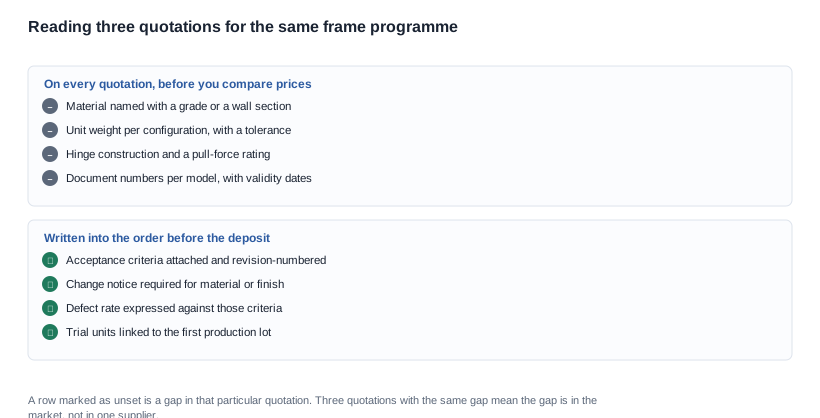
Quotation one answers three of the four with numbers. The weight is given per configuration with a tolerance and a sample size, which tells the brand the factory weighs its units and knows the spread. The material is named with a section at the electronics bay, which tells the brand the frame was designed around the cell. The hinge is described, but without a pull-force rating, and the documents are family-level rather than per model. The brand's read is that this is an engineering operation with a documentation gap, and the gap is closable in writing.
Quotation two is the cheapest and answers none of the four with a number. The material is a family name, the weight is an adjective, the hinge is absent from the document and the conformity statement is company-level. The brand's read is that the quotation is not wrong, but that nothing in it can be compared with anything, and that the eight per cent gap is not a saving — it is the absence of the characterisation that quotation one included.
Quotation three gives a very low unit price and offers to "develop the frame to your requirement", which is a statement that the frame has not been characterised yet and that the buyer will absorb the engineering. The brand's read is that this is a development programme priced as a catalogue order, and the total cost will not be visible until the tooling and the validation are added.
The brand does not choose on unit price. It converts each gap into a written requirement, asks each supplier to price the requirements, and then compares the totals. Two of the three respond with a number and a schedule. One responds with a paragraph explaining why the question does not apply, which is itself an answer.
Where our own catalogue falls into the same pattern
The boundary we hold: a frame specification should carry a material class, a gauge, a hinge construction and a torque figure rather than a material name, and we will publish the mechanical specification when the manufacturer provides it.
We will not fill those rows with typical industry values, because a composition written from convention rather than from the actual product is a number you will be held to when a customer returns a cracked temple. Our own catalogue falls into exactly the pattern described in this article: we publish no frame material composition for any model, one complete-unit weight for the MT6 at 158 g excluding its foldable 1200 mAh charging case, and no frame dimensions, temple length, hinge construction or finish standard anywhere in the range. A buyer who finds us quoting "acetate frame" should treat it the same way they would treat anyone else's.
What we will do is take the specific failure you are trying to fix and tell you which of these rows you need before you can evaluate it, because the seven flags do not all point at the same problem. The broader treatment of frame materials sits under materials and ergonomics, and the wider question of how a material choice interacts with the rest of the product is covered in do you need a frame material upgrade.
The phrase you want us to mark, and what each one is costing you
Tell us the failure you are trying to fix and we will tell you which specification rows you need first, and in what order to request them. If you send us the supplier's document with the phrases still in it, we will mark which of the seven it contains and what each one is costing you.
Related reading
- frame materials problems and fixes
- frame material specifications to compare
- do you need a frame material upgrade
Tell us the failure and we will say which specification rows you need first.


