

Frame material is one of the few upgrade decisions that touches the product's own electrical design, and that is why it is worth thinking about rather than defaulting. Put a metal core into a temple and you change the antenna environment. Thicken a polymer section near a battery and you change the internal volume budget. Neither change is free, and neither is visible in a photograph.
So smart glasses frame materials smart glasses upgrade considerations is less a question about which material is better and more a question about which failure you are actually trying to fix. Start from the returns pile, not from the material sample. A buyer who opens a mould before reading the returns data is solving a problem they have not yet identified, and in this product class the six changes that are available range from a packaging revision that costs almost nothing to a new moulding that costs a quarter of a year.
Smart glasses frame materials: start from the returns pile, not a sample
The returns pile is the only evidence you have that names a failure. Every other input — a material sample, a competitor's spec sheet, a sales conversation — describes a possibility rather than a problem.
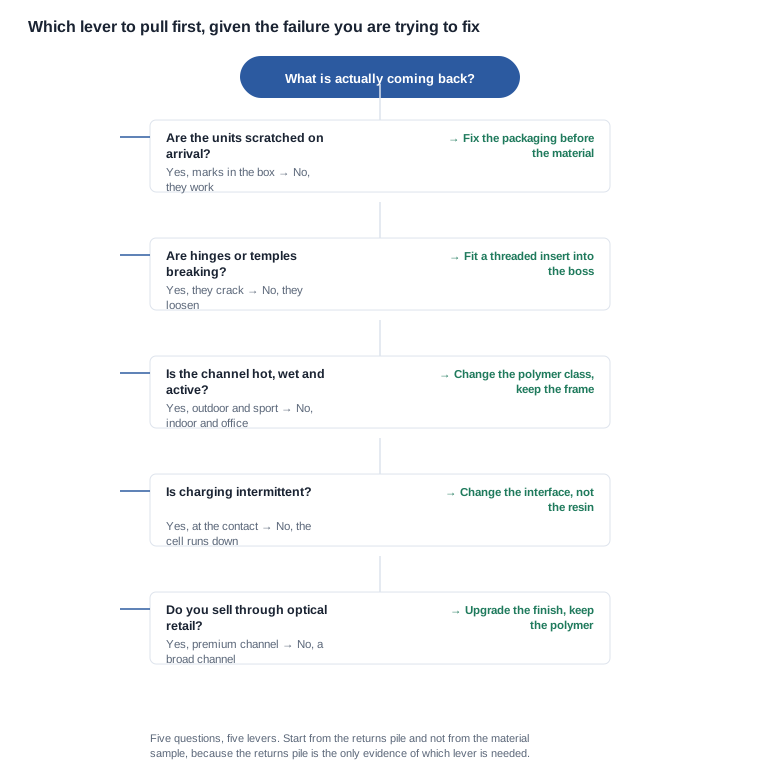
The decision tree above asks five questions, and the order matters because the branches are not equally expensive. A scratch on arrival and a cracked hinge look like the same kind of problem in a returns summary and require completely different responses: the first is a packaging problem and the second is a structural one. A product that stops charging and a product that stops holding a charge are also different problems, and only one of them is a frame problem at all.
The first question is whether the unit works. If the product functions and the complaint is cosmetic, the frame is almost never the right lever, and money spent on structural performance is money the customer will never see. If the product has stopped working, the question becomes whether the failure is in the frame, at the interface, or in the electronics — and in a camera platform with a charging contact in the temple, those three are physically adjacent.
The second question is what the failure is made of. Cosmetic failure on arrival, structural failure at a joint, and intermittent contact failure have three different root causes and three different levers. A plastic scratch and a hinge crack look identical in a returns log and share nothing.
The third question is the exposure the product actually has. Heat, sweat, repeated flex and impact argue for a different polymer family than an indoor retail channel does, and our own range already reflects that split: the sport platforms that carry an IP54 marking and a removable inner frame are separate platforms rather than variants of the retail chassis.
Note carefully what an IP54 marking on a catalogue page is — a label, not a tested conclusion. The catalogue entry carries no third-party report number, and until one exists the honest treatment is to describe the marking as a claim that has not been evidenced. Our article on IP ratings covers exactly what the digits mean and what a buyer has to request to make the claim usable.

The six levers, and what each one actually fixes
Six changes are realistically available to a buyer who wants to improve how a frame performs. They differ enormously in cost, in reversibility and in what they can actually do about a specific failure.
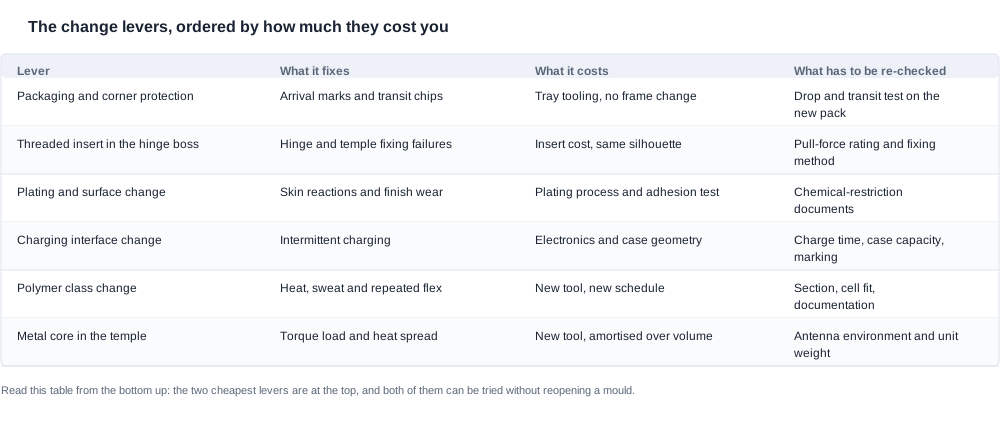
Packaging and corner protection fixes what happens between the factory and the customer. Arrival scratches and transit chips are the most common cosmetic complaint in this product class, and corner blocks and a rigid tray cost less than a material upgrade while fixing more of it. The lever is reversible, the schedule impact is one packaging cycle, and the thing that has to be re-checked is the drop and transit test on the new pack.
A threaded insert in the hinge boss fixes the joint. A steel threaded insert into a reinforced plastic boss survives torque that a screw in unreinforced plastic does not, and it requires no change to the frame silhouette, no new tooling profile and no acoustic retuning. It is almost always the first thing to try and almost never the first thing a buyer thinks of, because it is invisible in the finished product and the benefit only appears when something is dropped.
A plating and surface change fixes the skin-contact and finish problems: reactions at the contact points, wear at the temple, discolouration at the corner. It costs a plating process change and an adhesion test, and it brings the chemical-restriction documentation with it, because those obligations reach coatings and plating rather than the base polymer alone.
A charging interface change fixes intermittent charging, and it is the only lever in this list that is not really a frame change — it is an electronics and case-geometry change that happens to live inside the temple. On camera platforms this also means re-checking the charge time, the ingress marking and the case capacity, because all three are downstream of the interface.
A polymer class change fixes heat, sweat and repeated-flex failures. It is a moulding and tooling decision with a schedule attached, it changes the section thickness available at the electronics bay, and it requires the documentation to be reissued.
A metal core in the temple fixes torque load and heat conduction. It is the most expensive change in the list, it is amortised over volume, and it brings the antenna environment and the unit weight into question, because a metal core in a temple containing a radio is an electrical design decision as much as a mechanical one.
The two levers that cost almost nothing and are almost never tried first
Both the packaging revision and the threaded insert are worth separating out, because they share a property that matters commercially: they are testable without opening a mould, without a tooling amortisation calculation and without a re-validation of the product's documents.
The packaging revision is testable in a week. Build the new tray, put a unit in it, run the transit and drop procedure, and compare the arrival condition against the old pack. The cost is tooling for a tray, which is trivial compared with a frame tool, and the result is a measurable reduction in the most common cosmetic complaint.
The threaded insert is testable in a fortnight. Fit an insert into a sample boss, apply a defined pull force, and measure the difference against the unreinforced version. The result is a number you can write into the order as a minimum, and it applies to every unit from the next lot onward without any change to the frame's geometry.
The discipline these two share is that both should be exhausted before anyone opens a mould. A buyer who opens a mould while the packaging is still a corner-block question has paid for the most expensive lever and left the cheapest one untested.
Why a stronger material is sometimes the wrong answer
For a premium optical channel, the polymer is usually not the problem and the finish is. Acetate retains a polish and a hinge tension that a thermoplastic elastomer does not replicate. If the customer is paying for the product because it looks like an optical frame, changing to a technical polymer may read as a downgrade even if it is more durable in the field.
Upgrade the finish and the hinge hardware and keep the polymer. This is the branch where buyers most often make the wrong call, because they assume "stronger material" means "better product", and in a retail channel the relationship frequently runs the other way. The same logic applies to a channel with a price point that cannot absorb the cost of a characterisation programme: an unjustified upgrade raises the unit price without changing the thing the customer is buying.
When a polymer change breaks something else
This is the second-order risk that makes an upgrade decision properly difficult, and it is the reason a supplier's engineering answer matters more than a material sample.
It changes the antenna environment. A metal core changes the propagation conditions around a radio in the same temple. The radio compliance position has to be reviewed rather than assumed to carry over, and the Radio Equipment Directive framework under (EU) 2014/53/EU is the reference point for that review.
It changes the section thickness available. A stiffer material can be thinner and a tougher material can be thicker, and either way the volume available for the cell and the board at the electronics bay changes. If the bay section was tight for the cell configuration, the polymer change is a mechanical decision with an electrical consequence.
It changes the weight. The one published unit weight in our range is the MT6 at 158 g for the glasses unit including the 265 mAh cell and excluding the foldable 1200 mAh charging case, and no other model has a published weight. A material change therefore moves a number that the buyer cannot predict, which is a reason to request the new weight per configuration rather than to assume it lands in the same place.
It changes the documents. The material declaration, the product declaration and the chemical-restriction position all have to be reissued against the new configuration, and that reissue is a schedule item with a lead time of its own.

What each kind of change costs you, and which ones you can take back
The most useful way to rank the six levers is not by unit cost but by whether the change can be undone.
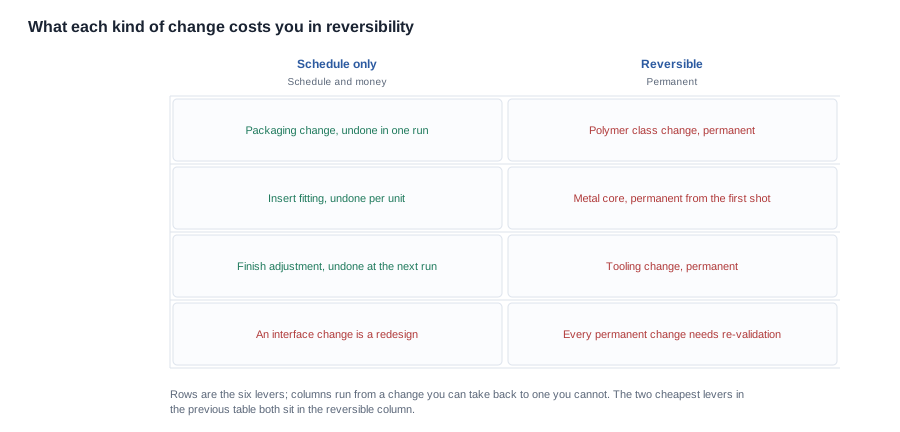
A packaging change is undone in one run. A threaded insert is undone per unit, because the insert is fitted rather than moulded in. A finish adjustment is undone at the next production run. These three sit in the reversible column, and they share a second property: they can all be trialed on a handful of units before the programme commits to them.
A polymer class change and a metal core are permanent from the first shot. The tool is cut, the tool is paid for, and the material is written into the bill of materials. A charging interface change is neither — it is closer to a redesign, because it moves the electronics as well as the frame and drags the case and the charge criteria with it.
The schedule a polymer-class change actually runs
The timeline below is a typical shape for a polymer change, and the point of it is not the durations but the order in which the items arrive.
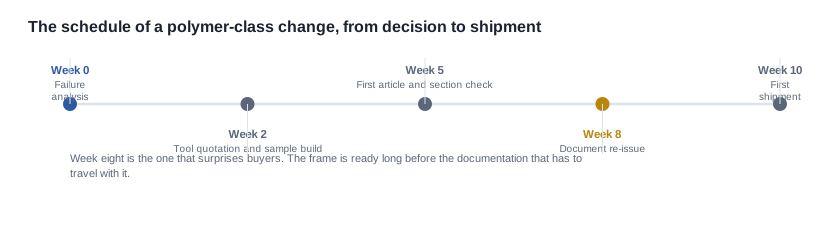
The item that surprises buyers is the documentation. The frame can be built and the first article can be approved well before the papers that have to travel with it, and the paperwork is the item with the external dependency. If the launch date is fixed, that is the item to ask about first, because it is the one that cannot be accelerated by paying more for the tool.

How to fund a change without opening a mould
Three mechanisms let a buyer test a change before committing to it, and all three cost nothing except attention.
Sample the lever on a handful of units. For the insert, this means fitting inserts into a sample and running the pull test. For the packaging, it means building the tray and running the transit test. For a plating change, it means a sample panel left in a salt and sweat soak. Each of these produces a number in days rather than months.
Make the change conditional in the quotation. Ask each supplier to quote the base configuration and the upgraded configuration separately, and state in advance that the upgrade is exercised only if the test result clears the threshold you wrote down. This turns the upgrade from a decision made in the dark into an option with a price, and it is the single most useful thing to ask for in this category.
Separate the tooling decision from the material decision. A change that does not alter the frame silhouette — an insert, a plating process, a packaging revision — does not require a new tool. A change that does — a polymer class, a metal core — requires one, and the tooling amortisation should be negotiated against the committed volume rather than against the first order. The two decisions are frequently bundled by suppliers because bundling is easier to quote, and unbundling them is where a buyer finds real margin.
The clauses that make the change reversible
If the upgrade is quoted as an option rather than as a change, it needs a trigger and a deadline. The trigger is the test result: a defined measurement, a defined pass mark, and a stated sample size. The deadline matters because an option with no expiry becomes the default by inertia, and a programme that ships a polymer it never intended to ship has a documentation position it cannot defend.
Two further clauses are worth having. One requires notice and re-approval before any further change of material, finish or temple type, because each of those invalidates the acceptance criteria written against the previous configuration. The other sets the warranty against the failure criterion used in the trigger test rather than against a general durability statement, so the two documents describe the same thing.
The criteria to write before you choose a lever
When two levers could plausibly address the same failure, the way to choose between them is to write the criteria down first and let them do the work. There are six that decide it in practice.
- Failure rate and cost per unit. How many units come back for this cause, and what does each one cost in freight, inspection, refund and slotting? A cause affecting two per cent of units and a cause affecting twenty per cent are not comparable on severity, and the trade-off between them is rarely the obvious one.
- Reversibility. Can the change be undone, and at what cost? This is the single criterion that most often puts the packaging revision and the threaded insert ahead of a polymer change.
- Tooling impact. Does the change require a new frame tool? If it does, the amortisation should be negotiated against committed volume rather than against the first order, and the schedule item becomes the dominant cost.
- Schedule impact. How many weeks does the change add, and does any of them sit on the critical path? A change that adds four weeks to a programme with a fixed launch date is not the same change as one that adds four weeks to a programme with float.
- Documentation impact. Which declarations, certificates and technical files have to be reissued, and who owns the reissue? This is the criterion that surprises buyers, because it is invisible in the engineering plan and it has an external dependency.
- Verification method. What single measurement would tell you the change worked, and can it be made on a handful of units before the programme commits? A lever with no verification method is a belief, and beliefs are expensive at this scale.
Write the six answers down for each candidate lever and the choice usually makes itself. The questions to ask a supplier are narrow once the criteria exist — which is the reverse of how most programmes start, where the material is discussed first and the criteria emerge at the end of the negotiation.
A worked scenario for a sports brand with a mixed returns pile
The case below is a hypothetical sequence, included to show how the decision would be made rather than to report a client project.
Assume a brand with a camera-glasses line aimed at outdoor and sport channels. Its returns pile is mixed: a cluster of units arriving with marks, a smaller cluster of temples cracking after a few months, and a trickle of intermittent charging complaints. The brand has no published frame material to compare and no supplier material specification to argue with, so it starts by sorting the pile rather than by choosing a material.
Step one: sort by cause, not by symptom. The arrival marks are separated out because they are a packaging failure. The cracked temples are separated because they are structural. The charging complaints are separated because they may not be frame failures at all. Once sorted, the largest cluster by count is the smallest cluster by cost to fix, and that is the first change.
Step two: fix the packaging first. The brand builds a rigid tray with corner protection and runs the transit test against the previous pack. The change costs a tray tool and one packaging cycle, and it is reversible in a single subsequent run. Because the brand asked for the base and upgraded configurations to be quoted separately, it can also see what a full polymer change would have cost, and it does not have to take it.
Step three: test the insert before the resin. The brand fits a threaded insert into a sample boss and runs a defined pull test. The result is a number it can write into the order as a minimum hinge strength, applied from the next lot, with no change to the frame geometry and no new tool.
Step four: treat the charging complaints as an engineering question. Because the charging contact sits in the temple, an intermittent contact can be a frame tolerance problem rather than an electronics problem. The brand asks for the contact seating after a stated number of mating cycles as an acceptance criterion, which costs a sample programme rather than a redesign, and only escalates to an interface change if the criterion fails.
Step five: hold the polymer change in reserve. The brand keeps a quoted option for the polymer class with a trigger attached — a flex test result below a stated threshold — and a deadline after which the option expires. That way the launch is not held up for a change that may not be needed, and the change is still available when the evidence arrives.
The result is a programme that addressed three failure classes with two reversible changes and one held option, and that spent its money on the largest cluster first rather than on the most technically interesting lever.
What we will and will not say about an upgrade
The boundary we hold: an upgrade should be justified by a failure rate, and the cheapest structural fix in this product class — a threaded insert in the hinge boss — should be exhausted before anyone opens a new mould. We will say so even when the answer means telling you not to spend the money.
Frame material composition, unit weight and temple dimensions are not published for our models, and we will not fill them with plausible numbers. If you need those rows for your own evaluation, ask and we will tell you which we can answer and which we cannot.
What we can do is tell you which material classes are workable for your use case and which we cannot support, and be explicit about which parts of the answer depend on information we do not currently hold. The wider treatment of frame materials sits under materials and ergonomics, and the sport platforms where the removable inner frame and the ergonomic frame design statement are published are on sport smart glasses.
Where to start with us on a frame change
Send us the channel, the use case and the failure you want to fix, and we will start from your returns rather than from our catalogue. If you can send the returns summary with the causes separated, we will tell you which lever each one points at and which of them you can test without reopening a mould.
Related reading
- materials and ergonomics for smart glasses
- what an IP rating actually claims
- sport smart glasses platforms
Send the channel, the use case and the failure you want to fix and we will start from the returns rather than the catalogue.


