

There is a consistent pattern in how these documents are written, and once you can see it you can read any of them more quickly. A spec sheet states the thing that is easiest to state and omits the thing that is hardest. A material becomes a family name. A weight appears without saying what it was measured on. An ingress code appears without a standard. A runtime appears without a condition. Every one of those rows looks complete on the page, and every one of them is incomplete in a way that only matters when something goes wrong. This article takes the frame rows specifically, because the frame is where the omissions compound: a material row sits upstream of the tool, the tolerance, the hinge, the sealing line and the antenna position at the same time.
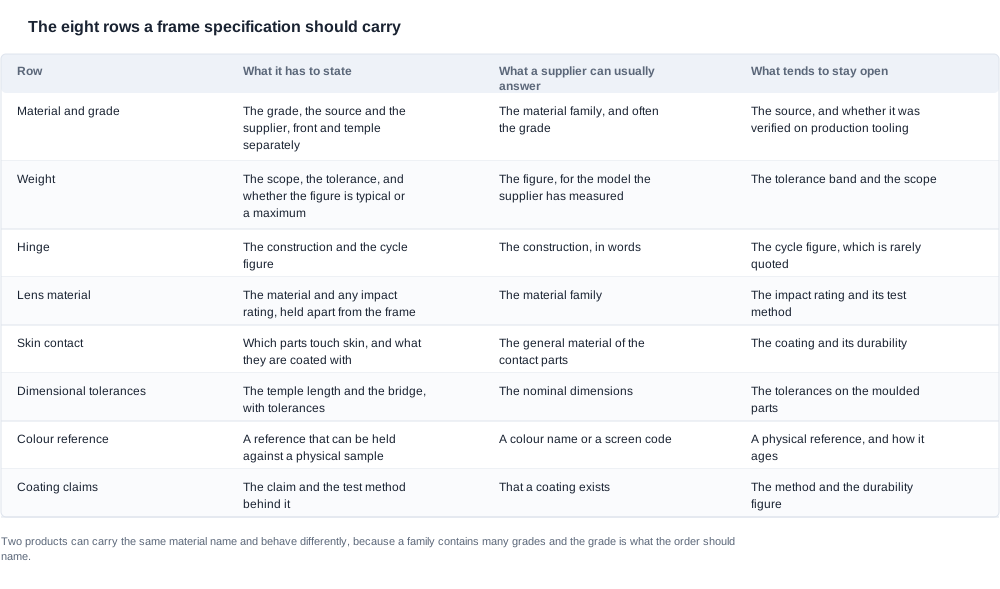
Smart glasses frame materials: family, not specification
The three pieces of information that turn a material into a specification
A datasheet that says a frame is made of a resin family has told a buyer very little, because a family contains dozens of grades, and the grades differ in stiffness, in how they take a surface finish, in how they age, and in whether they can be moulded with the tolerances the product needs. Two products both described by the same family name can be visibly different in the hand and behave differently over a year.
The reader here is a brand-side product owner or a channel buyer who has a frame specification that is really a list of adjectives, and who needs it to become something a factory can quote, a laboratory can test and a warehouse can check. The specific fear is a lot that turns up other than the unit that was signed off, in a way nobody can put into words, because the wording on the order does not describe a material.
Three pieces of information close that gap, and each of them answers a different question. The grade tells you the mechanical behaviour: how the material takes a load, whether it flexes, how it survives a drop onto a desk and how it holds a hinge. The source tells you whether the material is a standard catalogue item or something specified for this product, and a catalogue item has a lead time and a price that a custom compound does not. The supplier matters because it tells you who is accountable when the material does not behave as described.
There is a fourth question hiding behind the first three, and it is the one that catches the most programmes. Is the frame material the same as the temple material? The front and the temple carry completely different loads, and a frame that is reinforced at the front and not at the temple fails at the temple, which is the part the customer holds.
The rows that are always open, and why
Three of the eight rows in the table are open in almost every conversation with a factory, and it is worth knowing which ones and why, because a buyer who treats all eight as equally answerable will be disappointed in all of them.
The hinge cycle figure is open because it is a factory-internal test result rather than a catalogue attribute, and because the number that matters depends entirely on the opening mechanism. A buyer who needs a cycle figure for a given use has to ask for the test method as well as the number, because two factories can quote a cycle count and mean completely different things by it.
The coating claim and its method is open because a coating is easy to describe and hard to test. "Anti-scratch" and "scratch-resistant" are different claims with different methods, and a claim without a method is an aspiration. Where the method exists, the number is usually usable.
The colour reference is open because it is a physical property and the industry default is a name. A buyer who needs the colour to match a second production run needs a reference that can be held against a physical sample, and the sample is the reference. A screen code is not a reference, and a colour name is a description.
A weight without its scope cannot be compared to anything
Weight figures in this category are usually the bare frame, occasionally the frame with a cell, and rarely the complete unit as shipped. The difference is not trivial: a charging case, an electronic assembly and a set of accessories all add up, and the number a customer feels on their face is the weight of the front and the temples, not the total in the box.
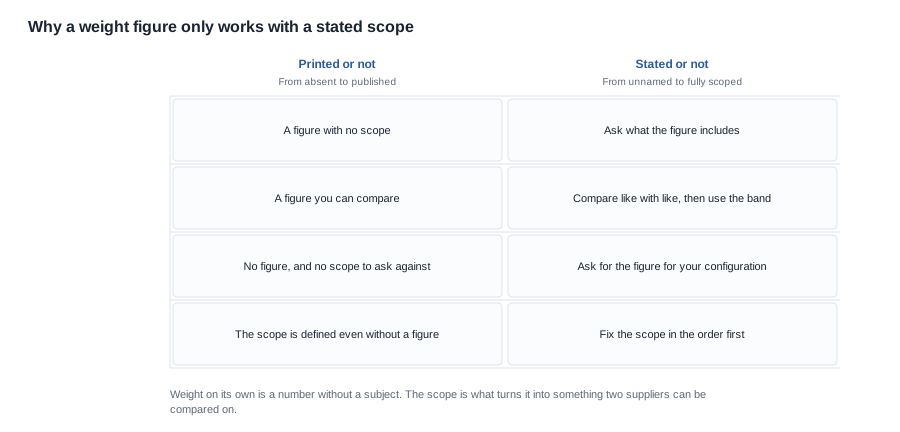
Our catalogue publishes one weight figure in the whole range, and the way it is published is the point. The catalogue states 158 g for the MT6 glasses unit — the assembled glasses, including the 265 mAh cell and the camera, and excluding the foldable charging case. The case itself carries a 1200 mAh cell, and the weight of the case is not published. No other model in the range carries a published weight, and no bare frame weight is published for any model, because a figure on its own is a number without a subject.
The matrix above is the whole argument in one view. A weight with no scope cannot be compared with anything, including another weight from the same supplier. A weight with a scope can be compared, and can then be used against a tolerance band, which is the only reason to ask for a weight at all. Where no figure is published, the useful move is to fix the scope in the order first — what the figure has to include — and then ask for the number against that scope, because a number with a defined subject can be produced even when a number without one cannot.

The eight rows a frame specification should carry
The table at the top of this article sets out the eight rows, what each one has to state, and what a supplier can usually answer. The third column is the practical one, because it tells the buyer where to spend the time: a supplier can usually name the material family, describe the hinge in words, and confirm that a coating exists. Those three answers cost nothing and are worth recording.
The fourth column is where the real gaps are, and the pattern in it is not random. The open rows are the ones that require a test, a measurement or a physical sample, and the ones that require a test are open because a test costs somebody an afternoon and has to be scheduled.
The distinction that matters most in practice is the difference between a row that describes a property and a row that describes a condition. Material family describes a property. Weight with a scope describes a condition. A colour name describes a property; a physical reference describes a condition. A coating claim describes a property; a coating claim with a method describes a condition. Properties are cheap to publish and easy to compare; conditions are expensive and require the buyer to know what to ask for. A buyer who only knows how to ask for properties will end up with a specification full of adjectives.
The questions to ask a supplier about the frame
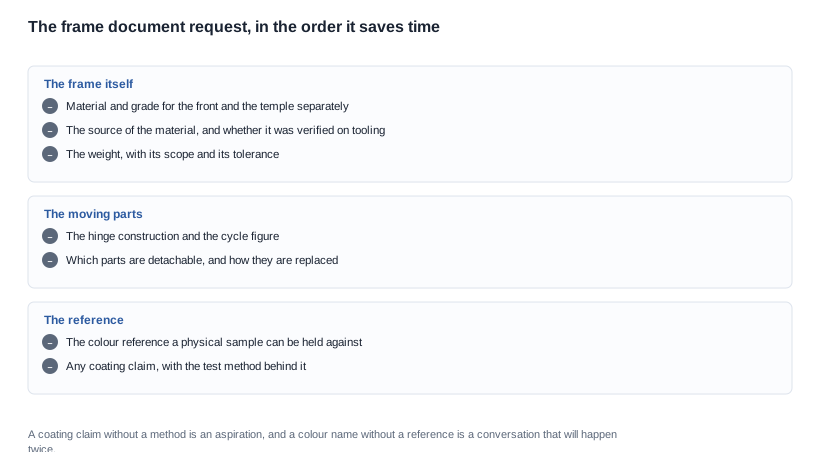
- What is the material, and what is the grade, for the front and for the temple separately?
- Who is the material supplier, and is the material a standard catalogue item or specified for this product?
- Was the material verified on production tooling, or taken from a supplier's data sheet?
- What does the weight figure include, and what is the tolerance band?
- What is the hinge construction, and what is the cycle figure for the test method used?
- Which parts are detachable, and how are they removed and replaced?
- What is the lens material, and is there an impact rating with a method?
- What are the tolerances on the temple length and the bridge?
- Is there a physical colour reference, and how does it age?
- For any coating claim, what is the test method behind it?
The first four decide what the factory can quote and what a second supplier could match. The fifth and sixth decide how the product ages in the field, which is where the returns concentrate. The last four are the rows that keep a claim defensible, and they are the ones a buyer is most likely to skip because they feel like detail. In a frame, detail is the product.
The tolerance row deserves a note of its own, because it is the one a buyer is most likely to treat as trivial and most likely to pay for. The nominal dimensions of a frame are easy to state and easy to hold, and a moulded part will vary across a tolerance band whatever the specification says. For a product with electronics in the temple, the temple length and the bridge are not cosmetic dimensions: they decide where the antenna sits relative to the head, where the electronics sit relative to the hinge, and how the product presents on a face of a given size. A tolerance agreed after the first shipment is a tolerance that has already been missed, and the remedy is a tool change rather than a note in a file.
Reading a frame row, and checking one on a sample
Five checks on a sample close most of the gap, and none of them needs a laboratory.
- Compare the material by behaviour, not by label. Flex the front and the temple separately and compare the response with the approved sample. Two materials from the same family behave differently under load, and that difference is visible before any instrument is involved.
- Operate the hinge through its full range, repeatedly. The hinge is the wear point in a frame, and the cycle figure is usually the row that is not published, which makes the physical check the only check available.
- Test the detachable or movable parts. Where a model has detachable temples, a removable inner frame or flexible temples, the movement itself is the thing to inspect: play in the joint, the force required, and whether the part returns to its position.
- Compare the colour against a physical reference in neutral light. A screen cannot be a reference. Where the factory holds a sealed colour sample, ask for it and keep it.
- Put the specification into a form a warehouse can check. A row that only a design engineer can interpret will not stop a substitution at goods-in, and a substitution at goods-in is a substitution in the market.
What a material or temple change does to the file
A change to the frame is not a cosmetic change, and the reason is structural. The frame carries the load path from the front to the temples, it carries the antenna in the temple, and it carries the sealing line at the interface. Change the material and you move the first of those. Change the temple and you move all three, in that order, and the consequences arrive in a sequence that is easy to underestimate.

The practical route is short. Raise the change against the part number it affects, because a change that is not attached to a part cannot be tracked. Ask which published rows depend on the changed part, and treat the answer as a list rather than a summary. Get the supplier's written position on each affected row, since a phone call about a sealing line is not a record. Decide whether the change is a new configuration or a new model, because that decision determines whether the conformity file is extended or restarted. Then update the order, the artwork and the claim set together, because a claim that survives a material change by accident is not a claim that survived it. Finally, re-verify on the first unit of the changed build, which is the only point at which the change becomes a fact rather than an intention.
The commercial point behind that route is that the cost of a change is set by when it is raised. A colourway change raised before the order is a new line in a quotation. The same change raised after the packaging is approved is a reprint, and one raised after the first shipment is a variant that nobody has evidenced.
A worked example: a brand adding a colourway to an existing frame
What follows is a worked example we built ourselves, not a client engagement, and it is there to show the sequence of checks rather than to report a result.
Assume a brand with an established frame, a good year in one colour, and a channel asking for two more. The binding constraint is that the first extension took four months longer than planned because the new colour was treated as a paint change.
The change is classified before it is priced. The brand asks whether the new colourway changes the material, the surface finish, the temple, the inner frame or the interface. A colour applied to the same material with the same finish is a configuration change. A colour that needs a different pigment load in a different compound, or a different temple, is not.
The dependent rows are listed. For a change that touches the temple, the list includes the load path, the antenna position and the sealing line. The brand asks for a written position on each, and gets one that says the antenna position is unaffected and another that says the sealing line has to be re-checked. That second answer is the one that matters, because the IP54 marking on the V06 and the S7 is attached to a sealed configuration.
The configuration decision is made explicitly. The brand decides this is a new configuration under the same model, which means the conformity file is extended with a confirmation rather than restarted, and the artwork and the colour reference are produced together.
The first units of the changed build are checked. Material behaviour against the approved sample, the hinge, and the seal line, before the run is released.
The claim set is reviewed. The listing copy for the new colourway is checked against the permitted claim set, and the brand confirms that nothing in the copy implies a different product.
The result is two new colourways that ship on a predictable schedule, because the classification was done before the tooling and the paperwork was done in the right order. The decisive decision was the classification, and it cost one email.
Our published position on the frame, and what to send us
The working rule we apply: a spec sheet is a document for a buyer who already knows the product, and the rows which look complete are usually the ones carrying an unstated condition. We will publish the rows we have, mark the ones we do not, and we will not fill a material row with a plausible resin grade or convert a structural capability such as a flexible temple into a materials certification. If a buyer asks us for a row that we cannot evidence, the answer is that it is not published, not a number we invented.
The structural rows we do publish are these. The V03 Pro carries flexible temples, a light-responsive lens configuration, three colour options, an 8 MP camera, a 220 mAh cell, a runtime of about five to eight hours and a Type-C charging port. The V06 carries a removable inner frame, an IP54 marking, four colour options, an 8 MP camera, a 260 mAh cell, a runtime of about five to eight hours and magnetic charging. The S7 carries a removable inner frame, an IP54 marking, a 13 MP camera, a 260 mAh cell, a runtime of about five to eight hours and magnetic charging. The G07 carries ultra-thin and detachable temples, a 55mAh*2 cell configuration, a runtime of about six hours, Bluetooth V5.4 and magnetic charging. And the MT6 carries a foldable charging case at 1200 mAh, a published weight of 158 g for the assembled glasses unit including its 265 mAh cell and its camera, an 8 MP camera, a runtime of about seven hours and magnetic charging.
The rows we do not publish for the frame are these. The frame material grade, the temple material grade and the lens material grade are not published, and we will not supply a typical value for any of them. The hinge construction cycle figure, the coating method and its durability, the dimensional tolerances on the temple length and the bridge, and the colour reference standard are not published either. The certification route is referenced on the catalogue cover as a company-level export certification capability, and it is not a per-model materials approval, so a buyer should read it as the former.
What we will do is take a datasheet, yours or another supplier's, and mark the rows that hold up against the eight questions above, so you know exactly where you are standing before you order. If you want that done on your own document, send it with the models, the quantities and the target market, and we will say which rows are settled for our configurations and which are yours to close. The background is under materials and ergonomics, the reading method is set out in reading a frame materials datasheet, and the regulatory side of a material change is covered in frame materials and industry standards.
Related reading
- The rows a material sheet should carry — materials and ergonomics
- How to read one in full — reading a frame materials datasheet
- The compliance side of a material change — frame materials and industry standards
- The documents that have to accompany the hardware — certification checklist
Send us the datasheet and we will mark the rows that hold up under the eight questions above, and the ones that are assertions dressed as specifications.


