

Six beliefs about production lead time in smart glasses survive because nobody in the conversation has ever been held to them. Each is wrong in a way that only becomes visible on a delivery date, and each costs weeks rather than hours, which is why a buyer can hold one for years without any consequence. They are also the beliefs that make a schedule negotiation unproductive: the arguments are about the wrong things.
They share a shape. Each one takes a real component of the schedule and promotes it into the whole schedule. Capacity is real, and it is not the lead time. Samples are real, and they are not the run. Certification is real, and it does not always fit inside the window the supplier has in mind.
The reason these beliefs spread is worth understanding, because it explains why they are so durable. Each one is a compression of a true statement, and the true statement survives in the buyer's memory while the compression replaces it in conversation. "Capacity affects the lead time" is true and becomes "capacity is the lead time". "Samples are built faster than production runs" is true and becomes "a fast sample means a fast run". The pattern repeats in every programme, which is why a buyer who has never been burned by a belief in this category has usually been burned by one anyway.
The corrective action for all six is the same shape as well, and it is cheap: each belief is replaced by a question that a supplier can answer in writing. A buyer who has the six questions ready can settle every one of them in a single exchange, before the deposit rather than after the delay.
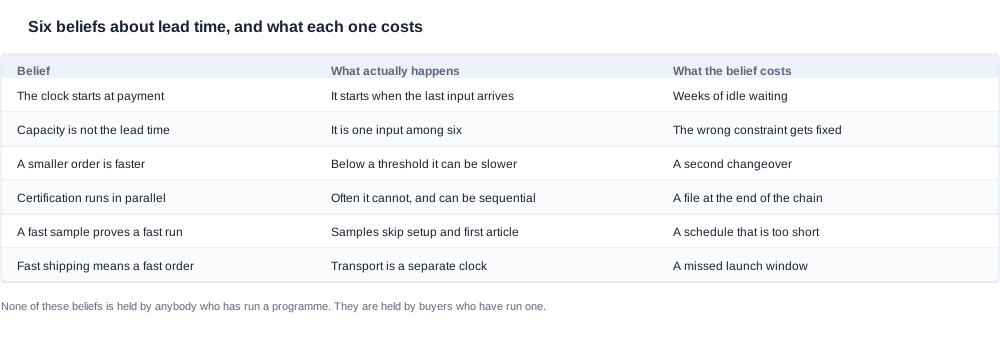
Smart glasses lead time: six beliefs that survive untested
Myth one: the production clock starts when the deposit lands
What the belief says. You place the order, you pay, the factory starts, and everything after that is the supplier's problem. This is the most comfortable belief available to a buyer and the most expensive.
What actually happens. The clock starts when the last input arrives. Artwork approval, the configuration freeze, the firmware sign-off, the compliance evidence, the packaging proof and the label content all sit upstream of the first production slot. A factory working to a schedule during that period is waiting rather than working, and the waiting is recorded as elapsed time.
What it costs. Weeks of idle time, and the particular unpleasantness of a supplier being able to point at a valid reason. The buyer who has paid cannot cancel, and the supplier who is waiting cannot start.
The question that settles it. "What has to be received before the first unit starts, and on what date will you have it?" The answer names the buyer's own work, which is why the belief is uncomfortable.
Myth two: capacity is not the lead time
What the belief says. Factory capacity is a red herring, and what really matters is something else entirely — the buyer's decision-making, the market conditions, the weather of the supply chain.
What actually happens. Capacity is one input among six, and it is rarely the binding one. A factory with idle capacity and a missing component arrives later than a full factory with the component on the shelf. The belief is half right, and the half that is wrong is the half that gets negotiated.
What it costs. A negotiation spent on the factor with the least leverage. Capacity is the one thing a supplier is eager to discuss and often has genuine slack in, so an argument about it can produce a concession that changes nothing about the date.
The question that settles it. "What is the critical path for this order, and which single item constrains it?" A supplier who answers with the line has answered about the wrong part of the schedule. A supplier who answers with a named part and its supplier's commitment date has answered the right one.
Myth three: a smaller order is always faster
What the belief says. A smaller quantity means a shorter queue, so ordering less is the reliable way to buy speed.
What actually happens. Below a threshold, a small order can be slower. It may not batch with other work sharing the same components and the same production slot, so it carries its own setup instead of joining a run. It may travel alone rather than consolidated, which is slower and more expensive. And it may not reach a price tier, which is a cost rather than a schedule but enters the same argument.
What it costs. A changeover that would not have existed, a consignment that travels alone, and a tier that is missed — three effects that all push the other way.
The question that settles it. "Can this quantity be scheduled with an existing run that uses the same components, and will it be shipped consolidated?"
Myth four: certification always runs in parallel
What the belief says. The certification work happens in the background and never touches the schedule, because it is a parallel activity handled by specialists.
What actually happens. Often it cannot. For radio equipment in the European Union the technical file and the declaration of conformity relate to the finished product, and for the General Product Safety Regulation (EU) 2023/988, applicable since 13 December 2024, the manufacturer identification and the responsible economic operator have to be settled before labelling. A factory quoting a date that assumes certification is already complete is quoting against a document nobody has seen.
What it costs. The entire documentation route placed at the end of the chain, where it has no float and no owner.
The question that settles it. "What does the certification route start from, and can it begin before the goods are finished?" If the answer is that it starts from the artwork approval, the route can run in parallel. If it starts from the finished goods, the date is longer than the quotation.
Myth five: a fast sample proves a fast production run
What the belief says. The supplier built a sample in five days, so the production run will be quick.
What actually happens. Samples are built individually or in very small batches and skip most of the setup cost. The first production run carries the tooling, the first-article approval and the line setup that a sample never touched. The sample's speed is evidence about responsiveness and about nothing else.
What it costs. A schedule built on a number that describes a different activity, and a first production run that is longer than the plan by the length of the first-article cycle.
The question that settles it. "Was the sample built on the production line or outside it, and what does the first production run add that the sample did not?"
Myth six: fast shipping means a fast order
What the belief says. The order is quick because the shipping is quick, and the transport time is the whole story.
What actually happens. Transport is a separate clock with its own rules, and it is the part nobody plans. A lithium-powered product has to satisfy dangerous-goods transport rules before it moves, so the test summary and the packaging arrangement have to exist in advance. Sea freight from the Chinese mainland to a European port is measured in weeks before anyone opens a carton, and a consignment that misses a consolidation window waits for the next one.
What it costs. A sailing interval rather than a delay, and the particular frustration of a programme that is finished, correct and sitting in a warehouse.
The question that settles it. "What mode is this consignment moving on, when is the booking cut-off, and is it consolidated?"

The belief that is usually right, and the one that is usually wrong
Not everything about lead time is folklore, and a buyer who treats every claim as suspect ends up distrusting the true ones as well.
The belief that holds. A factory that has run your configuration before will usually be faster than one running it for the first time, because the routing, the jigs, the firmware branch and the known quirks exist. That is a real advantage and it is worth paying for — and it is an advantage measured in days, not weeks, and it does not remove any of the six constraints above. It is a second-order effect being mistaken for a primary one.
The belief that does not hold. That the supplier who answers fastest will deliver fastest. Response speed measures the sender's communication habits and their current workload, neither of which predicts a production run in a factory the buyer has never seen. It correlates with nothing in particular, and treating it as a signal is how a buyer ends up with the wrong supplier on a schedule that had to be met.
The useful discipline is neither scepticism nor credulity. It is asking for the constraint that is binding, in writing, on each date you were given.
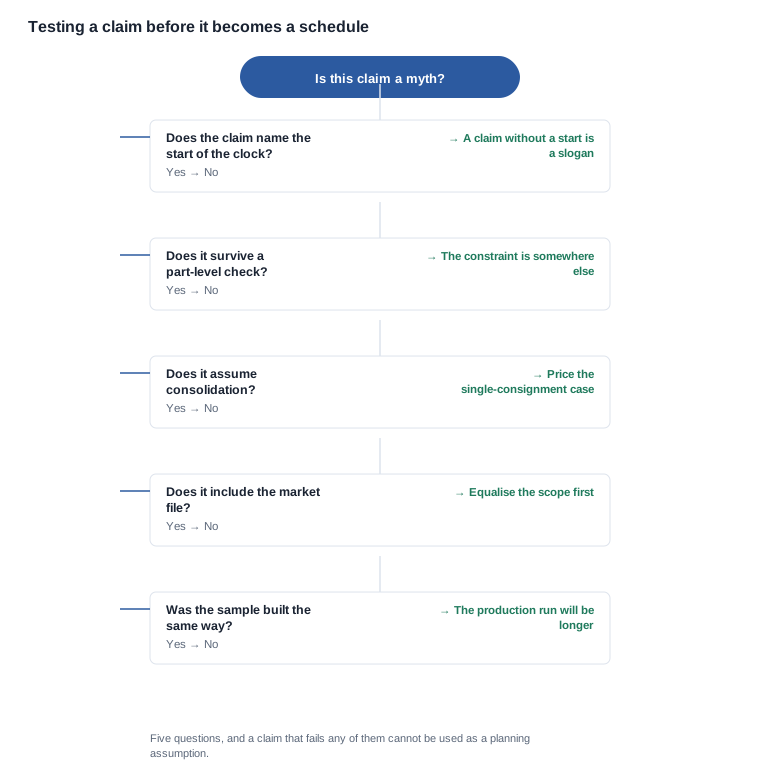

What a myth costs you in a negotiation
The case below is an invented scenario used to reason through the arithmetic. No customer, order or shipment is described; the model, the quantity, the durations and the destination are assumed.
The scenario. A first order for a camera model into a European market, with a launch requirement ten weeks after the order date. The buyer is negotiating against two quotations, both of which have been checked against a checklist and both of which look reasonable on the page.
The first myth costs twelve days. The buyer believed the clock started at payment. Artwork approval sat on the buyer's own calendar for twelve days after the order, and the production slot was held rather than used. Neither supplier caused the delay and neither could be asked to, because the contract was silent on the start condition.
The second myth costs a fortnight of negotiation. The buyer argued about capacity for two weeks while the binding constraint was a component with a four-week supplier commitment. The capacity concession that eventually arrived was worth nothing to the date, and the component was still the constraint when it arrived.
The third myth costs a sailing interval. A second order was reduced to a smaller quantity to "get moving faster". It could not batch with other work sharing the same components, it travelled alone, and it missed the consolidation window. The smaller order arrived later than the larger one would have.
The fourth myth costs the whole documentation route. The schedule assumed certification ran in parallel. It could not, because the label depended on an importer decision that had not been made, and the route started from the artwork approval in any case. The documentation route was therefore sequential with production rather than beside it.
The fifth myth costs the first-article cycle. A fast sample had produced confidence in a five-week production run, and the first run carried the setup and the first-article approval that the sample skipped.
The sixth myth costs a month of calendar. The consignment was ready and the shipping was assumed to be a formality. The booking cut-off had passed during the first-article cycle, so the goods waited for the next sailing.
The outcome. Six beliefs, roughly eight weeks of delay between them, and a programme that was never once at risk of being badly manufactured. Every one of the six delays was structural, and every one of them was visible before the order.
The two myths that are usually right, in the situations where they are
Two of the six beliefs are more defensible than the others, and a buyer who applies the corrective question without the context will over-correct. That is a real cost, so it is worth being precise about the exceptions.
Myth two — capacity — is right in one situation: a genuinely large order. When a programme is large enough to occupy a production run on its own, the line does become the constraint, because there is no smaller unit of work to schedule it into. The distinction is the order's size relative to a run, not the order's size in absolute terms, and the way to find out is to ask whether the quantity is a full run or a part of one.
Myth five — samples — is right in one situation too: a repeat configuration. If the factory has built the same configuration before, the sample no longer carries the full setup, and its speed is a genuine indicator for the production run because the first-article cycle has already been paid for. For a first order of a new configuration, the belief is false.
Both exceptions are decided by the same question — is this the first time this configuration is being built? — which is also a question worth asking for its own sake, because a first run and a repeat run are priced and scheduled differently.
The pattern worth taking from the case
Notice that no delay in that case came from a factory behaving badly. They came from six beliefs that arranged the buyer's own work in the wrong order. That is the general finding, and it is the reason this page exists: in this category the myths are mostly about the buyer's side of the line.
How to clear the six beliefs before the order is signed
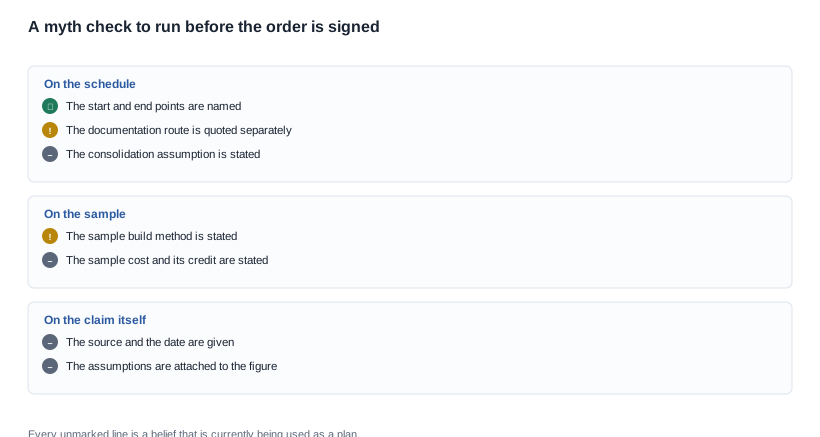
Six questions, asked before the deposit rather than after the delay, settle the whole set.
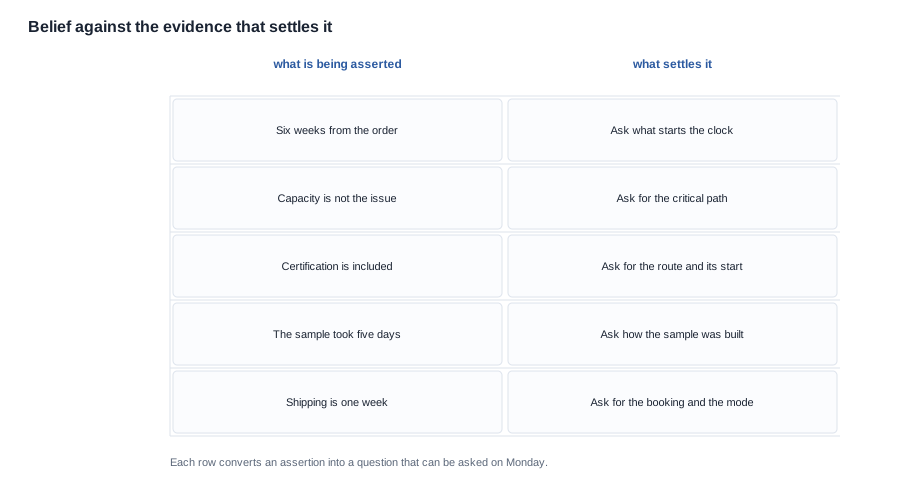
"What has to be received before the first unit starts?" Kills myth one and produces the buyer's own deadlines.
"What is the critical path for this order, and what constrains it?" Kills myth two and identifies the factor worth monitoring weekly.
"Can this quantity be batched with existing work, and will it ship consolidated?" Kills myth three and settles the size decision.
"What does the certification route start from, and can it begin before the goods are finished?" Kills myth four and converts the route into a plan.
"Was the sample built on the line, and what does the first run add?" Kills myth five and prevents a first-run surprise.
"What mode is it moving on, and when is the booking cut-off?" Kills myth six and puts the last week back on the calendar.
Why the questions belong in the enquiry rather than in the negotiation
There is a practical reason to ask all six before placing the order rather than after the delay appears, and it is about what a supplier can still change.
During an enquiry, the configuration, the artwork, the documentation route, the consolidation arrangement and the order quantity are all still open. Every one of the six questions is therefore an input to a decision that has not been made, and the answer changes something. During a negotiation, all of them have been decided and paid for, and the only thing left to negotiate is the consequence — which is exactly the part of the schedule that is hardest to move.
The second reason is commercial. A supplier who receives six precise questions before the order has committed anything will usually answer them precisely, because the answers are what wins the enquiry. A supplier who receives the same six questions during a delay has already had the business, and the answers will be vaguer and the positions harder.
This is also why the myth check belongs on the enquiry document rather than in a mental checklist. The six questions cost a buyer five minutes on the day the enquiry is sent, and they cost weeks when they are asked late.
The two-minute version
For a buyer who does not have time for six questions, the shortest useful version is three: what starts the clock, what constrains the run, and when is the booking cut-off. Those three answer myths one, two and six, which between them account for the largest share of the delay in most programmes.

Where Cynrin stands on lead-time claims
It is worth being precise: we would rather publish less and be quoted accurately than publish a schedule figure we cannot stand behind. A lead time without a configuration, a quantity and a range of dates is not a number, and a buyer who plans against one has been given a slogan.
So, for our own operation: production lead time, sample preparation time, production capacity, daily output and the stage durations behind them are not published in our documentation, and we will not quote one to close a deal. The published material is the specification — the twenty-eight models and their rows, including the charge time for every model, the charging method for the twenty-four where the catalogue states it, the Bluetooth version for the fourteen where it appears, the case capacity for the five models where it is published, and the ingress rating on the two that carry one.
We will also say plainly that one of these beliefs is ours to correct. If a supplier tells a buyer that the schedule starts at payment, the factory is describing a start condition the buyer has not yet met, and it is fairer to name that than to absorb the delay and quote a later date. A supplier who says no to a date nobody has decomposed is considerably more useful than one who says yes.
What we will do is build the schedule backwards from your in-store date, mark which stages are ours and which are yours, and tell you which of the six constraints is currently binding on your configuration. We will also say plainly when a date cannot be met.
The commercial structure of the schedule is set out on the lead time section, the place where a schedule becomes a commitment is at contract terms, the transport constraint behind myth six is at logistics, and the capacity claim behind myth two is at production capacity.
The action to take now. Before the next order, write the six questions on one page and send it with the enquiry. It takes five minutes, and it is the cheapest schedule protection available to a buyer.
Related reading
- Lead time section — the full sequence
- Contract terms — putting the schedule in the agreement
- Logistics — the transport constraint
- Production capacity — what a capacity claim has to include


