

We do not publish a lead time in weeks, and the reason is more useful than the number would have been. A single figure covers nine different drivers, and several of them depend on which model you chose and on whether the documentation for that exact model string already exists. A number that hides all nine is not a commitment — it is a decoy, and it is a decoy that costs more when it is wrong than the weeks it claimed to save.
So this is the decomposition instead, and it is usable on its own whether or not you ever buy from us. The practical method it produces is simple: treat the nine drivers as nine separate items, establish which of them are already closed for your configuration, and close the ones you control before you place the order. What remains is the part of the schedule that genuinely has to be negotiated, and it is a much smaller conversation than the one a single date invites.
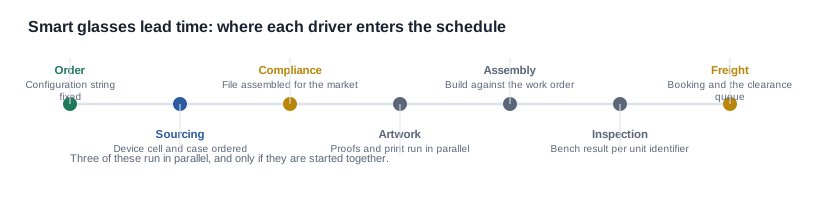
Smart glasses lead time: the order the nine drivers are closed in
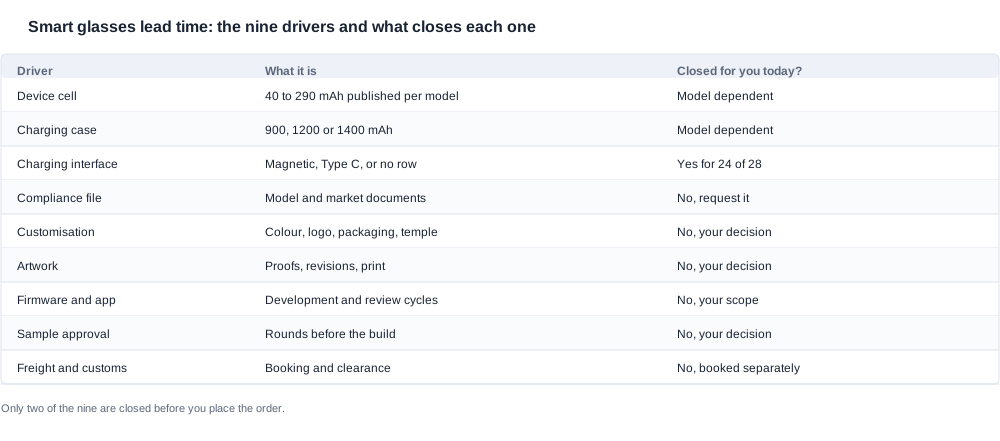
The table is the working version, and the third column is the one to read carefully. Two of the nine drivers are already closed for most configurations before you ask anything, and three are closed only by a decision you make. The remaining four are genuinely the supplier's, and they are the ones worth asking about.
The value of the decomposition is that it changes what you ask. Instead of asking "how long", you ask "is the cell for this model code already in stock, does a compliance file exist for this model string and this destination, how many sample rounds are included, and what does the artwork route require from me". Those are four questions with answerable answers, and the answers are what the schedule is made of.

The two component chains behind every camera model: device cell and case
Driver one — the device cell, in its own supply chain. The frame cell capacities in this range run from 40 mAh in the children's protective models through 55 mAh × 2, 70 mAh, 90 mAh × 2, 100 mAh, 115 mAh and 200 mAh, up to 220, 260, 265 and 290 mAh in the camera range. Two consequences follow, and both of them are scheduling consequences rather than technical ones.
The first is that a model is only as available as its specific cell, not as available as "batteries". A factory with 290 mAh cells in hand cannot start a 220 mAh model, and a buyer who hears "we have cells" has learned nothing at all. The published capacity is the number to ask about, model by model.
The second is that the published run-time band is a lever on the same chain. Every model publishes a run time — the camera models publish 5~8 h, 6~8 h or ~7 h depending on the model — and a run-time band close to the top of its range usually reflects a cell choice that is not the cheapest available for that platform. A buyer who wants a longer published run time has changed the material request, and that is a schedule conversation as much as a specification one.
Driver two — the charging case, which is a second supply chain entirely. The published case capacities are 900 mAh and 1400 mAh for the L2 Utral, 1200 mAh for the MT6's foldable case, and 1400 mAh for the L1 Pro and the CY03, and the CY05. The KY06 and the MT5 are catalogued with a charging case whose capacity is not published. The catalogue publishes no charging-case row at all for the V03 Pro and the V03, and the V06 and the S7, so the case for those four is an item to confirm rather than a line to schedule against.
The practical point is that an order containing case-equipped models is managing two component chains, because the case is sourced and tracked separately from the device cell. A buyer who treats the case as an accessory discovers this at the scheduling meeting rather than at the packing bench, and the discovery usually looks like a delay nobody can explain.
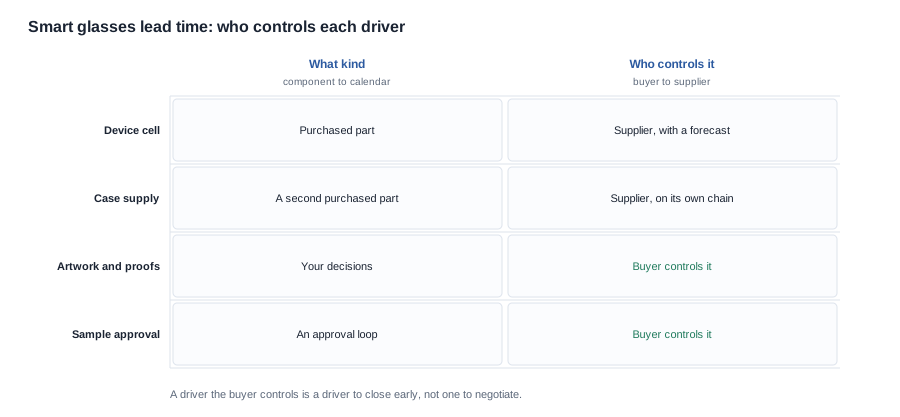
The matrix above is the grouping that matters for planning. The top two rows are purchased parts, and their timing is set by the supplier against a forecast you provide. The bottom two rows are your decisions, and a decision that has not been made is a driver that has not started.
A correction worth stating plainly. The charging interface in this range is published as magnetic charging on seventeen models and Type C on seven, with no charging-method row at all for four camera models — the CY03 and the CY05, and the L1 Pro and the MT6. No model in the range is published as offering both interfaces. If a quotation describes a variant with both, that is a build detail for that order rather than a published feature, and it belongs on the configuration string rather than in the product description.
The compliance file, the longest tail on the schedule and the one buyers omit
Driver three — whether the documentation already exists for your exact model string. This is the driver most often left out of a schedule and the one with the longest tail. A model whose file already exists, and covers the exact model string and the destination market, is a completely different proposition from one where testing, sampling, reporting and review still have to happen. And the file is model-specific: coverage for one SKU is not coverage for its sibling, and coverage for one destination market is not coverage for another.
The position of our own catalogue in this is worth being exact about, because it is commonly assumed to be better than it is. The catalogue has a company-level export certification page, and it has no per-model certification row. The text of the catalogue contains no CE marking, no FCC marking and no RoHS statement at all. We publish no certificate number, no issuing body and no validity date for any model, because the material does not contain them. A buyer planning a schedule from our range should therefore treat this driver as live rather than closed, and should ask for the document set in writing rather than infer it from a catalogue that does not carry it.
That request has a defined shape, and the document structure behind it is at certification verification. For a Bluetooth-equipped device sold into the European Union, the route runs through the Radio Equipment Directive (EU) 2014/53/EU, and the general product safety regulation has applied since 13 December 2024. The framework is not negotiable; the elapsed time attached to it is, and it is the part that belongs in the schedule.
The two things that most often turn this driver into a surprise are worth naming. The first is asking for a summary rather than a document set — a supplier who describes a compliance position in a meeting has not produced evidence, and the elapsed time only becomes visible when the evidence is requested. The second is discovering late that the file is per model string, so a programme that adds a second model after the first has been scheduled has added a documentation workstream rather than a production slot.

Customisation, artwork and firmware: the drivers that run on your decisions
Driver four — customisation. Colour, logo, packaging, temple shape, frame shape and lens options all sit on the customisation list in our material. Which of them trigger a setup, and which are simply a choice from an existing option, depends entirely on the part, so the honest answer to "how much does customisation add" is part by part rather than as a blanket figure. The published options make the distinction concrete: the V03 Pro publishes three colourways and the V06 publishes four, so carrying the V06 in all four is four colourways rather than one, and each colourway is a separate material set.
Driver five — artwork, which starts before anyone thinks about it. Packaging artwork has its own lead time — proofs, revisions, print — and it runs in parallel with component sourcing only if it starts on day one. In practice it is the item that pushes a date, because it depends on decisions you have not yet made. A buyer who supplies artwork late does not shorten the artwork step; the artwork step simply moves to the end and the whole schedule moves with it.
Driver six — firmware or app customisation. Where firmware or application work is in scope, development and review cycles sit on the critical path, and they are a specification item rather than a configuration option. The right way to treat it is to write the scope, name what is being reviewed, and state who signs the result, because an unbounded firmware scope on a fixed delivery date is the most common way a schedule that looked comfortable becomes a schedule that is late.
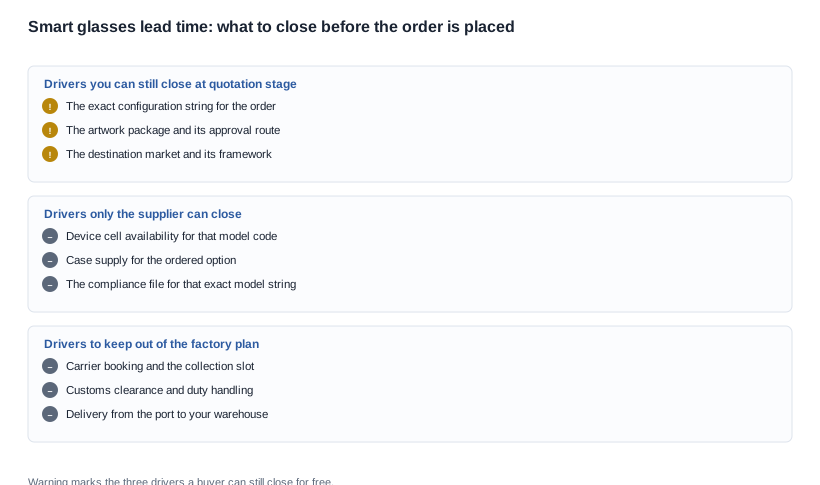
The checklist above is the practical output of the decomposition. The first group is the three drivers you can still close at quotation stage at no cost. The second group is the three that only the supplier can close, and they are the four questions to ask. The third group is the work that belongs outside the factory plan entirely.

Samples, seasonality and freight: the drivers that run on the calendar
Driver seven — the sample approval loop. Buyers budget one sample round. Most need two or three, and the loop is a calendar problem rather than a technical one, because each round has to be scheduled, reviewed and signed before the next one can start. It is also the round that resolves the questions that would otherwise appear mid-production — though it cannot resolve the ones the catalogue does not publish, which is a further reason to settle those in writing before the sample is ordered. The mechanics sit at sample evaluation.
Driver eight — the calendar. Two features of the year reliably consume calendar that a schedule drawn on an empty sheet does not show. The first is the retail build window ahead of the peak season, where components ship weeks before assembly and the demand arrives early. The second is the factory closure period around the Chinese New Year, which removes weeks from the working calendar rather than from the elapsed time between milestones. An order placed for a spring delivery is competing for winter capacity months earlier. The relationship between calendar and capacity is at production capacity.
Driver nine — freight and customs, which are not the factory's. Booking, carrier schedules and clearance queues sit outside the production schedule entirely, and they are frequently folded into "delivery" as though they were part of it. The distinction is worth defending in your own plan: a factory despatch date and a goods-available date are different dates, and the second one is the one your launch depends on. Keep them as separate lines, and keep the clearance queue visible, because a battery-equipped device moving across a border has documentation steps that a non-battery product does not. The detail sits at logistics.
Closing drivers before you order, and what we will quote
The decomposition has a use beyond analysis: three of the nine drivers are yours, and closing them before the order is placed is the cheapest schedule improvement available.
Close the artwork driver first. Artwork depends only on your decisions, it needs no supplier capacity, and it can run in parallel with everything else. A buyer who has proofs approved before the purchase order is raised has removed the single most common cause of a slipped date.
Close the configuration driver second. The number of colourways, the case option and the charging interface decide how many material sets and setups the order contains. Deciding them before the order means the supplier can plan against one configuration rather than discover four.
Close the sample driver third. Agree how many evaluation rounds are included and what triggers another one, before round one starts. The cost of the second round is the cost of the rework plus the unit plus the calendar, and it is entirely avoidable in the negotiation.
The drivers left after that — cell availability, case supply, the documentation for your model string, and the freight — are the ones to ask about. Those four questions are what a lead-time conversation should contain, and a supplier who cannot answer them is telling you something about the schedule they will eventually offer.
The four questions that make a lead-time answer usable
When a buyer asks for a delivery date, the useful answer is a date plus the four statements that make it checkable. Here is the sequence, in the order that produces the fastest useful reply.
- Is the device cell for this exact model code on hand, and is the charging case for the ordered option a separate item on the same schedule? This separates a schedule built from what is in stock from one built from what has to be bought, and it identifies whether the order is managing one component chain or two.
- Does a documentation file exist for this model string and this destination market, and if it exists, does it cover the configuration or only the model? This is the single largest source of schedule variance in the category, and the answer is frequently that the file covers a sibling rather than the ordered configuration.
- How many evaluation rounds are included, and what starts the clock on each one? This converts the sample loop from an assumption into a term, and it is the question that prevents a second round from appearing in the middle of the build.
- What does the artwork route require from us, and by when does it need to arrive to keep the schedule? This is the driver's start date, and it is the one that a buyer controls entirely.
Each of these four has a specific answer, and each of them either shortens the quoted schedule or explains it. A supplier who answers all four in the first round has given you a schedule you can plan against. A supplier who answers none of them has given you a date, and the date will move.
What a lead time never includes
There is a second layer to every quoted date, and it is the layer that buyers most often discover afterwards. It is the set of assumptions the quote is resting on, and it is rarely written down.
What the artwork is. A lead time quoted against a finished artwork package is a different lead time from one quoted against artwork that does not yet exist. The question to ask is what the supplier assumes the artwork to be.
What the destination is. The destination market determines the documentation work, and therefore the compliance driver. A schedule quoted for a domestic destination and applied to an exported one is missing an entire driver.
What the payment and approval steps are. The time between a purchase order and the start of production is not entirely production. It includes the buyer's own internal approval, which is frequently the longest single step in the chain and the one a supplier cannot see.
What the change allowance is. A schedule with no revision allowance assumes that nothing is found. A sample round that finds something is not an exception to the schedule; it is the normal operation of the schedule, and the honest question is how much of it was budgeted.
What "delivery" means. Factory despatch, port departure, clearance and arrival in the warehouse are four dates. A quote that names one of them is a quote about that one only, and treating it as the last of the four is the most common way a launch date slips by a fortnight for reasons that were never in dispute.
The practical response is to ask for the assumptions in the same message as the date. A schedule that states its own assumptions is one you can hold your own plan against. A schedule that does not is a number, and a number is what we decline to publish.
What we will do is quote a lead time as a range with its drivers attached rather than as a single confident number, and tell you which drivers are closed for your order and which are still open. For a first order from our range, the documentation, the artwork and the sample loop are almost always open, and that is normal rather than a warning sign. It is also why the schedule we agree with you will look longer than a schedule quoted by a supplier who already holds the documentation for that exact model string.
What we will not do is publish a lead time in weeks on this site, or quote one without naming the drivers behind it. A lead time that does not say which of the nine drivers it assumes is a number the buyer cannot use, and a number that cannot be used is worse than no number at all.
It is worth keeping the trade-off in view while you read the nine drivers, because a shorter schedule is not automatically a better one. Compressing the artwork window usually means compressing the review that catches a labelling error before print, and compressing the sample window usually means accepting a configuration that was never measured. The schedule a buyer should be optimising is the one where every driver has been closed deliberately rather than closed by default, and in most programmes that schedule is longer on paper and shorter in practice than the single-date quote it replaces.
The models involved are on the AI camera glasses page, and the wider scheduling background sits under lead time.
Send us your model shortlist, destination and required delivery date, and we will tell you which of these nine drivers are open for your order before we give you a number.


