

Microphone quality is usually asked as one question — how good is it — and the answer is always the same: it cannot be measured from a datasheet. This range publishes no microphone specification for any model. No pickup distance, no frequency response, no capsule size, no noise-handling description, no sampling rate. What the catalogue does publish is the acoustic technique names — open-ear acoustic structure, directional audio, intelligent noise reduction — and the electrical rows that describe the power budget.
So the useful thing to do with the question is to turn it into a specific test. That is the whole method behind smart glasses microphone quality smart glasses faq: five questions that procurement actually asks, and the test that converts each one from an opinion into a record. A buyer who runs the five tests has a defensible position in the purchase order. A buyer who does not has the supplier's demonstration, which is a record of the supplier's confidence rather than of the product.
Smart glasses microphone quality: the five questions procurement keeps asking
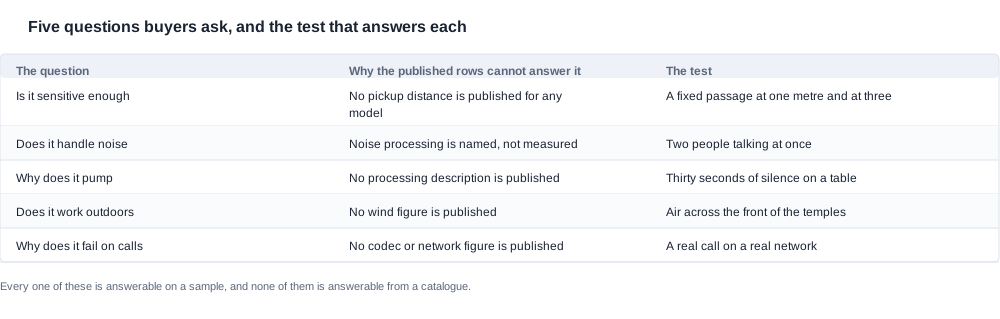
The five questions below are the ones that arrive from sourcing teams, product managers and channel buyers, in roughly this order. Each one is answered twice here: once with why the published rows cannot answer it, and once with the test that can.
| The question | Why the published rows cannot answer it | The test |
|---|---|---|
| Is it sensitive enough | No pickup distance is published for any model | A fixed passage at one metre and at three |
| Does it handle noise | The noise handling is named, not measured | Two people talking at once |
| Why does it pump | No processing description is published | Thirty seconds of silence on a table |
| Does it work outdoors | No wind figure is published | Air across the front of the temples |
| Why does it fail on calls | No codec or network figure is published | A real call on a real network |
The pattern across the five is worth naming, because it is the reason the whole subject is a testing problem rather than a sourcing problem. In every case the published rows are not wrong and they are not hiding anything. They are simply not about the question being asked. A Bluetooth version and a charge time are real, per-model and useful — they are simply silent on acoustic capability.
What the published rows answer, and what they leave to the bench
The electrical rows in this range are specific and they do settle several questions a buyer has to answer anyway. The K01 and the K02 publish two 90 mAh cells, roughly eight hours of rated use, magnetic charging and Bluetooth 5.3. The D11 and the D12 publish a single 100 mAh cell, roughly seven hours, Type-C charging and Bluetooth 5.4. The LC-105-1 and the LC-105-2 publish two 55 mAh cells, roughly eight hours and magnetic charging. The G07 and the YK12 publish two 55 mAh cells and a shorter rated window of roughly six hours, with the G07 noted for a slim and detachable temple and the YK12 for a surround sound slim temple. The YKC02 publishes two 70 mAh cells, roughly eight hours and magnetic charging. The D17 publishes 115 mAh, roughly seven hours and about an hour to charge on Type-C. The ZH12 publishes 100 mAh, roughly eight hours and about an hour to charge on Type-C.
Those rows answer the power questions: which platform can hold a call for a working shift, which platform can be recharged during a break, which platform will fit an existing cable, and which platform carries the newest radio generation. That is a genuine shortlisting criterion and it is available before any sample is despatched.
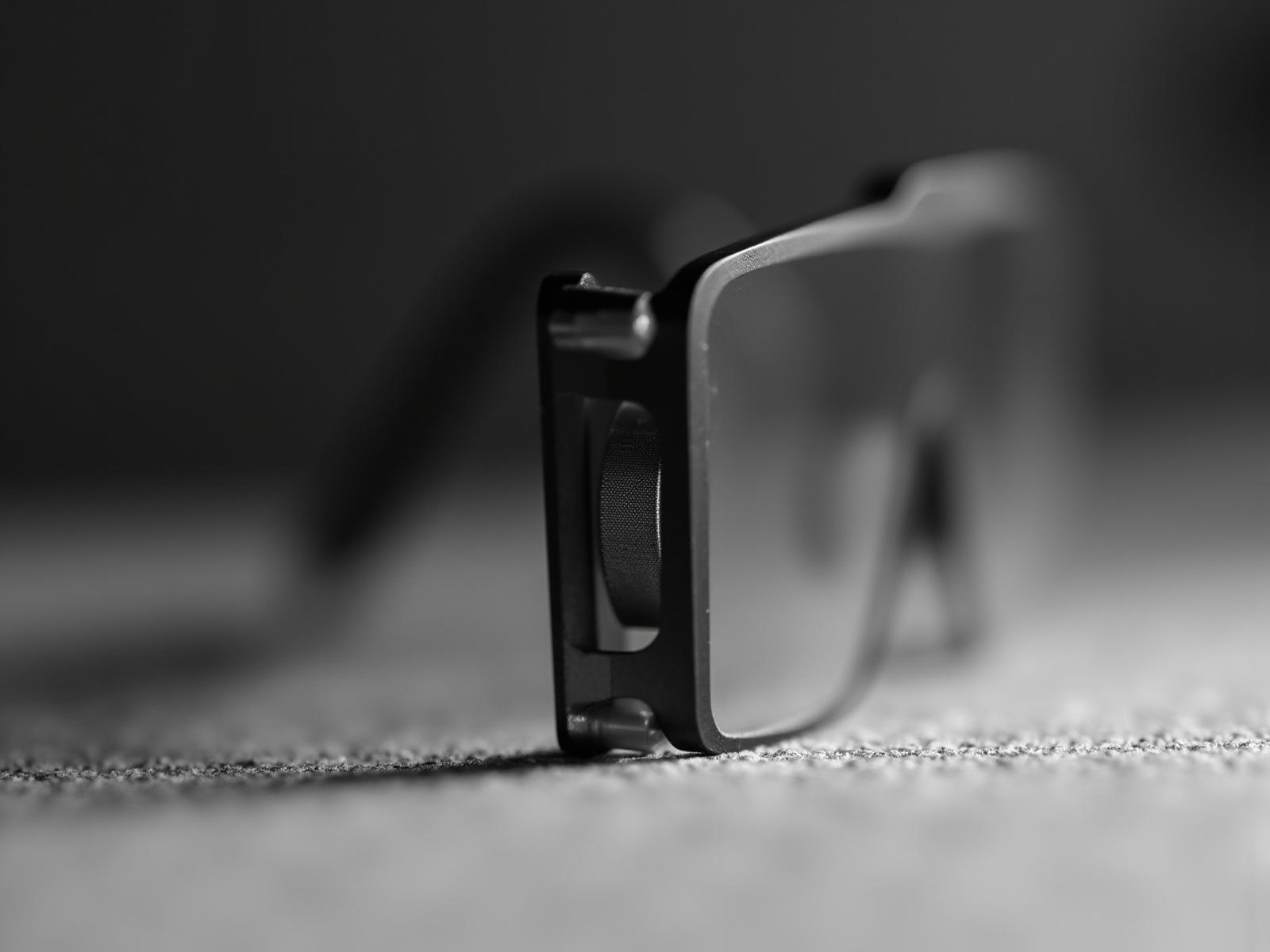
What they leave to the bench is everything acoustic. No microphone count, no capsule type, no sampling rate, no sensitivity, no signal-to-noise ratio, no frequency response, no pickup distance, no cancellation depth, no beamforming method. The published surface for the voice attributes is electrical and structural, and a buyer who wants an acoustic answer has to generate one.
There is one more published row that matters to a channel buyer and is easy to miss. The IP54 marking appears on the V06 and the S7, as a catalogue annotation, and on no other model. For an audio platform with an open sound port, that absence is a structural fact about the design rather than a gap in the paperwork, and it is relevant whenever a buyer is weighing an outdoor channel.
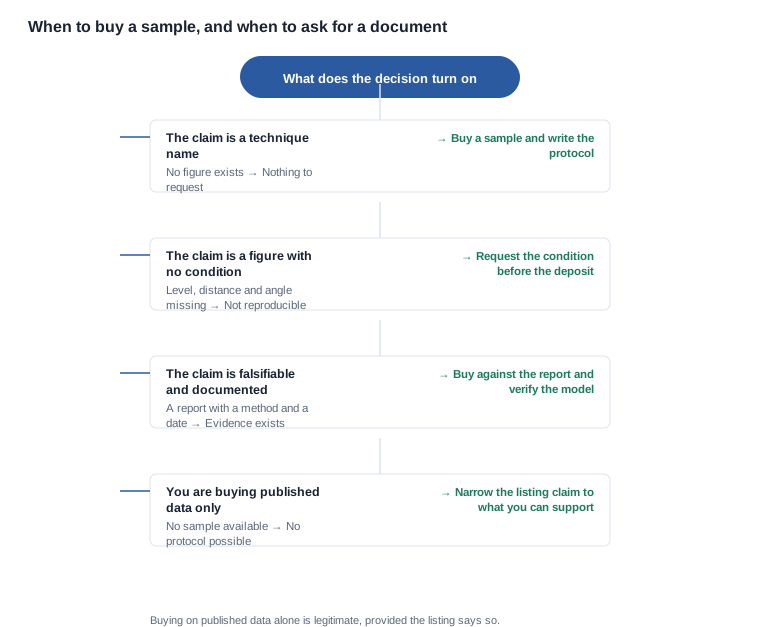
The two questions to ask before you buy a sample at all
Two questions decide whether a sample is even worth ordering, and both are answerable from a quotation.
Is the acoustic claim a technique name or a figure? If it is a technique name, there is no document to request, and the only route to an answer is a test. If it is a figure, there is a document to request, and the buyer should request it before spending on a sample.
Does the figure carry its condition? A figure without a level, a distance, an angle and a pass criterion cannot be reproduced. It is not better than a technique name, and it should not be treated as evidence.
Sensitivity, noise and the pumping question, with a test for each
Is it sensitive enough
This is the question a buyer asks first, and the published answer is that no supplier in this category publishes it usefully. A pickup distance quoted without an input level is not a measurement.
The test: play a fixed passage from a speaker at one metre, then at three, and record from the position the unit would occupy in use. One metre passes on almost anything; three is roughly conversational distance in a real call, and it is where sensitivity differences between platforms appear. Use the same script and the same recording level every time, because the comparison is between units rather than between absolute values.
What the test produces is a comparative statement: unit A holds the passage at three metres and unit B does not. That is enough for a shortlist, and it is enough to write into an incoming inspection criterion.
Does it handle noise
Two people speaking at once is the honest test of directional capture, and a single-capsule design cannot pass it. Ask the supplier what the design is rather than whether there is intelligent noise reduction, because a geometry-based approach has physical requirements that post-processing cannot substitute for, and single-capsule processing has inherent limits.
If the answer is that the product has one capsule, the improvement available is partial, and expectations should be set accordingly — for the listing as well as for the customer.
Why does it pump
This is the signature of aggressive noise handling, and it is audible mainly in quiet conditions: a quiet office, a vehicle at night. Nobody tests there, which is why it arrives as a field complaint rather than as a review comment.
The test is thirty seconds of silence on a table. If a sample has never been recorded in silence, this failure mode has never been observed. It is also the cheapest test in the set and the one most likely to change a sourcing decision, because a pumping unit is a unit that will generate complaints that nobody can reproduce.
Outdoor use, call failures and the recording you have to keep
Wind is the standard outdoor failure, and it is the one a buyer should treat as a hardware constraint rather than a refinement. A temple-mounted capsule sits directly in the airflow, and wind noise is low-frequency, which is the range a basic filter handles worst. Software reduces it; it cannot remove it, because the acoustic information is contaminated before the capsule receives it.
The test is air across the front of the glasses — a desk fan, or movement through a corridor at speed. If the product will be sold into an outdoor channel, this is a gating test rather than a refinement, and it should be gated before the sample is accepted.
It works in testing but not on calls
Make an actual call on a real network. A loopback test skips codec behaviour and packet loss entirely, and those are common causes of a wearable that sounds acceptable in testing and unusable in practice.
This is the single most valuable test in the set, and the one most often skipped, because it takes ten minutes and a colleague at the other end. It is also the test that most often exonerates the product and redirects the investigation to the carrier, the platform or the account configuration, which is a cheaper outcome than a platform change.

The order that makes the session produce comparable records
A first sample session should run as a sequence, not as an exploration. Fix the script, the distance and the angle, and write them down. Record the passage at one metre, then at three. Record thirty seconds of silence with the unit on a table. Place two people in the same room talking at once. Make a real call on a real network, and keep it. Then repeat the whole set on a second unit from the same batch.
The repetition at the end is not optional. The variation between units is often larger than the variation between suppliers, and a single unit tells you that a platform can work rather than that it does work. A buyer who has tested one unit has a result; a buyer who has tested two has a tolerance.
What each test looks like when it fails, and what that failure tells you
A test is only useful if the buyer knows what each failure mode means, because a failed test is not a verdict on the product — it is a pointer to the next question.
The passage fails at one metre. The capture path is not working, or the unit is not oriented as it will be in use, or the recording level is wrong. This is a setup failure before it is a product failure, and it should be checked before any other result is believed.
The passage fails at three metres but holds at one. The sensitivity margin is smaller than the channel requires. The decision is a scoping one: keep the platform and narrow the use, or move to a platform with a different geometry. This is a good result to get, because it is specific.
Two people talking at once produces both voices with equal clarity. The directional arrangement is not doing what the technique name implies, or the arrangement is single-capsule processing. The next question is about the mechanism, because the two have different upgrade paths.
Silence pumps, gates or produces periodic clicking. The noise handling is too aggressive for quiet conditions. This is the fault most likely to be invisible to a customer in a noisy street and most likely to be reported by a customer in a quiet office, and it is a firmware-level fault in the majority of cases.
Wind produces a low rumble or a loss of the voice outdoors. The wind path is a hardware constraint. The next question is about the windscreen, the port geometry and the capsule position relative to the airflow, and all three are tooling.
The call fails and the local recording holds. The capture path is doing its job and the problem is in the codec, the network or the platform. An upgrade to the glasses will not fix it, and a buyer who has run this test has saved the cost of finding that out later.
Recording these outcomes is what turns a test session into a diagnosis. The five failure modes above are also the five branches of the escalation decision, and a buyer who has a record of which branch a failure falls into can negotiate with a supplier about a remedy rather than about a general dissatisfaction.
Comparing two platforms on the same five tests
A buyer shortlisting two suppliers wants a comparison, and the comparison is only valid if both platforms were measured under the same conditions on the same day with the same script. This is the part that goes wrong in practice, because the two samples rarely arrive together and a busy buying team runs each test whenever it has the unit in hand.
Three rules protect the comparison. Same day if at all possible, because a room, a noise floor and a network route can all change across a week, and a change in any of them is indistinguishable from a change in the product. Same script, same speaker, same recording level, written on the protocol sheet each time. Same judgement rule, applied to the far end's ability to repeat the phrase rather than to the sound quality, because intelligibility is the thing the channel depends on and it is less subjective than audio quality.
The output should be a small table with five rows — one per test — and two columns, one per platform, plus a note on the batch each sample came from. That table is the artefact a buying committee can actually use, and it is also the artefact that can be attached to an acceptance criterion later.
The honest limit of the comparison is worth stating in the table itself. It compares the two samples, on that day, in that environment, under that script. It does not establish a product property, and it cannot be extended to the production run without the batch tolerance from the second unit. A table that is presented as more than that is how a sourcing decision quietly becomes an assumption.
Turning a test result into an incoming inspection criterion
A recording is not yet a criterion. The step that turns a test into something enforceable is writing down the condition under which the result was obtained and the condition under which the unit is accepted, and then putting both into the purchase order.
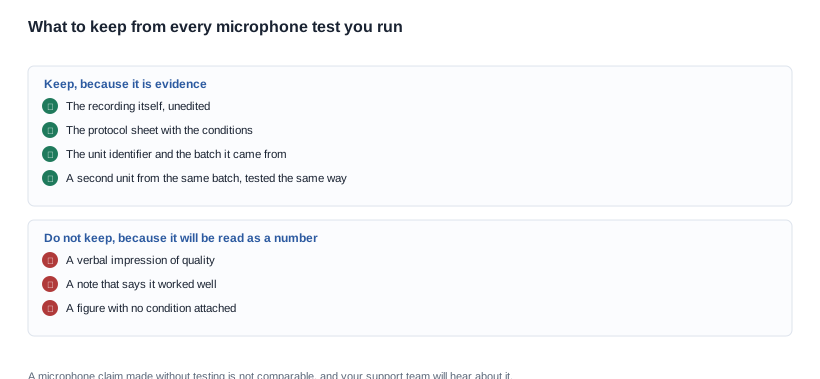
Keep, because it is evidence: the recording itself, unedited; the protocol sheet with the conditions; the unit identifier and the batch it came from; and a second unit from the same batch, tested the same way. These four items are what make a later dispute resolvable.
Do not keep, because it will be read as a number: a verbal impression of quality; a note that the result worked well; and a figure with no condition attached. These three are the most common items in a sourcing file and the least useful, because they look like evidence while carrying none of it.
From result to criterion, in four steps
- Write the condition, not the impression. "At three metres, on the fixed script, the passage is intelligible" is a condition. "Sounds clear" is not.
- State the population the criterion applies to. The unit you tested, the batch it came from, and the tolerance you will accept across the production run.
- Decide who runs the inspection. Incoming inspection at receipt, or a sampling check on a fixed interval, or a full check only on the first lot. The choice has a cost, and it belongs in the agreement rather than in an email.
- Write the failure path. Re-inspection, rework, a stated concession, or rejection of the lot. A criterion with no failure path is not enforced in practice, because nobody has decided what happens when it fails.
A microphone claim made without testing is not comparable, and the support team will be the first to discover that. The related material is at noise control and microphone pickup, the rows worth requesting are at microphone specifications, and the pre-ordering procedure is at how to test before ordering.
Where the five tests stop, and what has to come from documents
The five tests cover the capture path, because that is what a sample in a buyer's own hands can settle. They do not cover the paperwork, and the paperwork is where a voice product is more often stopped than the acoustics.
Certification comes first. A radio-enabled product placed on a market needs the conformity route for that market, and in Europe that route runs through the Radio Equipment Directive (EU) 2014/53/EU, with EN 301 489 as a harmonised standard for the electromagnetic compatibility part of the assessment rather than as the directive itself. A buyer who confuses the directive number with the EMC directive number will produce a technical file with the wrong reference on it, and the error is invisible until someone audits the file.
The transport documentation comes second, and it is not optional for any product with a cell in it: UN38.3 testing and the associated transport documentation, plus the battery information the customer or the carrier will ask for at the point of sale. The electrical rows a buyer holds do not tell the buyer whether that documentation exists for the specific model, and the model matters because the cell configuration differs across the range — two 90 mAh cells on the K01 and the K02, a single 100 mAh cell on the D11 and the D12, two 55 mAh cells on the LC-105-1 and the LC-105-2 and on the G07 and the YK12, and two 70 mAh cells on the YKC02.
The third document is the declaration of conformity itself, and it needs a model identifier. This is the point at which a buyer discovers whether the platform they are buying is a properly identified product with a technical file behind it or a family of configurations that have never been formally designated. It is also the point at which the acoustic question resurfaces in a different form: a technical file can name the acoustic technique, but it cannot create a measurement that does not exist.
None of these three documents can be substituted by a good test result. A buyer who has a beautiful five-test record and no conformity file has a product that cannot be shipped into the market they were aiming at.
What we will not put in writing about our own microphone
It is worth being precise: we publish the rows we have and mark the rest as not published. For the voice attributes of this range, that means the cell configuration, the rated runtime, the Bluetooth version, the charge time, the charging interface and the acoustic technique names — open-ear acoustic structure, directional audio, intelligent noise reduction. It means no pickup distance, no frequency response, no capsule type, no noise-handling description, no sampling rate and no third-party acoustic report.
We will not quote a figure we did not produce, and we will not offer our measurement in place of a supplier's when the protocol is unknown. Two results produced under different protocols are not two results; they are two unrelated observations, and a buyer who treats them as comparable has learned nothing.
What we will do is run the same five tests alongside a buyer's own team, on the buyer's samples, under the buyer's protocol, and report what we hear — including where the result is worse than the expectation. That is a smaller offer than a specification, and it is the only offer we can make honestly on this attribute.
If you send samples, we will run these five tests with you and report what we hear. Give us the platform, the environments your customers call from, and the pass condition you would like to apply, and we will tell you which of the five questions your data can already answer and which one needs a protocol written before the test rather than after it.
Related reading
- noise control and microphone pickup
- microphone specifications to request
- how to test before ordering
Send samples and we will run the same five tests with you and report what we hear.


