

Smart glasses microphone quality: why a specification must be written first
Why the catalogue is silent, and what a buyer does about it
Our catalogue publishes no microphone specification at all, and that is the most useful thing this article can tell a buyer who has been comparing microphone claims across three suppliers. There is no array topology, no channel count, no codec, no sample rate, no signal-to-noise figure, no beamforming claim and no echo-handling row anywhere in the published data. That silence is not a gap to be filled with a typical figure from the industry, because a typical figure is exactly the kind of number that produces a product which sounds excellent in a quiet demonstration room and unusable on a city street. The only lever a buyer has is a measurement protocol written before the sample order, and a microphone is not a component with a performance so much as a behaviour in a scenario. Write the scenario first — a call in a moving car, a voice command on a pavement, a call in a quiet office — and then require the supplier to show the behaviour in that scenario. If the supplier answers with a number and no scenario, the number describes a laboratory condition your customer will never be in.
The three enquiries that arrive with a microphone question
The reader is a brand-side product owner, a channel buyer comparing two quotations, or an engineering lead who has been handed a microphone complaint from the field and has to work out whether the product or the expectation was wrong. The situations are more specific than they look.
The first is a quotation comparison that has stalled. Two suppliers quote the same product with the same cell, the same interface and the same price, and the buyer has to pick one. The microphone is usually the tiebreaker, because it is the component the buyer can hear on a sample and because it is the one nobody has written down. The second is a new claim entering the listing copy. Somebody wants to write "crystal clear calls" or "noise cancelling" on the product page, and nobody in the business can say which measurement supports it. The third is a programme with a corporate or carrier buyer in the mix, where the purchasing organisation has a procurement questionnaire that asks for the audio path, the data handling and the change control, and where an unanswered questionnaire section delays the order by weeks.
The fear underneath all three is specific and it is not the unit price. It is a first shipment where the audio behaves differently from the approved sample, because the supplier changed a firmware release or a component. It is a marketplace listing that carries a claim nobody can evidence, discovered during a compliance review rather than during a sales call. It is a corporate procurement team that reads a data sheet with no microphone row and concludes that the vendor cannot describe its own product, which is a credibility cost that has nothing to do with the engineering.
Where you sit in the chain decides what you can actually control. A brand owner controls the app, the firmware release and the claim wording, so the microphone behaviour is something they can at least govern. A channel buyer buying a finished SKU controls only what goes into the purchase order, which means the acceptance criteria have to be written into the order rather than requested afterwards. A distributor who carries several brands has to solve the firmware pinning problem across every SKU it holds, because an unpinned firmware release is a change-control problem multiplied by the size of the range.
The audio rows we publish, and the microphone rows we do not
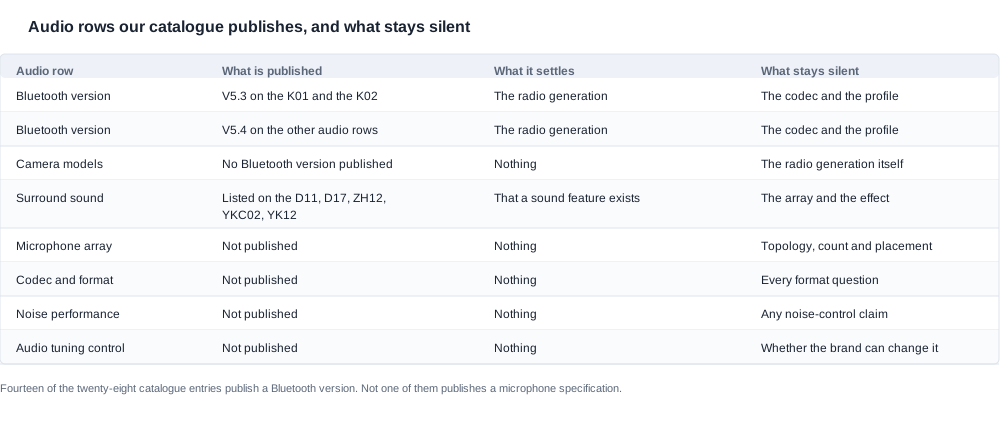
It is worth setting out precisely what exists, so that the open rows can be requested rather than assumed. The published audio data across the range is thin and it is thin in a specific direction: the radio generation is published, and the microphone is not published at all.
Fourteen of the twenty-eight catalogue entries publish a Bluetooth version. The K01 and the K02 are listed at V5.3; the AR glasses entry, the A07, the D11, the LC-105-1, the D12, the G07, the LC-105-2, the YK12, the YKC02, the D17, the ZH12 and the dedicated electrochromic entry are listed at V5.4. The remaining fourteen entries publish no Bluetooth version at all, and that set includes all eleven camera models, both children's protection models and the bone conduction entry. This matters for microphone work in one specific way: a Bluetooth generation is a radio fact, and it tells you nothing about the audio that the radio carries.
Five models carry a published surround sound row: the D11 and the YK12 in the audio family, and the YKC02, the D17 and the ZH12 among the sport models. What the row establishes is that a sound feature exists on that model. It does not establish how many channels the feature uses, whether the feature is spatial rendering or multi-driver playback, whether it applies to calls or only to playback, or how it behaves when the platform negotiates a call with a handset that supports something else. A feature name on a catalogue row is a category label, and a buyer who treats it as a specification is reading more into it than the catalogue says.
The microphone itself is absent from every row in the range. There is no published microphone count, no placement, no array type, no beamforming statement, no noise figure, no codec row, no sample rate, no echo or wind handling, and no statement about whether the brand can adjust the audio tuning. Our front page names directional audio, noise reduction and high-definition imaging as company-level technology capabilities, which is a statement about what the engineering organisation works on. It is not a per-model row, and it cannot be used to infer that any particular model in the range carries a given array.

That absence changes what a buyer should do. With a published row, a buyer compares numbers. With an unpublished row, a buyer has to create the measurement, because no supplier figure will be comparable to anything and because the act of writing the measurement down is what forces the supplier to answer.
One warning belongs here. Even once a supplier publishes a microphone figure, the figures will not be directly comparable between suppliers, and the reason is almost always the measurement rather than the product. A signal-to-noise figure measured with a fixed source at a fixed distance in an anechoic chamber is not comparable with one measured in a reverberant room, and neither is comparable with a figure that already includes the platform's voice processing. The threshold to hold is simple: a figure with a source, a distance, an environment, a processing state and a metric name. A figure without those is a marketing number, and it should be removed from the comparison sheet rather than propagated into it.
Nine questions that turn a microphone answer into a number
The order below is deliberate. The early questions fix the scenario, and the later ones only become answerable once the scenario is fixed.
- How many microphones does the product contain, and where is each one mounted relative to the mouth?
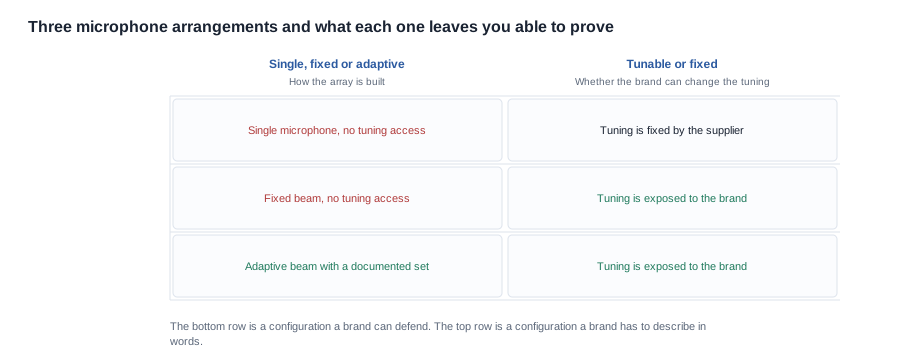
- Is the arrangement a single microphone, a fixed beam, or an adaptive array, and is that stated as a configuration rather than a marketing term?
- What codec and profile does the platform negotiate, and what is the default when both devices support more than one?
- Does the supplier publish a signal-to-noise figure, and under what source, distance, environment and processing state was it measured?
- Is there a voice-activity detector, and does the microphone stay open while the product is idle, or does it close when no call is active?
- What can the brand change in the audio path, and does each change require a firmware release from the supplier?
- Can the supplier change the microphone component or the array layout without notifying the brand in advance?
- Does a call run on the device itself, through a companion application, or through both, and what happens to the audio stream in each case?
- What are the data obligations that sit with the brand if the audio path runs through a companion application, and where does the factory's responsibility end?
Question six is the one that determines whether the buyer has a product or a black box. A brand that can adjust the microphone gain, the beam weights or the noise profile can adapt the product to a channel. A brand that cannot has to accept whatever the supplier's firmware does, and the only lever left is a change of supplier, which is an expensive answer.
Question seven is the change-control question, and it should be asked in writing before the sample order rather than discovered at the first shipment. A microphone substitution is invisible to a buyer who is not listening for it, because the product still works and still sounds acceptable. The defence is a clause, and the clause is cheap at the beginning of a programme and awkward at the end of one.
Question nine is where a lot of smart-glasses programmes discover that they have a software obligation they had not budgeted for. The hardware boundary is real and it is clean: the factory is responsible for the microphone, the signal path and the firmware that controls it. What happens to the audio after it leaves the device is the brand's responsibility and, in some markets, the software provider's. Our medical boundary page sets out the general way we handle these boundary questions, and the same discipline applies to data: establish where the responsibility ends before the listing copy promises anything about it.

A microphone test protocol that survives the field
Microphone verification is the part of the process that most buyers delegate to a demonstration unit, and a demonstration unit tells you almost nothing, because it has usually been tuned, adjusted and stood in a quiet room. The protocol below is designed so that each step produces a record that the next step can be judged against.
Step one: write the three scenarios before the sample arrives. A scenario is a combination of environment, source, distance and task, and it has to be specific enough that two people would run it the same way. A call in a moving car with the phone in a cup holder, a voice command on a pavement with traffic behind it, a call in a quiet office with a desk between the two parties. The number three is not a rule; it is the number of distinct environments your channel actually sells into. Writing them down is the step that converts an opinion about sound into a test.
Step two: build a repeatable rig, and record through a reference recorder rather than through the product. A fixed source at a fixed distance, a fixed noise source at a stated level, and a reference recorder positioned in the same place as the product's microphone. The reference recorder matters because it converts the comparison into a measurement: without it you are comparing two pieces of equipment on two different days, and you have no way to know whether the difference came from the product or from the room. This is the same method used across our bluetooth connectivity testing, and the samples process exists to make this possible at the point where a configuration is being approved rather than after launch.
Step three: run a live call on at least two real networks. A laboratory recording tells you what the device does with a clean input. A live call tells you what happens after the codec negotiation, after the platform's own voice processing, and after the far end's processing. Two networks is the minimum, because the negotiation result can differ between operators, and the difference between the two is where most of the surprising behaviour lives.
Step four: record the firmware and application versions that were tested, and pin them. Ask for the firmware version on the sample, and write it into the purchase order as the approved version. A supplier that ships a firmware update that changes the audio tuning is behaving normally; what is not acceptable is a supplier that changes the tuning without a change notice. The bluetooth audio glasses range is where the model families sit, and the version that was approved has to travel with the order.
Step five: check the change-control route, and the last date on which a component change can be made. A programme that launches in four months has a change window, and that window is a negotiable number that is far more valuable than a small unit price concession. Ask for it in writing.
Step six: write the scenarios and the acceptance criteria into the order. The three scenarios, the measurement method, the firmware version, and the pass condition for each. Without a written pass condition, a sample that fails is a discussion; with one, it is a rejection.
The microphone failures that only appear after launch
The demonstration that happened in a quiet room. The symptom is a set of field complaints that describe interference and a caller who cannot be understood. The root cause is that the evaluation was made in a controlled environment, which is the one environment a customer never uses. The control is the scenario protocol, written before the sample, and it costs nothing but a sentence in the purchase order.
The firmware release that changed the tuning. The symptom is a batch of units that sound different from the units already in the field, with no change to the hardware and no change to the order. The root cause is a firmware update the brand was not told about. The control is a change-notice clause covering the firmware, and a pinned version on the order.
The component that was substituted after approval. The symptom is a gradual drift in call performance across a production run. The root cause is a change of microphone supplier or a second source activated for supply reasons. The control is the same clause, extended to components, with a sample-level verification at the start of each production run rather than only at first article.
The call that failed because of the codec and not the radio. The symptom is a compatibility complaint from a specific handset or a specific network rather than a general quality complaint. The root cause is that the platform negotiated a codec that the far end handles poorly, and that nobody tested across enough combinations. The control is a matrix of networks and handsets in the test plan, and a stated default codec in the specification.
The voice feature that needs a network and failed in a lift. The symptom is a feature that works in the office and fails in the places the product was supposed to be useful. The root cause is that an offline-capable assumption was never stated. The control is to require the offline behaviour of every voice feature to be described in writing, because a feature that depends on a network is a network feature, and it should be described as one in the listing.
The listing claim that nobody could evidence. The symptom is a compliance review asking which measurement supports a phrase in the product copy. The root cause is that the claim was written for the channel rather than from a result. The control is to keep a claim register in which every audio phrase in the listing is tied to a scenario result, and to delete the phrases that are not.
Nothing here asks for an unusual factory, and none of these points is a reason to look for a different supplier. Each one is a line in the order or a clause in the agreement, and each one is cheaper to write in week one than to correct in month four.
What is negotiable on a microphone, and what is fixed
A microphone is a different kind of cost from a mould. It does not create tooling, it does not change the frame, and it does not usually change the packaging. It changes the electronic assembly, the firmware and, in some cases, the printed circuit board layout, and the second and third of those carry a lead time of their own. The commercial consequence is that a microphone change is usually cheaper than a frame change and just as consequential for the configuration, because the configuration string, the technical file and the approved sample all move with it.
What moves in a negotiation is worth naming. The tuning parameter set is negotiable, and a brand that has it can defend the product in a channel that another brand cannot. The firmware release cadence and the advance notice period are negotiable and are worth more than a unit price concession, because a pinned version with a change notice is a stable product. The sample quantity and the engineering support time during evaluation are negotiable and are often the cheapest way to shorten a programme. The change window for component and firmware changes is negotiable, and it should be tied to the launch date rather than to the order date.
What does not move is equally worth naming. The array topology is a hardware and firmware commitment, and a change is a new configuration rather than a setting. The codec support is a property of the platform and the licence position, and it is not negotiated per order. The component itself is a supply decision, not a commercial variable, which is exactly why the change-notice clause is the thing to insist on rather than a lower price. Certification and conformity work is fixed per product family and sits in a queue at the test laboratory, and pressing on it produces a longer schedule rather than a shorter one.
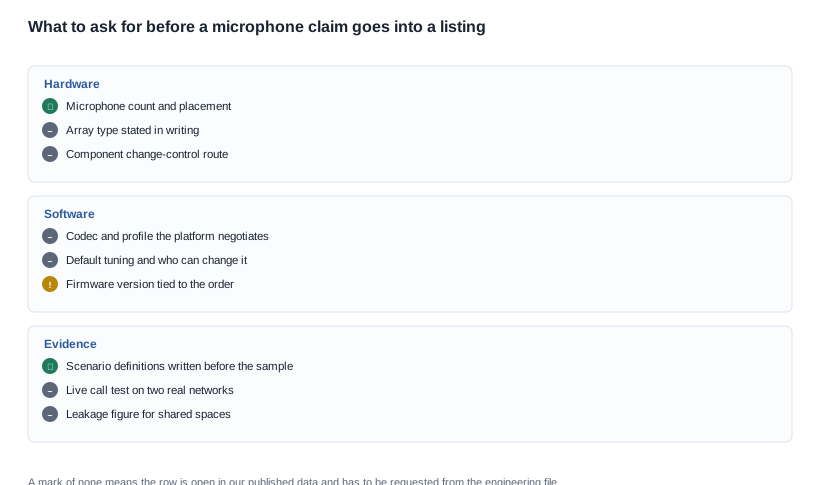
The documents worth collecting before the deposit are: the microphone count and placement for the quoted configuration, the array type in writing, the codec and profile the platform negotiates with the stated default, the tuning parameter set or a written statement that the brand does not receive one, the signal-to-noise figure with its measurement conditions or a written statement that it is not published, the firmware version of the approved sample, the change-notice route for firmware and components, and the application version in use at approval.
The clauses worth writing into the purchase order are: the microphone configuration as a named field, the approved firmware version, an advance notice obligation for any firmware or component change, the three scenarios and their pass conditions as the acceptance criteria, and a claim register obligation for any audio phrase the brand publishes about the product.
On our own side, the boundary is deliberate and it is the same one we apply to every unpublished row. We publish the Bluetooth version, the cell, the runtime, the charge time and the interface for every model we can, and we publish a feature name such as surround sound where the industrial design has fixed one. We do not publish microphone count, array type, codec, format, signal-to-noise figures, tuning parameters or any noise-performance figure, because none of them is in our published documentation and inventing one would be worse than useless to a buyer building an acceptance criterion. What we do instead is tell you which rows have to be requested from the engineering file, which is what the checklist above is for. A buyer who asks for these gets them, with the conditions attached, and a buyer who accepts a typical figure from a general data sheet will find the difference in the field, where the correction costs more than the question did.
Send the models, the quantities, the three scenarios that matter to your channel, and the target markets, and we will tell you which configurations exist, which microphone rows are open on our published data, and exactly what has to be put in the order to close them. The noise control and microphone pickup page is where the published audio rows sit, and we will tell you plainly which of the questions above we can answer from our documentation and which ones need the engineering team.
Related reading


