

Smart glasses MOQ talks are the wrong place to find out whether a supplier can do the work. By the time a buyer is negotiating the minimum order quantity, the questions that actually mattered have already been answered, usually without being asked. The right sequence is the opposite one: establish what the supplier can build and document first, read the floor last, and treat any supplier who resists that order as having told you something useful about how the relationship will run.
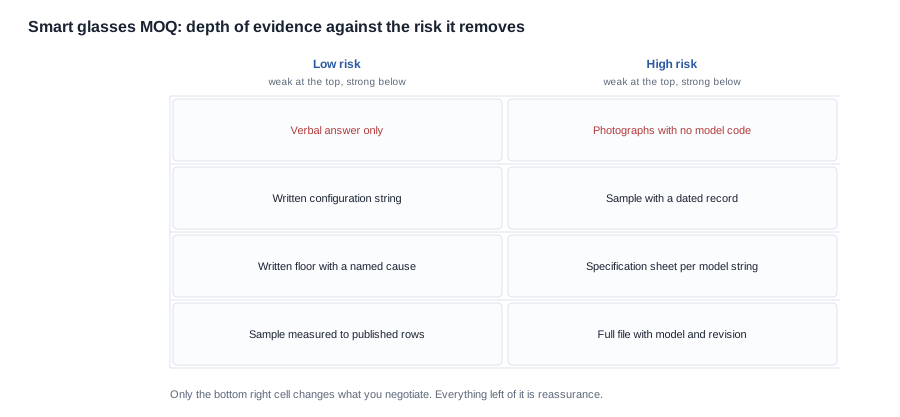
Smart glasses MOQ: the four tests that run before the number
The order of the tests, and why it is not the usual order
The four tests are deliberately sequenced so that each one is capable of ending the conversation on its own. Test one establishes that you are talking about a real, buildable thing rather than a product family. Test two establishes that the hardware matches its own published specification. Test three establishes where the order floor comes from. Test four establishes what the supplier knows to be open, before they are under pressure to be reassuring.
A buyer who runs them in the opposite order starts with the number, and the number is the easiest thing in the conversation to get. Every supplier can produce a minimum. Very few suppliers will volunteer the reason for it, and the reason is the only part of the number that can be worked on later.
The reader for this sequence is someone buying on the brand side, a channel buyer or an importer with a shortlist of two to five factories and no established relationship with any of them. The task is not to find the cheapest quotation. It is to find out which of the shortlist can produce evidence, and then to judge the quotations from the survivors. The order of operations is the whole content of this article, because in this category the cheapest quotation is very often the one whose floor is a policy rather than a constraint, and a policy cannot be renegotiated once the programme has started.
Test one: the configuration string
The first test is a single request: the exact build, written as a configuration string, with the model designation as it will appear on the box, the colour option, the charging interface, whether a charging case is included and at what capacity, the packaging, and the destination country.
The completion condition is simple. A supplier who can restate the build back accurately, in the same terms, has demonstrated that it holds the specification. A supplier who asks which of three variants you mean has demonstrated that its quotation is built from a matrix rather than from a build, and every number it produces will need the same disambiguation later at a higher cost.
This test also does something the others cannot: it gives the supplier a concrete reason to answer carefully. A request that specifies a build makes the reply a specification check. A request that says "send us your catalogue" makes the reply a sales exercise, and the two produce completely different evidence for the same buyer.
Test two: a sample measured against published rows
The second test compares physical hardware against the published specification rather than against a sales description. The published rows are the electrical ones: cell capacity, charge time, rated use, charging method, case capacity where one exists, and the resolution tier for the camera models. Across our own catalogue, those rows are specific enough to be a genuine test. Eleven models carry a camera, eight of them at 8 MP and three at 13 MP. Charging methods divide into magnetic, Type-C, and four camera models where the method row is simply not published. Case capacities are published at 900, 1200 and 1400 mAh for the models that carry one, and four camera models — the V03 Pro and the V03, and the V06 and the S7 — publish no charging-case row at all.
A sample that matches those rows proves something narrow and valuable: that the specification the supplier quotes is the specification the supplier builds. It does not prove that the same quality will be delivered at volume, and it does not prove that the production line the sample came from is the production line your order will run on. Both of those are separate tests, and a supplier who presents a sample match as evidence of manufacturing capability is making a category error you can name in one sentence.
Test three: the floor and its cause
The third test asks which purchased part sets the order floor, and how that part is allocated. The completion condition is a named component and a lot quantity, or an explicit statement that the floor is a policy figure rather than a constraint. Both are acceptable answers. What is not acceptable is a number with no cause attached, because a number without a cause cannot be revisited and cannot be traded against anything.
This is the test that most often gets skipped, because the buyer's attention is on the price at that moment. It is worth holding the line, because the cause also tells you the lead time of the floor. A floor set by a component arrives with that component's own schedule attached, and a supplier who is honest about the cause will usually volunteer the schedule consequence as well. That is the information a buyer needs before committing to a delivery date, and it is much cheaper to obtain before the order than after it.
Test four: the self-disclosure test
The fourth test asks what the supplier cannot commit to. Not what is uncertain in the market, and not what might change in the general sense, but what is open in this supplier's own file for this configuration. The question works because it is easier to answer honestly than to dodge: a supplier who names two or three specific open items has shown how their internal records behave. A supplier who answers "nothing, everything is ready" has shown the opposite.
The best version of this test asks for the answer in writing, attached to the configuration. It also asks the same question twice, once at the start and once near the end of the first round, because the two answers together are more informative than either one alone. A supplier whose open items shrink between the two questions is managing information. A supplier whose open items stay the same is managing the file.


Why the order floor is the last thing to test, not the first
The sequencing is the argument, so it is worth being explicit about what a buyer gives up by asking the floor last. Nothing, in practice, because the floor will be quoted whether or not the buyer asks for it early. What changes is the quality of the answer. A floor offered in the opening round is the supplier's best guess at a market number, because the supplier has not yet learned what the buyer is really ordering. A floor offered after the configuration has been tested, the sample has been checked and the cause has been named is a specific number for a specific build.
The second reason is leverage. The buyer who asks the floor first has nothing to trade. The buyer who asks the floor last has a set of levers already identified, because the cause of the floor is known and the levers follow from the cause. Where the floor comes from a component lot, the lever is consolidation or batch timing. Where it comes from a print run, the lever is artwork approval and the number of distinct runs. Where it comes from per-variant compliance work, the lever is the number of variants in the file. Where it is actually a setup charge, the lever is simply moving it to a line that can be amortised.
The third reason is diagnostic. A supplier who quotes a floor without being asked, and without attaching a cause to it, is trying to set the frame for the whole commercial conversation. That is not disqualifying on its own, but it is worth knowing before the quotation is compared, and it is a great deal easier to see before the price is on the table.
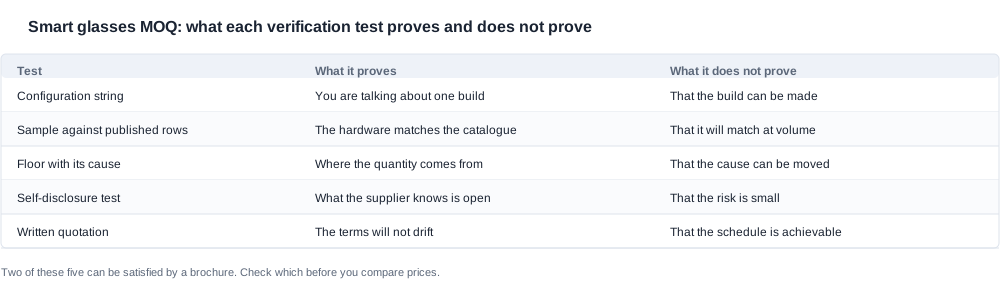
Two of the five rows in that table can be satisfied by a brochure, which is why the four tests are run in the order they are. A configuration string can be printed. A sample can be described. The floor with its cause and the self-disclosure answer cannot, and those two are where the evidence actually is.
The self-disclosure test in detail
The self-disclosure test deserves more attention than it usually gets, because it is the cheapest test available and the only one that produces information the buyer cannot get from a catalogue.
Ask it in three parts. First, what is not published for this build in the supplier's own material, which is a factual question that most suppliers can answer quickly and accurately. Second, what the supplier will not commit to in writing before the sample is approved, which is a question about their own internal approval process and therefore about the size of the organisation behind the quotation. Third, what has to come from a sub-supplier rather than from the factory itself, which is the part that most often surprises a first-time buyer in this category.
That third part deserves attention because it changes the risk model. When the camera module, the cell or the charging case is bought in by the factory rather than made by it, the supplier is managing somebody else's schedule, and that supplier's lead time is not your supplier's lead time. A supplier who discloses this openly has told you that the binding constraint sits upstream of them, which means a date that looks comfortable on their schedule may still be at risk. A supplier who does not disclose it has not told you anything false yet, but they have left the most important variable out of the model.
There is a fourth question that belongs to this test and is almost never asked: what would have to change for the supplier to reduce the floor. The answer is the most actionable sentence in the whole exchange. It identifies the lever in the supplier's own words, before either side has argued about it, and it is usually a short list.
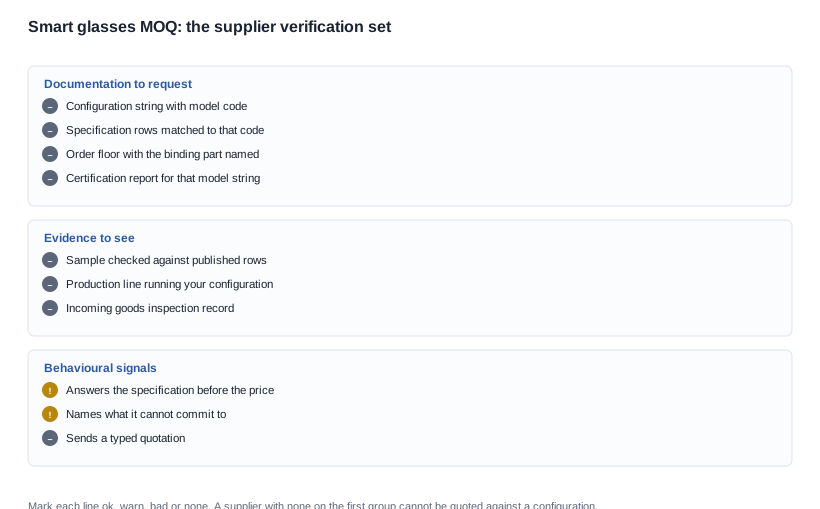
Work through that set as a document, not as a conversation. Mark each line with one of four states: verified, qualified, missing, or contradicted. A supplier with several lines in the missing state is not disqualified, because no supplier will hand over a full file to an unproven buyer in the first round. But a supplier with a contradicted line is a different matter, and the contradiction is worth resolving before the price is compared.
Running the four tests in one round without turning them into an audit
The practical objection to this method is that four structured tests against three suppliers feels like an audit, and audits have a cost: they slow the round down and they change how a supplier behaves. That objection is fair, and the answer is in how the request is framed rather than in softening the questions.
Send the same four questions to every supplier in the round, in the same order, with the same attachments. That symmetry is what makes the comparison valid, and it is also what makes the round efficient: a supplier receiving the identical request from three buyers in the same week answers it once, in a form that can be reused, rather than improvising three different responses. The alternative, a bespoke request per supplier, produces bespoke answers, and bespoke answers cannot be compared.
Keep the framing on the programme rather than on the counterparty. The request is a specification pack for a build, not a questionnaire about the factory. Test two asks for a sample to be measured against published rows, which is a request every supplier understands and none of them can misread. Test three asks for the cause of the floor, which is a reasonable question for a buyer to ask. Test four is the only one that needs care, and it is easiest to ask it as a practical matter: which items in your own file would you want the buyer to know are open before an order is placed.
The recording is where most of the value sits, and it is the part buyers skip. A one-page sheet with one row per test and one column per supplier, kept in the buyer's own file rather than in an email thread, is what makes the shortlist defensible later. It also makes the second round short, because the follow-up question is derived from a marked cell rather than from memory.
Turning four tests into a shortlist you can defend
Shortlisting in this category is usually done on price, and price is the one input that is guaranteed to be unreliable at this stage, because a price is quoted against a configuration that may not be the one you intend to buy. The shortlist should be built on evidence quality instead, and the price comparison comes after.
The working method is straightforward. Run the four tests with every supplier in the round, using the same request and the same order of questions. Record the answers in a single sheet with one row per test and one column per supplier. Then rank on three things: how many lines came back verified rather than qualified, whether the self-disclosure answer named specific items, and whether the floor arrived with a cause attached.
That ranking produces something a procurement manager can defend later, which matters more than it sounds. When the programme is reviewed or the buyer is asked why one supplier was chosen, the answer cannot be "the unit price was lower". It has to be "the evidence on this configuration was stronger, here are the four tests and here is what each one returned". A shortlist built on that basis survives contact with a finance team, and a shortlist built on price does not.
The cost of the method is two rounds of correspondence before any comparison is possible. That is a real cost and worth naming. What it buys is a comparison that is actually between the same thing, which is the alternative to paying for the difference afterwards.
For buyers who want the capability questions rather than the order questions, the factory audit route covers the plant side, and the certification verification route covers the documentary side. Neither replaces the four tests, because both answer questions about the supplier in general rather than about your specific build.

A failed test, and the programme it saved
Consider a constructed situation, not a client project. A brand is comparing three factories for a Bluetooth audio programme. The published audio range is eight models: two with 90 mAh × 2 cells at about eight hours, two with 100 mAh cells at about seven hours, two LC-105 variants with 55 mAh × 2 cells at about eight hours, and two further models in the same 55 mAh × 2 group running at about six hours.
Supplier A answers all four tests cleanly and quotes the lowest price. Supplier B cannot restate the configuration string and returns a catalogue extract. Supplier C answers everything, and in the self-disclosure test names one specific open item: the charging case for one of the 55 mAh × 2 builds has no published capacity.
That last sentence is what makes Supplier C the interesting one. The open item is small, specific and verifiable, and it is exactly the kind of fact that disappears into a unit price if the buyer does not ask. The brand asks for the case capacity in writing, receives it, and learns that the model in question carries a case whose capacity the catalogue does not publish, while the LC-105 models carry a 55 mAh × 2 cell. The order is restructured around a build with published rows, and the quotation becomes comparable with the other two.
Nobody in this sequence negotiated a lower minimum order quantity. What happened is that the buyer declined to compare three numbers that meant three different things, and asked instead for the build behind each one. The programme that was saved was not saved by a price negotiation. It was saved by a refusal to treat an unsupported number as a comparable one.
What our published catalogue can and cannot settle about a supplier
The working rule we apply: the published catalogue is the part of our own offering we can stand behind, and a supplier evaluation should be built on the same principle.
We publish the electrical rows for every model: cell capacity, charge time and rated use. The charging method is published for twenty-four of the twenty-eight, magnetic or Type-C, and four camera models publish none: the MT6 and the L1 Pro, and the CY03 and the CY05. Case capacity is published for five of them, and two further models carry a case whose capacity the catalogue does not state. We publish the resolution tier for the camera models, and the ingress marking where one applies. We publish the configuration options and the colour options. We publish the single complete-unit weight in the catalogue, which belongs to the MT6 glasses body at 158 g including its 265 mAh cell and camera and excluding the 1200 mAh folding charging case. We do not publish a bare frame weight for any model, and we would rather say that than offer a typical figure a buyer cannot verify.
We also have to be straightforward about what the catalogue does not settle. Our catalogue holds a company-level export certification page, but it does not carry a certification line for each model. A buyer who asks whether a given model holds CE, FCC or RoHS documentation will not find a per-model answer in our published material, and the right response to that question is a request for the written file against the specific model string, checked through the certification verification route rather than a general assurance. We have not published production photographs or video, and that gap in our own material collection is real. For the product families rather than the single builds, the current range is set out under Bluetooth audio glasses.
Nothing in this article is a substitute for reading the agreement a programme will actually run on, and the clauses that matter most in a supply relationship are covered under contract terms. The framework this whole sequence serves sits under MOQ and order quantity.
Related reading
Send the configuration, the quantity and the market, and we will say which parts of the order floor are settled and which are yours.


