

Most smart glasses MOQ negotiations fail for a dull reason: nobody defined the question. "What is your MOQ for smart glasses?" has no answer, because the answer changes with configuration, packaging, forecast and destination. Send the same twelve fields to every supplier in the same round instead, and the replies become comparable, which is the only reason to compare them at all. The template below is the instrument; the second half of this article is the part that matters more, which is how to read what comes back.
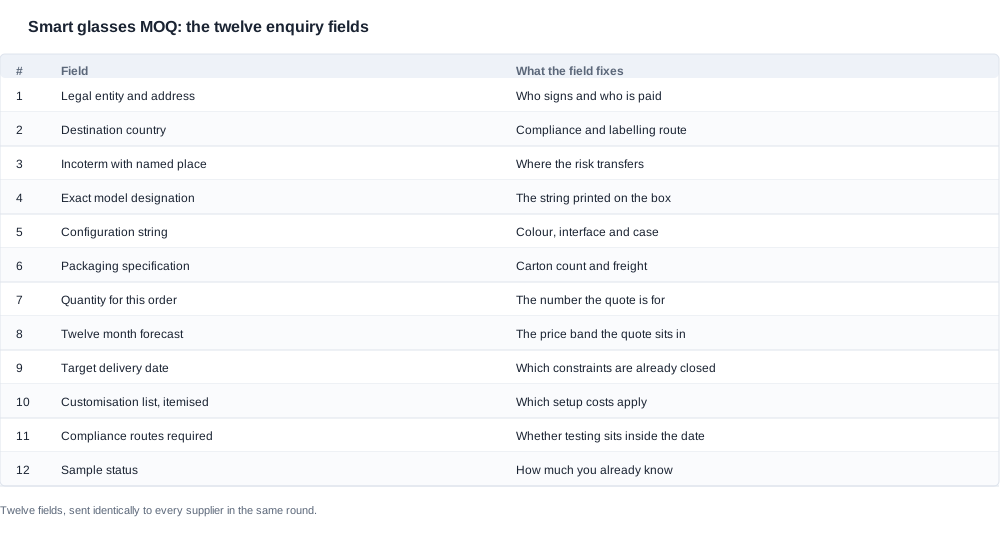
Smart glasses MOQ: the twelve fields that make two quotations comparable
Why a fixed field set beats a free-text request
A free-text enquiry produces a free-text reply, and free-text replies cannot be compared. Two suppliers asked the same open question will answer two different questions, and the buyer will spend the comparison stage translating one answer into the terms of the other. A fixed field set moves that translation work into the request, where it is cheap, because the buyer controls the request completely and the supplier controls only the reply.
There is a second, less obvious benefit. When twelve fields go out identically to every supplier, the shape of the replies tells you something about the supplier before you read a single number. A supplier that answers all twelve has a quotation process. A supplier that answers four has a catalogue. That difference is worth knowing before the price is compared, and it is visible in the reply envelope rather than in the answer itself.
The template is designed around one rule: every field has to change the answer. If a field would come back the same whatever it said, it does not belong in the set. That is why the set contains a quantity for this order and a separate twelve-month forecast, and why it contains an Incoterm with a named place rather than an Incoterm.
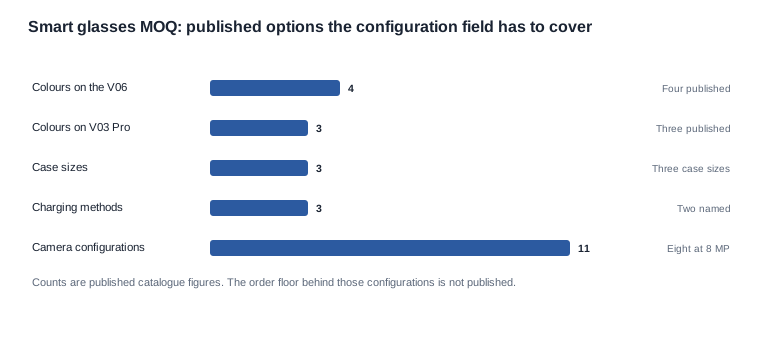
The published counts in that chart are the reason field five carries so much weight. Our catalogue publishes eleven camera models, eight of them at 8 MP and three at 13 MP, three case capacities of 900, 1200 and 1400 mAh, and three charging methods across the range, of which two are named for specific models and one group of four camera models has no published method row at all. Every one of those published options is a configuration, and every configuration is a possible separate order floor.

Filling fields one to six: the ones that decide whether a reply is possible
1. Legal entity and address. The registered name that will sign, not the brand. This exists because suppliers legitimately trade under several names, and because a finance team's payment process will stop if the account name and the contract name differ. It is also the field that decides where a dispute would be heard.
2. Destination country. A country, not a region. It determines the compliance route, the labelling and the documentation set, and it determines them differently in every market. The United Kingdom, for example, is a separate regime from the European Union and is not covered by the same set of obligations.
3. Incoterm with a named place. The term alone is ambiguous, and the ambiguity is about who carries the risk during transit, which is exactly the point a payment schedule is built on. "FOB Shenzhen" is not an instruction; "FOB Shenzhen, Incoterms 2020" is.
4. Exact model designation. The string that will appear on the box. If a supplier's catalogue shows a designation that looks like a typographical error, resolve it in writing at this stage rather than at the artwork approval stage. Our own catalogue prints one camera model as "L2 Utral", which appears to be a rendering of "Ultra", and that is precisely the kind of string that gets silently corrected by a factory and then printed on ten thousand boxes.
5. Configuration. Colour, charging interface, and whether a charging case is included. Across our range this means magnetic or Type-C charging, and case options at 900, 1200 or 1400 mAh. Minimums move with this field more than with any other, because the configuration determines the material set and the material set determines the lot.
6. Packaging. A retail box with insert, or a plain mailer. It changes unit cost, carton count, cubic volume and therefore the freight comparison, and it frequently changes the order floor on its own because printed packaging carries a print run length.
Filling fields seven to twelve: the ones that decide whether a reply is comparable
7. Quantity now. For this order alone. A price quoted without a quantity is indicative rather than a quotation, and it should be returned as such rather than compared as though it were firm.
8. Quantity in twelve months. An honest forecast. This field changes the price band more often than any buyer expects, and it also signals whether the supplier is pricing a transaction or pricing a relationship. A supplier who ignores it will quote you the same structure regardless, which is a fact about how they will treat your second order.
9. Target delivery date. A real date you need, not a quarter. This is the field that reveals which constraints are already closed for you, because a supplier who cannot meet the date will say so only if the date is specific enough to be a commitment.
10. Customisation required. Logo, temple shape, frame, lens, firmware. Whether each triggers setup is assessed per part, so list them individually rather than as a single "custom" line. A consolidated custom line will come back as a consolidated custom cost, and it will hide the one item that actually drives the floor.
11. Compliance routes required. Which markets, which model strings. This determines whether the testing sits inside your delivery date or outside it, and it is the field most often left vague, because the buyer assumes the supplier will handle it and the supplier assumes the buyer already knows.
12. Sample status. Requested, approved or not started. It tells the supplier how much you already know about the hardware, and it changes what they feel obliged to explain. A buyer with an approved sample gets a different answer about tolerances than a buyer who has not started.
The order of the fields is doing work
The twelve fields are numbered, and the numbering is not decoration. Fields one to four establish which legal entity, which market, which risk-transfer point and which exact build are under discussion, and none of the later fields can be answered sensibly until those four are settled. A supplier asked for the minimum before knowing the destination country will either guess the market or quote a general floor, and both of those answers are worse than a blank.
Fields five and six convert the build into something that can be produced and shipped, and they are the pair that most often moves the order floor. Field seven then converts the enquiry into a quotation, because a price without a quantity is not a price. Field eight is the only field that looks backwards rather than forwards, and it is the one that tells you what tier the supplier expects you to land in.
The last four fields are where most of the information lives. Customisation, compliance routes and sample status are the three things that most often separate two suppliers who quoted the same unit price, and the twelfth field is the one that changes the register of the conversation, because it tells the supplier whether they are dealing with someone who has already held the product or someone who has only read about it.
Buyers who reorder the fields for their own convenience should at least keep the numbering visible in the reply sheet. The numbering is what makes it possible to send the same twelve back with the reasoning attached, and that reply sheet is a far more useful artefact than the original request.


Reading the replies: four answers that separate a supplier from a brochure
The replies come back in three shapes, and the shape is visible before the numbers are.
A minimum quoted without conditions. If a supplier gives one figure and no per-colour, per-packaging or per-configuration qualification, they have answered a different question than the one you asked. The follow-up is short: name the configuration and ask whether the figure changes. A figure that survives that question is a policy figure, which is useful to know. A figure that changes is a constraint you can work with.
A minimum with conditions stated and explained. This is the reply that makes the rest of the process short. Suppliers who explain that a number comes from a specific cell, or from a specific print run, are telling you what will move it, and they are doing you the work of identifying the lever before the negotiation starts.
A field left deliberately blank. Blankness is information and it is not always bad. A supplier who leaves the compliance route blank may genuinely not hold a file for your model string, which is a fact you need. A supplier who leaves the Incoterm named place blank is not ready to quote yet, and the round is simply not finished.
A price with no validity period. A quotation without an expiry is an open invitation to re-negotiate at the moment of the order, and the re-negotiation is always priced against the buyer's new urgency. Ask for the window, and check it against the date on your own critical path.
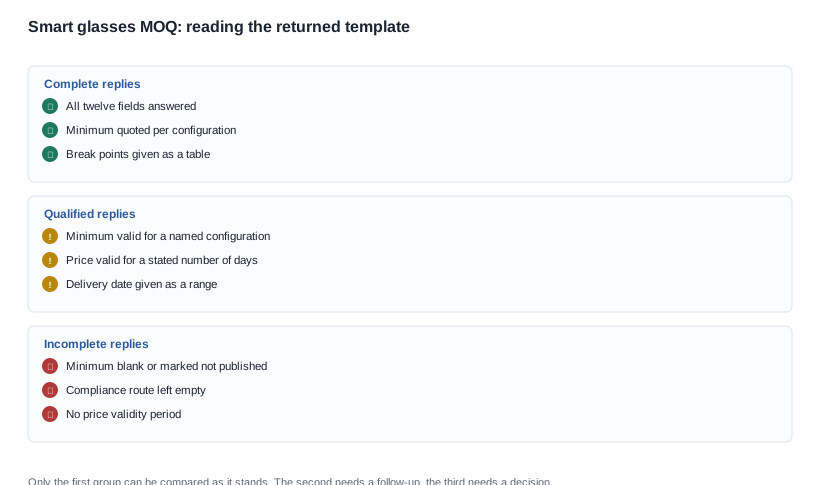
Mark every returned field in one of the three states in that chart before reading a single number. The discipline matters more than it sounds, because a supplier reply that mixes a complete set with two blanks is easy to read as complete when the blanks are in the middle of the document rather than at the end.
The follow-up round is where the comparison is actually won
One follow-up round is normal and sufficient. Send it once, containing only the fields that came back qualified or blank, and send it identically to every supplier whose reply had gaps. The follow-up has three rules.
Keep it to the gaps. Do not restate the twelve fields and do not open a new topic. A follow-up that re-examines answered fields invites a supplier to revise an answer it has already given, and the revision is rarely in the buyer's favour, because the first answer was priced and the second one is being re-priced under pressure.
Ask each gap as a closed question rather than an open one. "What is the minimum for this configuration?" is open and will return a paragraph. "Is the minimum for this configuration the same as the minimum for the same model in a stock colourway and standard packaging, yes or no?" is closed and will return a fact that can be put in a cell.
Write down what the answer changes. Every gap in a reply sheet should carry a note about which comparison it affects. A gap in the delivery date affects the schedule comparison. A gap in the compliance route affects whether the goods can be sold at all. A gap in the minimum affects the size of the order, and therefore the cash the buyer has to commit. A gap that changes nothing is not a gap worth a round trip, and this rule is what stops the follow-up expanding.
One warning about the qualified replies specifically. A supplier who qualifies the minimum against a configuration rather than quoting it flatly is usually the better supplier, because they have read the request. Do not penalise them for being precise while rewarding a supplier for answering a different question cleanly.

The cross-check: pairing minimums with unit prices
Put the returned minimums next to the returned unit prices and look for the pairing that is too good. A low minimum paired with a notably low unit price usually means somebody is absorbing risk into the unit cost, and it reappears at the second order, when the absorption stops.
There are three pairings that are worth checking by hand. First, the lowest unit price in the round against the highest minimum: a supplier with both is either very efficient or very wrong, and the difference is settled by asking what happens to the price at the second order. Second, the lowest minimum against the middle unit price: this is the classic case of a floor set by a single component lot, where the buyer can trade consolidation or timing rather than price. Third, the highest minimum against the lowest unit price, which is usually a supplier that wants the order for a different reason than margin.
| Cross-check | What it usually means | The question to ask |
|---|---|---|
| Lowest minimum, lowest price | Risk absorbed into the unit cost | What is the price on the second order? |
| Lowest minimum, mid-range price | Floor set by a component lot | Which purchased part sets the lot? |
| Highest minimum, lowest price | Floor set by a print or setup run | Is the setup charged separately? |
| Identical figures across suppliers | Catalogue figures, not quotations | Which configuration is this for? |
The commercial structure that normally sits alongside the minimum order quantity is at pricing. And the last row in that table deserves particular attention, because it is the most common result of a first round that was not run with a fixed field set: three suppliers who all quoted the same number, because they all quoted the same catalogue minimum rather than your build.
Turning the comparison sheet into a decision
Once the replies are normalised, the sheet needs one more column that is not in the template: what the answer costs you in cash and in time. A minimum is only meaningful next to the order you actually intend to place and the date you actually need. Two suppliers who both quote 500 units for the same configuration are not equal if one of them can deliver in six weeks and the other cannot commit to a quarter, because the second one has converted your flexibility into inventory.
The decision that comes out of the comparison is usually one of three, and it is worth naming which one before the numbers are read. Either the configuration is acceptable as quoted and the choice falls to price and schedule. Or the configuration is right but the floor is too high, in which case the negotiation targets the cause of the floor rather than the floor. Or the floor is acceptable but the configuration is wrong for the market you are selling into, in which case the honest conclusion is that this build is not the build, and the round should be restarted rather than negotiated.
The third outcome is the one buyers avoid, because restarting the round costs time that has already been spent. It is still the right call when it applies, because a programme built on a configuration that cannot clear its destination market does not have a price problem, it has a viability problem, and no negotiation fixes that.
Why we return the same twelve fields, and which two we will not guess
Concretely, we will return these twelve fields completed for your specific configuration, and we will leave a field blank rather than guess at it, with a note saying why. Two of the twelve will routinely come back marked in that way, and it is worth saying which two and why.
The first is the order floor. Our own internal statements on minimum order quantity are not reconciled, and we are not going to select one of them to win an order and then defend it in writing later. The second is the lead time against a specific configuration, because it changes with the model, the configuration, the mix and the volume, and a generic figure is worse than an open row that says why.
The two fields we will not fill on a generic basis are also the two that determine whether the goods can clear your market, so they are the two on which the written follow-up should be concentrated. The model designation and the compliance routes need attention first, because everything else in this template can be refined later while those two decide whether your compliance file covers the goods when they arrive.
The contractual consequences of getting them wrong are set out under contract terms, and the documentary route is under certification verification. The models this template is applied to are on the AI camera glasses page, and the framework the template serves sits under MOQ and order quantity.
One last practical note. Do not send the template as prose in an email body. Send it as a table with the twelve rows in the same order every time, and ask for the reply in the same table. The structure is the entire point, and email formatting will destroy it in the first round if you let it.
Keep the sent version. When the second programme arrives and one of the twelve fields has to change, the comparison you want is against what you sent last time, not against what you remember sending. A saved copy of the completed sheet is also the shortest possible specification for the internal colleague who has to take the order over, and it is the document that makes the agreement writable at all.
Finally, record the suppliers who did not reply in full, and why. The second round of a programme usually involves a supplier who declined to quote, and the reason is almost always more useful than the quotation itself: a floor too high for the quantity, a configuration they do not build, or a market they do not ship to. That list is the start of the shortlist for the next programme, and it is cheaper to keep than to rebuild.
Related reading
-
pricing structure — the tiers and setup charges this template is designed to surface
-
contract terms — what happens to the answers once they are in an agreement
-
certification verification — the documentary route for the compliance field
-
AI camera glasses — the models this template is applied to
Send this template to us with your twelve fields filled in and you will receive the same twelve back, with the reasoning attached to the ones we cannot commit to.


