

Smart glasses MOQ is a question with a number in it, and the number is the least informative part of the answer. A minimum order quantity in this category is not a figure a supplier picks off a shelf; it is the point at which a purchased component becomes worth ordering, a changeover becomes worth running and the per-order work becomes worth repeating. Ask what drives the minimum in a smart glasses MOQ decision and the answer is a structure rather than a figure. This article sets out that structure: the four things that set a minimum, why a single model in this range can carry several material sets at once, how to verify a minimum before ordering against it, what a mixed order actually costs, and how to get a real number rather than a catalogue one.
Smart glasses MOQ: a minimum is a structure, not a number
Which of the four actually binds
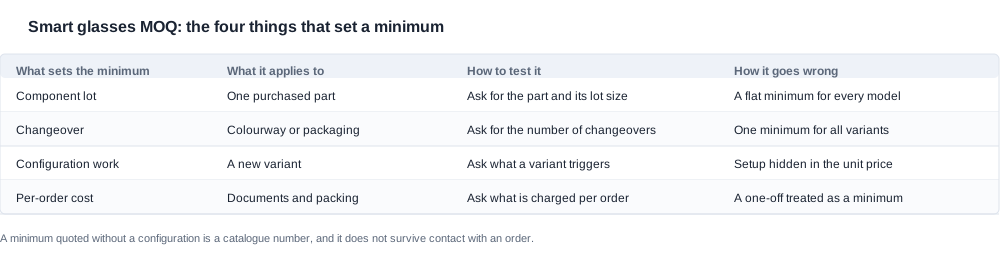
Four things set a minimum, and a buyer who knows which one is binding knows which term to trade. The first is a component lot: one purchased part is bought in a quantity the supplier will not break, and that quantity is the floor. The second is a changeover: a new colourway, a new package or a new market adds a setup the supplier will only absorb at a certain volume. The third is configuration work, because a variant can trigger a fresh technical file and a fresh approval, and that cost has to land somewhere. The fourth is the per-order cost of documents, packing and artwork, which is a real cost but a different kind of cost from a production constraint, and which is very often misread as a minimum.
The consequence is that a minimum quoted without a configuration is a catalogue number, and a catalogue number does not survive contact with an order. The order that settles it is the configuration string: the model, the charging case option, the colourway, the packaging and the destination market. In this range those dimensions multiply faster than buyers expect, and that is where the second half of this article goes.
Who is asking, and what the minimum has to do for them
The reader is a brand-side sourcing manager, a channel buyer or an importer. The situation is nearly always the same: a programme has a volume attached to it, the volume is fixed by the market rather than by preference, and the question is whether it clears the supplier's minimum, and if it does not, what has to be traded to make it clear.
The fear underneath that question is not a large order. It is a large order in the wrong place. A buyer who orders to the minimum because the minimum is the number in the quotation ends up with more units of a configuration than the market will absorb, and the cost of that is not the unit price, it is the holding cost of the difference plus the exposure of a product that cannot be sold because it was built for a brief that has passed.
What the catalogue settles, and what it leaves open
The catalogue publishes the product detail and none of the commercial terms. It publishes 28 models with their cell capacities, charge times, run times, charging interfaces where a row exists, camera classes, Bluetooth versions where they are published, charging case capacities where they are published, and colour availability for the two models that carry it. It publishes no minimum order quantity, no price, no price tier, no lead time, no setup cost and no sample cost.
That split matters for the conversation. A buyer who asks for a minimum with a configuration attached is asking for something the supplier can answer precisely, because the supplier knows the lot sizes of the parts behind that model. A buyer who asks for "your minimum" is asking for a number that has to be a compromise across the whole range, and a supplier answering that question is giving an average rather than an offer. The MOQ and lead time section sets out where the minimum sits in the order decision, the sample evaluation section covers the evidence a buyer should collect before committing, and the pricing structure section covers the cost inputs that change with configuration.

The four things that set a minimum, and how to test each one
Component lots, and the part that actually constrains the order
This is the most common floor and the most useful one to identify, because a lot-based floor is negotiable against something specific. The question is not how long components take in general but which particular part constrains this configuration, what its lot quantity is, and whether the supplier holds it or buys it against the buyer's order. The third point changes the commercial position as much as the schedule one: a supplier who buys speculatively carries the risk and can be more flexible on quantity, and a supplier who buys to order passes the risk through, which usually means a firmer minimum and a different lead time.
In this range the constraining parts are typically the cell, the camera module for the camera models, and the charging case. The case deserves particular attention because a case is not one procurement problem but several: the catalogue publishes case capacities of 900, 1200 and 1400 mAh across the range, and a magnetic charging contact is a different supply chain from a 1400 mAh case with its own pack.
Changeover economics, and the variants that create them
The second floor is the changeover, and it is the one that a buyer's own specification creates. A colourway, a package, a language, a market or a channel label all add a variant, and each variant is a setup the supplier has to justify. This is where the difference between a stock programme and a private-label programme appears in the number, and it is why one minimum for a whole catalogue is meaningless to a buyer who is building one product for one channel.
The question to ask is how many changeovers the quoted configuration involves, and what the supplier does when a buyer asks for a second one at a similar volume. A supplier who will absorb a second colourway at the same minimum has told the buyer something important about the economics of the run, and a supplier who will not has told the buyer something equally important.
Configuration work, and the setup cost that hides in the unit price
A new variant can trigger work that is not a production cost at all: a fresh technical file, a new artwork approval, a new test. That work is a real cost and it should be a line in the quotation, not a reason why the unit price is higher than the one on a competitor's sheet. The question is what a new variant triggers, who pays for it, and whether it is a one-off or a recurring charge. A setup cost quoted separately is a cost a buyer can decide about; a setup cost absorbed silently into a unit price is a cost a buyer cannot see and cannot trade against anything.
The per-order cost that is not really a minimum
The fourth floor is the cost of doing the order at all: the documents, the packing, the artwork preparation, the inspection and the paperwork. It is real, and it is the reason a very small order is uneconomic. But it is a cost, not a production constraint, and the two are treated differently. A buyer who reads a per-order cost as a minimum will over-order. A buyer who separates them can ask for a smaller production run and pay the per-order cost for what it is.
Why one model can carry several material sets in this range
The configuration string is longer than the model name
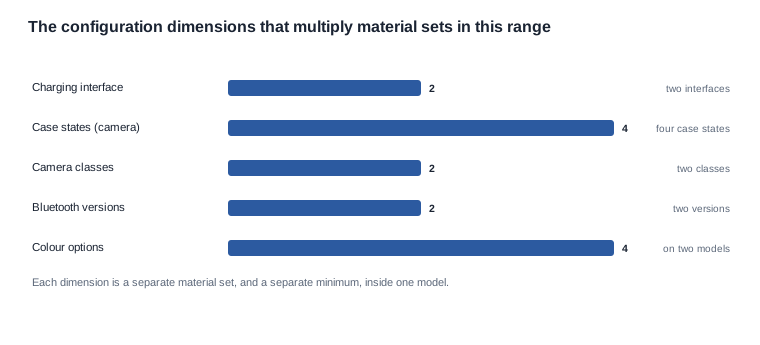
The dimensions below multiply, and each one is a separate material set and therefore a separate minimum inside a single model. This is the practical reason why a catalogue minimum cannot be applied to a buyer's order.
The charging case alone splits the camera models four ways
Among the 11 camera models the case position is not one thing or two. Five publish a case capacity, with the CY03 and the L1 Pro, and the CY05 — each at 1400 mAh, the L2 Utral at 900 or 1400 mAh, and the MT6 as a 1200 mAh folding case. Two publish a case with no capacity stated, the KY06 and the MT5. Four publish no case row at all — the V03 Pro and the V03, and the V06 and the S7 — which is an absence of publication rather than a statement about the box, and it has to be closed in writing before a case is put on a purchase order.
A buyer who has to choose between two of these is choosing between different supply chains, and the two may have different lot quantities and different lead times. A buyer who has to choose between a published 900 mAh case and a published 1400 mAh case on the same model is choosing between two material sets, and the L2 Utral is the model in this range where that choice actually exists.
The other three dimensions, in the same order
The charging interface is the second dimension: 24 of the 28 models publish one, split between magnetic charging on 17 and Type C on 7, and the four that do not publish a row are the CY05 and the MT6, and the CY03 and the L1 Pro. The camera class is the third: 8 of the 11 camera models publish 8 MP and three publish 13 MP, the L1 Pro and the L2 Utral, and the S7, and the camera module is a different purchased part in each case. The Bluetooth version is the fourth: the K01 and the K02 publish 5.3 while most of the rest of the range publishes 5.4, and the camera models publish no version at all, so for those the radio is a further configuration question to ask about rather than a row to read.
The colour dimension is the fifth, and it is the one buyers are most surprised by, because it is published for only two models. The V03 Pro publishes orange, off-white and black, and the V06 publishes orange, ice blue, black and a black ice blue. Four colourways on one model is four material sets if all four are taken, and the one that carries the ingress marking is one of them.

Verifying a smart glasses MOQ before you order against it
The six steps, in the order they work
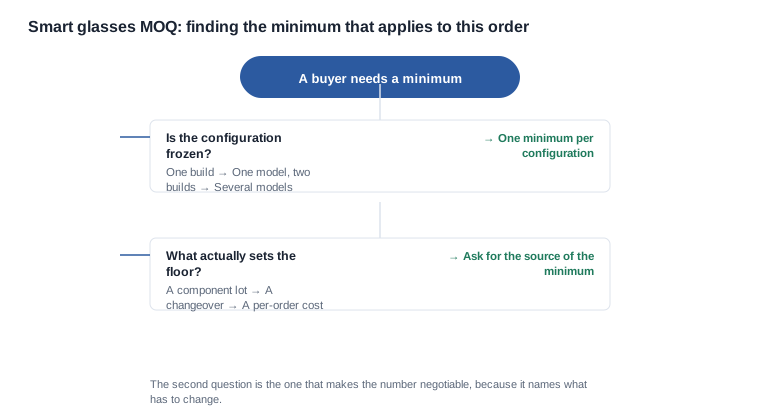
The sequence below starts from the specification rather than from the number, because the number is only meaningful once the configuration is written down.
- Write the configuration string first: model, case option, colourway, packaging, destination market. A minimum requested without this is a catalogue number, and the answer will be an average.
- Ask for the minimum in writing with that string attached, so that the number and the configuration travel together in the document.
- Ask what sets the floor and which purchased part constrains it, and then ask for that part's lot size. A minimum with a named cause can be traded; a minimum without one can only be accepted.
- Ask for the price tier table with the step boundaries stated, and check where the intended order quantity sits on it — on a step, or between two steps. A quantity that falls between steps is the single most common reason a landed cost turns out higher than it looked.
- Compare the minimum against the quantity the programme can actually absorb, and against the cost of holding the difference. If the gap is smaller than the holding cost, order the minimum and plan the channel carefully. If it is larger, something has to be traded.
- Re-test the floor with one variable changed — stock colourway, no custom packaging, a single destination market — and see which variable moves it. That single test tells the buyer which two terms are worth trading later, and it costs one message.

The enquiry checklist
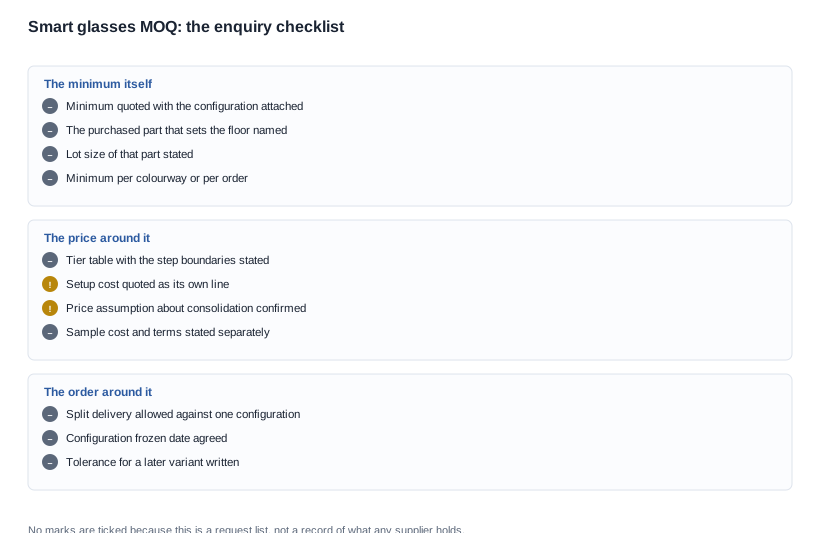
The checklist is the same six steps in a form that can be sent. The grouping follows the order a reader should work in: the minimum itself, the price around it, and then the order around it.
The arithmetic behind the minimum
A minimum is only comparable once the same four costs are on both sides of the comparison, and the fourth is the one most often left off. The first is the unit price, multiplied by the quantity actually ordered rather than the quantity quoted. The second is the cost of holding anything above what the market absorbs, which for a wearable device is not zero because the cells age, the packaging does not survive a warehouse, and a configuration that is out of season is not a configuration that can be sold next season. The third is the per-order cost, which is fixed and therefore penalises small orders much harder than large ones. The fourth is the documentation route, which is per model and per market and does not scale with volume at all.
A comparison that only carries the first of the four will systematically favour the larger order, and sometimes the larger order is the wrong answer. A buyer who orders to the minimum because the unit price looks better has usually optimised the cheapest of the four numbers in the comparison. The order that makes sense is the one that clears the binding component lot without leaving stock the channel cannot take, and when those two conflict, the second is usually more expensive than the first.

The failures, and what a mixed order actually costs
Four failures account for most of the disappointment, and every one of them is a specification failure rather than a pricing one.
The minimum that is really a per-order cost. A supplier quotes a quantity floor that covers document and packing work, and the buyer reads it as a demand signal and orders to it. The control is to ask for the per-order cost as its own line, so that the production minimum and the order cost are visible separately.
A configuration added late to a small order. A late colourway or packaging change creates a second material set and a second approval cycle, at the worst possible moment in the schedule. The control is a configuration freeze date, after which any addition is treated as a new programme with its own dates.
The price tier that was never published. The buyer assumes the quoted unit price holds at the ordered quantity, and the price breaks at a volume the supplier never mentioned. The control is to ask for the tier table and to check that the quantity is on a published step.
The consolidation that does not consolidate. The quoted price assumes a shipment grouped with other orders, and the volume does not support grouping. The control is to ask whether the price assumes consolidation and what the rule is if the consignment travels alone, because that question changes the landed cost rather than the unit price.
There is a fifth pattern that is specific to this category and worth naming separately, because it is a decision rather than a failure. A mixed order — several models and several configurations in one purchase order — can look attractive on a unit price and be the worst option available. A mixed order splits the quantity across material sets, and if any one of them ends up below the minimum it either raises the price of the whole order or leaves the buyer holding stock that cannot be sold. The rule of thumb worth applying is simple: a mixed order that leaves a material set below its own minimum is worse than a single model ordered to its minimum, because the second has one thing to sell and the first has two.
What we publish, and how to get a real minimum
Concretely, the published material is the part of a specification we can stand behind, and the rest is a question for the supplier's own file. We publish what our documentation states, we mark the rows that are open, and we will not fill an open row with a typical figure taken from general data. A buyer who builds a business case on an estimated number finds the error in the field rather than in the quotation, and the correction costs more than the question would have.
So, to be explicit about what is not published for any model in this range: minimum order quantity, price and price tier, lead time, sample cost, production capacity, yield, defect rate, tooling and setup charges, and the frame weight for every model other than the MT6, where the catalogue publishes 158 g for the glasses body including the 265 mAh cell and the camera, with the foldable charging case excluded and the case weight not published. The certification position is a company-level export-certification page with no per-model certification row, so certificate references, issuing bodies and validity dates are issued per configuration rather than published generally.
What is published, and what a buyer can build a configuration string from, is the product detail: the charge time for all 28 models, the run time for all 28, the charging interface for 24, the charging case capacity for the models that state one, the camera class for the 11 camera models, the Bluetooth version for the models that publish one, the ingress marking on the two models that carry it, and the colour options for the two models that publish them.
What we will not do is quote a minimum from a photograph, or fill a commercial gap with a number that cannot be traced to a document. What we will do is take a configuration, a quantity and a market, and tell you which parts are settled, which are open, and which have to come from a sub-supplier. Send us the models, the quantities and the target market, and we will tell you which configurations exist, which of them are open on the published data, and which of the four things above is most likely to be setting the minimum for your programme. That is the whole of what buyers most often ask about smart glasses MOQ: not a number, but the structure that produces it.


