

Choosing a service level in an OEM agreement looks like choosing between tiers of responsiveness, and it is actually deciding who carries which risk and for how long. The question is not what response time you would like. It is what happens, and at whose cost, when something goes wrong that nobody planned for: a unit that fails in a customer's hand, a batch that arrives with a component that is not the one that was approved, a market that asks a compliance question the programme never answered, or a firmware build that has quietly moved away from the sample everyone signed.
Our published position does not describe service levels, because a service level is a property of a specific programme rather than of a product. What we can do is show how much a service level has to cover, because the published gaps in our own documentation are exactly the gaps a service level has to plug.
The gaps are worth stating plainly, because they are unusual and they set the shape of the conversation. The catalogue publishes no per-model certification row for any product. The export-certification page is a picture page carrying ten patent certificate images — eight design patents and two utility models — and no certification entries at all. CE, FCC, RoHS, RED and EN 18031 do not appear in the catalogue body at all. Only two models in the entire range carry an ingress marking, and no third-party test report number is published behind it. A frame weight is published for one model only, the MT6 at 158 g for the glasses excluding its foldable case. Runtime figures for the camera models are stated with no test condition attached. And the catalogue does not publish price, minimum order quantity, lead time, warranty duration or capacity.
So smart glasses oem choosing a service level is a question about which of those gaps your agreement has to cover, and how the cost of covering them is distributed between you and the factory.
There is a cost to leaving this vague, and it is worth putting a number on it even when the number is rough. An unallocated service level in a channel that sells through retail means that the first large failure is settled ad hoc, at whatever moment the tension is highest, with no reference point. Ad hoc settlements are always more expensive than written ones, because the party under pressure at that moment is the one who pays. A second cost is analytical: without a service level that names triggers and clocks, the field data you accumulate about your own product is unusable, because a claim rate cannot be measured against a population if the definition of a claim keeps moving. A third is relational, and it is the one buyers tend to discover last. A factory that has had a service level written for it, with its own triggers and its own triage rules, has a reason to keep that agreement working, and that reason is worth more than a discount.
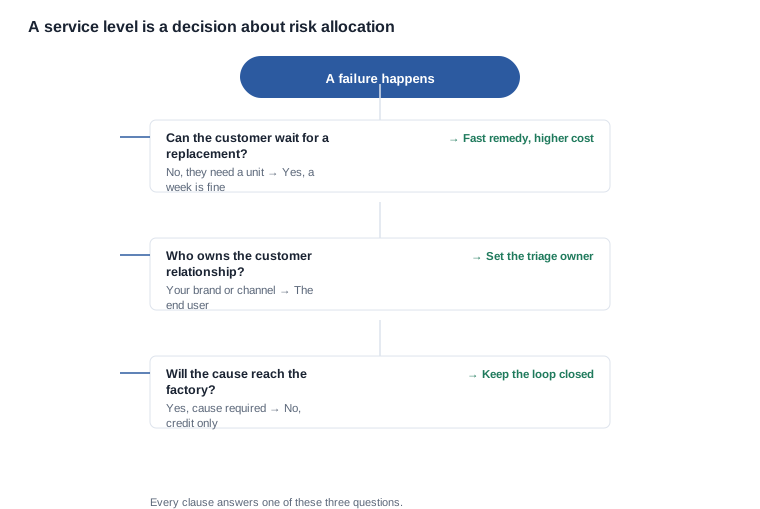
Smart glasses service levels allocate risk before they promise speed
Four distinct risks sit behind most service-level conversations, and buyers routinely negotiate them as one because they arrive in one document. Separating them is the fastest way to a workable agreement, because each one has a different natural owner and a different natural timescale.
The delay risk. Something is wrong and the customer does not have a working unit. This risk belongs to whoever's customer relationship is damaged by the gap. For a distributor whose customer is a retailer with a shelf, the cost of the delay exceeds the cost of the unit, and the delay risk is the distributor's to hold. For a brand selling direct through its own store, it is a support-queue problem, and the cost profile is different again.
The cost-of-remedy risk. A replacement is expensive, a credit is not, and the difference between them is usually much larger than the difference between the service tiers. This is the risk that a service level is really about, and the reason the remedy is the clause worth arguing over.
The root-cause risk. The failed unit is returned, or is not returned, and whatever is learned from it either reaches the production line or does not. This risk is almost always the factory's, because the factory owns the process that produced the defect, and it is also the risk most often left unallocated. A claim closed without a cause statement is a claim that recurs on the next unit, and a service level that does not require a cause statement will quietly teach your team to close claims fast rather than to close them properly.
The legal and compliance risk. Whether a product may lawfully be sold in a particular market is a legal question, and it does not become a service-level matter because it arrived alongside one. No service level can make a non-compliant product compliant, and a clause that appears to cover "all regulatory matters" is a clause that will be read literally at the worst possible moment.
Which of the four dominates is a channel decision rather than a product decision, and that is the whole answer to which tier to pick. A buyer who starts by asking a factory for a tier list has started in the wrong place, because the factory's list is organised around the factory's cost structure. A buyer who starts by writing down which of the four risks is largest in their own channel has started in the right one.
Weighting the four risks is easier than it sounds, because you can do it without any published data. For each risk, write two sentences: what it costs you if it happens once, and how often you think it will happen. The cost half is often easier than it looks — a missing unit on a shelf, a refund, a negative review, a chargeback, a week of a launch schedule. The frequency half is the harder one, and the honest answer in this category is that you do not yet have field data for a new programme, which is precisely why the agreement matters: the service level is the mechanism by which you acquire that data, because the cause statements it produces are your defect-rate history. A programme with no service level has no way of learning what its failure modes actually are, and a programme that learns has a much stronger position at the renewal negotiation.
That also reframes which side of the trade-off you should push. A buyer who wants a cheap service level is asking the factory to absorb an unbounded risk, and the price the factory quotes will reflect that expectation. A buyer who wants a fast remedy and pays for it is buying a defined commitment, and the same factory will usually quote better on a programme where it knows where its exposure ends.
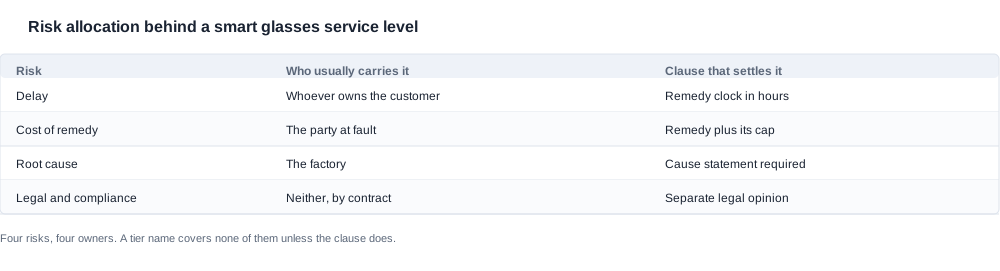

The four mechanics a smart glasses service level must specify
Strip away the tier names and every workable service level in this category is the same four mechanics. A document that specifies fewer than four is a policy statement, and a policy statement is what a customer reads when something has already gone wrong.
The trigger. The event that starts the clock, named precisely enough that both parties agree on it. "When the customer reports a defect" is a trigger, and it is a weak one, because it leaves the judgement of whether a defect exists to the party with the least incentive to concede it. "If quality issues arise" is not a trigger at all, because it never identifies whose judgement decides that they have arisen. Useful triggers are narrow, written as a list, and cover the failure classes you actually expect: a functional failure, a cosmetic failure against an agreed standard, a missing or incorrect accessory, a shipping discrepancy, a documentation issue, and a component substitution the factory made without approval.
The two clocks, separately. A response window and a remedy window are different commitments, and a supplier who commits to "48 hours to respond" has committed to nothing about the replacement unit. The response clock measures acknowledgement and triage. The remedy clock measures the point at which the buyer has a working unit or a credit. Only the second one is commercially meaningful, and it is the one that is usually left vague.
The remedy. Replacement, rework, credit, root-cause report, or a defined combination. A service level that stops at "respond" leaves the buyer with an obligation and no recourse, which is worse than having no service level at all, because it sets an expectation that the document cannot meet. The remedy also needs a stated boundary — a cap, a time limit, an evidence requirement — otherwise the remedy becomes the supplier's open-ended exposure and the negotiation will reflect that.
The named owner on both sides, and the disposition of the failed unit. A service level without a name is a policy. And a service level that does not say what happens to the returned unit leaves the single most valuable piece of evidence in the programme unaccounted for: the thing that failed is usually the only specimen of the defect, and the only way the root cause reaches the line is if the unit comes back and gets analysed.
Two drafting mistakes are worth naming because they are so common. The first is writing the trigger around a cause rather than around an event: "if the unit was damaged by the customer" is not a trigger, because who decides that the customer caused it is precisely the question in dispute. Write the trigger as an observable event — the unit does not power on, the unit does not pair, the lens shows a defect, the shipment arrives short — and let the cause be established afterwards. The second is writing the remedy clock as a range, because a range has no floor and a service level with no floor is a request. If the factory can only commit to "five to ten working days", get the five on the record and note what happens at day five, because that is the point at which your own customer will start asking.
There is a third, quieter one: writing the clocks without saying when they start. A clock that starts on "receipt of the claim" is a different commitment from one that starts on "receipt of the claim and the returned unit", and the second is a much weaker one in practice, because the return is in your control and the factory knows it. Where the remedy requires the unit back, say so explicitly and accept that the clock is really about the return.


Choosing a smart glasses service level by channel rather than by tier
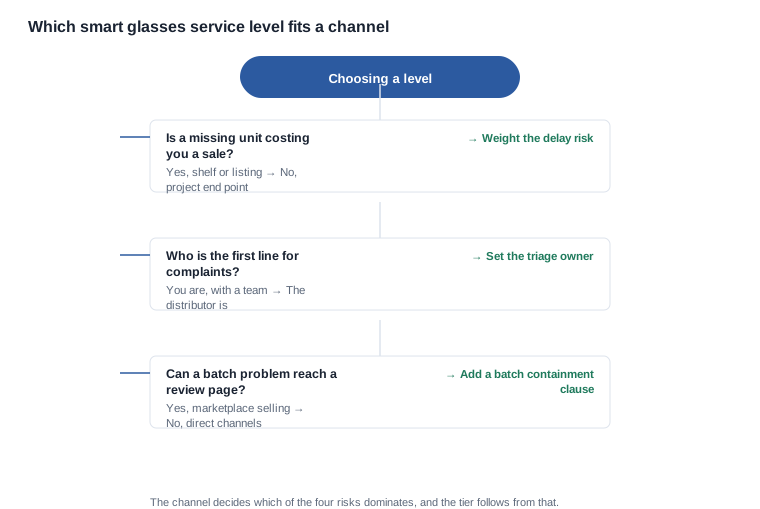
Because the tiers are named differently by every factory, the workable approach is to choose the risk allocation first and let the tier name fall out of it. Four channel situations cover most of the buyers we speak to, and each one needs a different answer.
A distributor selling into retail. The delay cost is the largest of the four, because a missing unit on a shelf costs more than the unit itself. The right allocation gives the distributor a fast remedy, usually a replacement shipped ahead of the return, and pushes the cost of the delay onto the party that caused the gap. What this channel cannot afford is ambiguity about the freight in each direction, because a cross-border return is frequently the largest single line in the whole warranty programme. Ask for the freight cost separately, per direction, per unit, in writing.
An e-commerce seller with a marketplace operation. Here the risk that dominates is a different one: a batch-level problem surfacing as a wave of identical reviews, which damages the listing's standing rather than one customer's day. The right allocation pushes towards a defined containment procedure — how a suspected batch is identified from a serial or a date, how units from that batch are traced, and who decides that a batch is implicated. None of that is a service-level question in most templates, and all of it matters in this channel.
A brand with its own support team. The factory's service level here is not a customer-facing promise; it is a wholesale backline for a team that will do the customer work. The right allocation gives the brand a short remedy clock and a defined diagnostic route, because the brand's people need information as much as they need units, and the information usually lives at the factory.
A project or programme with a defined end point. Here the delay risk is small and the cost-of-remedy risk dominates, because the volume is bounded and known. The right allocation is the conservative one, and the tier name matters least of all. The one thing that still needs writing down is the spares position, because a service level that promises a replacement for three years against a factory that has stopped making the part is a commitment nobody can keep.
The trade-off across all four is the same one: the faster and the more generous the remedy, the higher the unit cost and the less certainty the factory can give you about lead time on the replacement itself. A service level that promises a two-day replacement but does not promise that the replacement can be built is a promise about the shipping of a part that may not exist. That single check — whether the replacement path is separate from the new-order path — is the most useful question to ask, and it is the one most often left unasked.
A worked example makes the allocation concrete. Take a seller with a single marketplace store, two thousand units a year of one camera model, and no in-house support. The delay risk is real but small in absolute terms, because a single missing unit does not stop a listing. The cost-of-remedy risk is moderate, and the legal and compliance risk is the one that should dominate the conversation, because a marketplace listing is where an unfavourable customer report travels furthest and stays longest. The root-cause risk is the one that quietly matters most over two years, because a recurring defect on a listing with steady volume damages the account rather than a single order.
For that seller, the right service level is not the fastest one. It is one with a tight cause-statement requirement, a clear containment rule so that a suspected batch can be identified and traced, and a remedy clock that is modest but real. The batch containment rule is the clause that a generic template never contains and that this channel needs most. It is also the clause a factory resists least, because it requires a process rather than a payment, and because most factories already have something like it and have simply never been asked to write it down.

Terms a smart glasses service level should not leave open
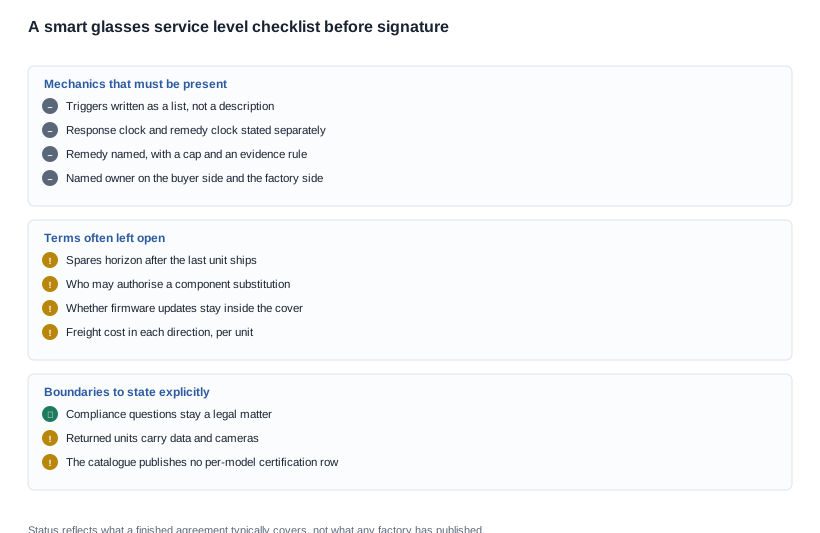
Beyond the four mechanics, a set of terms is routinely left ambiguous and then becomes the argument. These are the ones that cost money when they are unclear, and they are worth settling in the same document rather than in a side letter.
Spares and the end of production. How long the factory commits to supply the part, what the lead time becomes after the programme ends, and what happens to a spares order after the last unit of that revision ships. This is the term that quietly expires first, because it is the one nobody tracks.
Component substitution. Who may authorise it, what notice is given, and what happens to a claim if a failure is traced to a substituted part that was approved at a lower level. A substitution can be entirely benign and still destroy a claim if the process is not documented, because the question "was this approved" is answered by records rather than by recollection.
Firmware and software drift. Whether a unit built six months after the approved sample is still covered, and whether the service level extends to a defect introduced by a firmware update. In a category where the catalogue publishes no capacitive touch row and no translation row, and where the published configuration is the only configuration evidence a buyer has, this is worth writing down explicitly.
Documentation and marking changes. If a colourway, a temple shape, a device name or a packaging component changes after the compliance file was issued, the file no longer describes the product. A service level should say who owns reissuing that file, and at whose cost, because the certification position in this range is a document you will have to request, not one you can read off a product page.
Jurisdiction, freight and disposal. Which party arranges and pays for the return, what happens if the unit cannot be returned economically, who disposes of it, and what data or content on the unit must be dealt with before it is returned. Devices with cameras and microphones in them raise a further question that is easy to overlook and awkward to answer late: what happens to the data on a returned unit.
Negotiating a smart glasses service level with a supplier
The sequence of the negotiation matters more than the tier. Writing the service level last, after price and lead time are agreed, means the last thing you negotiate is the thing that governs every future disagreement, and suppliers price accordingly. Writing it first, before the quotation, is unusual and slightly uncomfortable, and it is the position that produces a better outcome.
Three moves are worth making. The first is to draft the triggers yourself and send them to the factory for comment, rather than asking for their trigger list. The list you send is specific to your channel, and a supplier who edits it is telling you where their exposure lies. The second is to make the remedy clock and the replacement path two separate sentences, because a supplier will often accept the first and resist the second, and the second is the one that matters. The third is to require the cause statement, which costs the factory little and is the mechanism by which a recurring defect gets fixed rather than absorbed.
Due diligence on the supplier's service capability is worth doing as a separate exercise from the commercial negotiation. The useful questions are about process rather than intention: who owns service internally, where a returned unit is received and stored, what happens to the data on it, how a cause statement is produced, and whether a factory audit can include the service area. A factory that will show you the service area is telling you something different from one that will show you the assembly line only, and the difference is worth a great deal in the channels where a single defect travels.
One more negotiation point is worth raising, because it costs nothing and it is frequently the most valuable part of the document: ask the factory to name the clauses it would refuse. A supplier that will tell you in advance which parts of your draft it will not accept is giving you information, and the refusal is usually narrower than the draft. A supplier that responds to a draft service level with a general counter-proposal is giving you less information, because you cannot tell whether the objection is about cost, about capability, or about a genuine limit on what the factory can do. In a service level, capability limits are the only interesting objections, and you want them on the record.
Two things we will and will not do are worth stating, because a service level that promises numbers is how buyers get misled. We will write the trigger, the response clock, the remedy clock and the remedy on the page that carries your specific configuration, with your volume and your destinations, because those are the inputs that determine whether a commitment is realistic. We will not publish standing response-time figures on this site, because a number quoted out of the context of a programme, a configuration and a destination misleads more often than it helps. And we will not state a warranty duration, a service tier list or a spares horizon as published facts, because none of them appear in our published documentation and none of them should be inferred from it.
The scope of what a service level can cover is described under smart glasses OEM, the tier structure and clause detail is in OEM service levels explained, the boundary between warranty and service is covered in what is covered by warranty, and the operational side is in after-sales and warranty support.
Related reading
- Smart Glasses OEM service scope
- OEM service levels explained
- What is covered by warranty
- After-sales and warranty support
Send the configuration, the volume and the destinations and we will tell you what we can commit to.


