

What is covered by warranty on a pair of smart glasses is a question that sounds like a consumer question and behaves like a contract question. Most warranty disputes in this category are not about a broken product. They are about a clause that named a period without naming a scope, or a remedy that turned out to be repair-only when the channel needed replacement, or a return process whose cost sat with the wrong party. A procurement team that treats the warranty line as a marketing sentence will sign a contract it cannot enforce later, so this page sets out the questions that have to be answered before a warranty term is accepted.
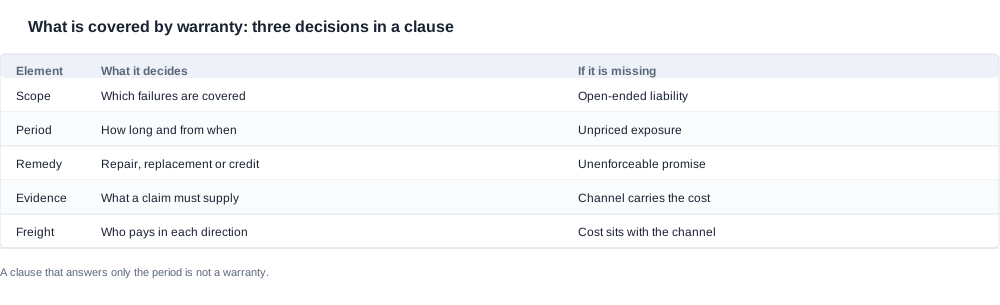
What is covered by warranty: the clause that decides the outcome
A warranty is three decisions, not one number
A usable warranty clause makes three decisions, and a clause that makes only the first of them is the source of nearly every dispute in this category.
The scope. Which failures are covered and which are not. This is the decision that requires product knowledge, because the answer depends on the physical design of the unit rather than on the category label. A camera model with a published ingress marking has a different exposure to liquid than a model with no ingress marking at all, and a model whose inner frame is published as removable has a different exposure to impact damage than one without it.
The period. How long the scope applies, and when the clock starts. A clause that starts at the factory shipment date and a clause that starts at the end-customer sale date transfer value between the parties in opposite directions, and the difference between them can exceed the cost of the units.
The remedy. What the supplier actually does when a covered failure occurs: repair, replacement, credit, or refund, and on what timescale. The remedy is where the commercial value of the warranty lives, and it is the part most often left unstated.
Why a period on its own is not a warranty
A period without a scope is an open-ended liability. A scope without a remedy is an unenforceable promise. A remedy without a period is a one-off gesture. The three have to be present together for a buyer to be able to price the risk, because each of the three changes the commercial exposure in a different direction.
A buyer comparing two suppliers on warranty length alone is therefore comparing the least informative part of the term. Two suppliers offering the same period can be offering completely different liabilities, and the difference shows up as a claim that either succeeds in a week or stalls for a month while the channel absorbs the cost of the replacement stock.

The warranty position this catalogue publishes
The warranty terms this catalogue does not publish, and the physical rows it does
The honest published position on warranty is narrow, and it is worth stating plainly. This catalogue publishes no warranty period, no response commitment, no remedy, no return allowance, no geographical coverage and no claim process for any model. There is no warranty row on any product page, and there is no warranty schedule attached to the range.
What the catalogue does publish is the set of physical rows that determine the failure surface a warranty clause has to address, and those rows are more useful than a warranty number would be, because a buyer can use them to test whether a clause covers the right risks. The camera range publishes a charging method on some models and not on others, a charge time of two hours or less across the range, cell capacities from 40 mAh on the children models through to 290 mAh on several camera models, camera resolution classes at eight and thirteen megapixels, and an ingress marking on two models only. The audio range publishes Bluetooth versions, cell capacities of 55 mAh by two cells, 70 mAh by two cells, 90 mAh by two cells and a single 100 mAh cell, along with the charge time and the rated runtime.
Those rows are the material for a warranty discussion. A clause that covers ingress failure on a model with no ingress marking is either unnecessary or a sign that the supplier has written one clause for the whole range rather than one clause for the product.
It is worth being explicit about why this is more useful than a published warranty figure would have been. A period alone tells a buyer nothing about which failures the supplier actually expects, because a supplier with a narrow product set and a supplier with a wide one can offer the same period and carry entirely different liabilities. The physical rows show the design decisions that create the failures in the first place, so a buyer who reads them can predict the likely claim mix before the first shipment rather than after it. That is a more durable position than a number would have been, and it is the reason a clause written against these rows can be evaluated at all.
The obligation terms a buyer has to request in writing
Everything that turns a warranty from a sentence into an obligation is absent from the published record, and each of the following is an item a buyer has to request in writing from the supplier.
The warranty period, and the date from which it runs. The covered failure categories, listed as failures rather than as marketing language. The remedy for each category, and whether repair, replacement, credit and refund are all available or only one of them. The response commitment, meaning the time from a claim being raised to a decision. The return shipping responsibility and who pays the freight in each direction. Whether a failed unit is replaced or repaired, and whether the buyer receives a spare unit while the failed unit is analysed. Whether accessories are covered on the same terms as the glasses, including a charging case, a cable, a remote shutter and a printed insert. The claim documentation a buyer has to supply, and the window in which the claim must be raised. The geographical coverage, and what happens when a buyer sells through a distributor rather than directly. The treatment of a unit that arrives with a fault that was not detected before dispatch, which is a different process from a failure that appears later. The extended warranty position, if one exists at all. And the spare parts position, which decides whether a channel can service a unit rather than replace it.
There is one more published row that matters here and is easy to overlook, which is the configuration itself. A warranty that refers to a model name rather than to a configuration leaves a gap whenever the factory changes a component, and the supplier's position on whether a changed unit remains covered is exactly the kind of question that stays unanswered until the moment it matters. The published rows give a buyer the material to ask it precisely. The charging method is not published on four camera models, the charging case row is absent on four of the eleven camera models, and the rated runtime bands differ across the range. Each of those is a place where a substitution can occur, and each is therefore a place where the configuration clause has to be specific rather than nominal.
How to ask the supplier to fill the gaps
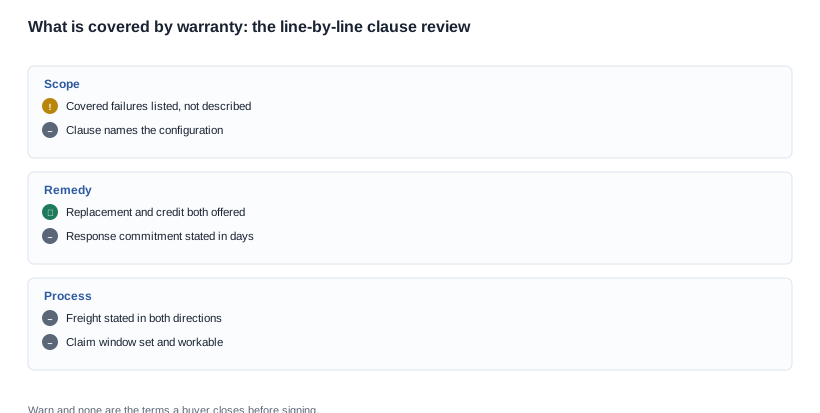
The request works better as a form than as a paragraph. A buyer who asks for the warranty terms will receive a sentence; a buyer who sends a list of the eleven lines above will receive a schedule, and a schedule is something that can be compared between suppliers and written into an agreement.
The order of the list matters. The scope and the remedy are the two that decide the commercial exposure, so they should come first, and the remainder can be treated as detail to be settled later. Where a supplier cannot answer the remedy question at all, that answer is more informative than a long document, and it tells the buyer to price the risk differently rather than to wait.

How to evaluate a warranty against the risk a buyer carries
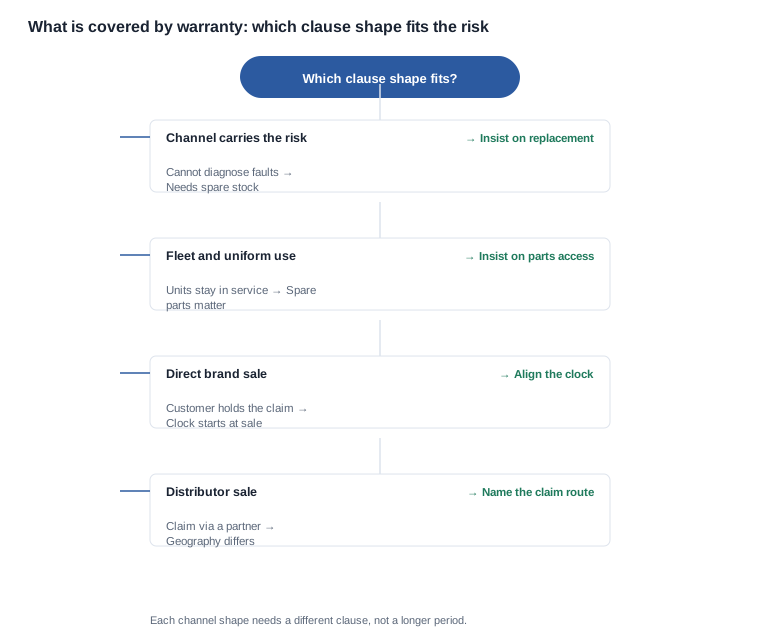
Match the clause to the failure the buyer cannot absorb
The right way to evaluate a warranty term is to start from the failure the buyer cannot absorb, and to work backwards to the clause that covers it. A channel selling a camera model into a retail environment carries a different exposure from a channel supplying a camera model into a uniform and logistics operation, and the same published hardware produces different warranty needs in each case.
The useful test is whether the buyer could survive the most likely covered failure without the supplier's help. If the answer is no, then the remedy line is doing all the work and the period line is decoration. A clause that offers repair only, on a unit that a channel cannot diagnose, produces a channel-side queue that nobody has costed.
The evidence a claim needs, and who assembles it
A claim is only as good as its evidence, and the evidence requirement is a term that has to be agreed in advance because it cannot be negotiated after a dispute.
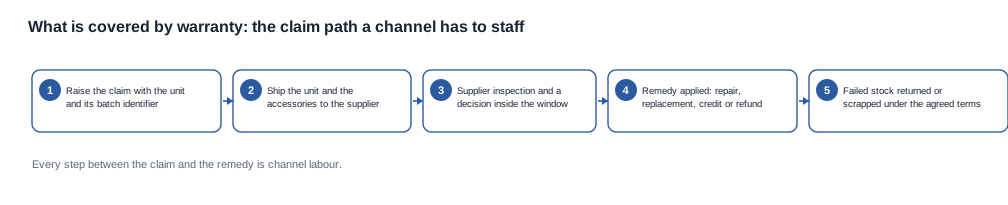
The evidence typically needed is the unit itself with its serial or batch identifier, proof of purchase or the delivery note, a description of the fault in the words the supplier asks for rather than in the channel's words, photographic or video evidence where the fault is visible, the accessories returned with the unit, and a diagnostic result if the supplier requires one. The channel side of that process is not free, and the cost of assembling it is a term the supplier can either support with a simple claim form or make the buyer carry by requiring a full teardown diagnosis first.
The failure modes that make a warranty unusable
A clause that names a product instead of a configuration. Where the warranty names a model and the configuration ordered differs from the configuration tested, the question of which one is covered is answered later, by whoever has more leverage. The fix is to name the configuration.
A clause that excludes the accessory. A camera model used with a charging case, a remote shutter or a replacement cable produces claims about the accessory, and a clause that covers only the glasses turns those claims into channel cost. This matters most for the camera models, where the catalogue publishes a charging case on five of them, a case without a capacity figure on two, and no case row on four.
A clock that starts at the wrong end. A period measured from factory shipment is a period the buyer has already partly spent by the time the unit reaches a customer. A period measured from the end-customer sale is a period the channel carries in stock.
A remedy with no timescale. A replacement without a response commitment is an open-ended liability, and it is the most common form of an unusable clause in this category.
A transfer rule that does not survive a resale. A warranty that dies when the unit is sold again is not a warranty for a channel, it is a warranty for the first buyer only.
A replacement process that only works one way. A channel that receives a replacement unit and ships the failed unit back at its own cost is funding the gap between the two events, and on a first shipment that gap is where the working capital goes. The clause has to say who carries the failed unit and how quickly it has to move.
A definition of failure that excludes the common case. A clause that covers the unit failing but not the accessory failing, or that covers failure inside the published conditions but not outside them, is a clause written for the supplier rather than for the channel. The published runtime bands and the published ingress markings are the natural test for this. If the failure happened within the conditions the catalogue describes, the clause should say plainly that the buyer is covered, because leaving that open is the same as saying it is not.

The commercial terms that make a warranty usable
The points worth negotiating
The warranty term is rarely the largest line in a negotiation, but it is one of the few lines where a small improvement changes the exposure materially. The points worth spending time on are the scope expressed as a list of covered failures, the remedy expressed as a set of available actions rather than a single one, the response commitment written as a number of days from a claim being raised, the freight responsibility stated in both directions, the spare unit question settled so that a channel is not funding the gap while a failed unit is analysed, the accessories question answered explicitly, and the claim documentation window set to something a channel can actually work within.
Two further points sit below the headline. The first is the treatment of units that fail on arrival, which in a first shipment is a meaningful volume and which many clauses handle poorly. The second is the spare parts position, which determines whether a channel can keep a unit in service, and which is worth more to a fleet buyer than an extended period is worth to a retail channel.
Where the cost of a warranty actually lands
The cost of a warranty term is not the cost of the replacement units. It is the cost of the process around them: the freight in both directions, the inspection time, the channel labour that handles the claim, the shelf space the failed unit occupies while it is analysed, and the cost of the customer relationship when the answer takes too long. A buyer evaluating a warranty should therefore ask what the claim handling looks like on the supplier's side, because that is what determines the speed of the answer.
This is also where a channel comparison becomes meaningful. Two suppliers with an identical warranty period can have very different claim handling, and the difference appears as a difference in how many days a channel's cash is tied up in failed stock.
There is a fourth cost that is usually invisible, and it is the cost of a claim that is valid but slow. A channel that cannot answer a customer quickly escalates, and the escalation lands on the channel rather than on the supplier, which is why the response commitment is worth negotiating harder than the period is. The same applies to the aged case. A clause with a period and no stated treatment for a unit that has been in service for a long time is a clause with a quiet hole in it, and a buyer who never asks about it will find the hole on the one claim that matters most.
What a pilot order can and cannot settle
A pilot order is the cheapest way to test a warranty term before it applies to a full volume, and it is worth being precise about what it tests. A small order reveals the claim process: how long a claim takes, how much paperwork the supplier asks for, whether the documentation matches what the clause promised, and whether the replacement arrives as a replacement or as a credit note. Those are the process questions, and a pilot settles them well.
A pilot does not settle the scope question, because scope depends on how failures distribute over a population rather than over a handful of units. It does not settle the question of whether the clause names the configuration, because a substitution made on a small order may never be noticed. And it does not settle the aged case, because a pilot cannot age anything. The sensible conclusion is that a pilot validates the process and leaves the wording to be settled in writing, which is the opposite order to the one most buyers assume.
What we will and will not state about warranty
Our published position is a short one, and we would rather state it than fill it in. This catalogue publishes no warranty period, no response commitment, no remedy, no return allowance, no claim process and no extended warranty position for any model. Everything a buyer needs in order to evaluate a warranty term for a smart glasses order has to be requested from the supplier in writing and agreed in the supply contract.
We will mark each warranty term as published, pending or not applicable rather than presenting a general assurance as if it were coverage, and we will quote a warranty line alongside the physical rows it actually applies to, so that a term written for one model is not read across the range. We will also tell a buyer plainly which of the published rows carry real failure exposure, because an ingress marking on two camera models and no ingress marking on the rest is a fact about the range that a warranty clause has to be built around.
We will not publish a warranty period, a response time or a remedy against a model before the supplier has confirmed it in writing against the exact configuration being ordered, and we will not present a general statement that a product is warranted as though it were a specific, enforceable term.
Send us the models, the configurations, the channel type and the destination market, and we will return the warranty lines that have to be settled for that order, with each one marked as documented or open. That is what is covered by warranty in a form a procurement team can act on.
Related reading
- The support framework behind the term — after sales
- How a claim is raised and handled — how do I claim warranty
- The warranty terms as published — warranty policy
- Where quality claims are assessed — quality claims
- The programme side of the same relationship — OEM and ODM


