

A non-disclosure agreement is the least useful document in smart glasses OEM confidentiality, and it is the one almost every buyer starts with. It stops a supplier from repeating your forecast to a journalist. It does nothing about the supplier showing your design to a competing brand, holding your tooling in a building you do not control, or continuing to make your product after your relationship ends. Those are the failures that actually cost a brand its position, and none of them is stopped by a signature on a two-page mutual NDA.
This article treats confidentiality as what it is in practice: a set of clauses, each attached to the moment at which the relevant information comes into existence, each written to a different subject, and each with a different enforcement mechanism. A single agreement can carry all of them, but only if somebody drafts them as separate obligations with separate triggers. The generic version covers the first moment and does nothing for the other three.
The scope is deliberately narrow, and it is a scope our own documentation forces. The catalogue publishes nothing about who owns a design, an application, a firmware build or any tooling. It publishes no per-model certification row, and the export-certification page is a picture page carrying ten patent certificate images — eight design patents and two utility models — rather than a certification record. CE, FCC, RoHS, RED and EN 18031 do not appear in the catalogue body at all. So there is no published position to inherit here, and nothing in this article should be read as one. What follows is contractual practice: what to write, when to write it, and what each clause is actually for.
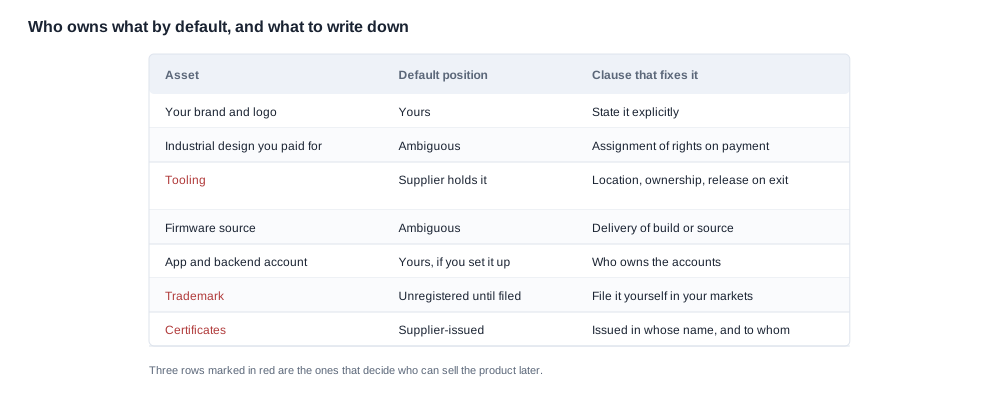
Smart glasses confidentiality is a clause set, not a single document
Four kinds of asset are at stake in a smart glasses programme, and they are protected by entirely different instruments. Buyers tend to treat confidentiality as a single risk and then discover, one dispute at a time, that the instrument they signed does not reach the asset that was actually taken.
The appearance and the industrial design. This is the part that makes the product recognisable. It is protected in two ways: by registration, where the mechanism is a trademark filing for the brand and a design registration for the appearance, and by contract, where the factory commits not to develop a directly competing product from your brief. The registration is the stronger protection and it is entirely within your control, because it does not depend on the factory's good behaviour.
The firmware, the app behaviour and the acoustic tuning. This is the part a competitor cannot reverse-engineer from a finished unit, because a finished unit shows the result and not the method. It is protected almost entirely by contract, and it is the part most likely to leak, because it circulates as ordinary engineering material: board files, firmware builds, tuning parameters, test scripts.
The commercial plan. The forecast, the target price, the cost structure, the launch dates and the named customers. This is the part with the shortest useful life and the widest circulation, because it is discussed in every commercial conversation by definition.
The tooling and the production assets. The moulds, the fixtures, the test jigs, the packaging tooling, and the firmware signing and provisioning infrastructure. Physical assets sit in the factory's building, and digital assets sit in the factory's accounts. Both need a named owner and a route out.
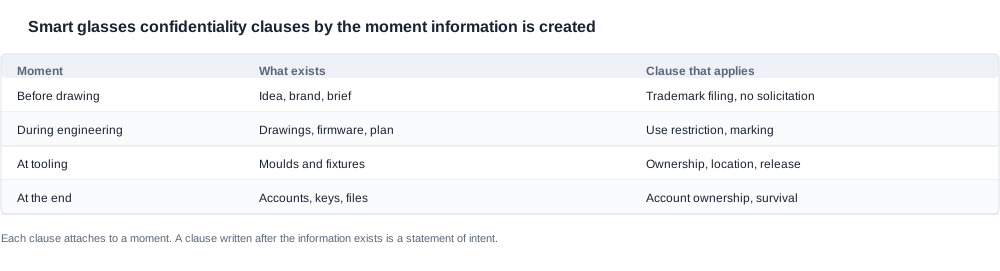
The most useful way to think about the clause set is as a mapping from information to moment. Information is created at a specific point in the programme, and the clause that protects it should be written at or before that point, because a clause signed after the information has already been shared is a statement of intent rather than a protection.
A worked scenario shows why the mapping matters more than the document. You have launched a camera glasses product under your own brand, with a firmware build you developed, a tuning profile for the open-ear acoustics, and a first order that has now shipped. Eight months later a competing brand of roughly the same size approaches the same factory with a similar brief. The question is not whether anyone would do this deliberately. It is whether anything in your arrangement prevents it, and whether anyone can tell afterwards.
Under a standard mutual NDA, the answer is no. The NDA covers disclosure of documents, and a factory showing a concept rendering to a potential customer in a meeting room is arguably not disclosing a document. Your firmware and your tuning do not leave your building, and the competitor's product simply converges on them, because the factory already knows how you solved a problem it now has to solve for someone else. What would have stopped it is a use restriction attached to the firmware and the tuning, a no-competing-product commitment tied to material identified by name, and the practical measure of keeping your own accounts so that a change of supplier does not mean a change of everything.
That is the difference the clause set makes, and none of it is visible in the NDA.
The clauses also have a price, and a buyer who negotiates them without acknowledging that will get less than they expect. A factory asked to hold tier-one material under a use restriction, to commit not to develop a competing product, to own the tooling on the buyer's payment and to release it on request, and to keep a spares position for the life of the product, is accepting four separate constraints. Each of them appears in the quotation as a condition, and a factory that has priced the constraints will say so — not by refusing, but by returning a quotation with a higher NRE, a different lead time, a different MOQ and a different payment term than the one you expected. That is not a penalty. It is the price of the protection, and a buyer who treats the clause set as free is asking for something that does not exist.
The audit angle is worth adding to the negotiation. A factory audit does not usually cover the confidentiality arrangements, but it can, and the version that does is more useful than it sounds: ask to see how a returned unit is stored, who can access it, whether it is logged, and what happens to it after analysis. A factory that receives units back from a customer has physical access to a competitor's product in a way that the clause set alone cannot control, and the storage and disposal procedure is the practical part of the promise. It is also the part that a buyer can observe during a visit, which means the same visit that establishes the assembly line can establish this.

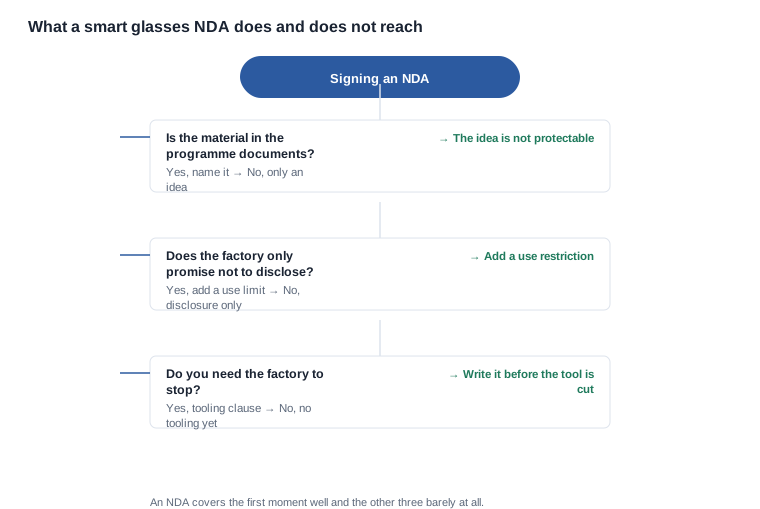
What an NDA does not cover in a smart glasses programme
Four gaps are worth naming directly, because the expectation that an NDA closes them is the source of most disappointing outcomes in this category.
Exclusivity. An NDA does not create it and cannot be negotiated into a general one. A factory that will not develop a directly competing product for a named period is making a specific, narrow commitment, and the commitment is only as good as the product definition inside it. "No competing product" is unenforceable because nobody can agree what competing means. "No product for any other customer using the appearance, the firmware or the acoustic tuning developed under this programme, for the duration of the order plus a defined period" is enforceable, because it is checkable against the programme's own documents. That distinction is the whole clause.
Protection of the idea. The concept of the product, the target segment and the business model are not protectable by contract in any practical sense. No NDA creates a right to stop somebody who independently arrives at a similar idea, and clauses that appear to do this are routinely struck out or found to be unreasonable, which weakens the rest of the agreement. What can be protected is the specific material the factory receives: the drawings, the code, the files, the plans.
The factory's own learning. A factory that works on your programme learns how to build a product like yours, and no reasonable NDA prevents that. Attempting to prevent it is both commercially unwise and legally fragile. The workable approach is to accept the learning and limit the reuse of the specific material: the files, the tuning, the drawings, the firmware, the app. This is the point where a buyer who is negotiating a real clause should also be honest about what they are asking for, because a factory that accepts an unreasonable restriction will price the risk into the quotation or ignore it.
The information you gave them. If the forecast you shared was inflated to improve the quotation, the factory now believes it, and the factory will build its planning around it. Nothing protects you from that, and it is a self-inflicted leak. A commercially realistic forecast is one of the most effective confidentiality controls available, and it costs nothing.

The four moments where smart glasses information is created
Following a launch through its life makes the structure obvious, because information arrives in a sequence and each step needs a different clause.
Before the first drawing. What exists at this point is an idea, a brand name and a requirement brief. The idea is not protectable. The brand name is, and the highest-value step in the entire sequence is to file a trademark for it in the markets you intend to sell into, before you announce it, because registration is the only protection that does not depend on anybody else's conduct. What to write down at this point is narrower and more useful: that the factory will not approach your named customers with a competing offer, and that it will not develop a directly competing product using your brief. Both are commitments a factory can actually make, and both are routinely left out of the first agreement because they do not feel important until the year they matter.
During engineering. This is where the leakage actually happens, and it happens as ordinary work: drawings move, board files move, firmware builds move, test scripts move, and the cost structure and forecast appear in every quotation. The protections that work are structural rather than contractual. Splitting the work so that no single party holds the whole picture reduces the value of any one leak, and it is worth doing even when the contract is airtight, because contracts are breached under time pressure and structures are not. Keeping the forecast realistic, as above. And marking your own documents clearly — a document convention with your name and a revision discipline — so that a leaked file is attributable and so that a dispute is about a specific artefact rather than about a suspicion.
When the tooling is built. The relationship changes most here, and this is where the weakest terms usually sit, because by the time the tooling clause is drafted the tooling already exists and the factory already knows how much it is worth. Tooling is a physical asset in somebody else's building. If you have not written down where it is, who owns it, who maintains it, how it is identified as yours, and what happens if you leave, then at the end of the relationship you hold a preference rather than an asset. The clause that solves most of this is short: ownership passes on payment, the tool is marked and located in a list, and there is a defined route to release, transfer or scrap it. Note the published boundary again — our own documentation says nothing about who owns tooling, so this has to be written per programme rather than assumed from a general policy.
At the end of the relationship. The question buyers forget, because the programme is over and attention has moved on. What happens to the firmware, the app, the backend, the cloud accounts, the signing keys and the certificates on the first working day after the supplier stops? The protection is ownership of the accounts, and it is only effective if the accounts were set up under your own names from the beginning. If your app is on your developer account and your backend is on your domain, moving is a configuration task. If the supplier created them under their accounts, moving is a project, and it is a project that will be attempted under time pressure during a difficult handover. This is the one area where the cost of getting it right in advance is trivial and the cost of getting it wrong is the entire software estate of the product.

Separating the smart glasses information worth protecting
Not everything deserves the same protection, and treating everything as confidential has a cost that shows up in the quotation and in the relationship. A workable programme sorts the material into three tiers and attaches a different mechanism to each.
Tier one, commercially decisive. The files that let a competitor produce the same product: the industrial design drawings, the firmware source and signing keys, the acoustic tuning, the app and the backend, the test scripts, the supplier's own component selections where they are non-obvious. These are the ones to restrict by use, not merely by disclosure, and to mark.
Tier two, operationally useful but not decisive. The bill of materials with pricing, the production test records, the yield data, the quality history, the forecast, the launch plan, the customer list. A competitor holding these improves their position but cannot reproduce the product. These are the ones to keep confidential under an ordinary use restriction, and to share on a need-to-know basis with a clear marking convention. The trade-off here is real: restricting the bill of materials and the cost data too tightly makes it hard for you to run cost-down programmes, and the usual outcome is that the restriction is quietly ignored. Better to mark them and rely on the use clause.
Tier three, already public or inherently generic. The published catalogue specification, the model family structure, the market category, the general technology approach, the certification route. Restricting these achieves nothing, because the factory's customers also know them, and pretending otherwise weakens the credibility of the clauses that matter.
Two practical problems appear when a programme tries to sort material into tiers, and both are worth planning for. The first is that the tiers move as the programme goes. A component selection that is generic in month one can become decisive by month six, because a tuning decision or a firmware structure that was obvious early becomes a defensible advantage later. The practical answer is to re-sort at the specification freeze rather than at the start, and to write the tier-one list against the frozen specification so that it stays accurate.
The second is that a factory will push back, and the pushback is usually informative. A factory that objects to a use restriction on the firmware may simply have a standard clause it uses with every customer, or it may be telling you that it does not intend to develop anything for a competitor in that category, in which case you have learned something useful for free. The distinction is worth making explicitly, because the response to a workable clause is usually a narrower clause, and the response to an unreasonable one is a refusal. Narrowing a clause that is too broad is a normal negotiation; a flat refusal to discuss it is information about the counterparty.
The trade-off to manage is the cost. A factory asked to hold tier-one material under a use restriction, and to run a programme with named-customer and no-competing-product commitments, is being asked to accept real constraints, and it will reflect them in the price or in the relationship. The alternative — a narrow NDA and silence on the rest — is cheaper at the start and much more expensive at the end, because the end of a relationship is when a tier-one leak does its damage and the clause you would have needed does not exist.
Writing smart glasses confidentiality clauses that survive the order
A clause is worth writing if it survives two tests: a dispute, and the end of the relationship. A clause that only works while the parties are getting along is not a clause, it is a courtesy.
Eight elements carry most of the weight, and each one attaches to a moment identified above.
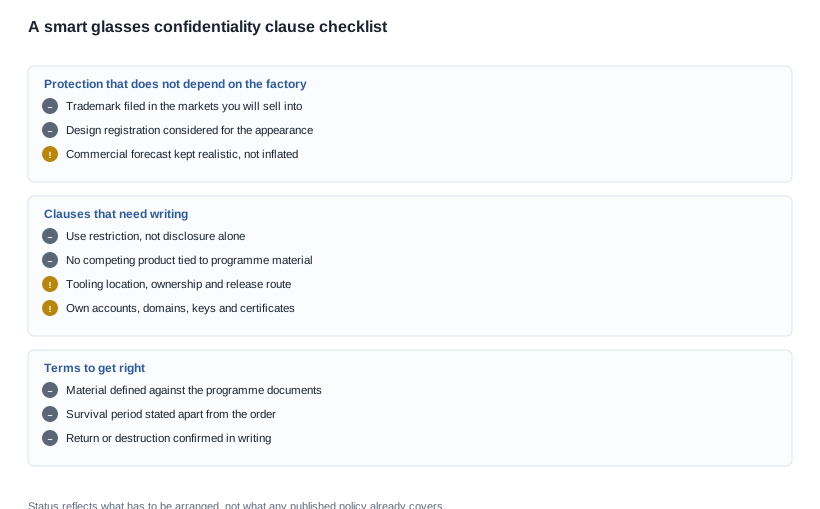
- Definition of the confidential material. Tie it to the programme's own documents — drawings, firmware builds, source files, tuning data, test scripts, the commercial plan — rather than to "all information", which courts and arbitrators treat inconsistently and which a factory can satisfy by producing nothing.
- A use restriction, not only a disclosure restriction. The factory may use the material only to perform the programme. Without this, everything is permitted provided it is not shown to a third party, and showing a design to a competing brand in a meeting room is not a disclosure to a third party.
- A non-solicitation commitment about your named customers, and a defined no-competing-product commitment tied to the programme's own material, with a duration. Both are the commitments a standard NDA does not make.
- Tooling: location, ownership, marking, maintenance and release. Physical assets need a physical clause, including what happens if the relationship ends early and the tool is mid-life.
- Accounts and registrations. Your own developer account, your own domain, your own cloud tenancy, your own certificates where obtainable. This is the difference between a handover and a project, and it should be settled at the start rather than at the end.
- Term and survival. A confidentiality term that expires with the order is a term that expires at exactly the wrong moment. The survival period should be stated separately from the order, and for the commercially decisive tier it should be long.
- Marking and handling. A document convention, a return or destruction obligation at the end, and a written confirmation when it happens. In this category the material is physical, it is in a factory, and it is generally not returned, so the destruction confirmation is worth more than the clause that requested it.
- A named contact on both sides. Not a department. Confidentiality is handled by people, and the people change.
Two things we will and will not do are worth stating. We will write all of these into the agreement for a specific programme, and we will write them so that they describe the programme in front of us rather than a generic category. We will not state a published position on who owns any design, application, firmware build or tooling, because our documentation contains none, and a general claim would be worth less than the specific clause in your own agreement.
Two cross-border practicalities are worth adding, because a confidentiality clause drafted in one jurisdiction and relied on in another is where the best intentions are usually lost. The first is enforceability: a clause is only as good as the forum, and if the factory is in a different legal system, the document that matters is the one that says which law governs and where a dispute is heard. The second is the practical enforcement of a use restriction across a supply chain. If the factory subcontracts a component or a service, the clause has to reach the subcontractor, and the way to do that is to require the factory to flow down equivalent obligations rather than to try to bind third parties you have never met.
The broader question of what to settle at contract stage is covered in smart glasses oem quality expectations, and the design and ownership question in a different form is in who owns the design.
Related reading
- What to settle at contract stage more broadly: smart glasses oem quality expectations
- The design and IP ownership question in FAQ form: who owns the design
Tell us the markets and the product category and we will tell you which of these steps apply to you and which are already handled by your structure.


