

Who owns the design is one question with five answers, and a programme that treats it as one question ends up with a dispute instead of a product. The industrial form of the frame, the mechanical arrangement behind it, the firmware and the app, the brand marks and colourways, and the written content that surrounds the product are five separate assets with five separate owners, and the most common failure in an OEM relationship is a clause that was written for one of them and has been applied to all five.
This page is written for the brand owner who has to decide the position before a first order rather than after a first shipment. It sets out the two commercial routes a programme can take, what our own published records can and cannot settle, the clause set that decides ownership in practice, and the questions to put to a supplier. It also states which parts of the answer are not published on this site, because our catalogue carries twenty-eight entries and no per-model ownership row, so no amount of reading it will tell you who owns the design of a particular model.
The reason this deserves the attention is that the design asset is the one part of the product a brand cannot replace at short notice. Tooling, firmware, the app and the packaging can each be re-sourced, and a supplier can be changed. The industrial design of the frame is the opposite: it is embedded in the tool, it is on the product, it is on the packaging artwork and it is in every photograph the brand has already published. If ownership of that is unclear, the brand's exit options are narrower than it believes, and the exit options are worth more at the start of a relationship than the unit price.

who owns the design: five assets that are routinely confused
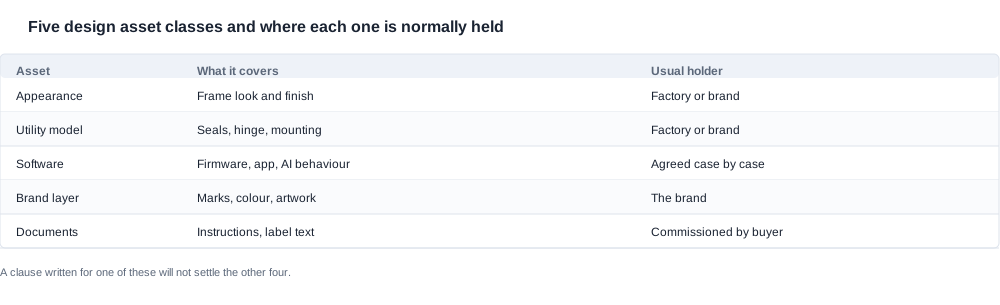
The first asset is the appearance design — the external look of the frame, its proportions, the temple geometry, the finish and the visible detailing. The second is the utility model — the mechanical and structural arrangement that produces that appearance: how the enclosure is sealed, how the electronics are mounted, how the hinge and the temple are built. The third is the software: the firmware on the device, the companion app, the cloud service if there is one, and any AI behaviour the brand markets. The fourth is the brand layer: the trademark, the logo, the colourways, the packaging artwork, the photography and the copy. The fifth is the documentation content: the instructions, the safety information, the label wording and the test reports that support the conformity position.
Each of the five can be held by a different party, and in most working relationships they are. A brand typically owns the fourth outright and the fifth by commissioning it, holds the second and the third under a negotiated arrangement with the factory, and has some form of licensed or assigned position on the first. When a dispute arrives, it is nearly always about the first or the second, because those are the assets with resale value.
There is a specific trap inside the third. Firmware and app ownership are frequently left out of the design clause entirely, on the reasonable-sounding assumption that software is not design. It is, in the sense that matters here: a brand that has paid for a branded interface, a branded voice assistant behaviour or a branded arrangement of the product's controls has made an investment in the software asset whether or not it is named in the contract. Our own product record makes the same point from the other side. The customisation capability recorded for the children's category — the app and firmware customisation specifically — is marked there as still to be verified, so even the supplier-side position on that category is not settled in our records.
A second trap sits inside the fourth, and it is more mundane. Colourways are often treated as marketing rather than as design. In our published catalogue, colour is published for two camera models only: the V03 Pro with orange, off-white and black, and the V06 with orange, ice-blue, white and black. Every other entry publishes no colour row at all. That distribution is worth reading carefully by a brand owner, because it tells you where our own published designs have been extended into multiple colour treatments and where they have not — and it is exactly the kind of detail that a brand may assume it owns once it has been seen in a photograph.
What our own published records can and cannot settle
Our published position on design ownership is narrow and we will not dress it up. Our product catalogue contains a company-level export certification page, and that page holds ten patent certificates — eight appearance designs and two utility models. That is a genuine statement about our portfolio. It is not a per-model statement, and it is not an assignment to any brand. The catalogue publishes no row anywhere that maps a patent to a model, and it publishes no ownership or licence row for any of the twenty-eight entries.
Three further limits are worth stating because they affect how a brand can use the catalogue as a diligence tool. The first is that none of the twenty-eight entries comes with photography, video or test-report evidence in our product record, so a brand cannot audit the design assets from the file. The second is that three entries — the AR model, the electrochromic model and the bone-conduction model — are published without a formal SKU, so for those there is no published identifier against which an ownership record could be attached. The third is that our product record flags several open items in the catalogue itself: the L2 Utral carries a variant spelling whose intended form is not stated together with a second variant name whose meaning is not stated, the MT5 carries a doubtful product classification, and the A05 and the A06 publish identical parameters with the difference between them marked unconfirmed.
That last group matters more for design ownership than it appears to. A brand that intends to re-label or to re-badge a product needs a clean, unambiguous product identifier, because a licence that covers "the L2 Utral" is not a licence that covers whichever of two named variants turns up in a shipment. The same applies to the A05 and the A06 pair, where our own record cannot state what distinguishes the two. These are diligence items, and they are cheap to resolve with a supplier and expensive to discover at the point of a shipment being held.
There is one category where our records say almost nothing, and it is the category a brand is most likely to want to differentiate. The electrochromic entry publishes no photochromic performance parameters at all, which means there is no published basis on which a differentiation claim could be made for it, and correspondingly nothing in the record for a brand to allocate a design claim over. The bone-conduction entry publishes an amplification gain of 35 dB, and our record marks that figure as carrying the highest regulatory risk in the range, with the customisation capability for that category not disclosed at all. Neither of those is a problem for a buyer who wants a catalogue product with a supplier's design. Both are a problem for a buyer who intends to build an exclusive product line on the basis of it.
Where ownership actually changes hands
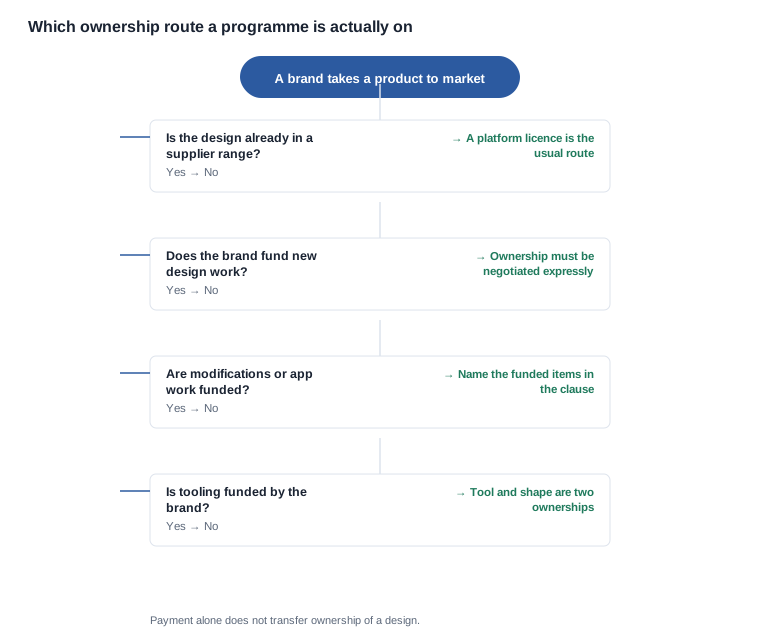
There are two commercial routes, and almost every programme is on one of them or on a third that combines them. The route determines which clause set matters, so it has to be identified before anything is signed.
Route one: platform adoption. The brand selects an existing design from a supplier's range and sells it under its own mark, changing the colourway, the logo and the packaging and otherwise leaving the product as it is. In this arrangement the factory normally retains the underlying appearance design and mechanical assets and grants the brand the right to use them for the products it orders. The brand's own brand layer and documentation are its own. This route is fast, cheap and low-risk, and its characteristic failure is that the brand later believes it owns a design it has merely been licensing, and plans an exclusive sub-line on that basis.
Route two: bespoke development. The brand funds the development of a design intended for it, either as a modification of the supplier's platform or as a new industrial design. This is where ownership has to be dealt with expressly, because the default assumption that payment transfers ownership is exactly the assumption that has to be checked against the signed document. The commercial reality is that in bespoke development the factory often retains the industrial design and licenses it exclusively to the brand for a period, with ownership transferring only on a later trigger. A brand that has assumed immediate assignment and then discovers an exclusive licence with a performance condition has a structural problem, not a paperwork one.
Route three: the hybrid, which is the most common. The brand adopts a platform, funds a set of modifications — a different temple, a different front, a different interface arrangement, a different colour treatment — and adds its own firmware behaviour and app. This is where the dispute risk concentrates, because "modification" and "derivative work" are not the same concept. The modifications the brand funds may be owned by the brand while the underlying platform remains the factory's, and the brand's right to keep using the modified product after the relationship ends depends on which of the two the licence is drafted to cover.
Three triggers change the picture in route two and route three, and they are worth putting on a checklist because they are the moments at which a short reply causes long trouble. The first is the approval of a design change: the moment the brand signs off a drawing, it may be creating a joint work whose ownership depends on the agreement rather than on the payment. The second is tooling: the brand that funds the tooling for a new enclosure has usually funded an asset that physically embodies the factory's design, and the ownership of the tool and the ownership of the shape it produces are two different questions. The third is the launch: artwork, photographs and listings are published at launch, and a launch that happens before the ownership position is documented is the point at which the brand's marketing becomes evidence of its own assumptions.
The confidentiality route deserves separate treatment because it is often confused with ownership. The OEM confidentiality reference covers what a confidentiality undertaking is for: stopping the factory from selling the same product to a competitor, and stopping either party from disclosing the other's commercial information. Confidentiality does not transfer ownership, and an NDA signed without a design clause leaves the ownership question exactly where it was. A factory that is bound to confidentiality and unbound on ownership is a factory that can lawfully sell the same design to somebody else.
The clause set that decides it
Most of the ownership position is settled by six clauses. Each one is a term to negotiate rather than a position to assume, and each one has a question attached to it that is easier to answer before the agreement than after.
- Assignment of existing and future designs. Does the factory assign the industrial design and the utility model to the brand, license them exclusively, or retain them? The answer should name the models, not the range, because our published range includes three entries with no formal SKU and one pair the catalogue cannot distinguish.
- Scope of the licence. Which products, which markets, which channels, which period? A licence without a term and without a territory is either meaningless or accidentally perpetual.
- Ownership of brand-funded modifications. Who owns a funded temple change, a funded colour treatment, a funded interface arrangement? This is the clause that settles the hybrid route, and its absence is the single most common gap in a first agreement.
- Tooling ownership and transfer on exit. Who owns the tool, what happens to it if the programme ends, and on what condition is it released?
- Firmware and app. Who owns the brand's software modifications, what source is delivered, and what happens to the brand's data and its app accounts when the relationship ends?
- Survival and exit. Which clauses survive the end of the relationship, and what rights does the brand keep over the products it has already shipped? The long-term support and engineering reference covers the operational side of that question, and it is usually the clause that decides whether a brand can continue to service its own customers after a supplier change.
The reason the clauses have to be category-specific rather than range-wide is visible in our own records. The customisation axes recorded for the camera category number seven, for the audio category five, for the sport category five and for the children's category two, and those sets do not overlap one another: the audio category carries no logo axis and no firmware axis, while the sport category carries a remote-control axis the other categories do not have. A single clause written against "the range" therefore leaves a gap in at least one category, and the gap is usually in the one the brand treats as the side line. Which model a brand expects to be the volume product is not necessarily the model whose ownership position is the most exposed, and the shortlist is worth building with that in mind.
Two clauses are worth adding beyond the six, and both protect the brand's marketing rather than its product. The first is a confirmation that the supplier has the right to license what it is licensing — a right to grant is a separate question from ownership, and a factory that has itself licensed a platform from a third party cannot grant more than it holds. The second is a change-of-control provision, so that the design position is not quietly transferred to a new owner by an acquisition on the supplier's side.
The questions a buyer should put to a supplier about design ownership
Design ownership is one of the last things a sourcing conversation addresses and one of the first things a buyer wishes had been addressed earlier. Seven questions cover most of the ground, and they are worth asking in this order because each one depends on the answer to the last.
- Which patents or registered designs cover the models I am quoting, and can the supplier evidence the filing for each one?
- Who is the registered proprietor of each, and are they the same entity that will sign my supply agreement?
- On what basis is the design made available to me — assignment, exclusive licence, non-exclusive licence, or no grant at all?
- What do I own outright if I commission a modification, a colourway, an interface arrangement or an app screen?
- Who owns the firmware and the app, and what is delivered to me if the relationship ends?
- Who owns the tooling, and on what condition is it released if the programme stops?
- Is any part of the product built by a subcontractor, and who holds the design rights in that part?
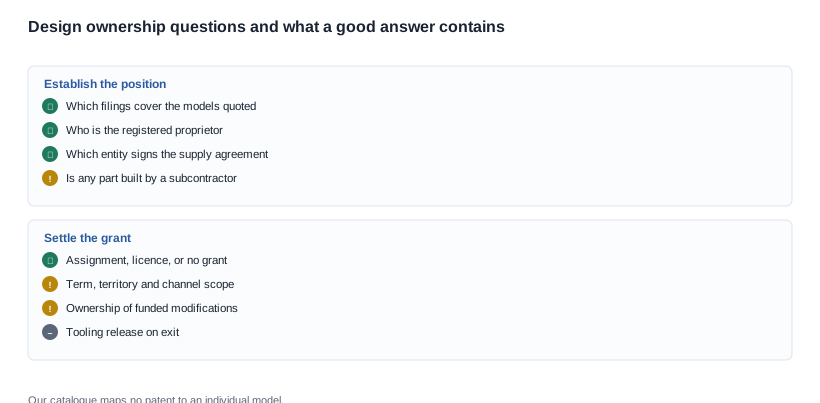
The first question is the one that most often cannot be answered cleanly, and the reason is on our side of the table as well. Our published records identify eight appearance-design patents and two utility-model patents, but they do not map them to individual models, so a buyer who wants a per-model position has to ask for a per-model position rather than assume the catalogue supplies one. Any supplier that answers route one questions clearly and route two questions vaguely is telling you which route it is on.
There is a due diligence step beyond the questions, and it is the one most often skipped: verify the answer against something other than the supplier's own statement. The register a design is filed in, the corporate name of the proprietor, the entity on the supplier's business licence, and the entity that signs the agreement are four separate things, and comparing them takes an afternoon. Where they do not match, the agreement should say which one grants what. Buyers who run that comparison usually find fewer surprises than they expect and a materially clearer position than they would have had.
The boundary of what we can publish on design ownership
We do not publish an ownership or licence position for any of the twenty-eight entries, and we will not present the ten patent certificates on our export certification page as though it were a per-model design record. What we do publish is the structure: twenty-eight entries across the camera, audio, sport, children's and three SKU-less categories; eight appearance-design patents and two utility-model patents held at company level; customisation axes recorded per category at seven for the camera category, five for the audio category, five for the sport category and two for the children's category, with those sets not overlapping one another, which is why a single clause covering "the range" leaves gaps; the app and firmware customisation capability for the children's category marked as still to be verified; and the customisation capability for the bone-conduction category not disclosed at all.
We will also tell you exactly where our own catalogue is ambiguous, because a buyer should not pay for the ambiguity: two camera models publish colour rows and the rest publish none; the L2 Utral carries two variant names with no stated meaning; the MT5's classification is marked doubtful; the A05 and the A06 publish identical parameters with the difference unconfirmed; three entries have no formal SKU; and no entry comes with photography, video or test-report evidence in the product record.
What we will not do is state a position on ownership for your programme, because that is decided by what you commission and by the document both parties sign. If you tell us which models you are considering, which modifications you intend to fund, and whether you plan to extend the product after the relationship ends, we will tell you which published rows bear on the question, where our records record an open item, and which of the six clauses has to be negotiated to put the design position where you want it.


