

Two quotations arrive on the same morning. One is a single figure with a validity date attached. The other is eight lines long, and one of those lines explains why the two numbers differ by more than the change in quantity would suggest. The second quotation is not more expensive. It is more useful, and a buyer who works from it will spend the next three weeks negotiating on things that can genuinely move.
The uncomfortable habit in this category is to negotiate the unit price first. It is the only number on the sheet, so it gets the attention. But a unit price in a smart glasses OEM quotation is an output, not an input. It is what remains after configuration, packaging, documentation scope, customisation depth and quantity have already been decided, and most of those decisions were made before the price was computed.
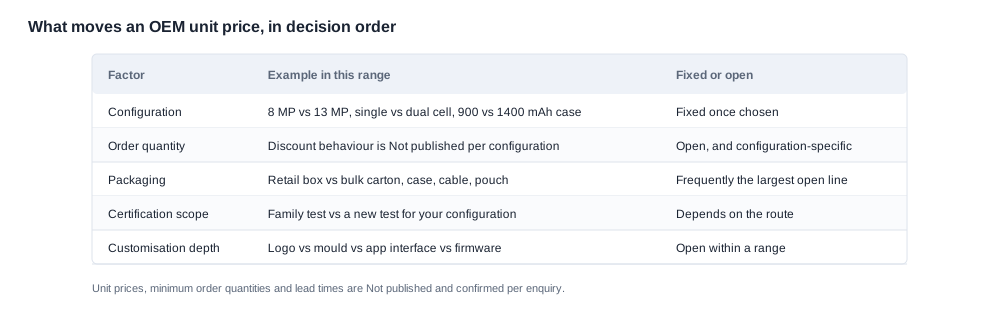
So the useful question is not "how do I get a lower number". It is "what has already been decided on my behalf, and which of those decisions is still open". That reframing is the difference between a negotiation and a complaint.
Smart glasses OEM pricing factors: what actually moves the number
The factors are usually listed as a flat set of variables, which is misleading, because they are decided in a sequence and each one narrows the ones below it.
Configuration comes first, because it fixes the bill of materials. In our published range the configuration differences that carry real cost are visible if you look at the rows rather than the marketing. Camera entries appear at 8 MP across eight models and 13 MP across three. Of the twenty-eight entries across six families, charging is magnetic on seventeen and Type-C on seven, with the charging method not published for four. A charging case is part of the configuration on some entries and not others: capacity is published for five of them, a case exists without a published capacity on two, three carry no case row at all, and one explicitly has no case. Each of these is a different product with a different cost, not a cosmetic variant.
The charging case deserves more attention than it usually gets. It is the single most under-considered line in a smart glasses quotation, because it changes the bill of materials, the packaging, the unboxing proposition, the freight weight and the accessory story on your product page. A quotation that says "camera model" without stating whether a case is inside the box is not comparable with one that does, and a buyer who compares them is comparing two different products and blaming the supplier for the difference.
Colourways and finishes come with their own setup. Our published colour options are narrow, which is worth noting because it tells you where the range is not yet flexible: three options on one camera entry, four on another. Where a colour requires its own mould or its own plating process rather than a change of supplier part, it is a setup item. Where it is only a supplier part swap, it is a variant. Ask which it is, per colour, because the two behave differently in the price and differently in the schedule.
Charge time is a component decision disguised as a specification. Twenty-six entries in the range publish a charge time of two hours or less, and only two publish something faster, at around one hour. Those two are telling you something real about what is inside them, because reaching roughly one hour takes a different battery and different power management from reaching two hours or less. When a buyer writes a charge-time requirement, they are choosing a component, and the price follows. If the requirement is written as an adjective rather than a figure, the factory chooses for you and the price is whatever that choice costs.
Runtime and cell capacity are coupled even when the numbers look independent. Across the camera entries the cell sits in the region of 220 mAh to 290 mAh, and the rated runtime sits in the region of five to eight hours, with no test condition published for either. A buyer who reads a runtime figure as a guarantee will build a claim the documentation does not support. A buyer who reads capacity as the specification will get a different product from the one the listing implies. The pricing point is simple: ask what the runtime is measured under, because the component chosen to deliver a runtime under a stated condition is not always the component chosen to deliver a runtime under an unstated one.
The published data is uneven, and the unevenness is itself a pricing signal. Bluetooth version is published for half of the range and not published for the rest. Charge time is published for nearly everything. Charging case capacity is published for a handful of entries. Ingress rating appears on only two entries in the whole catalogue, and frame weight appears on one. Where the data is dense, the configuration is a settled product and the price should behave predictably. Where it is sparse, you are looking at a configuration with more open engineering and more variance in the quotation. That is not a criticism of the supplier. It is a signal about where to spend your due diligence time before you compare prices.
Order quantity is decided after configuration, and it is configuration-specific. The discount behaviour for a given volume is not published on this site, and the reason is structural rather than evasive: a tier break that applies to one configuration does not automatically apply to another, because the underlying part cost and the setup burden are different. This is also why a quantity discount quoted against a configuration you are not buying is not a discount you can bank.
Packaging is frequently the largest open line. A retail box, a printed insert, a multilingual manual, a charging cable, a protective pouch and a colour-matched case are a materially different cost from a brown carton with a cable in it. If your quotation assumes retail packaging and your channel needs plain bulk packaging, the two unit prices are not comparable and the gap is not a discount opportunity, it is a specification difference.
Documentation scope is a budget line disguised as an administrative one. Whether a model is covered as part of a family, whether a variant needs its own testing, and which documents a destination market requires are all cost drivers. The certification checklist covers how to structure that request, and it is worth reading before the quotation rather than after.
Customisation depth is the last big variable before the number. Work that only changes what is applied to a part that already exists is a different order of effort from work that needs new tooling behind it, a different order again from work that needs a code base written to your specification, and a different order once more from work that needs an application layer built around it. The recorded set is held per category rather than as one list across the range, and the camera category records seven axes, audio five, sport five and the children's tier two. The price moves differently at each of those levels, and the question to put into the quotation is which of them arrives as a one-off setup line and which is folded into the unit price.
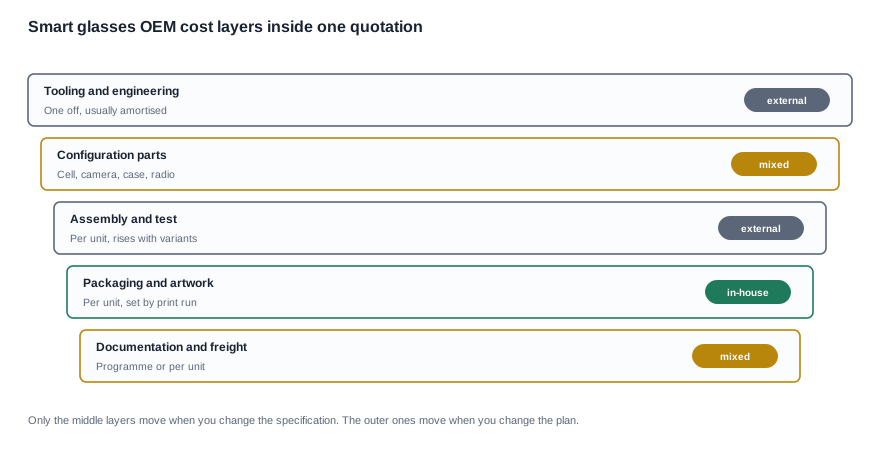

Reading a smart glasses quotation line by line instead of the total
Ask for the breakdown, and then read it in this order. The order matters because each line constrains the next.
- The unit line. What is physically in the box, stated model by model, with the configuration named rather than implied by a product name.
- The case and accessories. Included or excluded, and what the packaging contains.
- The packaging line. Box, insert, manual, languages, cable, pouch.
- The documentation line. What is covered, for which model, for which market, and what is excluded from the scope.
- The one-off lines. Tooling, engineering, artwork setup, certification. These should be identifiable as one-off, because that is what they are.
- The quantity tier. The volume bands, what triggers each break, and whether the break applies to your configuration.
- The freight and terms. Incoterm, port, insurance, payment structure, validity period and what invalidates the quotation.
A quotation that gives you only line one has given you a number and nothing else. You cannot negotiate it, because you cannot see what is inside it, and any request for a lower price will be met with a refusal that is entirely reasonable from the supplier's point of view.
Two things belong on the face of the quotation that are usually buried in the small print. The first is the assumptions: which cell, which case, which colour, which documentation scope and which packaging the number assumes. The second is the conditions: what quantity, what validity period, what freight term, and what happens to the price if any of those change. A price with no stated assumptions is a price for a configuration that does not exist yet, and when the real configuration arrives the difference appears as a change request rather than as an error.
The third habit worth building is a one-page comparison sheet with a row per quotation line and a column per supplier. Fill it in from the quotations, not from the conversations, and mark every cell where the supplier said something different from what is written. The pattern across your shortlist is usually clearer than any single sheet, and it tells you which supplier is actually quoting the same thing as the others.
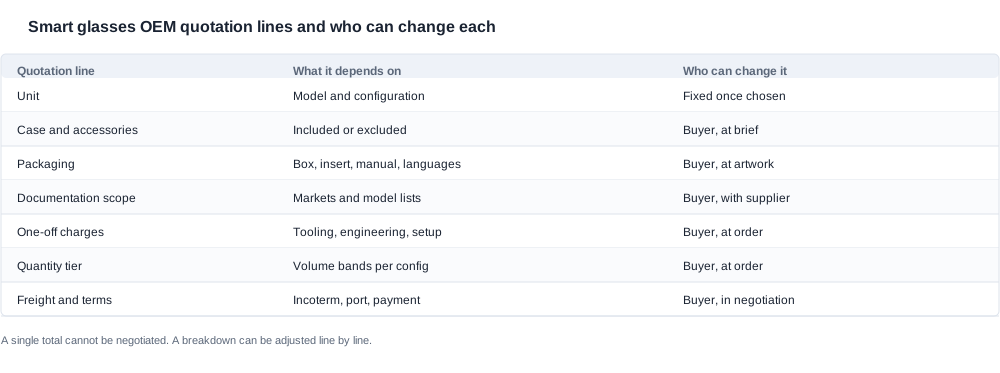
Which smart glasses costs are fixed by configuration and which stay open
Buyers lose time by negotiating lines that were never going to move, and by failing to notice the lines that were. Here is how the two categories separate.
Fixed once the configuration is chosen. The bill of materials for that exact model: the cell or cells, the camera module and its resolution, the radio, the charging interface, the presence and type of a charging case, the sensors actually fitted. These are not negotiable in a quotation negotiation. They are engineering facts of the product you selected. Attempting to move them means moving the configuration, and the supplier's refusal is correct.
Fixed by your own scope decisions, which you may not have made yet. The packaging, the manual languages, the documentation scope, the inclusion of a case or a pouch. These are yours to decide, and a supplier quoting a default is quoting a default rather than your requirement. A significant part of a smart glasses unit price often sits in this category, and it is invisible precisely because the buyer has not specified it.
Open, but configuration-specific. Quantity tiers. The break structure is real and it is quoted per configuration. The way to get at it is to ask for the tier table rather than to ask for "your best price", and to check whether the tier you need exists for the configuration you have chosen.
Open in every configuration. The documentation scope, the customisation depth, the freight terms, the payment structure and the validity period. These are genuine negotiation territory, and they are where a smart buyer gets a better outcome than a buyer who only chased the unit price.
None of this is the same as landed cost, and the distinction is where a lot of margin quietly disappears. A unit price is a factory gate price. The landed cost adds freight, insurance, duty, customs handling and the cost of stock sitting in a warehouse between the factory and the shelf. In a category where every product is battery-powered, the transport and handling side of that calculation is not a rounding item, and a buyer who negotiates the unit price while ignoring it has not finished the negotiation. The pricing and contract terms reference covers the structure we work to, and it is worth reading before the first figure rather than after.
There is a fourth category that has nothing to do with the supplier and everything to do with you: the cost of the specification changes you have not frozen yet. Every open colourway, every undecided language and every pending documentation scope is a future change order, and change orders are priced at a premium precisely because they disrupt a production plan that was otherwise working.
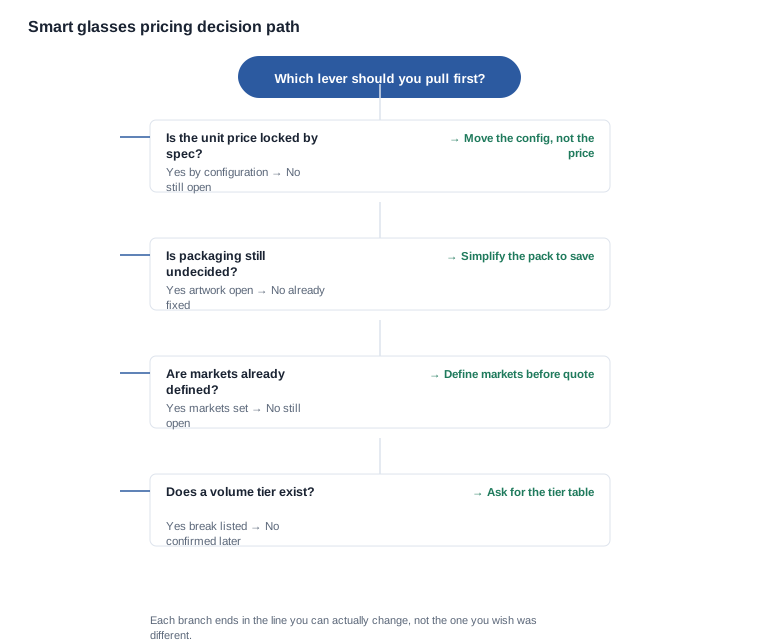

The smart glasses negotiation levers and the trade-off behind each one
Seven levers actually move a smart glasses OEM price. Each one carries a trade-off, and a negotiation that ignores the trade-off is a negotiation that will be won on paper and lost in practice.
- Simplify the configuration. Removing a charging case, or moving from a 13 MP camera entry to an 8 MP one, is a real cost reduction. The trade-off is the product proposition, and in this category the proposition is what you are selling. This lever is for a programme where the specification was copied from a competitor rather than chosen.
- Move the packaging tier. Bulk packaging instead of retail packaging, a digital manual instead of a printed one, fewer languages. The trade-off is the retail experience and the labour at the shelf, and it lands harder in consumer channels than in business channels.
- Consolidate the mix. One colourway and one configuration rather than three of each is a straightforward setup saving. The trade-off is range appeal, and in a slow-moving wholesale line it is usually the better trade than buyers expect.
- Commit to a quantity. The tier break is real and it is the cleanest lever available. The trade-off is working capital and the risk of sitting on the wrong configuration, which is why it should be committed only once the configuration has been validated in the field.
- Sequence the documentation. Launching in one market and adding another later is cheaper than launching in two at once. The trade-off is a slower revenue ramp and the loss of a window.
- Change the freight and payment terms rather than the price. A different incoterm or a different payment structure moves the landed cost and the cash cycle without touching the product. The trade-off is risk transfer, and it has to be priced honestly rather than treated as free.
- Amortise the one-off over a larger volume. This works only if the volume is real. The trade-off is the same as number four, with the added risk that tooling designed for a volume that never arrives becomes a liability rather than an asset.
The order in which you use these levers matters, and it is not the order they are listed in. Start with specification levers, because they change what is being built and everything downstream is recalculated afterwards. Move to the volume lever only once the specification is frozen, because a volume commitment against an open specification is a commitment to the wrong thing. Keep freight and payment terms for last, because they are the only lever that does not touch the product and therefore the only one you can pull without triggering a re-quote.
If you are comparing more than one supplier, run the same sequence against each and compare the resulting totals rather than the quoted unit prices. Two suppliers can quote different unit prices for the same product and still produce the same landed number, and the sequence makes the difference visible. Where you are asked to give a target price, give a target landed number and a specification, because a unit price target is an invitation to win on one line and lose on the rest.
The trade-off that most buyers skip is number three, and it is usually the best one available. A narrow range carried consistently is easier to quote, easier to stock and easier to support than a wide range carried thinly, and in this category the setup cost per configuration is the part of the price that a volume discount cannot remove.
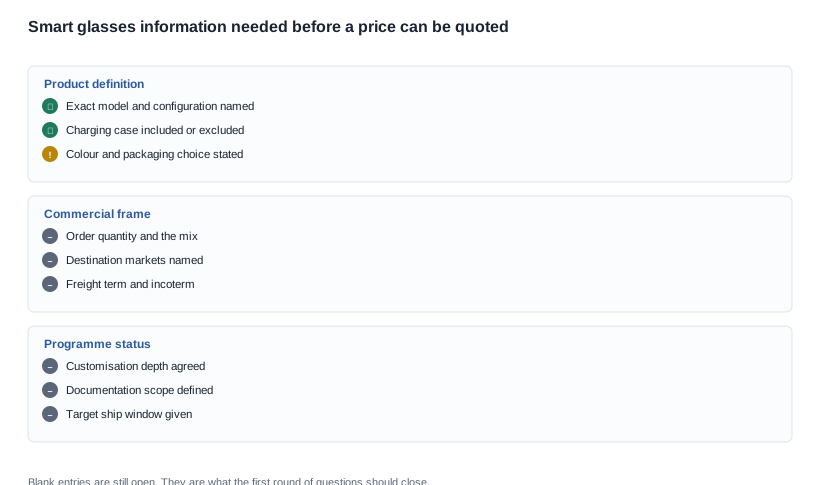

Which smart glasses model to quote first when you want a comparable price
When a buyer wants a price quickly and wants it to mean something, the choice of which model to quote first is not obvious. The intuitive answer, the model you actually intend to sell, is usually the wrong one.
The better rule is this: quote first with the model whose published rows are complete. When the charging method, the charge time, the Bluetooth version, the capacity and the case position are all on the page, the configuration can be quoted without a clarification round trip. A configuration with open rows cannot, and the first quotation you receive will be a request for information rather than a price.
Our published range makes this concrete. The charging method is not published for four camera entries, the Bluetooth version is not published for the camera tier and for a small number of other entries, and the charging case position differs between entries that otherwise look similar. Those are the configurations where a quotation takes a week longer and arrives with assumptions attached.
Two or three models on the first round is the right number. One gives you no basis for comparison. Ten gives you a reading exercise rather than a decision, and you will end up comparing answers to questions nobody has asked. Which one you choose matters less than that the shortlist is short, that every model on it is genuinely a candidate, and that the criteria for eliminating one are written down before the quotations arrive.
The criteria are simple and worth stating in advance: is the published data complete enough to brief a factory, is the configuration one you would ship, and does the model answer the workload you are buying for. The third of those is where this category punishes a buyer who shortlists on specifications alone, because the same published row can mean something quite different depending on whether the product is used continuously or occasionally.
There is a fourth criterion that costs nothing to apply and saves weeks. Ask each supplier to confirm which published rows they will hold fixed for the quoted configuration and which they will work out again for themselves. A supplier who can tell you that the charging method, the case position and the Bluetooth version are fixed for that model gives you a quotation you can plan against. A supplier who re-derives every row is building something new rather than quoting a catalogue product, and the schedule and the price will reflect that.
The due diligence on the commercial side is the same as the due diligence on the technical side: the same questions, asked in the same order, of every supplier on the list. If the answers diverge sharply on the configuration questions, the divergence will show up later in the price and in the schedule, and you would rather find it now.

What we publish about smart glasses pricing, and what we do not
A unit price, a production lead time and a minimum order quantity are each confirmed per enquiry, and so are sample fees, tooling costs, engineering charges, warranty periods, payment terms, shipping costs and volume tier tables. None of them is published on this site. The reason is not opacity. Every one of those numbers is a function of configuration, packaging, documentation scope, quantity, destination and the current schedule, so a published figure would be a number you could not plan against.
What we will do is itemise. Send the configuration, the quantity, the packaging, the destination markets and the level of customisation, and we will come back with a figure and the breakdown behind it, including which lines are fixed by your configuration and which are open for negotiation. That is the format described under procurement pricing, and it is the same discipline as standard OEM pricing drivers.
Two references are worth reading alongside this one. The customization options page sets out the depth available, which is the variable that most often explains a price difference between two quotations that look comparable. The engagement models comparison explains why the same model can sit at different prices under different scopes of work. And the OEM service scope page lists what is inside a standard engagement, so you can tell whether a quotation is pricing the scope you had in mind.
A quotation we build follows the same order as the decision list above. Configuration first, then case and packaging, then documentation scope, then customisation depth, then quantity and mix, then freight and payment terms. We will tell you which of those lines are set by the product you selected and which are set by the plan you have chosen, because the second group is where your negotiating room is, and it is invisible when the two are merged into one figure.
We will not publish a price range as a way of appearing transparent, because a range that spans configurations is not information. What we will do is give you a number you can negotiate against, and tell you which line is yours to change.
Related reading
- OEM engagement models compared
- Smart Glasses OEM service scope
- Procurement pricing and contract terms
- Standard OEM pricing drivers
- Certification checklist for procurement
Send the configuration, the quantity, the packaging and the markets and we will come back with an itemised figure you can negotiate against.


