

A standard oem price is a total dressed as a single number, and the part of it that matters most is the part that is not visible. Ask two suppliers for the unit cost of the same model and the two answers will differ; ask for the unit cost of the same model, the same configuration, the same scope and the same commercial terms and the answers become comparable. Everything in between is where procurement teams lose weeks. The purpose of this page is to make that gap visible before the quotation arrives rather than after it has been accepted.
The cost of a unit in this product class is built from three layers that behave differently. The first layer is the configuration itself, and most of it is visible in our published rows: the cell, the runtime, the charging method, the camera resolution class, the presence of a charging case, the colour, the presence of a removable part. The second layer is scope, and almost none of it is published: the packaging, the mark method, the accessory set, the documentation that travels with the unit, the assembly and test coverage. The third layer is commercial terms: payment, incoterm, the warranty position, the freight assumption and the commitment date. A quotation that mixes all three into one figure is not wrong; it is simply unreadable.
None of this page contains a price, a price tier, a discount band, a landed cost or a margin. Those are commercial terms that belong to a quotation against a named configuration, and publishing one without the other two layers produces exactly the false comparison this page is written to prevent.
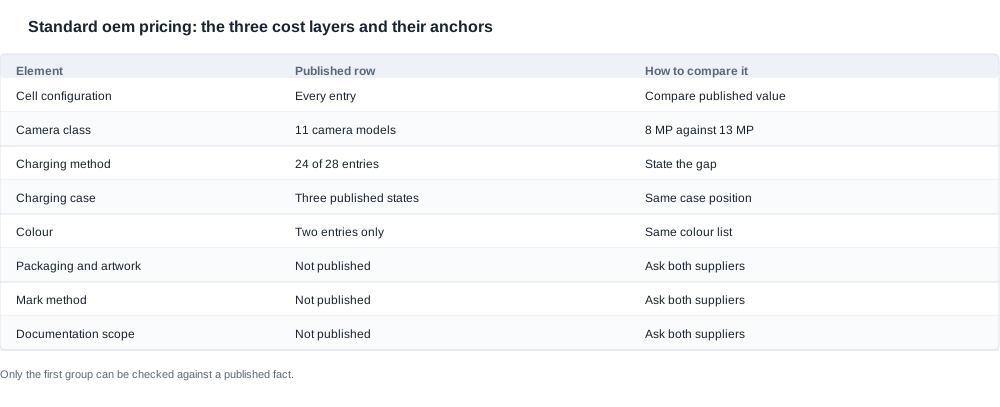
The table sets out the three layers and shows, for the first one, which published row anchors each element. Where the third column says the row is published, a buyer can compare that element across quotations with confidence. Where it says the row is not published, the element has to be normalised by asking both suppliers the same question.
What determines a unit cost in this product class
Start with the configuration layer, because it is the only layer where a buyer can check a supplier's number against a published fact rather than against another supplier's assertion.
The cell is the first anchor. Our catalogue publishes a cell configuration for every entry in the range, from 40 mAh on the A05 and the A06, through 55 mAh × 2 on the LC-105 pair, the G07 and the YK12, and 90 mAh × 2 on the K01 and the K02, up to 290 mAh across four camera models — the L2 Utral and the L1 Pro, and the CY05 and the CY03. Published cell values are cell values, not a total: 55 mAh × 2 is two cells, and a quotation that quotes the combined figure rather than the published one has moved the basis of comparison without saying so.
The camera resolution class is the second anchor, and it splits the eleven camera models into two published groups: eight megapixels on the MT5 and the V03, the CY05 and the V03 Pro, and the V06 and the KY06, and the MT6 and the CY03, and thirteen megapixels on the S7 and the L2 Utral, and the L1 Pro. Two quotations for "the same camera model" that sit in different resolution classes are not comparable, and a quotation that does not name the class has left a question open at the point where money is decided.
The charging method is the third. Magnetic charging is published on seventeen entries, a Type-C interface on seven, and on four camera models the charging method is not printed at all, which means a quotation for one of those four has to state the method in words before the two numbers can be compared. The charging case is the fourth, and it is the one that most often produces a difference nobody can explain afterwards: a capacity is printed for five camera models, two more show a case with no figure against it, and four camera entries carry no case line whatsoever.
Beyond those, the configuration layer contains a few smaller published rows that still move a comparison. Colour names exist for two entries only, with three on the V03 Pro and four on the V06. A removable part is published for three entries — the V06 and the S7 with a removable inner frame, the G07 with a detachable temple. An ingress marking appears on the V06 and the S7. A weight is published for one entry alone, the MT6 at 158 g for the glasses body and not for the folding case. A remote shutter is published on the D17 and the ZH12.
Now the scope layer, where the published record is almost silent. The packaging is not published for any entry, so two quotations can include or exclude a carton and a print run without either of them being wrong. The method of applying the brand mark is not published, so one quotation may carry a mark applied on the line and another may carry a mark carried by the moulded surface, and the two are different programmes rather than different prices. The accessory set is not published, so the difference between a quotation that includes the case and one that treats the case as a separate line is a scope difference. The documentation that travels with the unit is not published, and neither is the assembly and test coverage behind the unit.
The commercial layer is the third, and it is where the most expensive misunderstandings live. Payment terms, incoterm, the warranty position, the freight assumption, the commitment date and the validity period of the quotation itself are all invisible in a unit price, and each of them can move the total more than the configuration does. A unit cost quoted with freight excluded is not a cheaper product; it is a different scope with a different number on it.

Configuration, quantity and the questions behind both
A configuration is a tuple, and the questions behind it are short, specific, and answerable. Which model and which variant names it carries. Which cell configuration. Which camera resolution class, where a camera is involved. Which charging method, and which case position if a case is in scope. Which colour, and whether that colour is one the model publishes. Whether the configuration includes a removable part. Which accessory set goes in the box. Which market it is built for, and therefore which documentation and labelling travel with it. And which packaging and artwork.
Quantity is the second half, and it is where the questions stop being about the product and start being about the factory. How the volume splits across runs. How many distinct sellable items the order contains. Whether a packaging print run sits inside the order or alongside it. Whether a new moulded part is involved, and whether its cost is inside the unit price or beside it. And the threshold questions, which belong to the minimum order quantity discussion and not here, but whose answer determines whether the quoted unit price was produced by a run of the size the buyer intends to place.
The two halves interact in a specific way that buyers regularly underestimate. A configuration that is entirely standard and a configuration that differs in one published row are not the same commercial proposition, and the difference shows up in the production route rather than in the component list. A unit price produced on a standard route and a unit price produced on a modified route are quoted against different assumptions about setup, and a quotation that does not say which route it priced has left the comparison open.
The practical method is to write the tuple down before the quotation is requested, and then to ask each supplier to restate it. Where two restatements disagree, the disagreement is the finding, and it is a finding worth more than a percentage point of price, because it tells the buyer which side is pricing an assumption.

Why a price without a configuration means nothing
The argument is not that prices are unreliable. It is that a unit cost is a function of a configuration and a scope, and a number that arrives without either is a number about an unknown product.
Consider what happens when a quotation arrives with a model name and a unit price and nothing else. A buyer cannot tell whether the quotation includes the charging case for a model whose case position is published, because for four camera entries the catalogue prints no case line and the question would have had to be asked. A buyer cannot tell whether the packaging is inside the figure. A buyer cannot tell whether the quoted mark method is one that requires a new moulded part, which would normally appear as a separate one-off line and not as a unit price. A buyer cannot tell whether the documentation that has to travel with the unit for its destination is inside the figure, or whether it is a separate service.
None of these gaps can be closed by pressing the supplier for a discount. They can only be closed by a scope, and a scope is a written artefact that both sides have agreed to.
There is a second reason, which is about what happens later. A quotation is a snapshot of a set of assumptions: the model, the configuration, the quantity, the destination, the packaging, the date. Change any of them and the quotation is a different document, even where the printed number is identical. A buyer who treats a quotation as a price for a product rather than as a price for a configuration will find the number reappearing with different conditions attached, and will usually experience that as a breach of trust rather than as the ordinary consequence of a changed input.
The third reason is the one that costs the most: a price quoted without scope cannot be compared against a second price quoted with scope, because the second includes more and therefore looks worse. In practice this is where the choice between suppliers is usually made, and it is made on the wrong evidence.
A fourth reason is timing. Every quotation carries a validity period, and a validity period that expires before the buyer's own decision cycle completes guarantees a second round of comparison against a document that has already moved. The criteria for judging whether a quotation is still worth evaluating are simple, and they are worth checking before you order rather than after: whether the configuration it names is still the configuration you want, whether the scope it covers is still the scope you need, and whether the assumptions behind the volume are still the assumptions behind the plan. A buyer who checks those three things can decide quickly whether to re-quote, to negotiate, or to let the quotation lapse, and each of those is a decision rather than a delay.

Comparing two quotations on the same basis
Two quotations become comparable when they have been normalised against the same nine points. Each of the nine is a question to ask both suppliers, and each has a written answer.
The first point is the product and its version: the same model, the same variant names, the same cell configuration and the same camera resolution class. The second is the charging arrangement: the same method, and the same case position, published or expressly not published for that model. The third is the physical configuration: the same colour list, the same removable part arrangement, the same accessory set in the box.
The fourth point is the packaging scope: whether a carton and its artwork are inside the figure, whether a print run is inside it or separate, and whether the specification is new or reused. The fifth is the mark method, and whether any new moulded part is involved and where that cost sits. The sixth is the documentation scope: which documents are produced for the unit, which are transferred, and which remain with the supplier.
The seventh point is the destination and its labelling and regulatory work. The eighth is the volume and its structure: the same total, the same number of distinct sellable items, the same number of production runs. The ninth is the commercial terms: payment, incoterm, freight assumption, warranty position and the validity period.
Ask all nine of both sides, write the answers side by side, and the remaining difference is a price difference rather than a difference of product. That is the only comparison worth making, and it is the one that survives an audit.
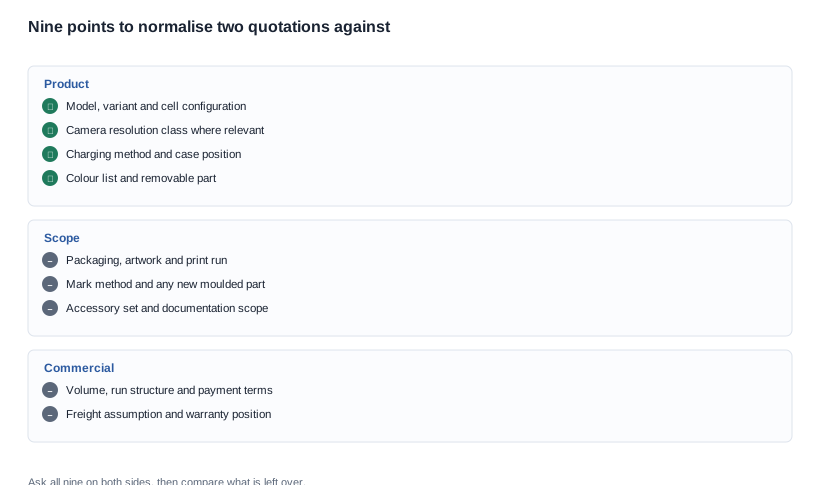
The red flags are specific and all of them are visible on the face of a quotation. A unit price with no configuration attached. A total that is not divided into a unit and a quantity. A one-off buried inside the unit price, which makes the second order impossible to model. A validity period shorter than the buyer's own decision cycle, which converts a comparison into a race. A quotation that names a model without naming its variant. A price that is quoted per colour without saying which colour. And a quotation whose exclusions are absent, because exclusions that are not written down come back as disputes.
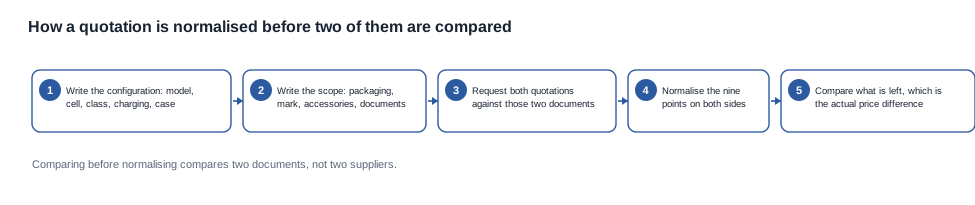
The flow above is the order to work in. Write the configuration, write the scope, obtain both quotations on those two documents, normalise the nine points, and only then compare. A buyer who compares before normalising will conclude something, and the conclusion will be about the two quotations rather than about the two suppliers.
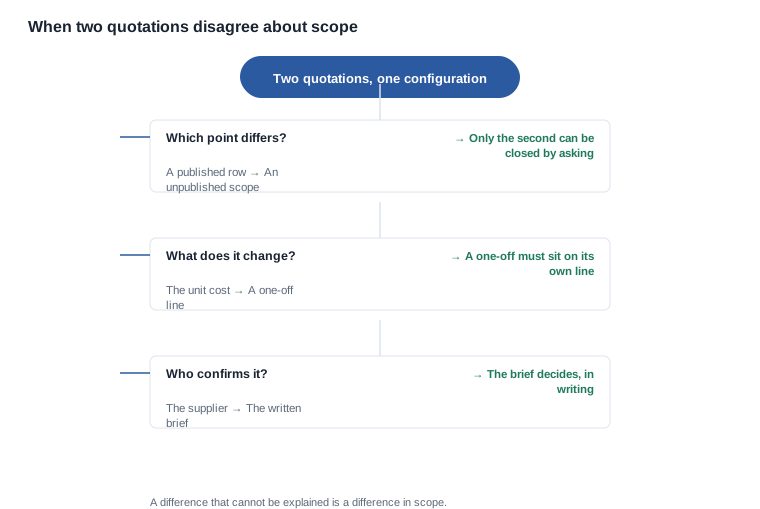
The decision diagram covers the case that comes up most often, which is a difference that cannot be explained by the configuration. The right answer is neither to accept the higher figure as the real price nor to discard it as inflated. It is to ask which of the nine points is doing the work, and then to close that point in writing on both sides.
How to ask a supplier to normalise a quotation
Two suppliers rarely quote the same scope, so the normalisation has to be requested rather than discovered. The questions to ask are the same on both sides, and the answers should come back in the same order: what the unit price covers, what sits on separate lines, what is excluded, and what the figure assumes about volume and destination. Ask for the assumptions in writing rather than for a summary of what is included, because a summary invites a description of the product while the buyer needs the boundary described. The trade-offs a buyer is making at this point are commercial and are invisible in any single answer; they become visible once the nine points sit side by side, and that comparison is exactly what a shortlist is for.
Where CYNRIN stands on standard oem quoting
A quotation is issued against a configuration and a scope, and both are written down before the price is quoted. We do not publish a unit price, a price tier, a discount schedule, a landed cost, a margin, a minimum order quantity, a lead time, a sample fee, a warranty period or a production capacity, because each of those belongs to the specific configuration and scope in front of us rather than to the range as a whole.
What we will do with a written configuration is itemise the quotation against the published rows where they exist, so that a buyer can see which parts of the figure are anchored in a published fact and which are assumptions. We will state explicitly what is included and what is excluded, because the exclusions are where the comparison is lost. We will quote one-off items on separate lines with their own recovery basis, so that the second order can be modelled rather than guessed at. And we will answer the nine normalisation questions for our own quotation, because a supplier who will not answer them has not priced a configuration either.
Two positions sit outside the commercial conversation and are worth restating. Our catalogue prints no certification line for any model and its text names none of CE, FCC or RoHS; the export certification page is company artwork showing ten patent certificates, which evidences the company rather than any model. The ingress marking that the V06 and the S7 carry is annotated on the catalogue page, carries no third-party report number, and cannot be restated externally without a report behind it. And the 35 dB figure the bone-conduction entry publishes comes with no acoustic evidence at all and supports no statement about medical use, about hearing or about suitability for any population.
For a procurement lead, the method is short. Write the configuration and the scope first, get both quotations against those documents, normalise the nine points, and let the price be the last thing you look at rather than the first. Buyers who work this way report one change of habit that matters more than the rest: the conversation with the supplier stops being about the number and starts being about what the number covers, which is the only version of the conversation that can be repeated for a second order.
Related reading
- the drivers that produce a threshold for a decided configuration
- the layers a carton carries and the claims that need evidence
- what a quality file can be checked against once a scope exists
- the catalogue rows a requirement can be built on
- what a tool line costs and who holds it afterwards
A unit cost without a configuration and a scope is a number about an unknown product — write the nine points down, normalise both quotations against them, and the price comparison becomes a real one.


