

An OEM timeline differs from an ODM timeline in one specific and important way: in an OEM programme most of the engineering is already done, and what is left is dominated by decisions that are commercial rather than technical.
That makes the timeline shorter and more predictable than buyers expect, and it also makes it more sensitive to the decisions on the commercial side. A configuration change, a packaging change or a documentation scope change can each move the date by weeks, while a hardware change would move it by months and would not be happening in an OEM programme at all.
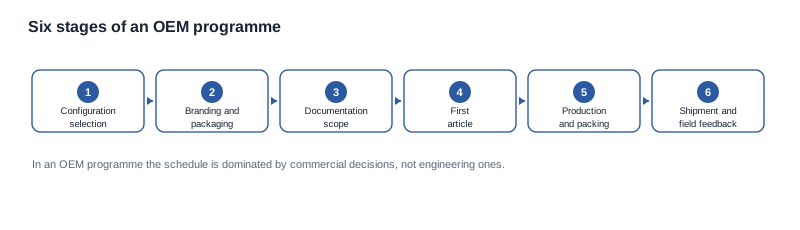
So the useful way to read a smart glasses OEM timeline is not as a number but as a structure: six stages, a gate that closes each one, and a set of decisions that belong to each stage. A buyer who knows which stage their programme is actually waiting on can tell, in one sentence, what to chase. A buyer who has only a date cannot.
Capacity and programme dates are published for no model in this range, and neither are unit prices, minimum order quantities or production lead times; each of those three is confirmed per enquiry instead, so this article is about the reusable part of the schedule rather than about any particular duration.
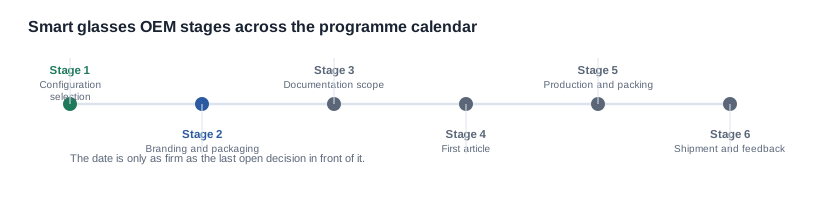
Smart glasses OEM timeline overview: six stages and the gates between them
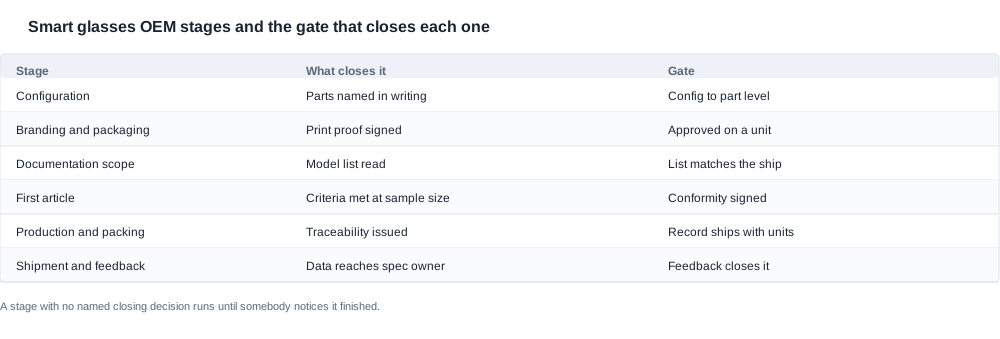
Stage 1: configuration selection. The programme begins here, and the decision is which published configuration to take. Our range offers a wide one: across six families there are twenty-eight entries, camera entries at 8 MP and 13 MP, charging that is magnetic on seventeen entries and Type-C on seven with four entries publishing no charging method at all, charging case capacities published for five entries, and colour options published for only two. The fact that colour options are published for just two entries matters for the schedule, because colourways that do not exist as configurations are developments rather than selections.
Gate: a configuration specified down to the part level, with the case position and the charging method written down rather than assumed from a product name.
Stage 2: branding and packaging. Every surface that carries the brand, on the product itself and in the printed materials that travel with it, is settled at this stage, and the model designation is settled with them. This stage is shorter than buyers expect and is more often the source of delay than the electronics, because the artwork cycle is external and the approval cycle is internal. The recorded set is not one list across the range but a count that differs by category: seven for camera entries, five for audio, five for sport and two for the children's tier. Each recorded item carries a different artwork dependency, and the useful question at this stage is which of them needs artwork approval from outside the factory and which can be handled internally, because that difference is what sets the duration rather than the electronics does.
Gate: artwork approved against a physical unit rather than a render, with a signed print proof.
Stage 3: documentation scope. Which documents are needed for which markets, and which of them already exist for the selected configuration. This is where the schedule risk concentrates, for the reason set out in the certification and lead time discussion. No per-model certification row is published for any entry, and the export certification page holds ten patent certificate images that name no model at all, so there is no published schedule of what covers what. A family-level document that does not name your model looks like coverage until somebody reads the model list.
Gate: the model list on each document confirmed against what will actually ship.
Stage 4: first article. The physical unit, checked against the approved configuration, the approved artwork and the agreed inspection criteria. Colour and finish approval is the most common rejection point, and it is the one that can be avoided by approving against a physical sample before the first article ships.
Gate: first-article conformity signed, with a stated sample size and stated criteria, including the tolerance.
Stage 5: production and packing. The run itself, with the changeover discipline and the traceability record in place. The traceability record, which is the batch or serial reference linking a shipped unit back to a production run, is the item most often deferred and most badly missed, because it is what makes a warranty claim work two years later.
Gate: the traceability record exists and is issued with the shipment.
Stage 6: shipment and field feedback. Field data is the only stage that produces information about real usage, and it is the stage most programmes skip, which is why the published runtime figures and the fit experience stay untested against reality.
Gate: the first feedback data reaches the people who own the specification, not only the people who own the channel.
The gate is where most of the schedule value sits, and it is the part buyers are least likely to insist on. A stage without a named closing decision runs until somebody notices it is finished, and what usually happens is that the noticing is done by someone downstream who then has to reopen it. Three properties of a real gate are worth writing down, because they are easy to state and easy to omit.
The gate names a decision, not an activity. "Artwork approved" is a decision. "Artwork sent" is an activity, and it has not closed anything. The gate names who makes the decision, because a gate with two possible signers will be signed by whichever one happens to be in the room that week. And the gate names what happens if the decision is no, because a gate whose only possible outcome is a yes is not a gate. It is a milestone drawn on a diagram.
Applied to the six stages, the questions are concrete. At stage 1, which parts are in the configuration and does the case go in the box. At stage 2, has the print proof been signed against a physical unit. At stage 3, does the model list on each document include what will ship. At stage 4, does the first article meet the stated criteria at the stated sample size. At stage 5, is the traceability record issued. At stage 6, did the field data reach the specification owner.
There is a reason to write the gates down at the start rather than as you reach them. A gate written at the moment you reach it is written by the person who has been waiting, and it will be shaped to match the situation. A gate written at the start is written by the person who set the plan, and it will be shaped to match the plan. The difference between those two documents is the difference between a schedule you can forecast and a schedule you can only describe.

The four smart glasses changes that move an OEM date more than engineering does
1. A configuration change after the first article. Changing the cell, the case capacity or the charging interface after stage 4 is not a small change. It reopens the documentation, it may reopen the transport paperwork, and it may invalidate a first article that has already been signed off. The date impact is typically larger than the physical difficulty, because the work that has to be redone is the paperwork work.
2. Artwork approval cycles. These are internal, they involve people who are not working on the product, and they compress badly at the end of a quarter. A packaging change that would take a week in the middle of a quarter can take three at the end of one, and no amount of factory capacity changes that.
3. A documentation question discovered at stage 3 rather than stage 1. The cost of discovering at stage 1 that the model is not on an existing document is a conversation. At stage 3 it is a schedule, because at stage 3 the production slot has usually been booked and the artwork is already printed. The rule that follows is simple and worth applying to every question in this category: find out what you can at the earliest stage, because the cost of a question is a function of when you ask it.
4. The sample configuration and the production configuration diverging. This is the most damaging and the least visible. A sample that is not the production configuration invalidates every evaluation the buyer did on it, and the divergence is usually in a cell, a colour or a firmware version. The control is to record the sample's build revision on the approval form and to have the factory confirm in writing that the production unit carries the same revision.
There is a fifth that is specific to this category, and it is the one buyers forget exists. A documentation scope change driven by the market rather than the product.
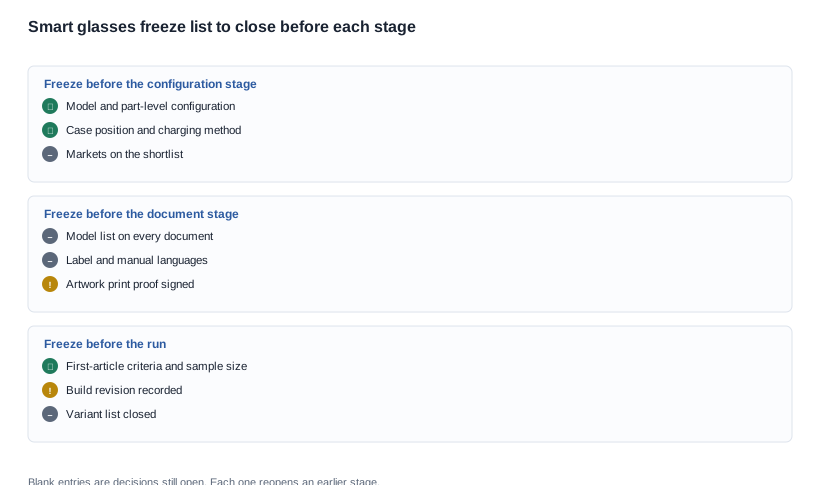
Before any of that, it is worth writing the freeze list down with the criteria that produced it, because a schedule built on an undocumented set of decisions is a schedule nobody can defend in a negotiation. The shortlist of candidate configurations, the criteria that eliminated each one, which model was kept and why, which one of the two documentation routes was chosen, and the trade-off accepted at each stage. That last entry is the one buyers skip, and it is the one that explains the schedule to anybody else who later asks why it took as long as it did. If the programme adds a market after stage 3, the model list on every document has to be re-read, the labelling has to be re-cut, and the manual may need another language, which our catalogue does not publish a row for at all. Market expansion feels like a sales decision and behaves like a product change.
It is worth being concrete about why the artwork cycle is the one that surprises people, because the factory has no control over it at all. An OEM programme's artwork depends on three clocks running in parallel: the printer who turns the artwork into a physical proof, the buyer's marketing function who approves it, and whoever holds the authority to approve a colour, a finish or a logo placement. The first is external and fast. The third is often a single person, and single-person approvals do not compress. They expand, because that person has other work and your file waits.
The practical countermeasure is to reduce the number of approvals rather than to chase them faster. Ask for one consolidated artwork review with all the changes batched into one round, and insist on physical proofs rather than renders, because a render generates feedback about things the factory cannot change while a physical proof generates feedback about things it can. In this category the temple styling and colour options are part of our published customisation capability, so the number of things that can change at artwork review is larger than it would be in a product with a fixed shell, which makes the number of approvals worth reducing deliberately.
There is a second reason the artwork stage sits where it does in the sequence, and it is not a scheduling reason. The artwork stage is where the buyer's own organisation commits to the product in a durable way. Before it, a colour change is a conversation. After it, a colour change is a reprint, a new sample, a new approval and a new date. Which means the artwork stage is where a buyer's indecision becomes expensive rather than merely inconvenient, and it is the stage at which it is worth slowing down and getting right.

Which smart glasses decisions to make first, and which to make last
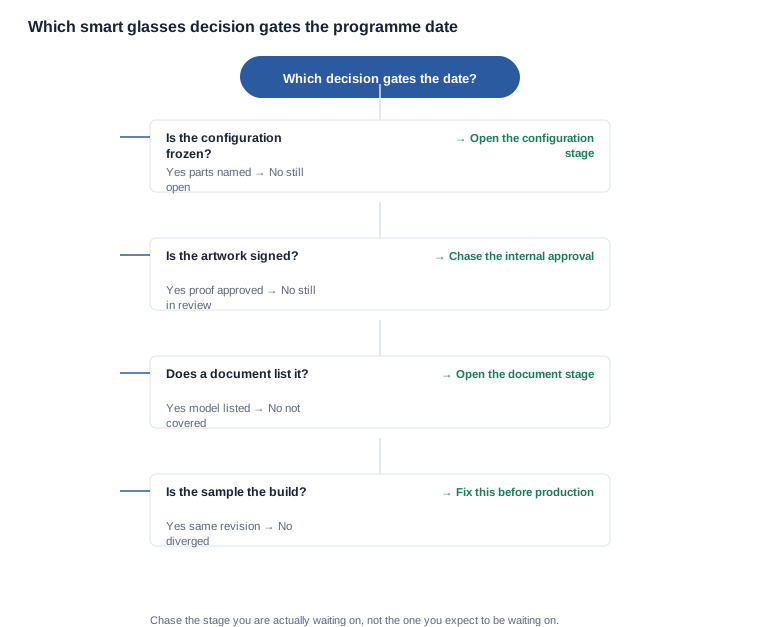
The useful ordering rule is not "technical before commercial" or the reverse. It is this: make first the decision that would be most expensive to reverse, and make last the decision that is cheapest to reverse.
Reversing a configuration choice is expensive, because the mould, the documentation and the packaging are all downstream of it. Reversing a packaging choice is cheap, because the box is a print run. Reversing a colourway is somewhere in the middle, and where it sits depends on whether the colour is a supplier part swap or a new mould, which is a question worth asking before you assume. Reversing the market list is expensive in a non-obvious way, because every document has to be re-read rather than re-written.
In practice that gives four decisions to make in this order.
- Which configuration. Fixed at stage 1, and the most expensive decision in the programme to reverse.
- Which markets. Fixed at stage 3, and the decision that determines what documentation work exists at all.
- Which branding and packaging. Fixed at stage 2 in practice, even though it sits between the other two in the sequence, because it is the one with the longest internal approval cycle.
- Which variants to carry in the first run. Decided at the stage 5 freeze, and the one most worth revisiting later, because it is the cheapest of the four to change for the next run.
The thing that goes wrong in practice is that the order gets inverted by people outside the programme. A marketing decision about a colourway, or a sales decision about a market, arrives in week six and reopens stage 1 or stage 3 without anybody noticing that this is what has happened. The defence is a freeze list: the set of decisions that are closed for this run, the date they closed, and the date they reopen for the next one. Once that list exists, a late request is visibly a request to reopen something, and it can be priced as one.

Building a smart glasses date that survives a configuration change
Buyers who ask a factory for "the lead time" and receive a single number usually get the number for the simplest possible programme, which is not theirs. Three dates are more useful than one, and they answer three different questions.
The earliest technically possible date. The date if everything is ready today, nothing needs re-testing, the artwork is approved and the documentation already covers the model. This is the number a factory quotes when you ask for the lead time, and it is useful as a floor.
The target date. The date the programme is planned around, assuming the stages run in order and the gates close on schedule. This is the number that should drive the launch plan, and it is the one that appears in a contract.
The committed date. The date the supplier commits to, conditional on the configuration, the quantity, the documentation scope and the current schedule. This is the only one of the three with contractual force, and it is the one that should be the one you plan against.
The gap between the earliest and the committed date is where your programme's risk lives, and it is created by decisions that have not been made rather than by work that has not been done. If the committed date is far from the target date, the cause is almost always an open decision somewhere upstream.
The other half of a date that survives change is dependency discipline. Every stage depends on something, and the dependencies are usually stated in terms of the buyer's own actions: artwork approval, the signed specification, the confirmed model list, the first-article sign-off. A date that assumes your artwork is approved on time is not a date, it is a hope. The practical method is to write the dependency list backwards from the shipment date, and to date each dependency. Where a dependency has no owner, the date is fiction.
One specific point about this category. For most entries the published charge time is two hours or less, two entries read around one hour, and no test condition is published for either. Any plan that puts a demonstration, a review or a campaign between the arrival of samples and a launch date has to allow for the evaluation to be inconclusive, because the numbers a buyer will see in the field will not match the published ceiling. Programmes that build a two-week evaluation into the schedule survive; programmes that assume the sample settles the question in a day do not.
Due diligence on the smart glasses timeline before you commit to it
Four questions get you most of the way to a schedule you can plan against, and the value of asking them is in what the answers refuse to say.
- Which stage is the programme currently waiting on, and what exactly is it waiting for?
- What has to be frozen for this date to hold, and who owns each frozen item?
- Which of our decisions, if reversed, would cost the most to redo?
- What is the sample configuration, and is it the production configuration?
The answer to the first question is the one that changes what you do next, and it is worth insisting on it because the answer is frequently not the stage you would have guessed. A programme with an approved first article and no artwork sign-off is waiting on artwork, not on production, and the two have very different remedies.
The second and third questions together give you the freeze list, and the fourth gives you the control that protects the whole schedule. If the sample is not the production configuration, every date downstream of it is provisional, and the correct response is to fix the configuration rather than to ask for a more confident date.
Working backwards from a launch date is the exercise that most reliably exposes an impossible plan, and it is worth doing before the order rather than after the artwork is printed. Write the date you need to be in a channel. Then write back through the field evaluation, the first article, the artwork approval, the documentation scope and the configuration selection, allowing for the review cycles that sit inside each one. The arithmetic is unforgiving, and the question it answers is not whether the factory can do it but whether your own organisation can.
Two findings come out of that backwards pass almost every time. The first is that the review cycle is usually the longest single block, and it is the block nobody puts in the plan because it belongs to the buyer rather than to the supplier. The second is that the field evaluation has to be long enough to produce a decision rather than an impression, and in this category that means longer than most buyers allow, because the published figures do not settle the question. For most of the range the published charge time is a ceiling of two hours or less with no test condition attached, and the published runtime figures for the camera tier come with no condition either. A one-day evaluation produces an impression, and an impression does not survive a customer who has measured it.
There is a discipline worth adding to the backwards pass, which is to name the decision that each block produces. If the artwork block produces an approved print proof, and the first article block produces a signed conformity, then each block has an output that the next block consumes. If one of them produces only an activity, the plan has a gap in it, and gaps in plans are where dates quietly go.
A final piece of due diligence concerns the supplier rather than the programme. A factory's schedule is a function of its queue, and a queue is not visible from outside. Production capacity, current workload and the slot your order would take are not published by us and are not something a buyer can audit directly, so the only available test is behavioural: ask what the slot is, ask what happens to it if the configuration changes, and ask what the factory would need to do to protect the date. A supplier who can answer all three has a real schedule. A supplier who answers with capacity figures alone has a marketing answer.
We will not publish an OEM timeline, a lead time, a capacity figure or a unit price on this site, because each depends on the configuration, the quantity, the documentation scope, the destination markets and the current schedule. A number published out of that context is not one you can plan against, and these are confirmed per enquiry. What we will give you is the stage structure and the gates, because that is reusable and it tells you which questions to ask and which decisions to make first.
If you tell us the configuration, the quantity, the destination markets and the date you are working back from, we will tell you which stage is the constraint on your programme. The development process reference sets out where each stage sits in the wider flow, the OEM scope page shows what is inside a standard engagement, the engagement models comparison explains why the model you choose moves the dates, and platforms built for contracted programmes are covered under OEM ready platforms.
Related reading
- Which stage your programme is actually gated by — development process
- The scope these commitments sit inside — OEM scope
- Why the engagement model moves the dates — engagement models
- Platforms that compress the early stages — OEM ready platforms
Send the configuration, the quantity, the markets and the date, and we will tell you which stage is the constraint.


