

Smart glasses payment terms are the part of a purchase order that most often gets agreed last and regretted first, because a payment schedule reads like a finance formality until the day a consignment sits at a border or a pallet arrives with the wrong case fitted. The checklist below exists because the terms in this category carry more moving parts than a typical consumer electronics contract: a lithium cell, a set of shipping documents, an inspection gate and a customs entry all sit inside one sequence, and each of them has a document attached to it.
The list has twelve items. Three of them decide how much of your money is at risk before anything can be checked; the rest are cheaper to close early than to raise late. We publish no payment terms of our own, because they depend on configuration, volume and the state of the programme, but we can show you the framework the terms sit inside and which of the twelve our current documentation already answers.
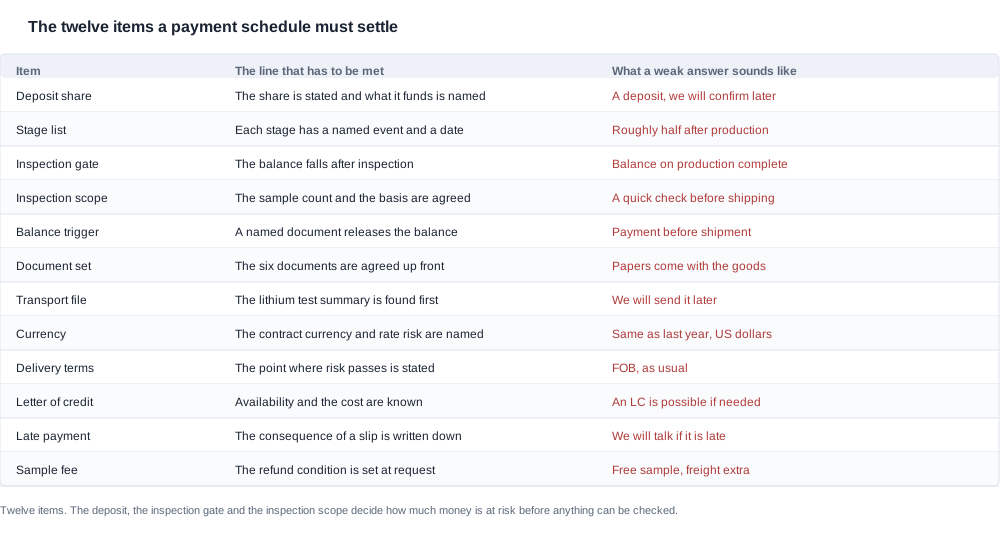
Smart glasses payment terms: twelve items to settle
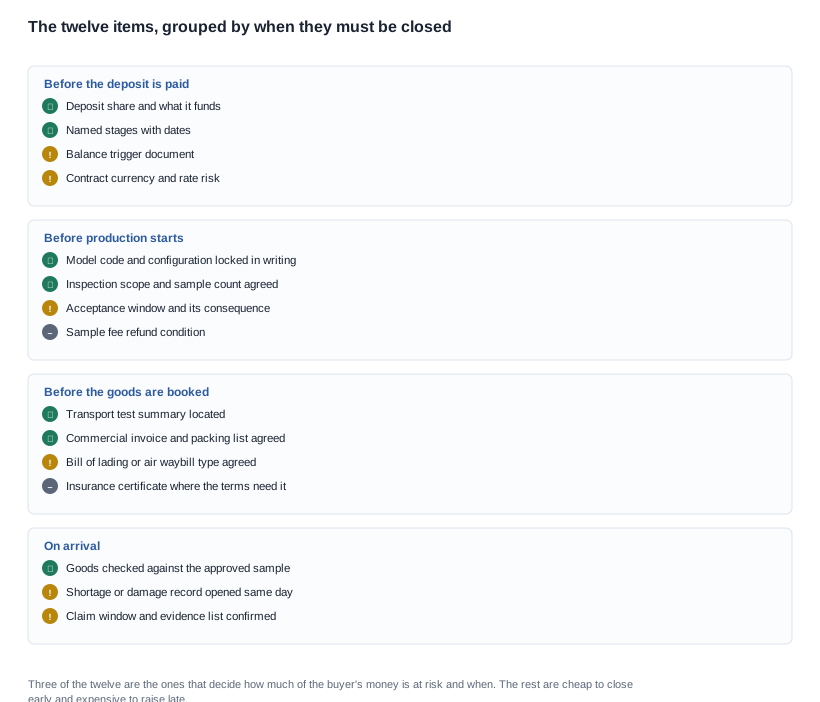
The twelve items are not a list of clauses to copy. Each one is a decision that either the supplier has already made or the buyer has to force, and the order in which they appear is the order in which they should be closed.
The deposit share is the largest single cash commitment in the transaction, and it is made before anything exists. Two halves have to be answered: the proportion, and what it buys. A deposit that funds materials is a reasonable commercial position because the supplier is committing cash to cells, boards and cases against your order. A deposit that also quietly covers tooling and artwork recovery is a different arrangement carrying the same label, and it is much harder to unwind later.
The stage list is what makes the rest of the list checkable. A schedule with two stages and no dates is not a schedule; it is an intention. Each stage needs an event attached to it, and each event needs a date, so that a missed stage can be identified rather than argued about.
The inspection gate decides whether the balance falls before or after the goods have been checked. If there is no inspection, or if the inspection happens after the balance has been paid, the buyer has paid for goods that were never checked, and the consequence of that is a claim made against a supplier who has already been paid in full.
The inspection instruction is what the inspection is compared against, and how many units are sampled. An inspection without an approved sample and an agreed sample count is a formality that produces a document rather than a judgement.
The balance trigger is the document that releases the balance, and it is where a payment term turns into a shipping term. The moment a missing document can stop the money, the schedule has a dependency in it, and that dependency should be visible before the order rather than discovered during it.
The document set is the commercial invoice, the packing list, the bill of lading or the air waybill, the certificate of origin, and the insurance certificate where the terms require one. A set agreed in advance arrives together; a set assembled under pressure arrives one piece at a time, and each missing piece holds the balance.
The transport file is the lithium transport test summary. For a device with a lithium cell this has been a required document since 2020-01-01, and the point to understand is that it is a booking constraint rather than a paperwork constraint: a consignment without it is refused rather than delayed, which means the schedule is already broken before anyone argues about the paperwork.
The currency and the rate decide whose exchange risk the order carries. A contract denominated in a currency you have not priced is a pricing decision disguised as a payment term, and no negotiation of the unit price changes it.
The delivery terms decide where responsibility and risk pass, and therefore who carries the battery compliance obligation and who makes the customs declaration. They are decided by the delivery clause rather than the payment clause, and they are routinely left unexamined.
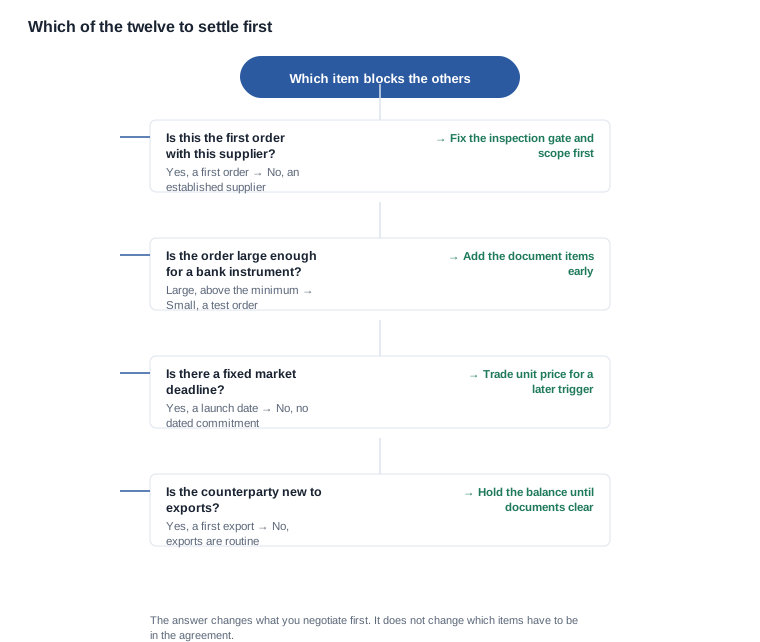
The letter of credit option is worth establishing early, because it changes what a first order feels like. It is the standard instrument for a buyer who wants an assurance rather than a supplier's promise, and it is slow and expensive in fees. For a repeat order with a supplier whose data you trust, it is often not worth it.
The late payment terms matter less for what they say than for whether they exist. A terms sheet with no late-payment clause is one in which the first delay is improvised, and improvised delays are where commercial relationships are lost.
The sample charge is usually a paid unit rather than a giveaway, and the refund condition is a term that has to be agreed at the point of the request rather than reconstructed afterwards.

Who is reading this, and what they are actually approving
The reader is a brand-side procurement manager, a channel buyer, an importer or an e-commerce selector. The situation is usually one of three: a quotation to compare, a new programme to open, or a market to enter, and each of the three ends with a different approval in front of somebody.
A buyer comparing quotations is approving a decision to narrow a field. What they fear is not a bad price; it is discovering after the award that the two quotations were for different builds, so the comparison itself was void. That is why the configuration string has to appear in the quotation, and why the twelve items are only half the job — the other half is knowing that both suppliers quoted the same thing.
A buyer opening a new programme is approving a risk position that nobody has measured. The fear is a schedule that slips and a cash position that has already been committed against a date that was never achievable. In this category the exposure is sharper than in a mechanical product, because a unit with a camera module and a charging case has a bill of materials that has to be committed to before the order is complete.
A buyer entering a market is approving a documentation route. The fear is a consignment that stops at a border because a document set was assembled after the booking rather than before it. This is where the transport file and the certificate of origin stop being administrative and become the entire schedule.

None of these three readers is deciding how the product feels over a long shift. They are deciding what is recoverable, what is documented, and what happens to their cash if the programme goes sideways — and the twelve items are the variables that determine the answers.
Where the money sits between order and delivery
A useful way to read the twelve items is as a map of where the cash goes and when it becomes unrecoverable. The deposit is the first irreversible point. Before it, a buyer can change the configuration, the quantity or the supplier at no cost beyond a conversation. After it, the buyer is funding somebody else's purchase of cells and boards, and the only remaining levers are contractual rather than practical.
The middle of the order is where a buyer is often weakest. The goods are part-built, the packaging may already be printed, and the artwork may be approved. The balance is typically the largest single payment, and if it is released against a copy of the bill of lading it will be released when the carrier takes the goods — which can be weeks before they arrive at your warehouse. That is the structural reason a payment schedule needs an inspection gate rather than a shipment trigger.
The end of the order is where most buyers are under-protected, and it is not a payment problem so much as an evidence problem. An acceptance window with no consequence means goods are accepted by silence, because silence is the default in most agreements when nothing else is stated. Retention only works if there is an inspection period behind it, because money held back with no window to raise a finding protects nobody.
One more point belongs here because it changes how the items are read. The catalogue we publish settles the electrical side of the product: cell capacity, charge time, charging method, case capacity and, for the eleven camera models, the resolution tier. It does not settle the commercial side. Per-model certification rows, production lead times, minimum order quantities and unit prices are not published, and in four camera models even the charging method is not published. Those are not gaps in the data; they are the specific written requests that a payment schedule should attach to its triggers.
It is worth being precise about why that distinction matters commercially. The published rows can be relied on without an inspection, because a cell capacity or a charge time is a fact about the product that either matches or does not. The unpublished rows cannot, and a buyer who builds a landed-cost model on an assumed figure discovers the error at the point of payment rather than at the point of comparison. That is a materially more expensive place to discover it, and it is why the request list attached to items 7 and 9 is not paperwork for its own sake.

The twelve items, and the three that decide the outcome
Items 1, 3 and 4 are the ones that decide how much money is at risk and when. The deposit share sets the size of the exposure, the inspection gate sets whether anything is checked before the money moves, and the inspection instruction sets whether the check is real. Get these three agreed before the specification is finalised, because both of them change the specification: the inspection instruction in particular determines what the factory is building to, and it is much cheaper to write than to re-run.
Items 5, 6 and 7 are the cross-border ones, and they are the items that turn a payment term into a shipping problem. Agreeing the document set early is what prevents a payment that is ready from being held up by a document that was not in anyone's list. The transport file is the clearest case in this category: our own catalogue publishes no per-model certification row and no test report numbers, so the buyer has to request that evidence in writing rather than infer it from a brochure.
Items 8, 9 and 10 are the risk-allocation ones, and they are the ones to read most carefully, because they decide who absorbs the things that go wrong. Currency decides who carries the exchange movement. Delivery terms decide who carries a shortage in transit and who makes the declaration. The letter of credit decides whether a supplier's promise is backed by a bank.
Items 11 and 12 are the small ones, and they are the easiest to leave out of a terms sheet and the most annoying to raise later. A missing late-payment clause only matters on the day it is needed. A missing sample refund condition only matters after the sample has been paid for.
Two ordering rules make the list workable. The first is that the document set is agreed before the first payment, not after it. A schedule that names the documents but attaches them later has simply moved the argument forward in time; the buyer has paid, and the set arrives one piece at a time in the week when the balance is due. The second is that the inspection instruction is written before the deposit rather than at the same time, because the inspection instruction is really a production instruction. It tells the factory what to build to and what to check, and a factory that receives it late will produce to the specification and inspect to whatever standard the pre-shipment moment happens to allow.
There is also a question of order between the two lists a buyer keeps: the payment terms and the specification. They are not independent. A configuration with two case options produces two bills of materials and two sets of packaging, and a payment schedule agreed against the cheaper one is not a payment schedule for the order being placed. A configuration that is not yet frozen produces a unit price with an expiry attached to it, and the balance of an order that changes after the deposit has been paid becomes a negotiation with no reference point. In both cases the fix is the same and it is dull: name the model code, the configuration and the quantity in the same line of the same document.
The last point on the list is one that buyers routinely leave until the second order, which is that the twelve items are also the file. A schedule that answers all twelve is a document that can be handed to a colleague, handed to an auditor, and reopened at the next order without anyone needing to ask the supplier what was agreed. That property — the file being self-sufficient — is the real return on the work of agreeing the terms, and it is the reason the list is worth doing in full on a first order rather than in part on a later one.
Turning the list into a signed schedule
The twelve items become usable when they are written as one artefact rather than twelve email threads. The practical form is a single table with a column for the stage, a column for the amount, a column for the trigger and a column for the document that evidences the trigger, plus a validity date at the top.
Three habits make the difference between a schedule that works and one that is merely signed.
Put the date in the document column, not in the email. A payment release that is evidenced by a dated document has a verifiable completion state. A payment release that is evidenced by a conversation has to be reconstructed, usually by the person with the least interest in reconstructing it accurately.
Name the party who prepares each document. Inspection reports are produced by an inspector, packing lists by the factory, certificates of origin by the supplier or an agent, and delivery notes by the carrier. A trigger that does not name its preparer is a trigger waiting for a dispute.
Write the consequence of a slip into the schedule itself. Not as a general good-faith clause, which does nothing, but as the specific remedy that applies if a named stage passes its date. This is the single most valuable sentence in the whole document, because it is the one that removes the need for improvisation later.
Here is what the twelve look like when they are answered, for a hypothetical single-configuration camera order. Nothing here is a CYNRIN term sheet; it is the shape of a complete schedule, and every cell is a decision rather than a number.
| Stage | Amount | Trigger | Document that evidences it |
|---|---|---|---|
| Order | 30 per cent | Configuration and quantity fixed | Commercial invoice naming the model code |
| Materials | Inside the deposit | Long lead cells and modules ordered | Written confirmation of the material position |
| Artwork | 30 per cent | Approved proof with a revision code | Proof signed and numbered by the buyer |
| Inspection | 15 per cent | Production lot complete | Inspection report against the approved sample |
| Balance | 25 per cent | Goods received and checked | Delivery note, packing list and claim record |
| Open item | Why it is open | What has to be requested |
|---|---|---|
| Deposit scope | Whether tooling recovery sits inside it | The amortisation schedule in writing |
| Charge method | Not published for four camera models | The charging line for that configuration |
| Certification | No per-model row exists in the catalogue | Test reports and the signed declaration |
| Currency | Not yet priced into the landed cost | The rate and the validity date |
The first table is what the buyer is trying to reach. The second is what the buyer still has to ask for, and putting both in one document is what stops the missing answers from being discovered at the port rather than at the desk.
What our documentation settles, and what stays open
The short answer: we publish the structure of the transaction and not the terms, because the terms depend on a configuration and a volume and they belong in an agreement both sides have read. We will not quote payment terms in a conversation that we cannot put in a contract, and we will not present a sample fee on a page.
What we can do is quote a configuration at a volume, show the sequence the money and the documents move through, and tell you which of the twelve our current arrangement answers directly. The commercial context sits under payment terms, the volume mechanics are in smart glasses MOQ, and the shipping side is in procurement logistics.
Send the model, the configuration, the quantity and the destination market, and we will tell you which of the twelve items our documentation already settles and which ones have to be written into the agreement for your particular order. If the destination market has its own document requirements, say so at the start rather than at the booking stage, because that is the point at which a change is still cheap.
Related reading
- The volume that drives the terms — smart glasses moq
- The documents on the way — procurement logistics
- The cost structure underneath — procurement pricing
Send us the configuration and the destination market, and we will show you the sequence and which of the twelve our documentation already answers.


