

The decision behind payment terms documentation is not a question of which product is better. It is a question of which configuration can be built, quoted, documented and shipped without the programme being rebuilt in the middle — and in this category the paperwork is not administrative decoration on top of a commercial arrangement. It is the commercial arrangement. A payment schedule in which every instalment is released against a named document is a schedule a buyer can enforce; a schedule with no named document is a schedule in which every payment is a fresh negotiation.
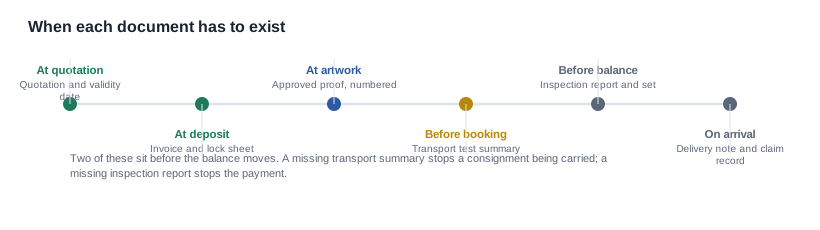
Smart glasses payment terms documentation requirements in this category have one specific feature that decides most of the work: the documents that stop a consignment are not the same documents that release a payment, and the two sets have to be assembled on different timetables. The inspection report and the packing list are produced days before the shipment and release the money. The lithium transport test summary and the certificate of origin have to exist days before the booking, or the carrier will not take the goods at all. A buyer who assembles the payment document set on the day the balance falls due has already missed the booking window.
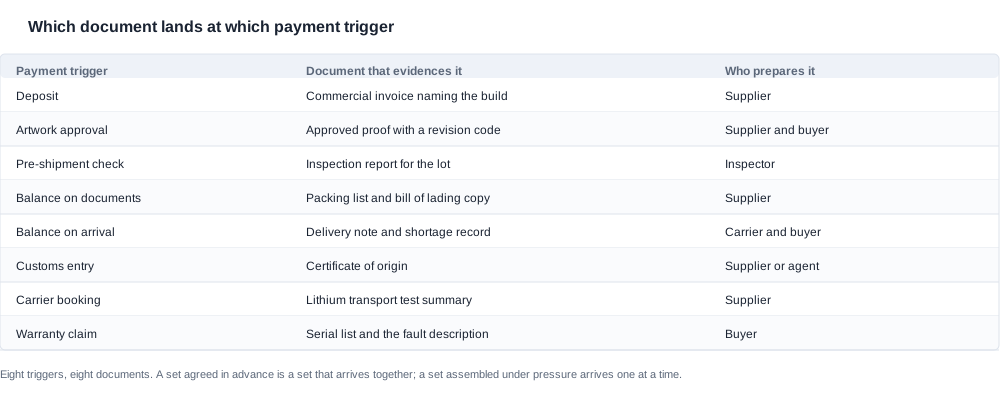
Smart glasses payment terms: documents at each trigger
The mapping below is the working document. Each row names a payment trigger, the document that evidences it, who prepares that document, and what the document actually settles. The last column is the one buyers skip and the one that matters most, because a document that settles nothing is a formality.
| Payment trigger | Document that evidences it | Who prepares it | What it settles |
|---|---|---|---|
| Deposit | Commercial invoice naming the model code | Supplier | That the deposit funds a named configuration |
| Materials placed | Written confirmation of the material position | Supplier | That the long lead parts are committed |
| Artwork approval | Approved proof with a revision code | Supplier and buyer | The artwork round and the packaging basis |
| Pre-shipment check | Inspection report for the production lot | Inspector | Whether the lot matches the approved sample |
| Balance against documents | Packing list and the bill of lading copy | Supplier | That the shipment matches the order |
| Balance on arrival | Delivery note and the shortage record | Carrier and buyer | What was actually received |
| Customs entry | Certificate of origin | Supplier or agent | The tariff treatment at the border |
| Carrier booking | Lithium transport test summary | Supplier | That the consignment may be carried |
| Warranty | Serial list and the fault description | Buyer | Which units the claim covers |
Three features of this table are worth noticing before anything else.
The preparer column is not decorative. A trigger without a named preparer has no completion state, and a trigger with no completion state is a trigger that gets argued about at the moment it matters — which is always the moment the buyer is least able to argue. The inspection report is prepared by an inspector who may be the buyer's own agent or the supplier's; that should be agreed rather than assumed, because it determines whether the report can be challenged on its own terms.
Two rows sit before the balance and two sit after it. The certificate of origin and the transport test summary are conditions of the shipment, and they are needed before the booking, not before the payment. The delivery note and the shortage record are conditions of the balance on arrival, and they are needed at the warehouse, not at the factory.
The warranty row is the only one that belongs to the buyer. Everything else in the table is a document the buyer receives. The serial list is a document the buyer creates, and it is the one that converts a claim from an argument about a specific unit into an argument about a batch.

The buyer reading this, and the file being assembled
The reader is a brand-side sourcing manager, a channel buyer or an importer. The situation is a quotation to compare, a new programme to open, or a market to enter, and in each of the three cases the question behind the documentation is the same one: which of the two or three suppliers in front of you can actually build what you have written down, and what happens to your schedule when they cannot.
The fear underneath the enquiry is not a bad price. What actually goes wrong is a delivery that does not match the signed sample, a paper route that holds the goods up at a border, or a first run that becomes a returns problem nobody priced.
Two questions arrive before the specification does. The first is what is being ordered in enough detail to be quoted, because a configuration described in general terms produces a price that cannot be compared with anything. The second is what the programme has to survive, and that is the part which decides whether the documentation is a specification exercise or a lesson in finding out later which supplier was right.

There is a fourth question that arrives earlier than buyers expect, and it is worth asking at the enquiry stage rather than at the sample stage: which documents does the destination market require, and which of them does the supplier produce and which does the buyer produce? In this category the division is not obvious, because the transport file and the certificate of origin sit on the supplier's side of the line while the customs declaration, the importer's registration and the destination-market labelling sit on the buyer's. A buyer who has not established the division will find it out at the border, which is the worst possible moment to discover which side of the line they are on.
Which document sits against which payment trigger
The table in the previous section is a reference. What a buyer actually needs is a way to build the table for their own order, and the method is straightforward once the categories are separated.
Start with the schedule, not with the documents. Write out the payment triggers as they appear in the proposed schedule — deposit, artwork, inspection, balance — and leave a column beside each one for the document that would evidence it. Any trigger that cannot be filled in that column is a trigger the buyer should not pay against, because paying against a trigger with no document means paying against an event that cannot be verified.
Then check the direction of each document. A document that evidences something that has already happened — an inspection report for a completed lot, a packing list for a packed pallet — can release money. A document that evidences something that has not happened yet — an approval that has not been given, a certificate that has not been issued — should not be the sole trigger for a payment, because a payment released against a future document is a payment released against a promise.
Then check the timing against the shipping calendar. This is where the two sets of documents separate. The payment set is produced between the artwork approval and the shipment date. The shipping set has to be in hand before the booking, which for most routes means before the production lot is complete. A buyer who asks for the shipping documents at the same time as the payment documents will get them too late, and the schedule will absorb the delay as an unexplained gap.
Then check the chain. A document that is produced by one party and consumed by another needs a named handover point. The proof is produced by the factory and consumed by the buyer; the inspection report is produced by an inspector and consumed by the buyer; the delivery note is produced by the carrier and consumed by the buyer's warehouse. Where the handover is a shipment of physical documents rather than a document transfer, the handover needs to be in the schedule, because it takes time and it can go wrong.
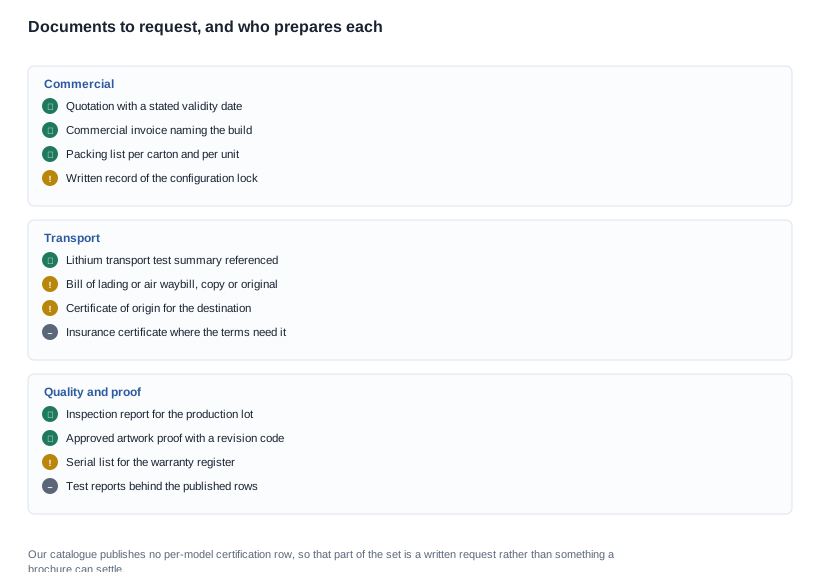
A fifth check completes the method: what happens when the document arrives and it is wrong? A packing list that shows a different quantity, an inspection report that records a defect, a proof that does not match what was approved. In each case the answer should be a defined consequence rather than a negotiation, and the consequence should be written where the trigger is written. A schedule with a defined response period for a non-conforming document is a schedule that behaves predictably on a bad day.
The three documents that are most often requested wrongly
Three documents in this set are requested in a form that does not do the job the buyer needs it to do, and the error is the same in each case: the buyer asks for a document that evidences a decision rather than a fact.
The inspection report. The common request is for an inspection report on the production lot, which sounds right and is frequently answered with a summary. A summary reports a conclusion; a report records the scope, the sample count, the comparison basis and the findings. Only the second kind can support a claim, because only the second kind shows what was checked against what. The request that works is specific: the report must state the scope and the sample count, name the approved sample and its revision, list the findings by unit serial, and be issued against the production lot rather than against a representative unit.
The artwork approval. The common request is for an approved proof, and the common answer is a PDF of the artwork file. A file is not an approval. The artefact that does the job is a proof — a physical or rendered representation of what will be produced — bearing a revision code, approved in writing by a named person on a stated date. Without the revision code, a later proof cannot be shown to be the same artefact, and the whole point of approving artwork before a print run is lost.
The packing list. The common request is for a packing list, and the common answer is a carton-level summary. A carton-level summary tells the buyer how many cartons there are; it does not tell the buyer how many units are inside them, which is the number the receiving team needs to reconcile against the delivery note and against the purchase order. The request that works asks for unit-level detail by carton, with the serial range for each carton where the units are serialised.
The reason these three recur is that they are the documents the buyer actually uses, and the supplier supplies the document the buyer named. Naming the artefact precisely — a report rather than a summary, a proof rather than a file, a unit-level list rather than a carton summary — is the whole correction, and it costs nothing to ask for on the first order.

Turning a supplier answer into a filed document
The step that separates a supplier who has done the work from one who has described it is the conversion of an answer into a filed document. Most enquiries are answered in prose, and prose answers are usable for orientation but not for enforcement.
The conversion takes five steps, and each one has a completion state that can be checked.
- Ask what the document is called, exactly. The name matters because it is what will appear on the invoice and on the carrier booking. "The test report" and "the lithium transport test summary" are not the same document in practice, because only one of them is the document a carrier will reference.
- Ask who prepares it and who signs it. A document prepared by a party and signed by another is two documents, and only one of them is the one you can rely on.
- Ask when it is issued relative to the event it evidences. An inspection report issued after the lot has shipped evidences a review, not an inspection. A packing list issued at the factory evidences the factory's count, not the carrier's.
- Ask in what form it is provided. Paper, PDF, or a data file, and whether the carrier needs an original. This determines whether the document can be produced in the window between the event and the payment, which is sometimes shorter than it sounds.
- File it against the order, not against the email. The filing convention is not administrative housekeeping; it is the difference between a document that can be produced in a claim and a document that has to be located, argued over and possibly reconstructed.
The fifth step is where most programmes lose their evidence, and the reason is not carelessness. Documents arrive by email, against a supplier's invoice number, in a folder named after the model rather than the order, and when the claim is made eighteen months later the person raising it does not know which of four folders holds the relevant proof. The fix is one convention: every document is named with the order number and the document type, and stored in one place with a short index. The index does not need to be elaborate; a single sheet listing each document against its trigger, its date and its location is sufficient.
There is a commercial reason to want the file rather than the folders, and it is not defensiveness. A well-kept file shortens the second order, because the configuration lock sheet, the approved proof and the inspection scope are already written and can be reused instead of re-requested. It also shortens the negotiation, because a buyer who can produce the prior agreed scope for the same configuration is arguing about a known quantity rather than establishing one.

The paperwork that stops a consignment, not a payment
One set of documents in this category has a property the others do not: a deficiency does not delay a payment, it stops the goods moving. That distinction is worth being precise about, because buyers routinely treat the whole document set as paperwork that can be chased.
The lithium transport test summary is the sharpest example. For a device containing a lithium cell this has been a required document since 2020-01-01, and the consequence of its absence is not a delay at the border — it is a refusal to carry. A consignment that cannot be carried has no commercial value on the other side of the booking, and the cost of that is not only the freight but the demurrage, the storage and the season.
The certificate of origin has a similar shape. It does not stop the goods physically, but it determines the tariff treatment, and a treatment that has to be renegotiated after the fact delays the clearance and creates a liability rather than a saving.
The destination-market labelling and documentation requirements are the third. These are buyer-side obligations in most markets and supplier-side in others, and the division is not obvious enough to be assumed.
The practical consequence is a second, earlier timetable. The shipping set has to be complete before the booking, which for most configurations means before the production lot is finished. That is a materially earlier deadline than the payment set, and a buyer who only asks for documents when the balance is due has already missed it.
Our own position on this is worth stating in plain terms, because it is the part of the documentation question that we can and cannot answer. We publish an export certification page at company level and we do not publish a per-model certification row. The catalogue does not carry the certification scope for an individual model against an individual market, so that scope is a written request that has to be made against a specific configuration and a specific destination. That is not an evasion; it is the honest position, and it is also why the certification question belongs in the enquiry rather than in the shipping week.
What our catalogue settles and what we must ask
The rows our published data does settle are these:
- Every catalogue row publishes a cell capacity and a charge time, twenty-four of the twenty-eight publish a charging method, and the camera models publish a resolution tier. These are checkable against the goods on arrival, which means they can be part of the inspection scope without any further request.
- The charging method is not published for four camera models, and the case capacity is not published for two camera models that carry a case. Those rows are open, and a buyer who needs them must ask for them in writing against the configuration.
- The range spans magnetic charging, Type-C and models offering both, and the case configuration is part of the packaging approval because a larger case and a smaller case are different parts and different cartons.
The rows we do not publish for any configuration are these:
- Unit prices, minimum order quantities and production lead times are not published anywhere in our documentation, and are confirmed per enquiry.
- Per-model certification rows, test report numbers and issuing bodies are not published. The catalogue carries a company-level export certification page and nothing per model.
- Conversion cost, yield and the component cost split are not published by anyone in this category.
What we will do is take a configuration, a quantity and a destination market, and say which documents exist on our side, which are open, and which have to be requested from a sub-supplier or from the buyer's own compliance function. The certification verification page covers what to ask for, sample evaluation covers the evidence that the approved sample and the production lot have to match, and logistics covers the shipping side of the document set.
We will not fill a specification gap with a number that cannot be traced to a document, because a buyer who builds a claim on an estimated figure discovers the error in the field rather than in the quotation, and the correction is more expensive than the question was.
Related reading
Send the configuration, the quantity and the market, and we will say which documents exist, which are open, and which are yours to obtain.


