

Smart glasses payment terms are usually negotiated as one conversation, and that is why they are usually wrong. A payment schedule is the output of five decisions, and each of those decisions constrains the ones that follow, which means the order in which they are taken is not a preference but a method. Fix the specification first, establish the compliance position second, set the milestone structure third, attach a remedy to each milestone fourth, and only then name the documents that trigger payment. A buyer who takes the steps in that order finds that most of the hard questions answer themselves, because the specification, the market and the production sequence have already narrowed the space of possible schedules to a very small one.
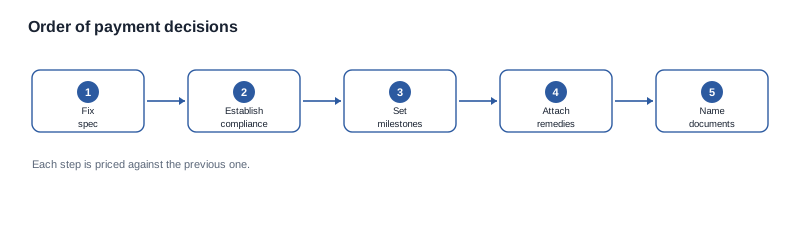
Smart glasses payment terms: the five decisions and the order they run
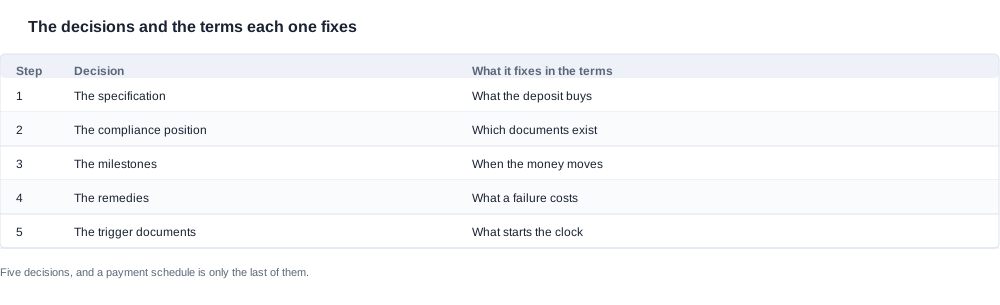
The five decisions in front of a buyer
A buyer arriving at a payment conversation has five decisions in front of them, and most conversations start at the wrong one. Usually the first thing discussed is the deposit percentage, which is the last thing that can be decided, because the deposit is a function of everything else.
- The specification. What exactly is being bought, down to the model, the camera tier, the case option and the colourway.
- The compliance position. Which market the goods enter, which documents that market requires, and which of them the supplier can actually produce.
- The milestone structure. What the stages of the order are, and which of them carry money.
- The remedies. What happens at each milestone if it fails, and within what window.
- The trigger documents. Which document proves each milestone, and who produces it.
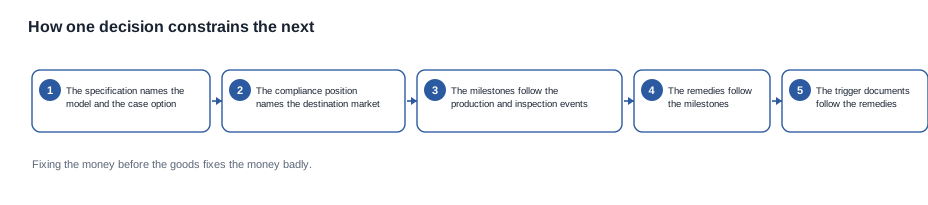
Each decision feeds the next. The specification determines which compliance documents are even relevant. The compliance position determines which milestones can exist, because a document that has to be produced before shipment is a milestone and a document that has to be produced on arrival is not. The milestones determine where the remedies attach. And the remedies determine what the trigger documents have to prove, because a remedy that requires evidence means a trigger document and a remedy that does not means the trigger can be a date.
Why the order matters more than the content
The content of a good schedule is not especially hard. Once the five decisions above have been made, the schedule writes itself, and a buyer who has them clear can produce a competent schedule in an afternoon with no legal input.
The order is the hard part, and the reason is that each decision is cheap to make early and expensive to make late. The specification is nearly free while nobody has built anything, and it becomes a tooling cost, an artwork cost and a delivery delay once it has been frozen. The compliance position is a question while the market is theoretical and becomes a held shipment once the goods are built. The milestone structure is a conversation at the quotation stage and a dispute once production has started.
There is a second reason the order is the method, and it is about the negotiating position rather than the arithmetic. A buyer who opens with the deposit is negotiating over the number that both sides can most easily agree on, and the agreement closes the conversation. A buyer who opens with the specification is establishing the frame, and the deposit then becomes a consequence rather than a subject. In this category, the difference between those two conversations is usually a better schedule at the same price.
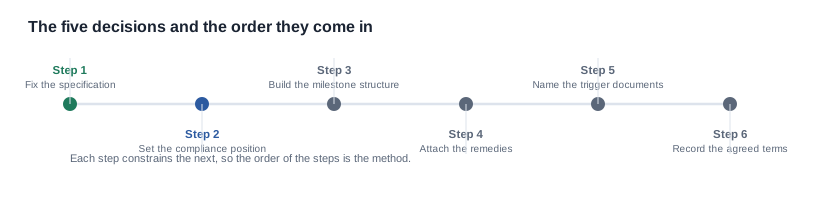

Step one: fix the specification before any money is discussed
What the specification has to name
A specification that can be built, quoted, inspected and shipped contains four things, and a schedule that refers to any of them by name is a schedule that can be enforced.
- The model. Not the family and not the range. Our catalogue publishes twenty-eight models, and the differences between them are commercial as well as technical: the L2 Utral publishes a 900 mAh or a 1400 mAh case, the MT6 a 1200 mAh folding case, the L1 Pro and the CY03, and the CY05 a 1400 mAh case, the KY06 and the MT5 a case whose capacity is not published, and the V03 Pro no case at all.
- The camera tier, where the model has one. Eight models carry an 8 MP camera, including the MT6, and three carry a 13 MP camera, including the S7. This is the row that an acceptance criterion is built from, and it is the row most often left implicit in a schedule.
- The case option and the charging method. Magnetic charging is published on seventeen models and Type C on seven, while four camera models publish a case capacity and no charging method row at all. Where the method is not published, it is a question for the supplier, and a question that belongs in the specification rather than in a later email.
- The quantity, the destination and the market. The market matters because it decides the compliance position, which is the next step.
The published rows that make it specific
The reason to be this precise is that a schedule against a vague specification cannot be checked, and an uncheckable schedule is the one that produces disputes.
| Decision | What it fixes in the terms | What to ask the supplier |
|---|---|---|
| The model | What the deposit is paid against | Which variant is quoted |
| The camera tier | The acceptance criterion | Which tier the build carries |
| The case option | What is inside the carton | Which case ships in the box |
| The charging method | Whether a dock is a separate line | Which interface the order uses |
| The quantity and the market | Which documents are needed | What the destination requires |
The last column is the part buyers tend to skip, and it is the part that protects them. A specification is not a description of what the buyer would like; it is a set of things the supplier has to confirm, and each confirmation is a small fact that can be checked later.
Step two: establish the compliance position
What the destination market actually asks for
The second step is to establish what the market requires, and it is a step buyers often skip because it sounds like a regulatory question rather than a commercial one. It is a commercial question because the answer determines which milestones exist.
The mechanics are straightforward. Certain markets require conformity documentation for products that carry radio equipment, and the European framework for that is the Radio Equipment Directive, (EU) 2014/53/EU, supported by harmonised standards for electromagnetic compatibility in the EN 301 489 series. The EMC directive that sits alongside it is (EU) 2014/32/EU, and the two are different instruments with different numbers, which is a detail worth getting right because it appears in correspondence. Lithium cells add a transport question, with UN38.3 testing being the evidence that a cell is safe to ship. The point is not to enumerate the requirements, it is to establish which documents the destination demands, because each one is either a milestone or a non-event.
Where our own catalogue is open
A single company-level export certification page appears in the catalogue rather than a per-model certification row, and it publishes no certificate numbers, no validity dates and no per-model scope. That is a genuine open row, and the way to handle it is to treat it as a specification the supplier has to satisfy.
The questions to ask, in this order, are: which document does this market require for this configuration, who produces it, by when, and what does the schedule do if it cannot be produced. The fourth question is the one that turns the compliance position into a term. A schedule that makes an unproducible document the trigger of the balance has built a stop into the order, and a schedule that says what happens instead has built a condition.
The same reasoning applies to the rows the catalogue leaves open on the product side. The charging method on the four camera models whose rows carry a case capacity but no method, the case capacity on the KY06 and the MT5, the Bluetooth version on the eleven camera models, and the weight on every model except the MT6, where 158 g is published for the glasses body including the 265 mAh cell and the camera and excluding the folding case, are all rows the buyer has to specify rather than copy. That is not a weakness in the catalogue. It is the honest position, and a buyer who asks for the missing row gets a fact, while a buyer who assumes one gets a dispute.

Step three and four: milestones, then remedies
Step three: the milestone structure
With the specification and the compliance position fixed, the milestones fall out of the production sequence rather than out of a template. A typical order in this category has five or six: the order and the configuration freeze, the deposit, the start of production, the completion of production, the pre-shipment inspection, and the shipment with the document set. The compliance documents slot in wherever they fall, and a document that has to be produced before loading is a milestone with a date attached.
The discipline is to give every milestone a trigger, an owner and a date, and to check the three of them against each other. A milestone with a date and no owner is a date. A milestone with an owner and no trigger is a status report. A milestone with a trigger and no date is a condition that may or may not have occurred, which is the same problem in a slower form.
The question to ask at this step is which milestones carry money and which carry evidence. A milestone that carries money and no evidence is a payment for trust. A milestone that carries evidence and no money is a control point, and it belongs in the schedule even though nothing is released by it, because it is what the next milestone's release depends on.
The milestone structure as a working example
A milestone structure for a mid-sized order in this category is short enough to be read in one minute, which is a useful property, and specific enough to be checked. The order below is an illustration of the shape, not a template, because the dates belong to a particular order.
- Order accepted and the configuration frozen. The configuration string is fixed, the destination is confirmed, and the deposit becomes payable. The trigger is the signed configuration, and the owner is the buyer's procurement manager.
- Production started against the frozen configuration. No money moves here. The trigger is the production record, and the owner is the factory. This is a control point, and it belongs in the schedule precisely because it carries no payment.
- Production completed and the goods presented for inspection. The trigger is the production completion record against the configuration, and the owner is the factory's production lead.
- Pre-shipment inspection completed. The trigger is the inspection report with the lot identifiers, the sample size and the limits, and the owner is the inspection party. This is where the balance is released, and it is the milestone the whole schedule is built around.
- Conformity documentation handed over. The trigger is the document set for the destination market, produced by a named owner with a date.
- Shipment and document release. The trigger is the bill of lading, and the owner is the forwarder. This milestone carries the retention release, once the remedy window has closed.
Two features of this structure are worth naming. The second milestone carries no money, which is the point: it is the control point that makes the fourth milestone meaningful, and without it the inspection is an inspection of an unknown build. And the balance is released at the fourth milestone rather than the sixth, which is the entire difference between a schedule that protects the buyer and one that only describes them.
Step four: a remedy for every milestone
The fourth step is the one most schedules never reach, because the remedy is usually written as a single clause at the end of the document rather than as an attachment to each milestone. The result is a schedule where a failure at the inspection stage and a failure at the delivery stage are handled by the same vague sentence, and the buyer has to work out at the point of failure which one applies.
The better structure is simple: for each milestone, state what happens if that milestone fails. A failed inspection leads to a hold on the shipment, a documented finding, a remedy inside a window, and a retention held until the window closes. A failed document production leads to a named alternative and a new date, or to a defined fallback in which the balance releases against a substitute document. A changed configuration after the freeze leads to a re-quote and a decision about the deposit.
The reason this matters is that each remedy is a different kind of claim. A hold on a shipment is something the supplier can do immediately. A credit is something the finance function has to process. A replacement is something the factory has to schedule. Attaching the remedy to the milestone means the buyer knows which of those has to happen and when, which is exactly what a buyer needs when a milestone fails.

Step five: naming the trigger documents, and where buyers get stuck
Which document starts which clock
The fifth step is to name, for each milestone, the document that proves it and the party that produces it. This is where the schedule either becomes checkable or stays descriptive.
A workable trigger document set for this category is small and specific: the production completion record against the configuration string, the inspection report with the lot identifiers, the sample size, the characteristics examined and the limits applied, the packing record that connects the report to the specific units that shipped, and the conformity documentation for the destination market, produced by a named owner with a date.
Each of these answers a question the buyer will need answered later, and the answers have to be obtainable from a document rather than from a memory. The packing record is the one most often forgotten, and it is the one that connects a report to a shipment, without which a report can be attached to the wrong units.
Which step are you actually stuck on
Buyers rarely get stuck at the point they think they are stuck at. A negotiation about the deposit share is usually a symptom of an unresolved specification, because the buyer does not yet know what the money is for and is negotiating the only number that is available. A dispute about a balance release is usually a symptom of a milestone structure that was never agreed, because the balance was attached to a date because there was nothing else to attach it to.
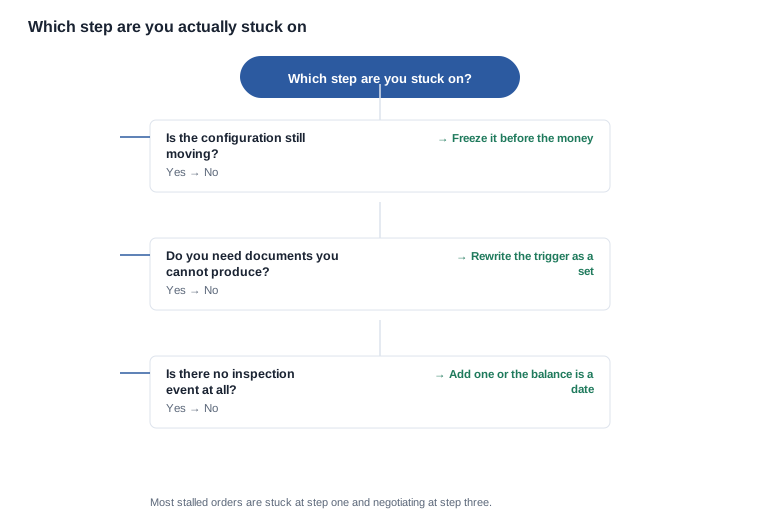
The three diagnostic questions below locate the stall quickly.
- Is the configuration still moving? If it is, nothing else can be settled, because every term is conditional on a product that does not yet exist.
- Does the market require a document that cannot be produced? If it does, the trigger has to be rewritten as a document set with a named producer, and the milestone structure has to be redrawn around the alternative.
- Is there no inspection event in the schedule at all? If there is not, the balance is a date, and that is the last thing to change and the first thing to argue about.
The questions that locate a stalled sequence
When a schedule is not moving, the useful move is to ask which of the five decisions is actually unresolved, and to ask it as a question with a short answer.
- What exactly is being bought? If the answer is a model family, or a model with two case options, the specification is not fixed and no term can be settled. This is the most common cause of a stalled payment conversation, because it is invisible: the buyer believes the specification is settled and the supplier believes the buyer is still choosing.
- Which market, and which documents? If the answer is that the buyer will decide the market later, the compliance position is open, and the milestone structure will have to be redrawn when it closes.
- Which stages of the order carry money? If the answer is that the balance is due on shipment, there is no milestone structure, and the remedy in step four has nothing to attach to.
- What happens if a stage fails? If the answer is that it will be handled case by case, step four has not been done, and the schedule will be interpreted rather than applied.
- Which document proves each stage? If the answer is a certificate number without a scope, the trigger is decorative and the last step has not been reached.
Asked in this order, these five questions locate the stall in a single exchange, and they are answerable in a sentence each by a supplier who is prepared. A supplier who cannot answer the first one in a sentence is quoting a product range, and the terms will have to wait for the configuration to be settled anyway.
Where Cynrin stands on the sequence, and the next step
What we will commit to, and what we will not
We will follow the sequence with a buyer rather than starting at the deposit. We will name the configuration, state which of our published rows are open for that configuration, propose the milestone structure that follows from the production sequence, attach a remedy to each milestone, and name the document that triggers each one. Where a document is not published on our side, we will say so and ask for the specification rather than estimate it.
What we will not do is quote a schedule that releases a balance on a date with no inspection behind it, or accept a trigger document that cannot be produced. Those two are the two points at which a payment schedule stops being a set of conditions, and we would rather say that at the quotation stage than at the shipment stage. Our payment terms framework sets out the commercial structure, contract terms covers the clauses around the schedule, logistics covers the shipment and document stage, and the certification checklist covers the document route for the destination market.
Sending the configuration for a sequence review
Send the model, the case option, the quantity, the destination market and the schedule you have been given, and we will tell you which configurations exist, which milestones the order needs, which documents we would produce for each one, and where the published data leaves a row open. We will also tell you where we think the order in your own process needs to move, because a sequence that is being run out of order is the most common reason a payment schedule in this category ends up weaker than the parties intended.
Send the configuration, the quantity and the market, and we will tell you which step the schedule has reached and which one it still needs.


