
Smart glasses payment terms are worth more attention than the unit price they accompany, because in this category the configuration freezes at tooling release and money paid before that freeze buys a specification you can no longer amend. Two quotations can carry the same unit price and still lock up very different amounts of your working capital, and the difference is entirely in the schedule rather than in the number. Below is the clause-by-clause reading of a payment schedule, what each clause is actually deciding, and the eight questions that settle them before a deposit moves.
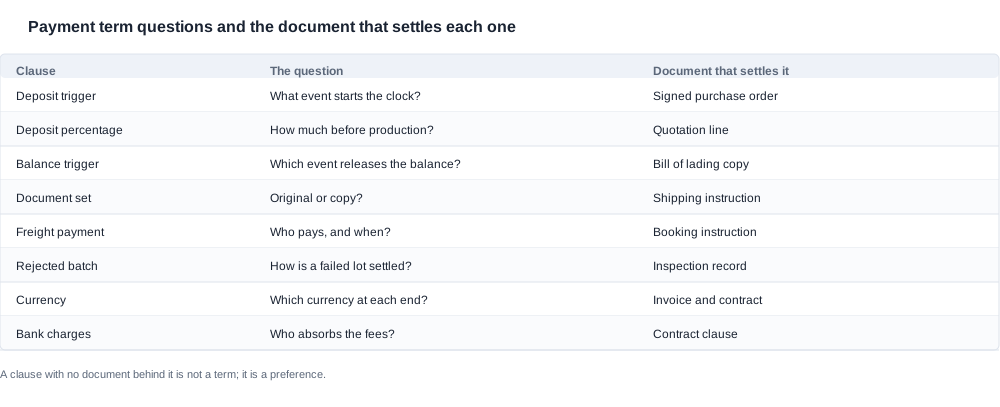
Smart glasses payment terms settle cash exposure before they settle price
The buyer reading this, and the decision sitting on the desk
The reader is a procurement manager on the brand side, a channel buyer or an importer who already has two or three quotations in front of them and has to decide which one receives a deposit. The question underneath the payment conversation is not a philosophical one about terms. It is a short-horizon question about this programme: how much cash becomes unrecoverable, at which point in the schedule, and against what evidence.
What makes this category different from a simple assembly job is the freeze point. Once tooling is released, the electrical configuration is fixed — and the catalogue makes that visible in a way that is easy to under-estimate. It publishes, for every model, the battery capacity, the published runtime and the charge time, and the charge method for twenty-four of the twenty-eight. It publishes those rows for the camera models with a twelve-megapixel sensor and for the ones with an eight-megapixel sensor. It publishes that only two models carry an IP54 marking. It publishes a charging-case capacity for some camera models and publishes no charging-case row at all for others.
That means the specification your deposit buys is a specific one, and it is a specification you can describe in advance because the supplier can describe it too. The commercial consequence is that a payment schedule is effectively a decision about when you accept that the specification is closed. A deposit triggered by drawing approval accepts it before you have seen a working sample. A deposit triggered by a signed purchase order accepts it against a written specification. Both are legitimate; they are not equivalent.
Why two quotations at the same unit price tie up different amounts of cash
Take the cash exposure of one order apart and it has more pieces than the deposit and the balance. There is the deposit itself. There is the tooling and non-recurring engineering, which is usually invoiced early and is usually not recoverable at all once the tool is cut. There is the balance, which becomes due on some document event. There is freight, which is frequently arranged on your account and prepaid, because a carrier will not extend credit against a consignment. There is the inspection window, which runs while your money is already committed. And there is the exposure between signature and settlement if the quote currency and your operating currency differ.
The unit price sits at the end of that list, not the front, because the unit price only tells you what one unit costs. It says nothing about how many units you have to buy before the supplier will cut the tool, whether the tooling is amortised into the unit price or invoiced separately, when the balance falls due, or whether you have to fund the freight yourself.
The catalogue detail that changes this arithmetic most often is the accessory configuration, not the glasses. Across the camera models, five publish a charging-case capacity — the L1 Pro and the CY03, and the CY05 — each at 1400 mAh, the L2 Utral at either 900 or 1400 mAh, and the MT6 as a 1200 mAh folding case. Two more, the KY06 and the MT5, publish a case without publishing its capacity. Four, the V06 and the V03 Pro, and the S7 and the V03, publish no charging-case row at all, which is an unpublished item rather than an absent one, and what the box contains for them has to come back from the supplier in writing.
Those are eleven camera configurations that differ in order value while sharing a camera and a battery, and a buyer who asks for a quotation without specifying the accessory position will get a quotation that does not cover the accessory question. This is exactly the sort of gap where a payment schedule and a bill of materials get out of step: the quotation assumes one case configuration, the purchase order assumes another, and the deposit is calculated on the first.
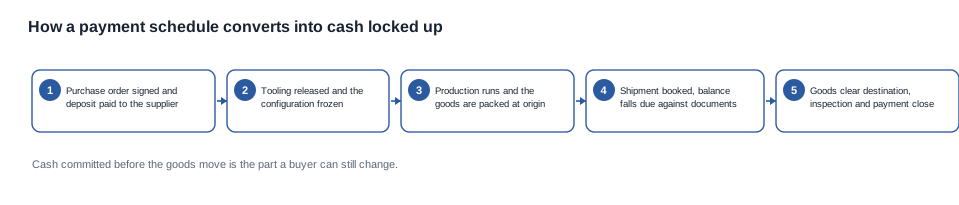
The flow above is the one that matters for a credit decision. Notice where the money becomes unrecoverable: not when the goods arrive, but when the tooling is released, because at that point the specification is closed and the supplier's cost has been incurred. Everything after that point — production, inspection, shipping — is a question of whether the goods match what you bought, and that is a verification problem, not a negotiation problem.

The eight clauses that decide how much working capital one order locks up
The deposit percentage, and the trigger that actually releases it
The percentage is the easy half and the one buyers spend the least time on. The trigger is the half that decides everything. There are, in practice, four trigger events a supplier will accept, and they are not equal.
- Signature of the purchase order. The specification is closed by the contract itself, and the deposit is the price of that closure. This is the cleanest version, because the document that triggers payment is the same document that fixes the configuration.
- Approval of the technical drawing. The configuration is closed, but it is closed by a document you have not seen a physical sample of. Acceptable when you have already approved a sample.
- Release of the tooling. The tool is cut. This is the point at which the cost is genuinely incurred and the specification is genuinely irreversible, so it is also the point at which a deposit is hardest to recover.
- Start of production. Late, and the supplier will usually ask for more money up front to cover the material cost.
A deposit triggered by drawing approval, before any sample has been seen and tested, is the ordering that costs a buyer the most when the specification turns out to be wrong. That is not a moral judgement on the supplier; it is a normal request given that drawing approval often precedes a sample in a first order. It is a negotiation for the buyer to understand, and the question to ask is not "will you move the trigger" but "what do I receive in writing at the moment the trigger fires".
The balance trigger, and why "after shipment" is not an event
Ask for a document, not a description. "The original bill of lading" is an event with a name, a number and a date. "After shipment" is not, because shipment has at least three meanings in a factory workflow: goods packed and handed to a forwarder, goods loaded on the vessel, or goods departed the origin port. Each of the three means a different thing about how much risk you are still carrying, and each of them can be weeks apart.
The practical test is whether the buyer can point to the document and say what releasing the balance means. If the balance is released against the bill of lading copy, then the buyer releases money against a document that proves the goods are on a vessel, and the remaining exposure is the shipment itself. If the balance is released on a photograph of a packed carton, then the buyer has released the entire order value against an image.
One practical detail that is worth settling in the same clause: the release event should say what happens if the event does not occur. Goods can be held at the port. A consignment can be refused. If the clause has no answer for "the shipper never loads", the buyer has paid 100% of the order value and holds a claim.
Currency, bank charges, and the gap between signature and settlement
Where the quotation currency differs from the currency the buyer operates in, there is an exposure between the two dates that does not appear anywhere on the quotation. The useful question is whether the invoice currency is the same as the quotation currency, and what happens to the price if the settlement currency moves between the signature of the purchase order and the date the balance falls due.
Bank charges are the second half of this and they are decided by whoever raises them first. On a large order they are a rounding error. On a first order from a new supplier, or on an order in a currency where correspondent bank fees are heavy, the fee structure can be a visible percentage of the deposit. It is normal to negotiate and abnormal to omit, which is why it ends up allocated by default rather than by agreement. Put it in the clause.
Original documents, copy documents, and who takes the risk
Original documents hold the goods. Copies do not. If the buyer has an inspection arrangement at origin, copies are usually workable, because the inspection happens before the release of the goods to the carrier. If the inspection happens at destination, the buyer generally needs originals, or at least needs to know who is holding them.
The reason this is worth asking is that it is frequently decided by default rather than by choice. A supplier's standard practice on an export order is to release originals against payment, and a buyer who has not asked will get that practice whether or not it suits the inspection plan. It is a one-sentence question with a real consequence.
Who funds the freight, and when it is charged
If freight is arranged on the buyer's account and the balance falls due on arrival, the buyer has funded goods that are still at sea, on top of having already paid the balance. This is a delivery clause with a payment consequence, and it is almost never examined in the same conversation as the balance trigger, because it belongs to the logistics discussion and the logistics discussion is usually about price rather than about timing.
The alternative is to let the supplier book the freight and include it in the invoice, so that the freight is paid once, at the moment the goods are handed over, and the carrier's invoice arrives as a document the buyer can check. That has a cost, and it is discussed in the payment terms framework.
The remedy line for a rejected batch
Payment terms are usually silent on this, which means a rejected batch is settled on the same schedule as an accepted one. That is a serious exposure: the buyer has paid the deposit and the balance, the goods have arrived, and they are not what was ordered. The remedy — a credit, a replacement, a rework — is then something to be negotiated with a counterparty who has already been paid in full.
Getting a remedy written into the order before production is straightforward. Getting one afterwards involves a claim, and a claim against a supplier in another jurisdiction, with goods already in your warehouse, is a different exercise entirely. This is the point at which a payment schedule stops being about money and starts being about evidence: the remedy clause is only worth something if the acceptance criteria it refers to are written down and were applied at a point where someone with authority could act.
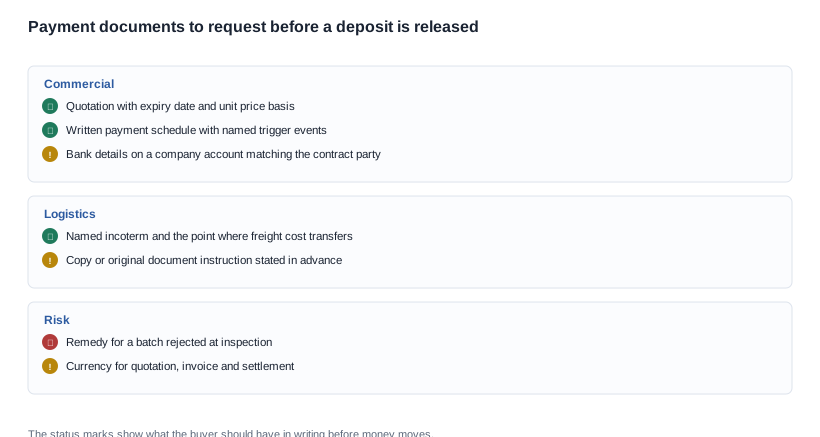
Checking the payment schedule against the configuration you are actually buying
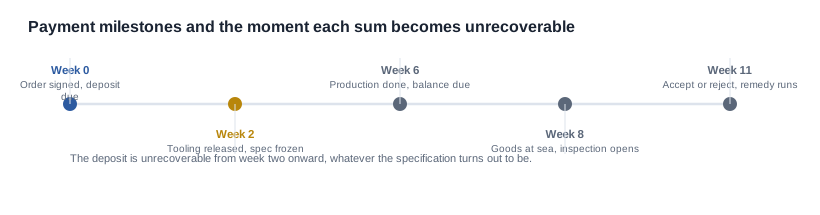
Tooling and non-recurring engineering, and the point at which the deposit stops being recoverable
Tooling is a cost that belongs to the programme rather than to the unit, and the commercial question is whether it is amortised into the unit price or invoiced as a separate line. A buyer who negotiates only the unit price can end up with a lower unit price and a much larger total outlay, because the tooling is a fixed cost that has to be paid whether the first order is small or large.
The payment-side question is narrower and more useful: which of the two triggers applies to the tooling invoice, and is it before or after the sample is accepted. If the tooling invoice is due on signature, the buyer is funding a tool for a configuration that has not been validated on a physical unit. If it is due after sample approval, the buyer has a working reference. The second costs the buyer a few weeks and materially reduces the risk of paying for a tool cut to a specification that turns out to be wrong.
There is a category question here too that no payment clause resolves. If the buyer wants a private-label variant, the artwork, the packaging and the software configuration are non-recurring costs that sit in the same category as the tool, and they are the costs most often left out of the quotation entirely. Ask what non-recurring costs exist for the specific configuration, in writing, at quotation stage.
Accessories and configurations that change what the order is worth
The order value is not the glasses. In this catalogue the camera models alone span several different BOM positions, and the ones a buyer is most likely to get wrong are the ones that sound smallest.
The camera sensor splits into two published tiers: eight megapixels across eight camera models, and thirteen megapixels across three. That is a real cost difference in the bill of materials and it is a real difference in what the deposit is calculated on.
The charging-case position changes the order in the opposite direction, by adding a second cell and a second assembly step. A model that ships with a 1400 mAh case and a model whose case position the catalogue does not publish are two different orders to price, and the second one cannot be quoted until the supplier has confirmed in writing whether the box carries a case at all. And for the four camera models where the charge method is not published — the L1 Pro and the MT6, and the CY03 and the CY05 — the case capacity is published, which means the question is not whether a case exists but how the goods get into it. That is a documentary gap, and gaps like this get settled in the contract and often in the payment schedule as well.
The general point is that the deposit percentage is meaningless without the configuration attached to it, and the configuration is exactly what the buyer has to specify. This is where the how to calculate smart glasses payment terms guide becomes useful, because the calculation is only as good as the configuration it is calculated on.
A clause-by-clause comparison, worked from a published configuration
The table below takes one published camera configuration and shows what the buyer should ask against each clause. It is a comparison of question shapes rather than of answers, because answers belong to the quotation and the quotation belongs to the supplier.
| Clause | Weak request | Request that produces a usable answer | Why the difference matters |
|---|---|---|---|
| Deposit trigger | "Can we pay after the order is placed?" | "Which document and which date trigger the deposit?" | A document can be checked; a conversation cannot |
| Deposit base | "What is the deposit percentage?" | "What is the percentage applied to, including tooling and packaging?" | The base determines what the percentage actually protects |
| Balance event | "Is the balance due before or after shipment?" | "Which named document releases the balance?" | "Shipment" has three meanings and each carries different risk |
| Document set | "Can you send us the paperwork?" | "Original or copy, and who holds them?" | Originals hold the goods; copies do not |
| Freight | "Can freight be included in the price?" | "Who books it, who is invoiced, and when?" | Determines how much is funded before arrival |
| Rejected goods | "What happens if the goods are not right?" | "What is the remedy, who decides conformity, and by when?" | An undefined remedy is a claim, not a term |
| Currency | "Is the price in dollars?" | "Which currency for the quotation, the invoice and the settlement?" | The gap between them is an unpriced exposure |
| Warranty | "Is there a warranty?" | "Which period, which party services it, and against which document?" | The returns policy and the payment schedule have to agree |

Where a payment schedule breaks in practice
The deposit that fires on drawing approval
What happens. The buyer approves a technical drawing to release the deposit, and the drawing turns out to differ from the sample in a detail the buyer did not have the means to assess — a camera housing tolerance, a hinge configuration, an accessory interface that the catalogue row does not describe because the catalogue does not publish it.
Why it happens. Drawing approval is often a formality in a first order, because the drawing is derived from the sample rather than negotiated from a specification. It is reasonable for the supplier to want the money before cutting a tool.
How it is avoided. Ask for the tooling invoice to fall due after sample approval, and put the sample into the payment sequence rather than alongside it. If the supplier will not move the tooling payment, ask for the deposit to be structured so that a meaningful part of it is credited back against the balance if the goods fail inspection — that is a smaller concession to negotiate than a percentage change, and it protects the part of the money that actually matters.
The balance that falls due before anyone can inspect
What happens. The balance is released against the bill of lading, the goods sail, and the specification check at destination finds a problem. The money is gone and the goods are on the water.
Why it happens. The trigger is a document event, and a document event about shipping says nothing about conformity. The two things are conflated because both are "after production".
How it is avoided. Separate the two events explicitly. Write an inspection point into the order — at origin, before the documents are released — and tie the balance to the release of the documents that follow the inspection rather than to the bill of lading. Where an origin inspection is not commercially possible, ask for a pre-shipment inspection with a defined scope and a defined deadline, and ask what happens to the balance if the inspection report is not issued.
The rejected batch that is paid for on the accepted schedule
What happens. A batch is rejected at inspection. The payment terms contain no remedy, so the buyer pursues a credit note, a replacement or a rework, and the conversation starts from a position where the supplier has already been paid in full and the goods are sitting in the buyer's warehouse.
Why it happens. Payment terms and acceptance criteria are drafted by different people, often in different documents, and neither is written to reference the other. The agreement then contains a perfectly clear payment schedule and a perfectly clear inspection provision, and neither one tells you what happens when both are triggered at once.
How it is avoided. Write the acceptance criteria into the purchase order, write the remedy into the purchase order, and make the payment schedule refer to the acceptance clause by name. The contract checklist is the place where the two documents get joined up.
The currency that moves between signature and settlement
What happens. The quotation is made in one currency, the invoice in another, and the buyer's operating currency is a third. The order is placed against a number that no longer holds by the time the balance falls due, and the buyer discovers this at settlement rather than at quotation.
Why it happens. The quotation and the invoice are produced by different systems and the currency is often picked by the payment operation rather than by the commercial negotiation.
How it is avoided. Ask for a single settlement currency in the order, and ask what happens to the price if the settlement currency moves against the buyer by a stated margin. If the answer is that the price is fixed regardless, that is worth having in writing. If the answer is that the price follows the market, then the exposure belongs in the buyer's own risk assessment and should be treated as a cost line rather than as a detail.
The warranty clause that the payment schedule contradicts
What happens. The supplier's terms say that the warranty runs from the bill of lading date, while the buyer's commercial model assumes it runs from the date the goods are placed in the channel. The difference is a month of warehousing on every unit.
Why it happens. Warranty terms and payment terms are two documents that both refer to dates and are written by different functions.
How it is avoided. Put the warranty start event and the payment events in the same clause list, and check they are consistent before the order is signed. The contract reading guide sets out how to trace the dates through a document without reading every line.

A hypothetical programme, worked clause by clause
The scenario below is a reasoning exercise rather than a customer project, and no client, order or figure is claimed. The model, the quantity and the market are assumed so that the steps can be followed, and the point is the order in which the clauses are settled.
The situation. A brand owner is opening a camera-glasses programme for sale into a European retail channel. The first order is in the low thousands of units. The specification is not a catalogue configuration exactly — it requires a brand logo on the temple and a retail carton — so it is a custom configuration of a published camera model with a published charging-case position. The buyer has three quotations and no sample in hand.
Step one: settle the configuration before the money. The buyer picks the camera model and states the accessory position in writing, because the catalogue publishes the case capacity for some camera models and does not publish a case row for others, and a quotation without that line is not comparable. The buyer also asks for the charge method, because four camera models publish no charge-method row at all and an open question there is an open question in the tooling and the packaging.
Step two: ask all three suppliers the same eight questions. Not the questions each supplier's own documentation suggests — the same eight, in the same order, to the same named person. The comparison is only worth making if the answers are comparable, and comparability comes from asking identically rather than from the answers being similar.
Step three: read the triggers in order of how much they bind. The deposit trigger comes first, because it determines how early the specification closes. Then the balance event, because it determines how much is committed before conformity is checked. Then the currency and the bank charges, because they are small in isolation and annoying in aggregate. Then the remedy, because it is the clause that a rejection will be argued under.
Step four: choose the schedule, not the supplier, on this axis. In this exercise the quotations differ by less than a buyer would expect at this volume. The difference in cash exposure between the best schedule and the worst is larger than the difference in total cost. That is the finding, and it is a finding that only appears when the schedules are written down side by side.
Step five: put the sample between the deposit and the tooling. The buyer asks for the sample to be produced against the same specification that will go into production, and asks that the tooling invoice fall due after the sample is approved. The supplier who accepts this is not necessarily cheaper; the buyer is trading a few weeks of schedule for a materially lower chance of paying for a tool cut to the wrong specification.
Step six: fix the inspection point before the balance clause is written. The buyer decides where conformity is checked, and only then asks which document releases the balance. The order of these two operations matters. If the balance clause is written first, the document event it names becomes the answer to a question that was never asked.
What we will commit to on payment, and what we will not
Our own deposit percentage, the trigger document, the fee allocation and the settlement currency are Not published as a standing policy, because in this category they depend on the configuration, the volume, the destination and the terms of the individual order. We will answer all eight of the questions above in writing at quotation stage, against the specific configuration and quantity you give us, and if a term you need is one we will not accept, we will say so at that point rather than letting it surface after production.
There is a second boundary worth stating plainly. We publish the electrical rows and the configuration facts for our models — battery capacity, published runtime, charge time, charge method, the charging-case position, the camera resolution tier, the IP54 marking on the V06 and the S7 — because those are the facts you need to write a specification. We do not publish production capacity figures, yield figures or lead-time commitments as standing numbers, and we are not going to quote a typical figure you cannot verify. For those, the useful approach is to ask for the figure against your own order, in writing, and to treat the answer as a commitment rather than as a market range.
Our practical position on payment is this: the payment schedule should describe the same programme the technical specification describes. If the two documents disagree about what is being bought, the schedule will eventually be read as an excuse rather than as a term, and the buyer will find it more expensive than negotiating it at quotation stage.
Related reading
- How the structures work — payment terms
- Structures compared side by side — payment comparison
- Where payment sits in the contract — contract checklist
- Working the arithmetic — how to calculate smart glasses payment terms
- Reading the dates in an agreement — how to read a smart glasses contract
Pass on the target market, the quantity and the required configuration, and we will report what is available and what is not.