

We do not publish unit prices as fixed figures on this site, because in this category the price of a smart glasses unit is decided by a configuration rather than by a model, and a price quoted without a configuration is a number with a short life. What we can do is give you the checklist that turns a headline unit price into something you can actually plan a business on. Every item below is a place where real money moves, and most of them are the items that get left out of the first quote.
The pricing section covers how commercial terms are normally structured, and minimum order quantity covers the quantity side of the same conversation. The customisation rows this checklist refers to are listed under customization options.
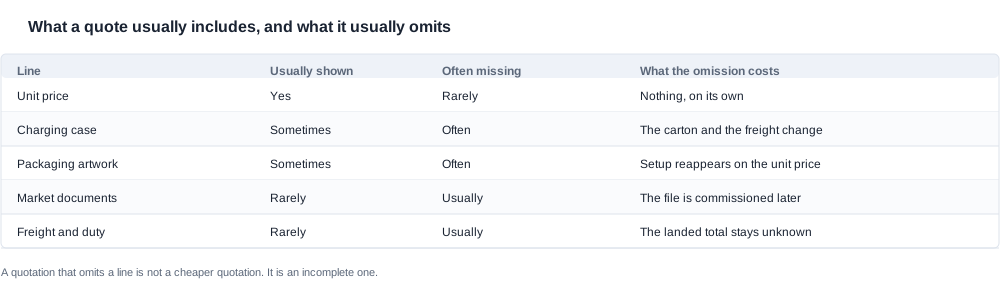
The table is the first half of the checklist: the line items a quotation in this category usually shows, the ones it usually leaves out, and what each omission ends up costing.
Smart glasses pricing: the anatomy of a landed cost
Why the unit price and the landed total are different numbers
The unit price answers one question: what the goods cost to build against a stated configuration. The landed total answers a different one: what it costs to have those goods, documented and compliant, sitting in the buyer's warehouse in the destination market. The two are separated by four things, and all four are real money.
Those four are the freight to the destination, the duty on the declared classification, the compliance scope amortised across the run, and a provision for the units that come back. A buyer who has modelled only the first of them has modelled a factory quote rather than a landed cost, and the difference is exactly the part of the transaction that nobody can argue about afterwards.
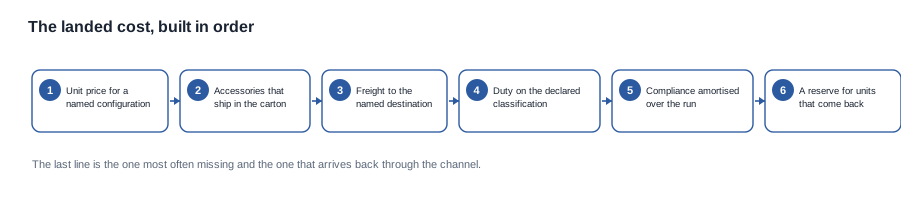
The order in the flow is not arbitrary. Each step depends on the one before it, and the fourth step is the one that changes the retail price rather than the cost.
The omissions, and what each one costs
The omissions on a first quotation follow a pattern. The unit price is present. The charging case is sometimes present and often absent. The packaging artwork is sometimes present and often absent. The market document set is usually absent, and the freight and duty are usually absent. A quotation that has all five omissions is not a cheap quotation; it is a quotation for a different transaction, and the difference arrives at invoice.
The pattern is worth understanding, because it is not a pricing strategy. It is a sequence: the goods are quoted first because the goods are what the enquiry asked about, and each of the other lines arrives later when the configuration, the packaging or the destination is settled. By that point the line has become a change rather than a quotation, which is why it is expensive and why it is argued about.
There is a cost to that sequencing beyond the money. Each omitted line that arrives late is a change, and changes carry a different price and a different approval path from a quoted line. A buyer who has to approve five changes after the order is placed is spending the organisation's time as well as its money, and the review that follows a change is rarely as rigorous as the review that follows a quotation. It is worth asking for all of it at once, in a single request, before the order rather than after it.

The four items that move the unit price most
Colourways: a per-colour minimum, not a per-order minimum
Our catalogue documents some models in several colours — the V06 in orange, ice white, black and black ice blue, and the V03 Pro in orange, off-white and black. Each additional colourway is a separate production setup, and the question that determines the real cost is the minimum per colour, not the minimum per order.
This is the single most common way a planned unit cost becomes a different number after the order is placed. A buyer who plans one order across four colourways has been quoted a minimum that applies to one of them. The correction is to ask for the minimum per colour and to ask what happens to the other three at that quantity, which is a different question and usually has a different answer.
The charging case: a bill of materials item and a freight item
Several camera models ship with a case: a 1400 mAh case on the L1 Pro and the CY05, and the CY03, 900 or 1400 mAh on the L2 Utral, and a foldable 1200 mAh case on the MT6. The V03 Pro has no charging case in the box at all, and the KY06 and the MT5 carry a case whose capacity is not published.
The case is both a bill-of-materials item and a freight item, because it changes the box volume and the shipping weight, and a carton that is larger than the buyer assumed moves the freight band. Ask whether the quoted price includes it and what it costs to add, and ask the same question about the case on a model where the capacity is not published, because the fact that a case exists does not tell the buyer which one it is.
Frame or temple tooling: a project cost, not a unit cost
A change to the frame is a project cost rather than a unit cost, and it should be quoted separately with its own terms. If a supplier folds tooling into the unit price without saying so, the buyer cannot tell whether they have bought the tool or been lent it, and the distinction decides what the second order costs.
The related trap is the moulded insert, which is tooling and is frequently quoted as packaging. A folded card insert is a printing cost; a moulded one is an amortised project cost with a minimum run length attached, and it is one of the few items in this category that constrains the second order rather than the first.
Firmware, interface and the Bluetooth name: engineering hours
These are engineering hours. Our catalogue documents firmware and system customisation for the camera line and Bluetooth name and system customisation for the audio line, with app and firmware capability marked unverified on the children's line and undisclosed entirely on the bone-conduction and AR entries. Anything described verbally and not quoted as engineering is not costed.
The Bluetooth name is a small item that is easy to leave out of a specification and awkward to add late, because it is written into the firmware build and the channel's instructions at the same time. A branded name is also the cheapest visible customisation available, which is why it is worth asking for by name rather than as a general request for branding.
The four items that move the landed total most
Freight is driven by packaging
A retail box with a case is a different shipping volume from a plain carton, and the difference compounds across a whole order. Every model in this range carries a rechargeable cell, which means the mode is partly chosen for the buyer, and a freight quotation for a cell-bearing consignment is not comparable with a general cargo rate.
The order of operations matters here too. A freight figure quoted before the packaging is settled is a figure for a carton that does not exist, and it will be revised at the point of booking rather than at the point of quotation.
Duty depends on the declared classification
Duty depends on the tariff classification the supplier declares, so the question to ask is which code is being used for the destination rather than accepting whatever is filed. The classification can also move when the box contents change, and the presence of a charging case in the carton is exactly the kind of change that moves it. Ask for the code and ask what changes it.
Certification is model-specific
A test report for one model code does not cover its siblings, and commissioning new testing mid-programme is expensive and slow. This is why the compliance scope is a per-model, per-market line rather than a programme-level one, and why a quotation that prices a single file for a multi-model programme is either under-scoped or has quietly assumed the models are identical.
The catalogue here has a company-level export certification page and no per-model certification rows, which means the certification position of any specific model is a document to be requested rather than a fact to be read. That is a useful thing to know in a negotiation, because it is a question to ask every supplier in the round rather than a line to accept from one.
The returns provision: the item most often absent and most often argued about
Who pays the freight back, and against what threshold? This is the item that is most often missing from a quotation and most often argued about afterwards, and the reason it is missing is that it is a cost the factory can carry and the channel cannot easily avoid.
The published endurance figures are the reason the provision is hard to size. They are published without a test condition, so they cannot be converted into a return rate, and a margin calculated on the assumption that the units do not come back is a margin calculated on a rate of zero. The provision has to be a deliberate number set against the buyer's own experience, and it has to be written down with a threshold, because an unbounded provision is an unbounded liability for the factory and will be priced into everything.
The same applies to the freight on a return, which is the item that turns a small number of returns into a visible cost. A returned unit in this category travels back in a box that was sized for a case and a retail insert, which is not the same box it went out in, and the cost of that return journey is set by the packaging decision rather than by the returns decision. A buyer who has specified a large retail box has specified an expensive return, and that is a second reason the packaging line and the returns provision belong in the same review.

How the landed cost drivers differ across the range
The camera group: the heaviest cartons and the widest case options
The camera models are the logistics-heavy end of the range, and the reason is visible in the published rows rather than inferred. Eleven models carry a camera, and their published cell values run from 220 mAh to 290 mAh, which is a larger energy package than the rest of the range carries and therefore a larger physical volume in the same form factor. The case options make it worse: three models publish a 1400 mAh case, one publishes a 900 mAh or 1400 mAh option, one publishes a foldable 1200 mAh case, two publish a case with an unstated capacity, and one publishes no case in the box at all.
For a buyer, that means the camera group is where the freight band and the carton assumptions matter most, and where a quotation that has priced a plain carton for a model that ships with a 1400 mAh case is going to move. It also means the camera group is where the case question in the specification is worth the most effort.
The audio group: the smallest cartons and the simplest freight
The audio models are the other end. Eight models are published as audio, six of them with two cells and two with a single cell, and the published cell values are 55 mAh, 90 mAh and 100 mAh. A smaller energy package means a smaller carton, a smaller shipping weight and a simpler freight calculation, and the whole compliance story for an audio product is a lighter one to carry through a review.
The other thing that makes the audio group simpler to quote is that its configuration surface is narrower. There is no case, no camera module and no colourway branching in the same way, so an audio configuration is closer to a single product than a camera configuration is.
The sport group: the shortest charge times and the odd shapes
The three sport models are published with 70 mAh across two cells, 115 mAh and 100 mAh, and the D17 and the ZH12 publish a charge time of roughly one hour on Type-C while the rest of the range publishes two hours or less. The shortest published charge time in the range belongs to a sport model, which is a selling point and a logistics fact: a unit that recharges in an hour changes how a store or a warehouse turns its stock over.
Their shapes are the logistics variable. A sport model with a remote control, a camera function and surround sound is a different carton from the same model without them, and the customisation scope question is sharper here than anywhere else in the range.
Why the group a buyer chooses changes the logistics before it changes the price
The practical consequence for a landed cost is that the product group decides the freight and duty arithmetic before it decides anything else. Two quotations that differ only in which group they quote are not comparable at the landed level, because the cartons differ, the volumes differ and the duty treatment may differ with them.
The corollary is that a buyer comparing a camera quotation against an audio quotation is almost never comparing two options for the same product. They are comparing two different businesses, and the cheapest number on the sheet will be the audio one for reasons that have nothing to do with the quality of the camera product.
The structure that produces a usable quote
A structure that produces a usable quote
Give the configuration in writing before asking for a number: model, colourways, case included or not, logo treatment, packaging type, firmware or interface work, destination country and expected annual volume. Ask for three answers rather than one — the unit price at the stated minimum, the unit price at double it, and what specifically changes between them.
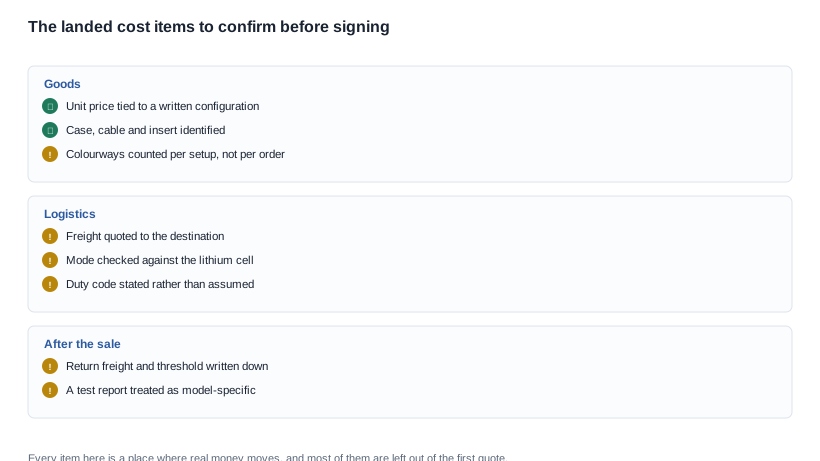
The checklist groups the confirmations by what each group settles, and the order matters because the last group cannot be built until the first two are.
The third answer, and the one that distinguishes a supplier from a competitor
That third answer is the one that distinguishes a price break from a different production setup, and it is the difference between a supplier the buyer can reorder from and one the buyer renegotiates from scratch every time. A break that comes from a different production setup will not repeat; a break that comes from a genuinely lower cost will.
The question is worth putting to every supplier in the round because the answers are usually inconsistent, and the inconsistency is informative. Two suppliers who describe the mechanism behind the same break differently are describing different cost structures, and only one of them is going to be predictable in the second order.
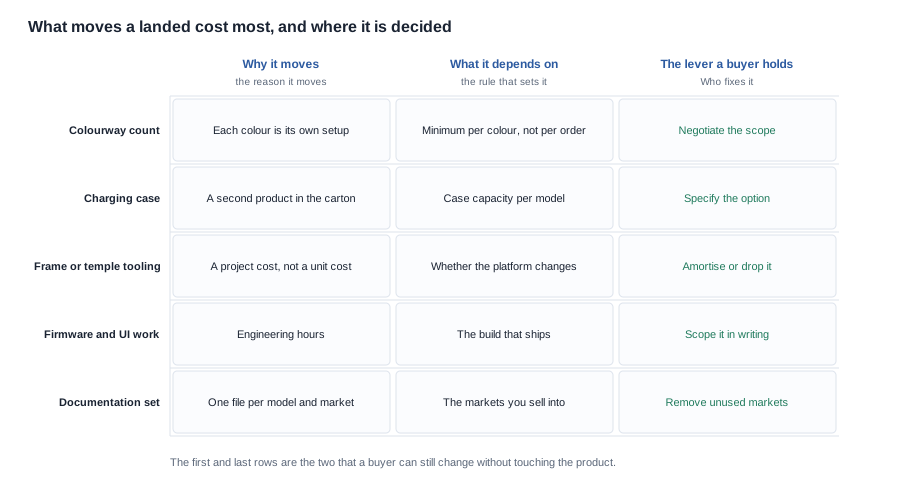
The matrix sets out the five items that move a landed cost, what each of them depends on, and the lever a buyer actually holds over it. Three of the five are scope decisions rather than price negotiations, which is the point the whole checklist arrives at.
Where a quoted price stops being true
A quoted price holds for a configuration, a volume, a scope and a date. A change to any of the four stops it holding, and in this category three of the four change as a matter of routine: the configuration changes when a case option or a colourway is added, the scope changes when a market is added after the file was priced, and the volume changes when the ordered quantity lands on the other side of a break.
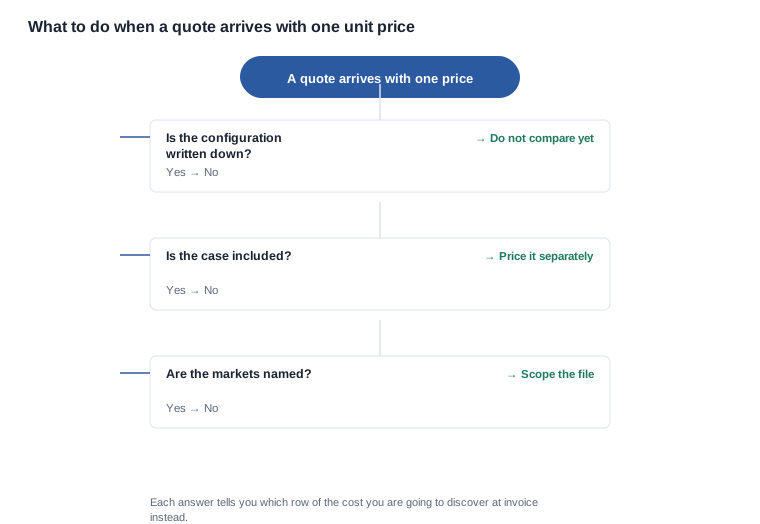
The three checks are the ones that catch an incomplete quotation before it becomes an invoice, and each of them is answered by a document rather than by a conversation.
What we publish, and what we will confirm against a specification
The rows that make a configuration checkable
The boundary we hold: we will not publish a unit price that we would have to retract, and we will not quote a price without stating which configuration it applies to. For a specific configuration — model, colourways, packaging, destination and volume — we will come back with confirmed commercial terms, and we will tell you which rows in that configuration are documented in our source and which are open.
The documented rows are the ones that make a configuration checkable: the resolution tier, the cell value, the charge time, the rated use figure, the charging method where the catalogue publishes it, the case capacity, the colour availability, and the IP rating where it is published. The open rows are equally useful to a buyer, because each one is a question to put to every supplier in the round rather than to one.
We are equally direct about the opposite case
If a supplier's quote is materially below the range we would expect for that configuration, the question to ask is not how they did that but which row of the configuration is missing from the quote. In this category the most likely candidate is the compliance scope, because it is the line that is most often excluded from a quotation rather than priced within it, and it is the line whose absence makes the total look like a saving.
Send the model, colourways, packaging, destination and expected volume and we will come back with confirmed terms for that configuration, and with the open rows marked so that the comparison is made on the same basis on both sides.
Related reading
- How the commercial terms are structured — pricing
- The quantity side of the conversation — minimum order quantity
- Which customisation rows are documented — customization options
Send us the model, colourways, packaging, destination and expected volume and we will come back with confirmed terms for that configuration.


