

What affects it to know about smart glasses pricing is not one number but nine drivers, and the practical skill is knowing which of them you can still move after the first quotation arrives. Four of them are already decided by the time you have a product in front of you: the camera module, the frame cell, the charging case and the charging method. Three more are decided by choices you make rather than by arguments you win: the configuration count, the colourway and the packaging. The last two — the volume and the scope of the work — are the ones a negotiation genuinely moves. Buyers who understand that ordering avoid spending goodwill on the four fixed drivers and concentrate it on the two that respond.
There is a second reason this ordering matters. Two quotations for the same model code can differ by a factor of two, and the difference is almost never a margin decision. It is a difference in what was priced: a different configuration, a different compliance scope, a different shipment basis, or a different set of costs quietly excluded. The unit price is the least informative line in a quotation. The decomposition around it is where the comparison actually happens.
What affects it to know about smart glasses pricing: the nine drivers and their leverage
The table below is the working version. Each row states what sets the driver, and — the column that matters — whether a negotiation can move it.
| Driver | What sets it | Can a negotiation move it |
|---|---|---|
| Camera module | The resolution tier of the ordered model | No |
| Frame cell | The published cell capacity of the model | No |
| Charging case | The published case capacity, if the model has one | Partly |
| Charging method | Magnetic, Type C, or an absent row | No |
| Colourway | One per published colour | Partly |
| Tooling | A mould for a changed temple shape | Partly |
| Artwork and packaging | Print and carton setup | Yes |
| Compliance scope | The number of destination markets | Scope only |
| Volume | Units per model code and configuration | Yes |
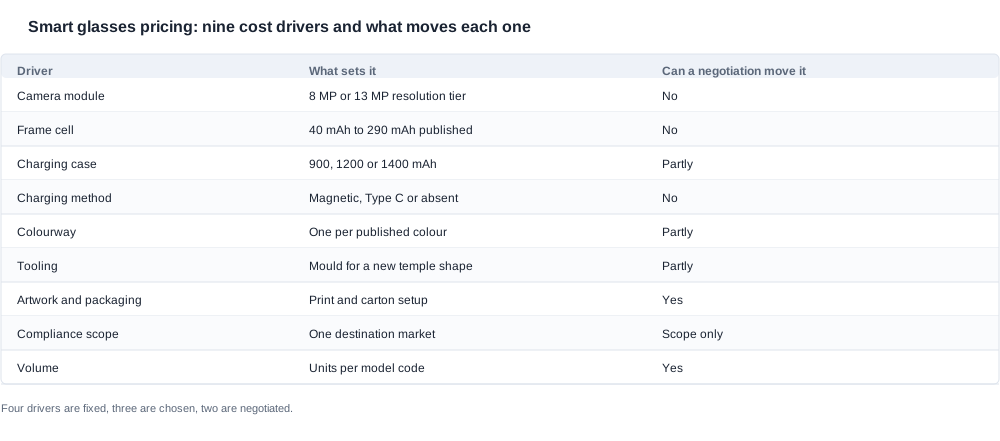
Read the third column as a forecast. If a driver says no, then the price difference you are chasing between two suppliers is not coming from that driver, and a request to move it will either be declined or will be answered with a smaller concession somewhere else. If a driver says yes, then that is where the conversation belongs.
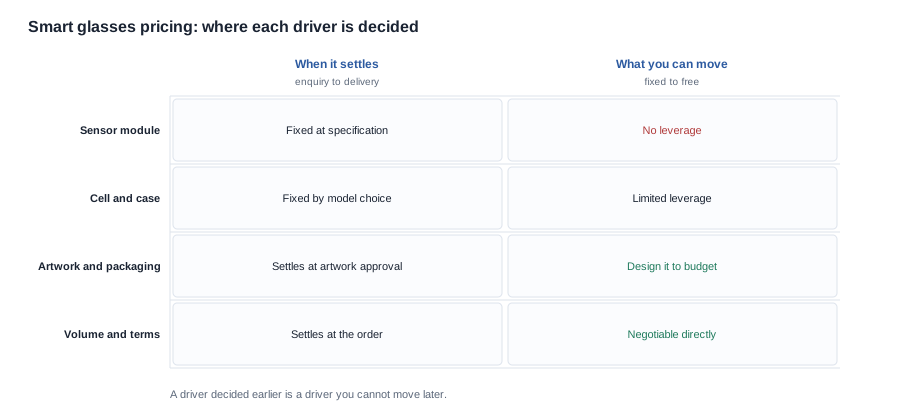
The matrix above makes the timing point as well as the leverage point. A driver that settles at specification is gone before the quotation arrives. A driver that settles at artwork approval can still be designed to fit a budget. A driver that settles at the order can still be negotiated. Understanding when each one closes is worth more than knowing the number behind it, because the number is the supplier's and the timing is yours.

Four drivers the order cannot move: module, cell, case and charging method
The camera module. The resolution tier is a module decision, and it is the single largest structural driver in the camera models. Our published catalogue puts eight of the eleven camera models at eight megapixels — the CY03 and the KY06, the MT6 and the V03, the V06 and the V03 Pro, and the MT5 and the CY05 — and three at thirteen megapixels: the L1 Pro, the L2 Utral and the S7. Stepping up is a change of module, not a change of firmware or a supplier's discount. A quotation that offers a resolution upgrade at a modest uplift is doing something, and the questions to ask are what module is fitted, whether it is the module the sample carried, and whether the supplier holds a written specification for it. We publish the resolution class for all eleven camera models. We do not publish the sensor part number, the field of view, the video resolution or the frame rate, so those are rows that have to be requested for the ordered model code rather than inferred from the catalogue.
The frame cell. The frame battery capacity ranges from 40 mAh in the children's protective models, through 70 mAh in the A07 and 90 mAh × 2 in the K01 and the K02, to 220 mAh, 260 mAh, 265 mAh and 290 mAh in the camera range. Capacity correlates with the run-time band, and both are published for every model, so this driver is unusually legible: if two quotations price different models, the cell row tells you why. What is not published is any cycle-life rating or any indication of how the cell was selected, and those are the questions to put to the supplier directly.
The charging case. The published case capacities are 900 mAh or 1400 mAh for the L2 Utral, 1200 mAh for the MT6's folding case, and 1400 mAh for the CY03, the CY05 and the L1 Pro. The KY06 and the MT5 ship with a case whose capacity is not published, and the catalogue publishes no charging-case row at all for the V03 Pro and the V06, and the S7 and the V03, which is a configuration variable a quotation cannot price until the supplier answers. Those four cases are different in kind and the distinction matters: an unpublished capacity is an unknown you can ask about, while an explicitly absent case is a design decision you cannot pay to change. A quotation that bundles a case into the headline without naming its capacity is selling you a row you cannot compare.
The charging method. Seventeen models are published as magnetic charging, seven as Type C, and four — the CY05 and the CY03, and the MT6 and the L1 Pro — publish a case capacity with no charging-method row at all. This driver is invisible in the price and visible in the operation. A buyer whose warehouse assumes magnetic charging holds an order that is materially different on those four models, and the difference is not a line in the price but a line in the returns. It is also the driver most often discovered after the first shipment, which is why it belongs in the pre-order question set rather than in the goods-in process.
Three drivers you move by choosing rather than by negotiating
The configuration count. The minimum order quantity applies per model code and per configuration, and this is the most commonly mispriced item in the whole category. A four-model range with two colourways each is eight commitments rather than four, and each commitment carries its own setup. The V03 Pro makes the point cleanly: its published colourways are orange, cream white and black, so one model code becomes three commitments. The driver moves when you decide how many combinations you are willing to carry, and it stops moving the moment the first purchase order is raised.
The colourway. A published colourway per model is a small cost driver, and the way to move it is to reduce the number you carry rather than to argue about the price of each. The trade-off is a channel decision rather than a commercial one: a narrower palette simplifies the warehouse and the returns, and it usually costs fewer units per configuration.
The artwork and the packaging. This is the softest driver in the set, and it is where a well-prepared buyer gets a real concession. Print setup, carton design, insert cards and the outer box are all redesigned to fit a budget rather than argued about line by line. The question to ask is not "can you discount the artwork" but "what does this artwork package consist of, and which parts of it are quoted as fixed". Two suppliers will then quote the same job differently, and the difference will be visible.

Two drivers you move by negotiating: volume and the scope of the work
The volume. The published catalogue contains no minimum order quantity, no price tier and no volume band, because each of those depends on the configuration, the quantity and the date, and a number published without those three is a number that cannot be relied on. What you can do is ask the supplier to state, in writing, which quantity the quoted price assumes and how long it holds. That single question is worth more than a general negotiation, because it converts a headline into a curve. It also exposes the most common structural error in this category: a price that is stated as valid until the next order is not a price, and the re-confirmation is where the number usually moves.
The scope of the work. Compliance work, market-access documentation, test reports and the technical file are the second genuinely negotiable driver, and the negotiation is about scope rather than about price. A destination market for which the supplier already holds the work is a different cost from a destination market that requires new work, and a buyer who names one market gets a different number from a buyer who names three and hopes for the cheapest. The framework itself is not negotiable — for a Bluetooth-equipped device sold into the European Union, the route runs through the Radio Equipment Directive (EU) 2014/53/EU, and the general product safety regulation has applied since 13 December 2024 — but what work is required inside it is entirely a matter of what the supplier has already done.
Two related items belong in the same conversation. The incoterm and the destination change the landed cost without changing the unit price at all, and a price that stops at the factory gate and a price that arrives at your warehouse are two different products. And the returns and warranty reserve belongs in the model rather than in the margin, because a margin structure that assumes zero returns is not a margin structure.

Decomposing two quotations until the comparison means something
A quotation is comparable only when both sides have decomposed it the same way. The sequence below is the one that produces a usable comparison, and it works with documents rather than with a sample.
- Take the quotation apart on a single line. Write down what the unit price is said to include, and ask the supplier to confirm it in writing. The gap between the two documents is where a budget goes missing.
- Test the configuration dependency. Ask the same supplier for the unit price of a second configuration that differs in one visible way, such as the case or the logo treatment. If the answer is identical, the first price was a catalogue price rather than a buildable one, and the whole comparison has to restart.
- Check the validity clause against your own timetable. A price that expires with the component market has to be re-confirmed, and the re-confirmation is where a number usually moves. Ask for the review date, not for the validity period in general.
- Put both quotations on the same sheet. Align the configuration, the incoterm, the destination, the compliance scope and the payment terms first. Only then compare the unit cost.
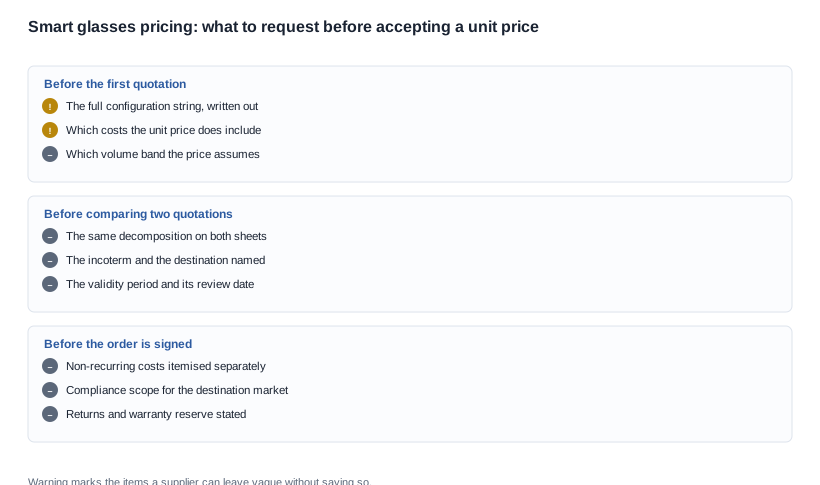
The checklist above is the set of documents that make step four possible. It is worth sending as one request in the first round, because a supplier who answers all of it has given you a comparable quotation and a supplier who answers two of the six has given you a headline figure with unknown coverage. The questions to ask are the same six for every supplier, and the comparison only works if the answers are the same questions.
The four failures that cost more than the price
The price that is not the product. The headline comes from a stock configuration and the order is customised. Control: require a configuration string on every quotation line and treat any quotation without one as a starting point rather than a price.
The compliance cost that was not quoted. The technical file and the market-access work are charged later, after the order is placed. Control: ask in the first round which compliance work is included in the price and which is billed separately.
The freight assumption that did not survive. The price assumed a consolidated shipment and the order shipped alone. Control: ask for the shipping method in the quotation and for the price if the consignment travels on its own.
The margin that evaporated at the returns counter. The cost structure carries no allowance for channel returns and replacements. Control: build the reserve into the model before the price is signed off, and agree the return condition for each channel.
None of these is a reason to change supplier. Each is a line to put in the order.
What to do when the lower price is the incomplete one
The situation above is the common one, and it is worth having a procedure for it rather than an opinion about it. The procedure is to refuse to compare, in writing, and to say what is missing. A short written statement of that kind — "this quotation names a model code but not a case capacity, so it cannot be compared with a quotation that names both" — is not a negotiating position, and it is difficult to argue with.
Three things make it work. The first is to name the missing row in the supplier's own terms rather than in yours: ask for the case capacity that the catalogue publishes for the ordered model code, not for "more detail". The second is to ask both suppliers the same question in the same round, so that neither is disadvantaged for having answered a question the other was not asked. The third is to keep the decomposition sheet, because the next quotation you receive will arrive in the same incomplete form and the sheet is what makes the pattern visible.
The pitfall to avoid is filling the gap yourself with an assumption. A buyer who decides that the missing case capacity is probably the 1400 mAh option has just invented a configuration, and if the assumption is wrong the error does not surface as a price difference — it surfaces as a delivery that cannot be charged at the station.
A cost model for one configuration, and what we will not publish
Two quotations for the same model code, compared line by line
The example below is constructed. No client, no order and no price is claimed; the camera model with a charging case, the European destination, the first production run and the two quotations are all assumed, so that the decision sequence can be followed.
A brand is comparing two suppliers for a camera model with a charging case, into a European market, on a first production run. Both quotations name the same model code. The first is lower by a margin the buyer finds comfortable; the second is higher and itemises more.
The first step is the configuration check. The lower quotation does not name a charging-case capacity, and the model it quotes is one where the catalogue publishes a case capacity of 1400 mAh. The higher quotation names the capacity and names the charging method. The buyer now has a comparison in which one side has priced a configuration and the other has priced a category, and the lower number is not comparable at all.
The second step is the scope check. Neither quotation states whether the market-access documentation for the European destination is included. When asked, the lower quotation says the documentation work is charged as a separate item; the higher quotation states that the work already completed for the ordered configuration is included in the unit price and names the framework. The gap between the two numbers narrows, and it narrows for a reason the buyer can explain to their finance team.
The third step is the validity check. The lower quotation states that the price holds until the next order. The higher quotation states the volume band and the review date. The buyer now knows which number is a price and which is a starting point, and they know it before the deposit rather than after.
The fourth step is the reserve. The buyer adds the returns and warranty reserve to the model on the same sheet for both suppliers, and both figures remain workable. The decision is made on the coverage difference, which is the difference that actually predicts which supplier will deliver a programme.
The decisive moves were all made on the quotation. None of them required a discount, and none of them happened after the money was committed.
The rows we publish, and the rows we will not invent
Stated plainly: the published rows are the part of the cost structure we can stand behind, and the rest is a question for the supplier's own file. We publish the resolution tier, the cell capacity, the run-time band, the charge time, the charging method, the case capacity where one is published, and the colourways. Those rows are enough to explain most of the price difference between two quotations, because they identify which product is being priced.
What we will not do is publish a unit price, a minimum order quantity, a price tier, a production lead time or a monthly capacity figure. Each of those depends on the configuration, the quantity and the date, and a published figure without those three is a figure that cannot be relied on and cannot be compared with anyone else's. We would rather tell you that than quote a typical number you cannot verify — a buyer who builds a margin on an estimated price finds the error at the first invoice, and the correction is more expensive than the question was.
What we will do is take a use case, a configuration, a volume band and a destination market, and tell you which of the nine drivers is fixed for that configuration, which are open, and which have to be requested from the supplier in writing before the quotation can be compared.
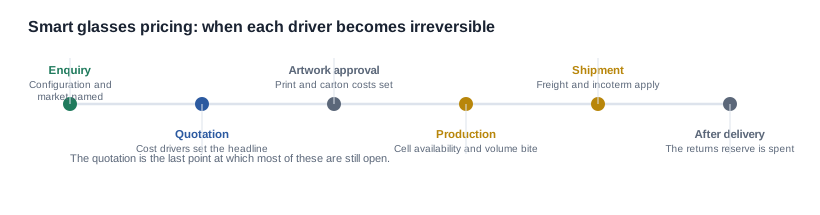
The practical next step is short. Send the models, the quantities and the target market, and we will tell you which cost drivers are already fixed for that configuration, which ones are still open, and where the remaining negotiation actually sits.
Related reading
- The cost structure — procurement pricing
- The volume mechanics — smart glasses moq
- The platform range — oem ready products
Send the configuration, the quantity and the market, and we will say which parts of smart glasses pricing are settled and which are yours to negotiate.


