

Almost every lead-time complaint turns out to be a capacity misunderstanding, and almost every capacity misunderstanding comes from treating capacity as a number instead of a queue. A factory that can build ten thousand units a week has delivered nothing to you if your job is sitting behind three changeovers and your artwork is still at the printer. This is a working set of six beliefs about smart glasses production capacity that buyers should drop, what each one actually costs, and the question that dissolves it in a single round.
Smart glasses production capacity myths that survive a first meeting
The reason these beliefs persist
These beliefs survive because each one is plausible, each one is repeated by suppliers who are not misleading anybody, and each one holds long enough for a decision to be made on it. A belief does not have to be false to be expensive. It only has to be wrong often enough to matter and to sound right at the moment of the decision — which is precisely when nobody is checking.
The reader here is a brand-side purchasing manager, a channel buyer or an importer. They are not a beginner; they have ordered before and they have been disappointed before. What they are managing is the reason the last three programmes slipped, and the discovery that the reasons were not the ones they assumed. The fear underneath the enquiry is not a bad price. It is a schedule that moves for reasons nobody can name, and a repeat of that with a larger order on the line.
The six, and what each one is worth
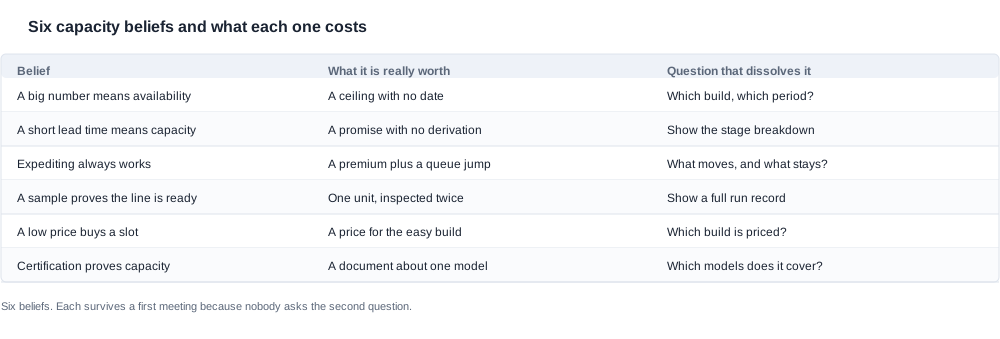
The table below sets each belief against what it is really worth and against the question that dissolves it. Read the third column before you read the first one again — most of these beliefs are not wrong, they are answers to a different question.
One thing the six have in common is that they all convert an unknown into a false certainty. Each belief replaces a question that has to be asked with an answer that does not have to be, and the price is paid in the currency of the thing that went unexamined: the date, the set-up, the consistency, or the scope. That is also why the beliefs are so durable. A question costs a round trip and produces an answer that may be inconvenient. A belief costs nothing and produces a decision that can be acted on immediately, which is exactly why it is chosen under pressure and why the pressure is when it costs the most.
| Belief | What it is really worth | Question that dissolves it |
|---|---|---|
| A big number means availability | A ceiling with no date | Which build, which period? |
| A short lead time means capacity | A promise with no derivation | Show the stage breakdown |
| Expediting always works | A premium plus a queue jump | What moves, and what stays? |
| A sample proves the line is ready | One unit, inspected twice | Show a full run record |
| A low price buys a slot | A price for the easy build | Which build is priced? |
| Certification proves capacity | A document about one model | Which models does it cover? |

Six beliefs, and what each one costs
Belief one: a large capacity number means your order is available
It does not, and the gap between the two is the whole queue. A capacity figure describes what the plant could produce if everything upstream of it were available, and in a category where the differentiating components are the scarce ones, that condition is rarely met. Our own range shows how sharply a single product family changes the chain: of the twenty-eight models in the catalogue, eleven carry a camera module, eight are audio models, three are sport models, and the remaining six are the AR frame, the three children's models, the electrochromic model and the bone conduction model; it is the seventeen models without a camera module that avoid the module and the firmware integration step entirely.
The cost of this belief is a date that moves. The belief is easy to hold because the number is usually quoted confidently and because a large number is reassuring in a way that a modest one is not. It dissolves the moment somebody asks which build and which period the figure covers, because a figure that does not name its own scope cannot be used to promise anything.
Belief two: a short quoted lead time means the factory has capacity
It means the factory quoted a standard. A lead time quoted without a derivation is a template, and a template describes the build the template was written for. In this category the template is almost always the simpler build, because the simple build has a shorter chain: fewer parts, no module, no integration step.
What it costs is a planning error that is invisible until it is expensive. The buyer has planned the launch backwards from a date that was never buildable, and the discovery comes at the point where the date has been committed to a campaign. The question that dissolves the belief is a request for the stage breakdown — which stage, how long, and starting from which event — and it is worth asking for the breakdown in writing even when the answer is roughly what you expected, because the written version is the one that can be checked.
Belief three: expediting will always solve it
It will move your order to the front of one queue, and the front of one queue is not the front of the chain. Expediting compresses the wait behind the binding stage; it does not compress the arrival of a purchased part, and it does not compress a setup that has a fixed duration. The premium is real, the queue jump is partial, and the run is now under pressure, which means the acceptance criteria have changed without anybody agreeing to them.
The cost is paid in three places at once: the premium, the quality exposure, and the argument about what counts as a defect. The question that dissolves the belief is what moves and what stays — name the stage, name the premium, name the change to the acceptance criteria, and see whether the answer is worth what it costs.
Belief four: an approved sample proves the line is ready
An approved sample proves one unit was built and inspected twice. It does not prove that the line can hold that consistency across a production lot, under a schedule, with a different set of operators. The sample is the reference the run is measured against, which is a valuable thing for it to be and a different thing from being evidence of production readiness.
The cost arrives at the second order, when the units that were measured against a sample begin to differ from it in ways that are small individually and visible collectively. The question that dissolves the belief asks for a full run record from a comparable build, and the answer either exists or it does not.
Belief five: a low price means you have secured a slot
It means the price was set for the easiest build on the list. In a category where the configuration changes what the line has to do, a price quoted for a single-build programme is not comparable with a price quoted for a multi-build one. The set-up is inside the quotation and the set-up is the number that moves.
The cost is a margin that disappears at the second invoice. The question that dissolves the belief asks which build the price was set against, and the answer is normally written down somewhere — in a quotation line, in an order confirmation, or in a conversation that will be impossible to reconstruct in six months.
Belief six: certification shows the factory can produce at volume
A certification document describes one model and one assessment. It says nothing about how many units the line can produce, how long a changeover takes, or whether the supplied parts arrive on time. It is a document about conformity, and it is often the most carefully written document in the file, which is why it is mistaken for evidence of everything else.
In our own catalogue the distinction is visible: the catalogue carries a company-level export certification page and does not carry a per-model certification row at all, so which certification covers which model is something to request rather than something to read. The same applies to capacity — no document in a conformity file tells you how many units a line can finish in a week. The question that dissolves the belief asks which models the document covers, and then asks a second question about the rate, because the first answer has told you nothing about the second.
Diagnosing which belief is running the decision
Three questions that locate the myth
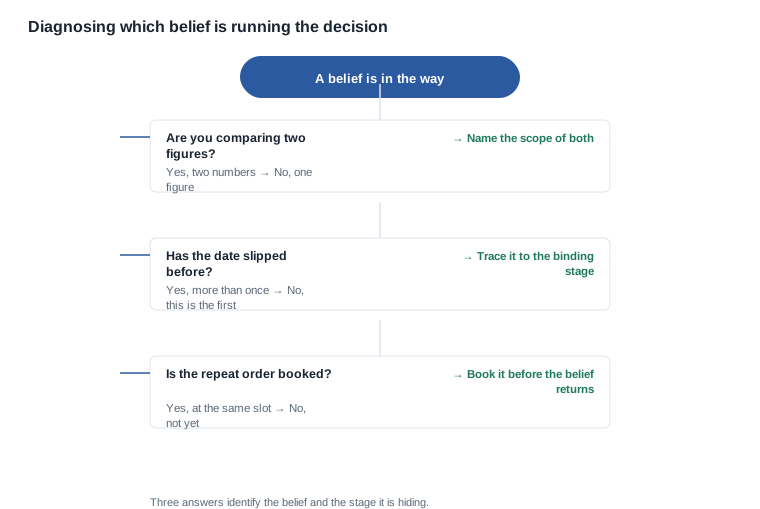
You do not have to test all six beliefs to find the one that is costing you. Three questions will narrow it down. Are you comparing two figures? If so, the belief is probably the third one — that expediting resolves the gap — or the fifth, that the lower price is the better deal. Has the date slipped before? If so, the belief is the second, that the quoted lead time was a plan, or the first, that the capacity number described availability. Is the repeat order booked? If not, the belief is the fourth, that the sample proved the line is ready.
Each question points at a belief and at a stage. That is the point of the exercise: a myth is not just an idea, it is an idea that hides a specific part of the chain. The belief that a big number means availability hides the queue. The belief that a sample proves readiness hides the run. The belief that a low price buys a slot hides the set-up.
Why the myth comes back next quarter
Beliefs return because they are convenient under pressure. A buyer holding two quotations and a launch window does not have time to derive a rate from a line count, and it is easier to take the larger number at face value than to ask for the derivation. The defence is not willpower; it is a written row in your own file. If the number is on a sheet with a date, a scope and the supplier's name beside it, it has to be revisited when the circumstances change. If it is in a conversation, it does not.

The replacement for each myth
Turning a belief into a question
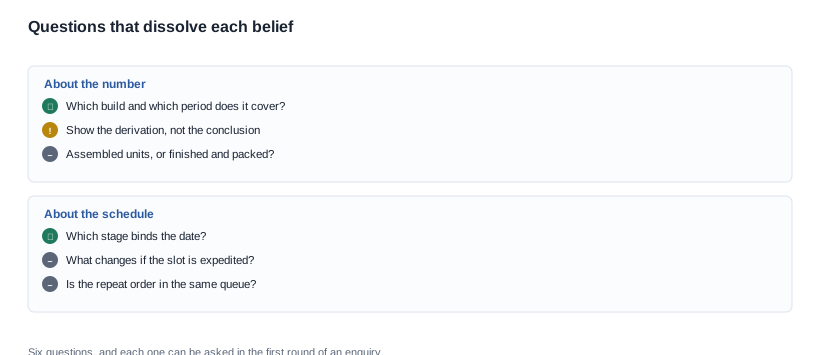
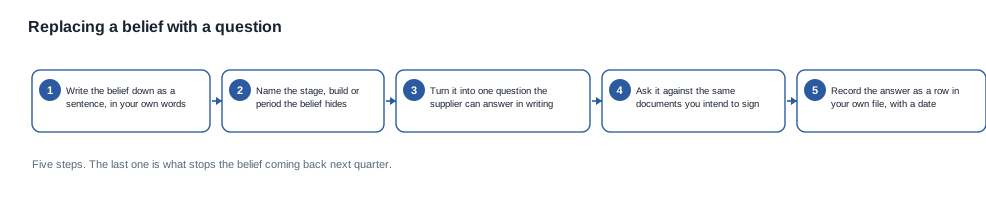
The replacement for a myth is never a counter-belief. It is a question that the supplier can answer in writing and that you can record. For the first belief the replacement is: for which build, on which line, over which period, and with which parts already on site. For the second: give me the stage breakdown from the arrival of the constrained parts to the shipment. For the third: name the premium, name the stage it moves, and name what changes in the acceptance criteria.
For the fourth: show me a run record from a comparable build with the customer details removed. For the fifth: name the build the price was set against, and the set-up fee for each build on the order. For the sixth: tell me which models the file covers, and separately tell me the rate for my configuration.
The test of a good replacement question is that it can be answered with a document or a number. "Why was the order late?" cannot be answered that way. "Which stage did not start on the date you confirmed?" can, and the answer usually identifies the belief that was running the programme.
The five questions that dissolve the most of them
If you only have room for five questions in the first round of an enquiry, these are the ones that dissolve the most belief for the least effort. Is the rate for my exact configuration or for the family? Is it assembled units or finished units? Which stage binds the date, and what happens if that stage slips? What does the set-up cost for each build on my order? And what is the longest run length you will commit to, which tells you whether the set-up is a one-off or a recurring charge?
Those five are drawn from the six beliefs and from the chain itself, and between them they cover the two questions that decide almost every programme: what actually sets the date, and what the order will actually cost when the set-up is added. The lead time page covers the schedule side of those answers in more detail.
Questions that dissolve the myth in one round
The order to ask them in
The order in the checklist is the order to use. The first group is about the number, because a claim that does not name its own scope cannot be tested against anything else and every later question is wasted on it. The second group is about the schedule, because the schedule is where the belief does its damage, and because the questions in the second group are the ones a supplier is most able to answer without anything further.
One habit is worth forming: record the answers as rows with a date, in the same order for every supplier, so that a comparison is a matter of reading across rather than of remembering. It takes five minutes at the point of the answer and saves an afternoon three weeks later, when a date has moved and somebody has to work out which of three suppliers said what.
The question that finds a belief without naming it
There is a diagnostic question that is more reliable than asking about any of the six beliefs, because it does not require the buyer to have identified the belief in advance. Ask: if this order had to be built by a date we did not agree with you on, what would happen? The answer describes the constraint without naming it. A factory whose binding stage is a purchased part will describe the part. A factory whose binding stage is the setup will describe the setup. A factory that has no queue at all will describe the order arriving and the work starting, and that answer tells you something quite different from all three.
The follow-up converts the description into a commitment: what would have to change for that to be different? A supplier who can answer that question has a plan they can vary, and the answer tells you the lever. A supplier who cannot has a constraint they do not understand, and the schedule you have been given will reflect a constraint they cannot explain.
What to do with a belief you have already acted on
Buyers rarely catch a belief before it costs something. When it has already been acted on — a quotation accepted, a deposit paid, a campaign planned — the recovery is procedural rather than intellectual, and it has three parts. First, convert the belief into the question it implies and ask it in writing, so that the answer exists as a document even if it arrives too late for the current decision. Second, put the question into the order as a clause, so that the next time the same belief appears the answer is already on file. Third, record what the belief cost, in the same currency you use for everything else.
That third step is the one people skip and it is the one that makes the others work. A belief written down with a cost attached does not return, because the next time it appears the buyer has a number rather than a feeling. A belief that has only been discussed returns within two quarters, and it returns with a senior colleague who agrees with it.
The parts of this we can substantiate
Where the published specification ends and the supplier file begins
The boundary we hold: the published material is the part of the specification we can stand behind, and the rest is a question for the supplier's own file. We publish what our documentation states, we mark the rows that are open, and we will not fill an open row with a typical figure taken from a supplier's general data. Production capacity, line counts, daily output and stage durations are not published in our documentation, and the belief that a factory's own figures can be replaced by an industry figure is one we will not act on.
The rows our published data does settle are these. The catalogue carries twenty-eight models: eleven camera models, eight audio models, three sport models, and six others — the AR frame, the three children's models, the electrochromic model and the bone conduction model. Camera resolution is published across eleven models, with eight megapixel on eight of them and thirteen megapixel on three. The ingress marking IP54 appears on the V06 and the S7 only. Charge time is published for every model, with twenty-six at two hours or less and the D17 and the ZH12 at around one hour — and that figure carries no starting state of charge and no completion criterion, which is exactly the kind of gap this page is about. The unit weight is published for one model only, the MT6 at 158 grams for the glasses body including the cell and the camera and excluding the foldable 1200 mAh case, whose own weight is not published.
Minimum order quantities are not published, and no typical figure stands in for them. The threshold changes with the model mix, and a published figure that changes with the mix becomes a commitment nobody intended to make.
What we will tell you instead
What we will tell you is what your configuration requires, which stage is binding, what has to be true to hold a slot, and which documents you should request from any supplier you shortlist. The production capacity section sets out the assessment framework. Send the models, the quantities and the target market, and we will tell you which configurations exist, which of them are open on the published data, and which of these six beliefs the data settles for your build.
Related reading


