

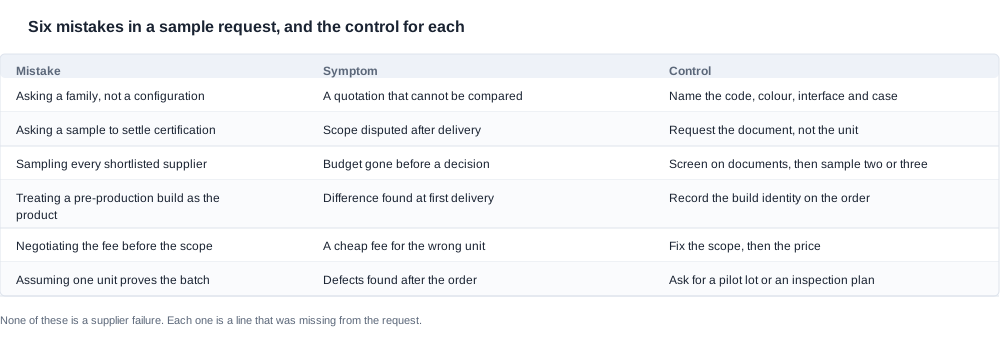
A smart glasses sample policy has six mistakes that live in the request rather than in the supplier, and every one of them is made before any hardware moves. They share a single cause: the request describes a product instead of describing a configuration, so the answer that comes back is a product answer and the buyer receives a unit that cannot settle the question.
The three that cost the most are the ones that appear most reasonable. Asking for the family rather than the model code produces a quotation that cannot be compared with anything. Asking a sample to settle a certification question produces a unit that answers it in the wrong register entirely. And negotiating the fee before the scope produces a cheap sample of the wrong thing, which is the most expensive outcome in the category because it appears successful.
Smart glasses sample policy: the mistakes that live in the request
The conclusion first. A sample request is worth sending only when it carries four things: an exact catalogue model code, the questions the sample is expected to answer, the questions it is explicitly not expected to answer, and the terms on which the unit is being sent. Everything else in this article is detail on why those four are non-negotiable and how to recover when one of them is missing.
Two situations are worth separating at the start. A buyer who is opening a new programme and has not yet chosen a model cannot write a configuration string, and the right first step for them is a document request rather than a sample request. A buyer who has a settled configuration and a repeat order usually does not need a sample at all, and the sample policy pillar covers when a sample can be skipped in favour of a documented acceptance procedure.
Who is reading this, and where the mistake usually happens
The reader is a procurement manager working for the brand, a channel buyer or an importer, and the decision in front of them is whether to send a sample request, and in what form.
The usual moment is a shortlist. Two or three suppliers have responded to an enquiry, the prices are within a range that the commercial comparison cannot separate, and a buyer now has to choose. The instinct at that moment is to ask each of them for a unit, because a unit feels like a decisive thing to hold in the hand. That instinct is where the six mistakes start, because a request built for comparison is a request that has to be precise, and precision is what a product description does not provide.
What the reader is protecting against is a specific outcome: a sample programme that returns a unit which cannot be matched to a quotation, cannot be matched to a specification, and cannot be matched to a decision.

Six mistakes, and the control that stops each
The table below is the working version. Each row names a mistake, the symptom that appears weeks later, and the control that would have prevented it.
| Mistake | Symptom | Control |
|---|---|---|
| Asking for a family, not a configuration | A quotation that cannot be compared | Name the code, colour, interface and case |
| Asking a sample to settle certification | Scope disputed after delivery | Request the document, not the unit |
| Sampling every shortlisted supplier | Budget gone before a decision | Screen on documents, then sample two or three |
| Treating a pre-production build as the product | A difference found at first delivery | Record the build identity on the order |
| Negotiating the fee before the scope | A cheap fee for the wrong unit | Fix the scope, then the price |
| Assuming one unit proves the batch | Defects found after the order | Ask for a pilot lot or an inspection plan |
None of the six is a supplier failure. Each one is a line that was missing from the request, and each one can be put back into the request in under a minute.
The first two mistakes, in the detail they deserve
A family name instead of a buildable configuration
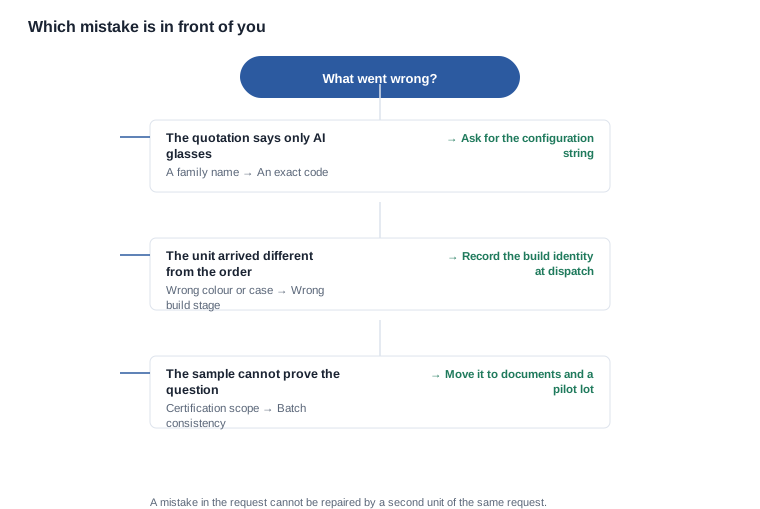
This is the mistake that generates the most downstream damage, because it produces a quotation that appears complete. A request that says "AI camera glasses with a case" comes back with a price, and the price is attached to a specific model the buyer never named. The comparison then runs across two suppliers who quoted different models, and the arithmetic is meaningless even though both numbers are correct.
The catalogue is wide enough that a family name has to mean something. It covers twenty-eight models: eleven camera models, eight audio models, three sport models and six further entries — the AR frame, the three children's models, the electrochromic model and the bone conduction model. The eleven camera models alone sit in two resolution classes, with eight models at 8 MP and three at 13 MP, and they run on cell capacities from 220 mAh to 290 mAh. Four of them publish a case capacity but no charging interface line at all: the CY03 and the CY05, and the MT6 and the L1 Pro. Seventeen models across the range are published with magnetic charging and seven with Type-C, and the V03 Pro is published without a charging case while the KY06 and the MT5 have a case whose capacity is not published.
Every one of those lines is a decision, and a family name decides none of them.
A configuration string is short and it is made of published values: the model code, the colour where colour is published, the charging interface, and the case configuration where one applies. Where the catalogue leaves a row open, the string should say so, and it should ask for the answer in writing. The four models whose interface is not published are the clearest test of a supplier's willingness to answer an open row, and it is a much better test than asking a general question.
Two published rows are worth putting in the string on purpose, because they are the rows buyers usually forget. The V03 Pro publishes three colours and a photochromic lens configuration with a Type-C interface, and the V06 publishes four colours with magnetic charging. Colour is a published option rather than a custom one, so an order that names it should be buildable without a tooling conversation, and an order that leaves it open will be filled with whatever the line has that week.
Hardware asked to settle a question that belongs on paper
A sample proves things about a unit. It does not prove things about a model, a regime or a batch, and the confusion between those three is the source of the most expensive disputes in this category.
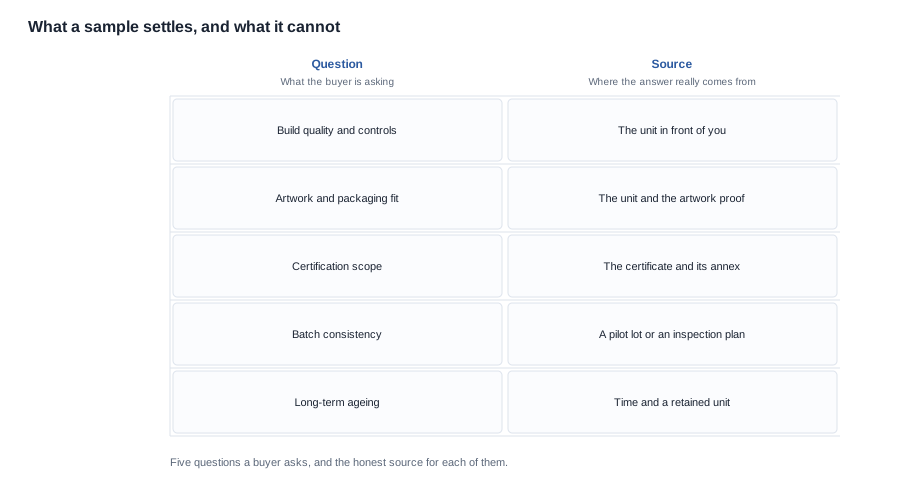
The clearest example is certification. The catalogue shows a company-level export certification page and it does not have a per-model certification row, and the text of the document contains no CE, FCC or RoHS marking for any product. A buyer who asks a supplier to confirm the certification scope of a model by sending a unit is asking for something no unit can produce, and the answer that eventually arrives will be a certificate for a different variant, a different model, or a different scope.
The physical rows work the same way. The range publishes exactly one weight figure, 158 g for the MT6 glasses body including its 265 mAh battery and camera and excluding its foldable charging case, and no bare frame weight for any model. No model publishes a field of view, a video format, a frame rate or an ingress test report number. Those are open rows, and an open row is settled either by a document or by measurement, never by inspection of a unit.
The most productive way to think about this is to divide the buyer's question list in two before the request is sent. The first column is what a unit can answer: build quality, the configuration, the controls, the capture path, how the case connects, the construction at working distance. The second column is what needs a document: the certification scope, the ingress rating, the sensor part number, the batch behaviour, the long-term ageing. A sample request that only contains questions from the first column is a good sample request.
The last four mistakes, and the root they share
The fourth, fifth and sixth mistakes share a root, which is that the request treats the sample as a purchase rather than as an instrument.
Sampling every shortlisted supplier. The fee per unit is small enough that sampling eight of them feels rational, and the freight is the line that makes it expensive. The reason it is wasteful is not cost but information: a documentation screen removes most of the candidates, and the candidates it removes are the ones a unit would not have separated either. Ask for the published specification extract, the list of open figures and a written statement of what a sample proves, and the shortlist usually falls to two or three names before any hardware is ordered.
Negotiating the fee before the scope. A buyer who opens with a request for a discount has anchored on the smallest number in the transaction. The fee is quoted per request in this category, because it depends on the model, the configuration, the branding and the destination, so a buyer who has negotiated the fee against an unspecified model has negotiated a number for a product that does not exist. Fix the scope first. The fee then becomes a quotation rather than a bargaining position, and the two of them can be compared across suppliers without further work.
Assuming one unit proves the batch. This is the mistake that survives longest, because the sample passes. A unit that is perfect establishes that a unit can be built and that it behaves in the buyer's hand. It does not establish what a thousand units will do, because it was not drawn under a sampling plan and was not inspected against a defect classification. The evidence for batch behaviour comes from a pilot lot or from an inspection on the production run, and a buyer who expects a sample to provide it has no mechanism left when the defects appear.
Treating a pre-production build as the product. This one is fixed by a single question. Ask whether the unit is a stock unit, a pre-production build or a production build, and get the answer in writing rather than inferring it from how the unit is presented. A build made to demonstrate a design is a legitimate thing to receive and a poor thing to approve.
There is one more failure that sits behind all four, and it is the one that is hardest to see because it produces no symptom at all until the invoice arrives: not asking what a second round of samples costs, or whether the first round is the only one. A request that says the sample is required for evaluation and does not say how many rounds that evaluation may take leaves the round count open, and an open round count is usually closed at the second round, at the second round's price, with a second unit in transit. Putting the number of rounds and the cost of each in the request is one sentence, and it is the sentence that keeps a sample programme inside its budget.
What a corrected request looks like
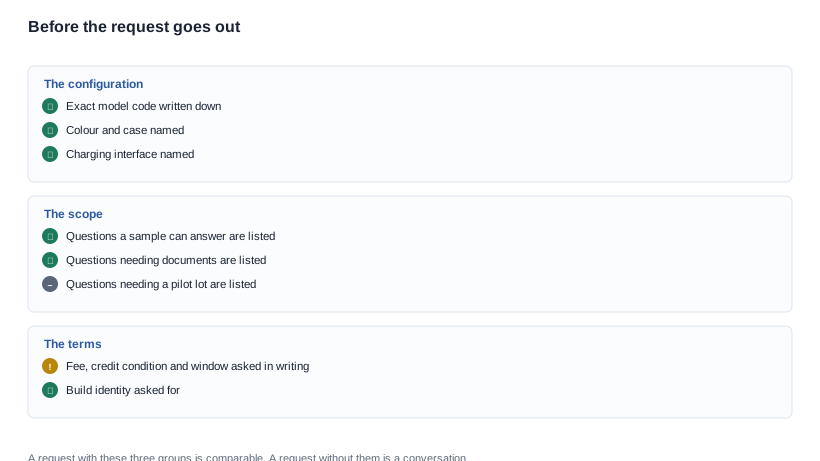
A request with these three groups is comparable across suppliers, because it asks the same three questions in the same order. A request without them is a conversation, and the answers that come back from a conversation are assurances rather than commitments.
The three groups are cheap to assemble and they reuse material the buyer usually already has. The configuration group comes from the catalogue rows. The scope group comes from the buyer's own question list, divided into the two columns above. The terms group comes from the sample request itself, and it should carry the build identity question, the fee, the credit condition and the dispatch window in a single message.
A corrected request, line by line
The eight lines below are the corrected version of a request that contained the first two mistakes. They are written as the request itself, because that is the form a supplier can answer and a buyer can file.
- Configuration string. One line: the catalogue model code, the colour where colour is published, the charging interface, and the case configuration where one applies. Where the catalogue leaves the interface open, say that it is open and ask for it in writing.
- Build identity. One line: the unit is a stock unit, a pre-production build or a production build, and the answer is required in writing before the unit is built rather than inferred afterwards.
- Questions the sample must answer. A numbered list, one question per line, each written so that it can be answered yes or no or with a measurement. A question that can only be answered with an adjective will be answered with one.
- Questions the sample must not answer. The same format, listing the certification scope, the ingress rating, the batch behaviour and the long-term ageing as out of scope for the unit, with a note of where each one has to come from instead.
- Test list and sign-off. The list that answers question three, plus the name of the person who signs the evaluation and the name of the person who receives the unit.
- Fee, credit condition and dispatch window. All three in the same paragraph, with the refund credited against a later order stated as a condition with a window rather than as a general intention.
- Freight and fault path. Who pays, by which mode, what happens to a unit that arrives damaged, and the destination country for the consignment.
- Retained unit and no-display condition. Two short statements: that the unit is retained by the buyer as the reference against the production run, and that it is not displayed, traded, resold or used in public.
Line four is the one that changes the character of the request, and it is the one buyers leave out. Naming what the sample cannot prove converts the request from a request for proof into a request for evidence, and it removes the most common source of disappointment in this category, which is a unit that behaved perfectly and still did not answer the question the buyer had in mind.
What this adds to the request is a little length and a lot of comparability. Two suppliers answering the same eight lines can be compared line by line, and a supplier who answers six and leaves two vague has told the buyer something worth knowing before any freight is paid.
What we will and will not put in a request
The short answer: the published material is the part of the specification we can stand behind, and the rest belongs in the supplier's own file. We publish what our documentation states, we mark the rows that are open, and we will not fill an open row with a typical figure from a general product page. Where a claim rests on an estimated number, the error shows up in the field rather than in the quotation, and putting it right afterwards is more expensive than asking would have been.
We publish the model code, the resolution class, the charge time, the cell capacity, the rated endurance, the charging interface where it is published, the case capacity where it is published, the Bluetooth version for the audio and sport models, and the colour options where they exist. The single weight figure in the range is the MT6 glasses body at 158 g, which includes its 265 mAh battery and camera and excludes the foldable charging case, and no bare frame weight is published for any model.
We will not supply a certificate number, an ingress test report number, a sensor part number, a field of view or a video specification, because we do not hold them in a form that can be handed over. We will not quote a sample programme from a model name and a quantity alone. And we will not send a unit in a configuration that differs from the one intended for the order, because that produces an evaluation of a product the buyer is not buying.
The two questions we will answer before anything else
When a request arrives, two things determine what we can do with it, and they are answered before the fee.
The first is whether the configuration exists. If the model code, the colour, the interface and the case are a combination we already build, the answer is a unit and a date, and the sample programme is short. If the combination is new, the answer is a build slot, and the sample programme has a step in it that the buyer should be told about in advance rather than discovering it as a delay.
The second is whether the question can be answered by a unit at all. A request that asks what the unit is like can be answered with a unit. A request that asks for a certification scope, a weight for a model whose weight is not published, or a guarantee about a batch cannot, and the honest response to it is a document request and a short explanation of why. We would rather say that in the first message than send a unit that cannot answer the question and let the gap surface a fortnight later.
Both answers are free and both are quick, and together they decide whether a sample request is a two-week exercise or a two-month one.
Send us the models, the quantities and the target market, and we will tell you which configurations exist, which of them are open on the published data, and which of your questions a sample settles and which need a document. The samples pillar sets out the wider process, and the e-commerce model comparison works through how a configuration string changes a channel decision.
Send the configuration, the quantity and the market, and we will say which parts of the request are settled and which are yours.


