

A smart glasses sample policy is not a formality attached to a purchase order — it is the only instrument you have for confirming that the supplier in front of you can build the configuration you specified, before your schedule starts depending on it. Six questions come up in almost every sample round, and the quality of the answer matters more than the unit itself: a supplier that answers all six precisely has told you more about its operation than a photograph of a finished sample ever will. The six are what the unit actually is, what the sample fee covers, what a sample can legitimately prove, how many rounds the quoted price assumes, what happens when the unit fails, and which terms survive into the first production order. This guide sets out each question, lists the catalogue rows you can check a unit against, and is explicit about which answers we can give you and which ones you have to obtain in writing from the supplier.
Smart glasses sample policy: the six questions that decide a supplier
The buying situation these questions come from
The reader here is a brand-side procurement lead, a channel buyer or an importer who already has one or two quotations in hand and is deciding whether to spend evaluation budget on physical units before committing to a production order. The sample round is not a trial of interest. It is the last inexpensive moment to find out that a supplier has quoted a family of products rather than a buildable configuration, or that the documentation route for your destination market does not exist yet.
Three things drive the timing. The first is artwork freeze: once packaging and branding are settled, a sample that arrives afterwards describes a product nobody will buy. The second is the point at which a factory has to commit line time to your configuration, which is when a change of mind becomes expensive. The third is a compliance gate — if your programme depends on a technical file that only exists once the configuration is fixed, the sample round is where you find out whether that file can be produced at all.
The fear underneath the enquiry is rarely price. It is a first shipment that does not match the unit you approved, a certification route that closes in week nine, or a returns problem that was never priced into the margin. A sample policy that leaves the six questions below unanswered keeps all three of those risks in place and postpones them rather than removing them.
Deciding what to ask is itself a procurement task with a deadline, and it is the one most often deferred until a quotation has already been accepted.
Why the cost of a sample round is settled before the unit ships
The economics of a sample programme sit in three places: the supplier's fee, the freight and duty to move one or two units to your bench, and the calendar time your team spends waiting for them. The first is quoted, the second is small, and the third quietly dominates the other two combined. The total cost of a round, once all three are counted, is usually a calendar number rather than a money number.
That third cost is why the number of candidates who receive a unit is the most expensive decision in the round. Sampling four suppliers instead of two does not materially increase the chance of buying a bad product, because the written screen has already removed most of that risk. What it doubles is the coordination load, and every additional unit arrives on its own schedule against its own approval deadline. The most expensive sample programme in this category is the one with the most units and the least written record of what each unit was meant to settle.
The second structural point is that a sample is a weak instrument for some questions and the only possible instrument for others. It is the right instrument for asking whether a unit matches a published configuration row, because that is a comparison against a document you can hold. It is the wrong instrument for asking whether a process holds across lots, whether a component supplier meets a standard, or whether a certification file will cover a market you have not yet chosen. Buyers who spend sample budget on the second group of questions pay twice: once for the unit, and again for the evidence they should have requested instead.
There is a third consideration that belongs here because it is the one most often forgotten. A sample round is a documentation event as much as a physical one. If the order does not name the configuration, if the bench work is not run against a written protocol, and if the result is not recorded against the unit identifier, then the unit was purchased as an object rather than as evidence, and the programme has spent money and gained an impression. An impression is not something you can put in front of a finance reviewer as a justification for a production order.
What a complete answer to each question has to contain
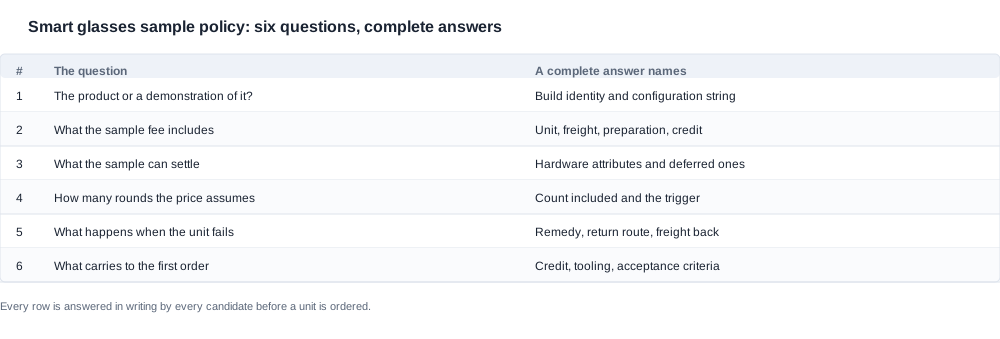
The six sample questions, side by side
| # | The question a buyer asks | A complete answer names | A vague answer sounds like |
|---|---|---|---|
| 1 | Is the sample the product or a demonstration of it? | Build identity, configuration string, stock unit or pre-production build | "It is the same as the production unit" |
| 2 | What does the sample fee include? | The unit, the freight method, the preparation, and what is credited back | "The sample cost is on the quotation" |
| 3 | What can this sample actually settle? | The attributes tested on hardware and the attributes deferred to documents | "Everything can be checked on the sample" |
| 4 | How many rounds does the price assume? | The number included, and the trigger and cost of each further round | "Revisions are free" |
| 5 | What happens when the unit fails? | The remedy, the return route, and who pays the freight back | "We will replace it" |
| 6 | What carries into the first production order? | The credit condition, tooling ownership, and the acceptance criteria | "The sample terms apply to the order" |
What separates an answer from a description
The most useful single test on each row above is whether the answer contains a noun you can put in a file. "It is the same as the production unit" contains nothing you can file. "The sample is a pre-production build of the L2 Utral with the 1400 mAh case, built in the same week as the pilot lot" contains a configuration, an option and a production window, and every one of those three can be checked again later. That is the whole difference between a supplier who can build your product and a supplier who can describe one.
The second test is whether the answer distinguishes what the sample settles from what it defers. Most suppliers will agree that a sample can be inspected. Far fewer will volunteer that a single unit cannot establish production consistency, that a sample of a camera model cannot settle certification scope, and that no sample can establish the defect rate of the line that will eventually make your order. A supplier who draws that line in writing is describing a process rather than selling an inspection, and that is what a buyer is actually paying for.
The third test is the one buyers most often skip, which is whether the answer survives being read by somebody who was not in the negotiation. If your procurement colleague cannot act on the answer without asking you a follow-up question, then it is not a complete answer. Treat that as a defect in the answer rather than a gap in your colleague's understanding, because the second reading is the one that happens without you in the room.
Three red flags recur in these answers, and they are worth recognising on sight: a model name with no configuration behind it, a figure with no measurement condition attached, and a date with no owner.
The one answer that changes the comparison
Two of the six answers, when given properly, will disqualify a supplier regardless of price, and it is worth knowing which ones those are. Question one is one of them: a supplier who cannot say what the sample physically is has not decided what it is building, and a unit with no build identity cannot be tied to a production lot later. Question four is the other: a supplier who will not state how many rounds the price assumes is telling you that the second round has not been priced, and an unpriced second round always costs more in calendar time than the first round did.
Everything else in the set is negotiable in the ordinary sense. A supplier that answers all six plainly, even where the answer is "no" or "not yet", has given you a usable position. A supplier that answers four and leaves the other two vague has given you an indication, and indications do not compare with each other, which is the practical reason the set has to be sent to every candidate in the same round.
Both of the disqualifying answers above settle the candidate before any unit is built. The remaining four decide which model a supplier is really quoting and how to compare two answers that both look complete on the page.
The published catalogue rows a sample can be checked against
What the catalogue publishes for every model
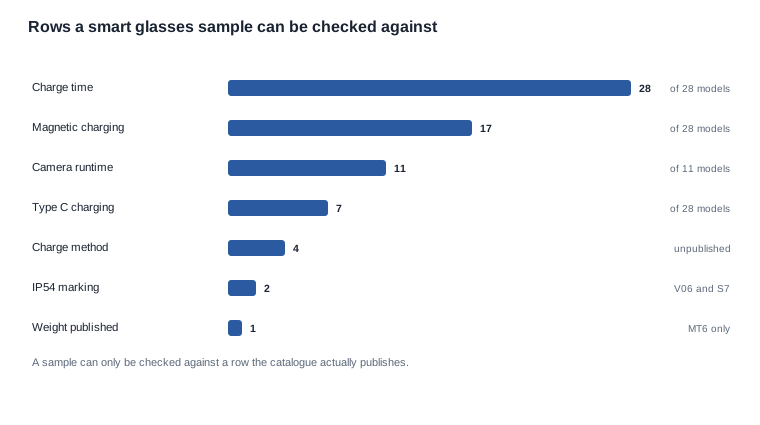
Our catalogue publishes the electrical rows for all twenty-eight models, and those rows are what a bench protocol should be written against. Charge time is published throughout — up to two hours on twenty-six models and about one hour on the D17 and the ZH12 — so a sample can be checked against the figure its own model carries. Runtime is published for all eleven camera models, and that is the number buyers most often want to test: about seven hours on the CY03 and the MT6, and the L2 Utral and the L1 Pro, and the CY05, six to eight hours on the KY06 and the MT5, and five to eight hours on the V06 and the V03 Pro, and the S7 and the V03.
The camera tier is published as well, and it is the cheapest substitution check available in this category. Eight camera models are published at 8 MP — the CY03 and the V06, the MT6 and the MT5, and the CY05 and the V03 Pro, and the KY06 and the V03 — and three at 13 MP — the L1 Pro and the S7, and the L2 Utral. A unit that behaves like a different tier than the one ordered is the earliest signal that the configuration string is not being honoured, and you get that signal in an hour on the bench rather than in a quarter on the market.
What the catalogue does not publish, and how to ask for it instead
Two areas are conspicuously open, and knowing that in advance saves a sample round from being asked to settle something it cannot.
The charging method is published as magnetic on seventeen models and as Type C on seven, but is not published at all for four camera models — the L1 Pro and the CY03, and the MT6 and the CY05. Those four publish only the pixels, the cell capacity, the charge time, the runtime and the case capacity, with no charging-method row at all. They need the supplier's written statement rather than a bench check, and a sample of any of those four cannot answer the question on its own. The charging case is published with a capacity on five camera models: 1400 mAh on the L1 Pro and the CY05, and the CY03, 900 mAh or 1400 mAh on the L2 Utral, and a 1200 mAh folding case on the MT6. The KY06 and the MT5 ship with a case whose capacity is not published, and the catalogue contains no case row at all for the V03 and the V06, and the V03 Pro or the S7 — which is a different statement from "no case", and one worth chasing before you order, because the sample is the cheapest place to close it.
The second open area is certification. Our catalogue carries a company-level export-certification page and no per-model certification rows, so the certification scope of any named model is something to request in writing rather than infer from a brochure. The same applies to weight: the MT6 glasses body is published at 158 g including its 265 mAh cell and its camera and excluding the folding charging case, whose own weight is not published, and no other model in the range carries a published weight. A sample of any other model therefore cannot settle that figure, and a buyer who wants it has to ask for it.

Verifying a smart glasses sample policy answer before you pay for the round
The four-step evidence check
Verification happens before the fee is paid, not after the unit arrives, and it costs one round of written questions.
- Send all six questions in writing to every candidate, with the same deadline. Comparability between quotations depends on them answering the same questions, and a supplier who answers four of six has told you something more useful than a supplier who answers none. The questions to ask are the same six for everybody, in the same order, and a candidate that answers them out of order has still answered them.
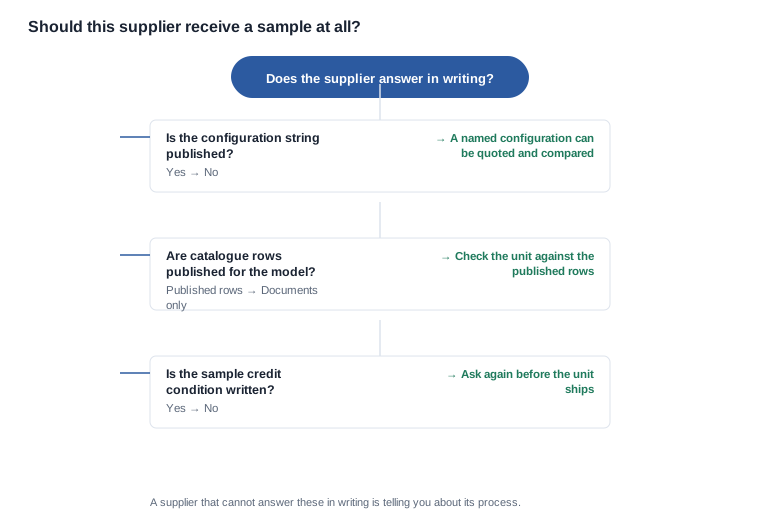
- Match each answer against the configuration string on the quotation. If the quotation names a model and the answer names a configuration, the two documents are not describing the same thing, and that gap has to close before a unit is shipped rather than after it arrives.
- Mark every claim as published, requested or inferred. The catalogue publishes some rows and not others. A supplier's answer about a published row should match it; an answer about an unpublished row should be labelled as their statement rather than promoted into a specification.
- Score the supplier on what it answered. Not on how quickly it replied and not on how the sample looked in the photograph. A supplier that answers precisely and slowly is a better bet than one that answers quickly and vaguely. This last step is the only part of the round that is genuine supplier due diligence rather than administration, and it is the one most often replaced by a preference for a fast reply.

The three documents that have to travel with the unit
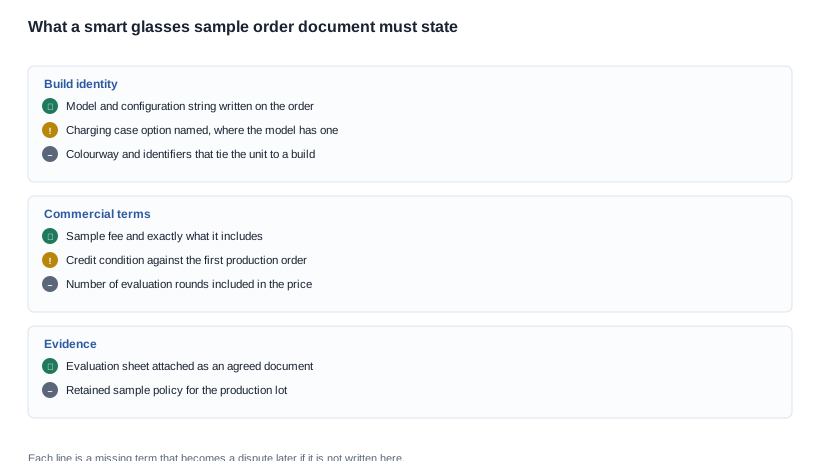
Three documents make a sample unit usable as evidence rather than as an object. The first is the build identity — model, configuration, colourway, case option, and the identifiers that tie the unit to a production window — because a unit that cannot be traced back to a build proves nothing about the lot that will follow it. The second is the evaluation sheet: the attributes you will judge, the method, the limit, and the name of the person who signs each result. The third is the order confirmation carrying the sample fee, the credit condition and the number of rounds, since those three terms are otherwise renegotiated from a standing start once the money has moved.
One procedural point deserves attention because it costs nothing. The order of the tests matters. A runtime test consumes the charge state the unit arrived with, so it has to be scheduled consistently either before or after the checks that depend on that state, and the protocol has to record which convention was used. A case-to-unit match test should come before a long runtime test, because a unit that will not charge in the ordered case option may not survive the bench session at all, and a unit that dies on the bench produces a false failure on the next measurement that follows it.
Where sample programmes go wrong, and which terms can still move
Four ways the round fails
The unit was not the product. A modified retail unit is shipped for evaluation and the approved configuration is never built. The symptom is a unit that passes every check and arrives in packaging you did not specify. The root cause is that the order never named a configuration. The control is to make the configuration string a mandatory field on the sample order and to check the shipped identifiers against it on receipt.
A production question was answered with a sample. A consistency attribute is judged on a single hand-built unit and the programme then treats the result as a rate. The symptom is a first shipment that varies from the unit you approved. The control is to split the evaluation sheet into hardware-settled attributes and production-only attributes, and to schedule a pilot lot for the second group instead of buying more samples.
The second round was never priced. Revisions are made on a new sample, at a new cost, with a new lead time, against a schedule that was already tight. The symptom is a programme that misses its own artwork freeze. The control is to agree the number of rounds and the cost of each one before the first round begins, and to state in advance the condition that decides when to open a further round at all.
The credit disappeared. The sample charge was expected to be credited against the first production order and was not, and the argument about it happens at the moment the buyer has the least leverage. The control is to put the credit condition in the order confirmation with the order value attached, before the unit ships.
Every one of these is ordinary, and none of them is a reason to look for another supplier. Each is a missing line in a document, which is a considerably cheaper thing to repair than a first shipment that has to be returned.
Which terms a supplier can move, and which the build fixes
The sample fee on a shortlisted candidate is the cost of the whole programme and is usually fixed. Discounting it saves less than it appears to, because a supplier who discounts the fee and delivers a unit with an unstated configuration has simply handed the cost back through a later return. The fee worth renegotiating is the one attached to a candidate who never gets past the written screen, and the correct way to reduce that cost is to reduce the number of candidates rather than the price of a unit.
The terms that genuinely move are the ones that trade convenience for evidence. The trade-offs inside that set are worth naming, because the usual pitfalls are all about the wrong one: buyers optimise the freight when the round count was the real cost. The sample lead time shortens when the configuration is simple and artwork is not yet involved. The freight mode is the buyer's decision, because the buyer knows whether the arrival date matters. The scope of what the sample demonstrates can be agreed in advance, which matters because a sample that arrives with a complete certification file set attached usually means the certification work was done at sample stage — and that work gets paid for again after the design changes.
The terms that do not move are the cost of producing a unit to the published specification and the time a factory needs to build a unit that is genuinely a production configuration rather than a demonstration unit. A supplier who can produce a production-configuration unit quickly is telling you something about its line that is worth more than a discount on the fee. What should be written into the agreement is the build identity of the sample, the evaluation sheet as an agreed document, the number of rounds included, the credit condition against the first order, and the ownership and amortisation of any tooling the programme creates.
A sample policy worked through, and the limits of our own answers
A sample round reasoned through, step by step
The scenario below is constructed for the sake of the argument rather than reported from a client engagement. No customer, order or engagement is described; the candidate count, the destination market and the launch date are assumed so that the reasoning can be followed from the first written question through to the signed evaluation sheet.
A channel buyer is entering a new market with a camera model and has budget for a small number of samples. Four suppliers responded to a request for information. One returned a configuration string, a quotation and a written refund position. One returned a capability description and a price. One returned a price only. One did not reply. The buyer has an artwork freeze date eleven weeks out.
Step one is the written screen against the six questions. The silent supplier is removed, because silence at the quotation stage predicts silence at the point where a document set is needed, and the sample budget is better spent on candidates who answer. The price-only supplier is asked one question — what is the configuration string of the unit you would ship — and does not answer it, so it is removed as well. Two candidates remain, and the programme now has a shape it can be scheduled against.
Step two is the published-row check, and it changes what each sample is for. One candidate is quoting the L2 Utral with the 1400 mAh case. That case option is published for that model, so the sample can be checked against it, and the configuration string on the order has to say "1400 mAh case" rather than "L2 Utral". The other is quoting the CY05, whose charging method is not published at all, so the charging arrangement cannot be settled on the bench and has to come back as a written statement before the unit is ordered rather than after it arrives.
Step three is the protocol, written before the units ship. Two units arrive, one from each candidate, each with its build identity recorded against it. The bench session is one hour: configuration match first, then charging, then a runtime check against the published band for each model, in that order, because the runtime test consumes the charge state. The CY05's runtime is published at about seven hours, so that comparison runs against a published figure; its charging method is a request, so it is recorded as the supplier's statement rather than as a bench result.
Step four is the first production order. The evaluation sheet is attached to the order confirmation as an agreed document, the sample credit condition is written against the order value, and the tooling ownership question is answered in the same document. The programme has one sample round, two units, a cost that is visible, and a record that survives a finance review without you in the room to explain it.
What we will answer, and what we will not
Here, the published rows are the part of a smart glasses sample policy we can stand behind, and the rest of it belongs in the supplier's own file. We publish the electrical rows, the camera tier, the runtime band, the charge time, the charging method where it exists, the case option where it exists, and the ingress marking where it exists — and we mark the rows that are open rather than filling an open row with a typical figure taken from somebody else's general data. A buyer who builds a specification on an estimated number finds the error in the field rather than in the quotation, and the correction costs more than the question ever did.
What we will not do is quote a sample from a photograph, or treat a catalogue row as a certification claim. Our catalogue carries a company-level export-certification page and no per-model certification rows, so certification scope for a named model is a written request to the supplier rather than something a physical unit can settle. We will also not publish a frame weight for a model whose weight we have not measured, and we would rather tell you that than quote a typical figure you cannot verify.
What we will do is take a model, a configuration, a quantity and a target market, and tell you which parts of the answer are settled by published data, which parts are open, and which parts have to come from the supplier in writing. We will also tell you when the honest answer is that a sample cannot settle the question you are asking, because that is the answer that saves a round rather than the one that flatters it.
What to send us to get a sample answered
Send the models, the quantities and the target market, and we will tell you which configurations exist, which of the six questions each one can be answered against, and what has to be requested in writing before a sample is worth paying for. If you already hold a sample policy document from a supplier, send that as well — we will mark the rows the published data settles and the rows that remain a supplier request, so that your first round of questions starts from a position rather than from a blank page.
Related reading
- Bluetooth audio glasses
- AI camera glasses
- sample policy
- reducing sample cost without losing risk control
Send the configuration, the quantity and the market, and we will say which parts of a smart glasses sample policy are settled by published data and which are yours to obtain.


