

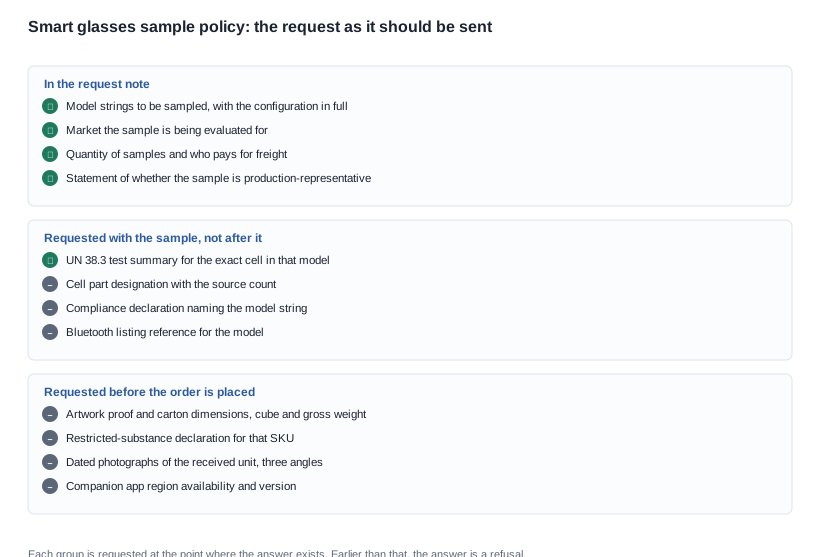
A sample request without a document list produces a box on your desk and a negotiation later. The sample proves the hardware feels right; it cannot tell you whether it is production-representative, which cell is inside it, whether the compliance file covers the model string on the label, or what the carton will cost to ship. Those four questions are all answerable, and all of them cost nothing to ask for at the moment the sample is requested.
The reason the sample cannot answer them is structural rather than accidental. A sample is a unit taken out of a process, and the documents describe the process — what was set up, which lot was fitted, which declaration covers which string, what the carton weighs. Once the unit leaves the building, the process stays behind. So the documents have to travel with the sample or not at all.
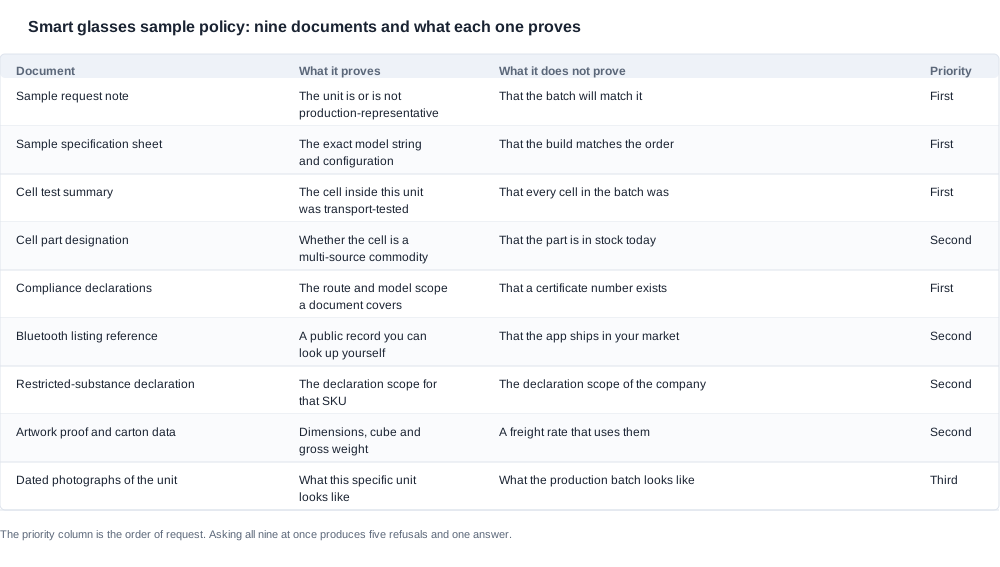
Nine documents, grouped below by what each one actually proves, and ordered by the point at which the answer exists.
Smart glasses sample policy: the request note, and who must produce it
1. The sample request note. One paragraph stating whether the sample is production-representative, and if it is not, what differs — firmware revision, component lot, packaging print run. This is the document that starts the chain, and it is the one most often omitted.
2. The sample specification sheet. The exact model string, the configuration, the colour, what is in the box, and the firmware or app version the unit is running. Without it you are approving an unidentified object.
These two documents are the cheapest and the most consequential, and they are the two most often left out of a request. The note is one paragraph of prose, and the specification sheet is a data sheet that any supplier already holds for its own production use. What makes them valuable is not their content but their existence: a supplier that answers both has described its own process accurately enough for you to rely on, and a supplier that answers neither has told you that the sample will have to be evaluated against your own assumptions rather than against anything it can show you.
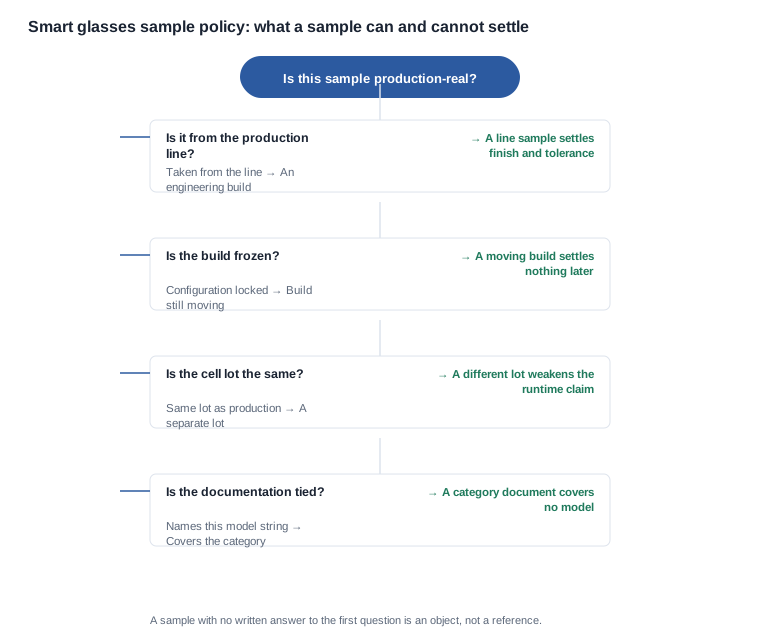
There is a third question embedded in the note that is worth separating out, because it is the one that determines whether the sample is a reference or merely an object: is the configuration frozen? A sample from a build that is still moving — where the firmware is about to be updated, or where the case option is still under discussion — settles nothing about the batch that arrives later. A sample from a frozen build settles finish, tolerance and packaging.
The reader, and what the sample is being asked to settle
The reader is a procurement manager working for the brand, a channel buyer or an importer, and there are three common situations. A buyer is comparing suppliers and has been offered a sample from each, and needs to know which sample is worth building a decision on. A buyer has received a sample and is about to place an order on the strength of it, and needs the documents that make that approval defensible if something arrives that differs. Or a buyer is sampling to settle a specific question — the runtime on a particular cell, the case option on a particular model, the app behaviour in a particular market — and needs the document that answers it rather than a general sample.
What is at stake in all three is the same, and it is worth stating plainly: a sample approval is a decision to spend money on a batch. Once it is made, the buyer's position against the supplier is whatever the sample and the documentation together establish. A sample with no documentation behind it gives the buyer nothing to enforce, because the supplier can always say the sample was never a specification.
That is the whole argument for treating the document list as part of the sample request rather than as an optional extra. The list does not lengthen the request meaningfully — nine items, most of which already exist — and it converts an informal approval into an evidenced one.

Cell and transport evidence
3. UN 38.3 test summary for the exact cell used in that model. Not a general declaration for "the product category" — the summary for the cell that is physically inside the unit you are holding. In this catalogue, device batteries run from 40 mAh to 290 mAh and charging cases appear at 900 mAh, 1200 mAh and 1400 mAh, so "the battery" is not one thing.
This document is what the carrier asks for, and it is asked for before the booking, not at the port. The handling and declaration consequences are covered at logistics.
The reason the exact cell matters is arithmetic that is easy to do badly. The catalogue publishes device cells from 40 mAh on the A05 and the A06, through 70 mAh on the A07, 100 mAh on the D11 and the D12, 115 mAh on the D17, 200 mAh on the bone-conduction model, up to 220 mAh, 260 mAh, 265 mAh and 290 mAh across the camera models. A transport document that covers one cell does not cover another, and a request that says "the battery" will be answered with whichever document is easiest to find.
The charging case complicates it further, because a case is a second cell in the consignment. The L1 Pro and the CY05, and the CY03 are published with a 1400 mAh case, the L2 Utral with a choice of 900 or 1400 mAh, and the MT6 with a 1200 mAh foldable case. Each of those options changes what the transport paperwork has to cover for the same product, which is why the case option belongs in the sample request note rather than being decided later.
4. The cell part designation. Not a marketing specification — a part number. It tells you whether the cell is a commodity item with multiple sources or a constrained one, which is the difference between a reorder that works and a reorder that takes eleven weeks.

Compliance evidence tied to the model string
5. Compliance declarations per route, naming the model. Our catalogue carries a company-level export certification page and it does not carry a per-model certification row. There is no published certificate number, no issuing body and no validity date for any individual model, and the published material contains no CE, FCC or RoHS claim tied to a model string. That is our position, and it is why this line on the request list is non-negotiable from your side: the document has to come from the supplier's own file, with the model string on it, or it covers nothing. The verification procedure is at certification verification.
There is a related point about the children's models specifically, and it deserves stating as a question rather than a conclusion. The catalogue publishes the A05, the A06 and the A07 as children's models with their electrical rows — 40 mAh and about twenty hours for the A05 and the A06, 70 mAh and about twenty hours for the A07 — and it publishes no certification row for them. Whether a given model string carries any particular conformity assessment for a given market is not a question the catalogue can answer, and the correct response to a supplier who cannot answer it either is to keep that model out of the first order rather than to assume the answer is favourable.
6. A Bluetooth listing reference you can look up. The published Bluetooth versions are specific: V5.3 on the K01 and the K02, and V5.4 across most of the newer models including the D11, the D12, the LC-105 pair, the G07 and the YK12. The camera models are a separate matter, because the catalogue publishes no Bluetooth version row for the camera series at all — that row is not published for those models, and a supplier who claims otherwise is claiming something the published material does not support. A listing is verifiable in a public database; a logo on a datasheet is not.
7. A material or restricted-substance declaration for the specific SKU. Not for the company, not for the category — for the model string that will appear on your box.

Physical and packaging documents
8. Artwork proof plus carton data. Dimensions, cubic volume and gross weight per model and per configuration. We do not publish carton dimensions or unit cube, so these have to be requested, and a freight quote without them is not comparable to one that has them.
The reason this sits with the sample rather than with the order is that the carton is not yet determined at sample stage in most programmes. The packaging artwork is usually being revised at that point, and the case option — which changes the carton size — may still be open. A buyer who requests carton data before the artwork is settled gets a preliminary answer; a buyer who requests it after the artwork is approved gets the answer the forwarder will actually use. Both are valid requests, and it is worth being explicit about which one you are making.
9. Dated photographs of the actual unit you received. This one is specific to our situation and worth stating plainly. We have no product photography in our published material. So when a sample arrives, ask for dated photographs of that unit, at the same time, from two angles plus the open box. It takes the supplier a minute, it gives you a reference image that actually matches what shipped, and it protects both sides later.
The gap this closes is specific. Without a reference image, the first argument about a delivered unit is a dispute about what the unit looked like when it arrived, and that argument is unwinnable because photographs taken after the fact are of the disputed unit. With a dated image taken at receipt, the comparison is between two things that both exist.
How to compare two suppliers by their sample policy rather than by the sample
Two suppliers will both send a sample, and the samples are usually the part of the comparison that carries the least information. What differs between them is the policy underneath: what they will document, how quickly they will produce it, and whether the documents they send identify the unit you are holding. That difference is visible in the first exchange, before either sample has shipped, and it is a far better basis for choosing a supplier than anything the sample itself will show.
The method is to send both suppliers the same nine-item request, in the same wording, with the same deadline, and to compare the answers rather than the units. Three outcomes are worth distinguishing.
Every item answered, in a document. This supplier has a process and keeps records in the form a dispute would need. The documents are in their file and can be retrieved against a serial or a model string.
Most items answered, with the gaps named. This is a normal and acceptable answer from a smaller operation, and it is a good sign, because a supplier who names a gap knows it is a gap. The gaps are then your job to close, and you close them by asking another supplier or by asking for a different build.
Items answered with documents that do not identify the unit. A declaration covering a category, a test summary for a different cell, a specification sheet for a neighbouring model. This is the outcome that matters, because it is the one that looks like a complete answer and provides nothing enforceable. The giveaway is that the document is plausible and specific but the model string on it is not the model string you asked about.
A fourth outcome deserves naming because buyers misread it: the supplier sends the documents and no sample at all. That is sometimes a deliberate and sensible position — the units are custom-built, or the sample would come from a batch that does not exist yet — and it is not a red flag on its own. What it changes is the sequence, because there is no unit to evaluate and the request note becomes the only representation of the build. Ask in that case for a photograph of the current line running the configuration, and for the last delivered batch's records instead.
Whichever outcome you get, the criteria for judging it are the same: does the document identify the specific unit, the specific model string or the specific lot that you would have to enforce against, and does it exist in a form a third party could read.
A sample policy, and what it says about the order that follows
There is a second reason to read the sample policy carefully, and it is about what happens after the order rather than before it. The documents a supplier produces for a sample are a reliable preview of the documents it will produce for a production run, because the two are produced by the same habits.
A supplier that sends an accurate specification sheet with the sample will send an accurate packing list with the shipment. A supplier that answers the cell part designation will answer the reorder question later, which matters more when the programme depends on a reorder arriving before the season rather than on the first order arriving before it. And a supplier that names its gaps will tell you before the deposit whether the certification file for your market and model exists, rather than after the goods are made.
So the sample policy is worth reading as a document in its own right, not just as a way to get more out of the sample. The due diligence question to put to yourself is simple: if this supplier documents a sample this carefully, what will its documentation for a 5,000-unit batch look like, and will the record still be retrievable in eighteen months when a customer complains about a unit?
The red flags are the ones already listed — a category document in place of a model-specific one, a cell summary for the wrong cell, a specification sheet for a neighbouring model, and an empty answer on whether the sample is production-representative. None of them is unusual. All of them are cheaper to find at the sample stage than at the first customer complaint.
One document worth adding if you ship apps
The companion app's region availability and version. A product that pairs perfectly in the factory country and fails to install in your customer's market generates returns rather than complaints, and the fix is a five-minute test on your side before launch.
This one is genuinely a side issue with respect to the supplier's documentation, which is why it sits outside the nine. But it belongs in the same request, because the same person answers it, and because a sample evaluation is the natural moment to run the test. The check is not complicated: install the app on a handset with a SIM from the destination market, pair, and confirm the feature that matters for your channel actually works.
The window between the sample and the order
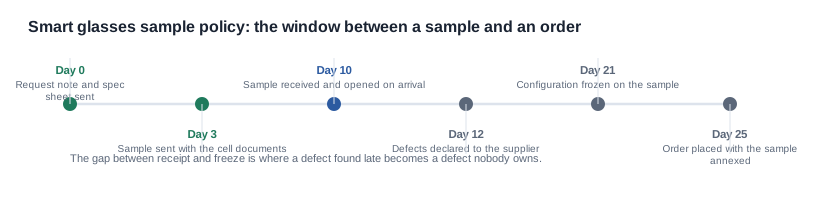
The timeline above is the point of the whole document list. Between receiving the sample and freezing the configuration there are roughly two weeks, and almost everything that will ever be wrong with the order is decided inside them. A defect found on day twelve is a conversation with the supplier. A defect found on day twenty-five, after the configuration is frozen against the sample, is a change request, and change requests are priced.
The four items on the timeline that a buyer controls are the request note, the specification sheet, the defect declaration and the configuration freeze. Each of them is free, each of them is time-sensitive, and each of them has a document behind it. That is why the sample policy is a document list rather than a piece of hardware.
The commercial terms of a sample programme
The sample itself is rarely where the money is, but the sample programme has commercial terms that are worth settling before it starts, because they set the tone for the order that follows.
What is worth agreeing is the sample cost and who carries the freight in each direction, whether the sample cost is credited against the first order, and what happens to the credit if the order does not follow. The third of those is the one that is usually left unstated. A credit that survives only when the order follows converts a sample fee into an incentive to order, which is precisely the wrong incentive if the sample is meant to be an objective evaluation rather than a sales device.
Two terms are worth resisting. A refundable sample fee, which ties the supplier's money to your decision in a way that makes a candid evaluation awkward for both sides. And a sample that is described as free with the freight billed to the buyer, which is the same arrangement with worse optics.
The trade-off worth naming is between speed and evidence. A sample request that asks for four documents instead of nine arrives faster and tells you less; one that asks for nine arrives slower and gives you a defensible approval. For a first-order evaluation the nine is right. For a repeat order on a configuration you have already approved, four is enough, and the supplier will tell you which four those are.
Our position, and the document boundary we will state
The working rule we apply: we will supply the four documents we hold — the specification sheet, the sample request note with the representativeness statement, the artwork proof, and photographs of the unit — and we will tell you plainly which five we do not hold in a form we would stand behind.
That boundary is not modesty, it is accuracy. Where a document does not exist, saying so is more useful than sending a generic declaration with the wrong model string on it, which is what tends to happen when nobody asks. A per-model certification row is one of those documents: our catalogue carries a company-level export certification page and no per-model row, so we would rather point you at the supplier's own file for that than hand you a document that does not identify your model. The same applies to Bluetooth listings for the camera series, where the published material gives no version row, and to carton data, which is not published because it depends on the final retail packaging rather than on the device.
Which models carry which configuration, and what the range actually contains, is set out on the Bluetooth audio glasses page.
A hypothetical order, worked through
Read the scenario below as invented rather than a client project. What it shows is the order. A channel buyer is evaluating a camera model with a charging case for a European programme, and has requested a sample from a supplier whose initial answer was a single carton and a price.
The request note is the first thing sent back for completion, and it produces two answers that matter more than the sample itself. The sample is production-representative on the frame and finish but was fitted with an earlier cell lot, and the configuration is not yet frozen because the case option is still under discussion between two case capacities.
That answer changes what the sample can be used for. It can settle finish and tolerance. It cannot settle runtime, and it cannot be annexed to the order as a specification, because the build it represents is not the build that would be ordered. So the sample is still worth evaluating, and the evaluation is now bounded rather than open.
The second thing the request produces is the list of what the supplier does hold. The specification sheet and the artwork proof arrive immediately, the UN 38.3 test summary for the 1400 mAh case arrives with the sample, and two of the compliance items arrive with a written answer of what the supplier does not hold in a form covering this model string.
The decision is not whether to order. It is that the configuration is frozen first, on a second sample, and the order follows the freeze rather than the other way around. The programme loses three weeks and does not lose a batch.
Tell us which models you want sampled and which documents you hold already, and we will send what we have and list by name what we do not.
Related reading


