

The decision behind smart glasses shipping is not which carrier is cheapest. It is which shipment rule your price depends on, and what happens to the cost and the schedule when that rule turns out not to hold. Six questions settle that, and every one of them has to be answered in writing before the booking is made.
The reader here is someone buying on the brand side, a channel buyer or an importer. Two or three quotations are on the table, a launch date is set, and the choice has to be made this month. The anxiety underneath the enquiry is not a bad rate. The real failure is goods that arrive other than the approved sample, a document trail that stops the consignment at the border, or an opening shipment that turns into a returns issue nobody costed.
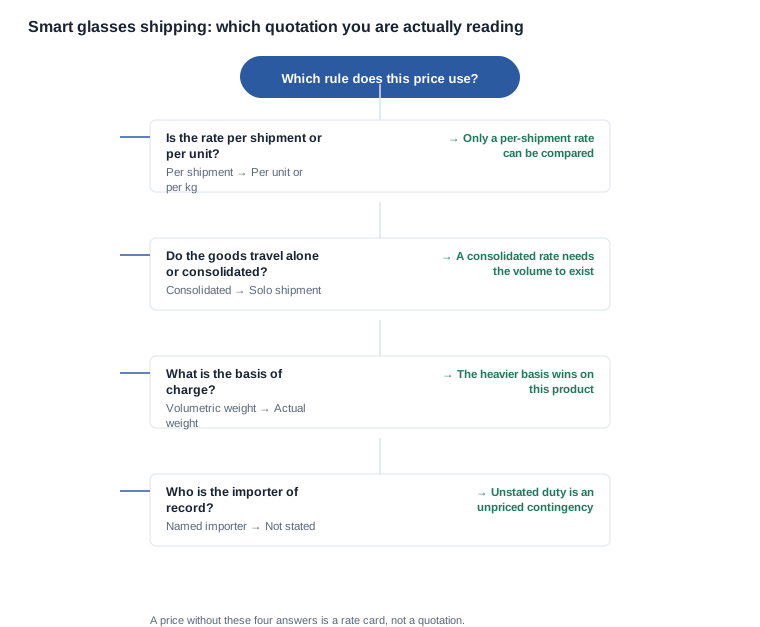
Smart glasses shipping: the six questions that decide which quote applies
A freight quotation is a rate plus a set of assumptions. The rate is legible. The assumptions are not, and they are where two quotations of the same product diverge by a factor that nobody can explain afterwards. So the useful way to read a quotation is not as a price but as an answer to six questions, and a quotation that leaves any of them open is not a quotation yet.
The six questions are these, and the order below is the order a buyer should ask them in:
- What is the shipment rule the rate depends on? The rule covers how the goods are grouped, whether they travel alone or consolidated, and whether the quoted figure is for a solo movement or a group one.
- Is the cost per shipment, per kilogram, per unit or per cubic metre? Four different bases, and they produce four different numbers from the same carton.
- What is the packaging specification the rate was calculated on? Carton type, units per carton, carton dimensions and gross weight, and whether the rate assumes the packaging as quoted.
- Which battery transport documents travel with the consignment, and against which destination regime? Named documents, not a phrase like "compliance handled".
- Which incoterm applies, and where does risk pass? The term decides the insurance obligation, the customs paperwork and the point at which the goods become the buyer's risk.
- Who is the importer of record, and what is the customs classification? The party that carries the duty and the obligation to be identified on the product or its packaging.
Everything below this point is an elaboration of those six. Everything a buyer usually asks first — which carrier, which port, which departure — sits downstream of them, and asking in the wrong order produces a rate that cannot be compared with anything.
The one test that separates a quotation from a rate card
There is a single question that exposes whether a figure is a quotation or a rate card: if this shipment does not meet the assumption, what happens to the price? A supplier who can answer that question is pricing a shipment. A supplier who cannot is quoting from a table, and the table is a starting point for a conversation rather than an answer to one.
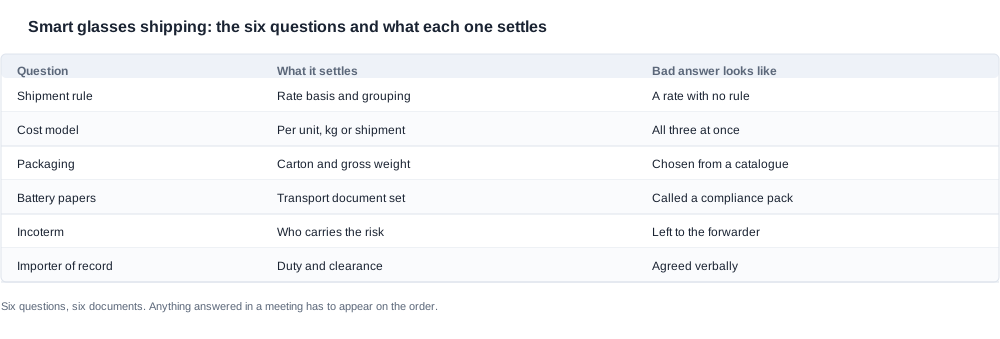
The table above is the working sheet. The third column is the one that matters when two quotations land in the same inbox: what a bad answer looks like. A rate with no rule, three cost bases at once, packaging chosen from a catalogue, a compliance pack rather than named documents, a term left to the forwarder, and duty agreed verbally are six different ways of producing a number that will move later.
What to do when a supplier answers only some of them
In practice, two quotations rarely answer the same subset. One supplier will answer the shipment rule and the cost model and go quiet on the importer of record; another will answer the paperwork in detail and leave the rate basis unstated. Neither is a reason to disqualify either, and treating the unanswered questions as disqualifying is how a buyer ends up choosing the quotation that answered the fewest useful questions.
The workable approach is to score the answers rather than to wait for completeness. For each of the six questions, mark the answer as answered, partially answered or refused, and then read the pattern:
- Three or more answered, including the shipment rule and the cost model — the quotation can be compared with another one. Everything else is negotiation.
- The cost model unanswered but the rate stated as a single figure — the quotation is not comparable and will have to be re-quoted against a measured carton before it can be used.
- The importer of record refused — this is not a packaging question, it is a question about whether the supplier is prepared to be named. The refusal is more informative than the missing document.
- The battery documentation answered with a phrase rather than a document list — the route is probably being handled by a third party, which is a normal arrangement, but it means the schedule dependency sits outside the supplier's control and has to be tracked separately.
The value of scoring rather than waiting is timing. A quotation that scores two out of six in week one and six out of six in week five is a different commercial proposition from one that scores two out of six in week five, and the difference is the information the buyer generated in the meantime.

Question one and two: the shipment rule and the cost model behind the rate
Question one, the shipment rule. A forwarder books cargo either as a solo consignment or as part of a group movement. The rule attached to the quotation tells you which one it assumed, and it is the assumption most likely to be wrong on a first order, because a first order is frequently smaller than the volume the quoted rate was written for. That is not a supplier failing to quote honestly; it is a rate that applies to a different shipment.
The criterion for this question is simple and it is checkable before anything ships: the quotation states the method, and states the solo-shipment figure alongside the group figure if the group figure is the headline. Where only one figure appears and it is the group one, the buyer has a rate for a shipment that may not exist.
Question two, the cost model. The four bases are not interchangeable, and on this product they produce genuinely different answers. A per-shipment rate divides the freight across every unit in the consignment, so it rewards volume and punishes a small first order. A per-unit rate divides the freight across the units and hides the carton entirely. A per-kilogram rate punishes the actual weight, which for a boxed product with a large charging case is rarely the binding constraint. A volumetric rate punishes the space, which is usually the binding constraint.
The criterion is that the basis is stated in the quotation and that the buyer knows which one it is. For this category, the useful working assumption is that the carton governs rather than the cell. A model with a 1400 mAh charging case occupies materially more volume than the glasses body alone, and the case is the item that decides how many units fit into a master carton. The catalogue publishes the case capacity for five camera models — 1400 mAh on the CY03 and the CY05, and the L1 Pro, 900 mAh or 1400 mAh on the L2 Utral, and a 1200 mAh foldable case on the MT6 — and it publishes the unit weight for one model in the entire range, the MT6 glasses body at 158 grams including its cell and camera and excluding the foldable case. Neither number lets a buyer calculate a freight cost. What they do is tell a buyer which two numbers to request from a weighed sample before the booking, and that is the correct use of them.
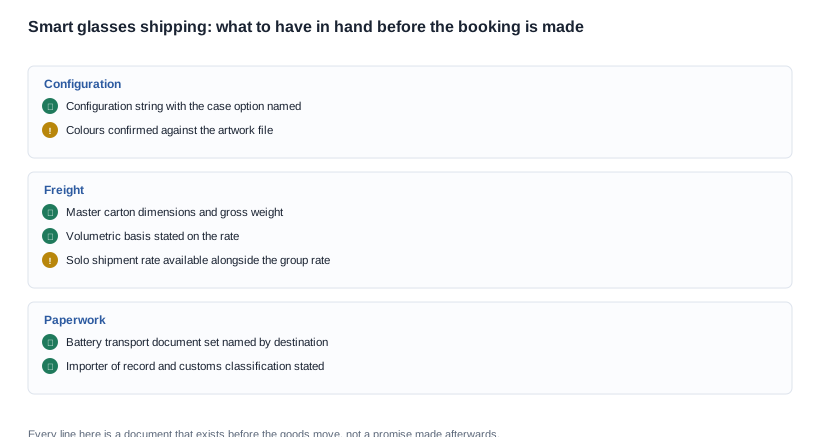
The checklist above is the practical version of questions one and two. Note the two lines marked as incomplete rather than satisfied: the solo rate alongside the group rate, and the colour confirmation against the artwork file. Both are lines that a buyer discovers the hard way, because neither produces a visible failure at the moment it is missing.

Question three and four: the packaging specification and the battery paper route
Question three, the packaging. The rate was calculated on a carton specification, and the buyer has to know which one. Units per master carton, master carton dimensions and gross weight are the three numbers a forwarder needs, and for a product in this category none of them is published. The catalogue does not publish a packed unit weight for any model except the MT6 glasses body, and that figure is the eyewear alone, with the battery and the camera in it and the foldable charging case out of it; the case weight is not published either. There is no published gross weight, no published carton count and no published carton dimension anywhere in the range.
That absence has a direct consequence for how a buyer should answer this question. The answer is not "ask the supplier for the specification" — the supplier does not have a measured specification for a configuration that has never been packed. The answer is to weigh and measure one sample of the actual shipped configuration, and to treat that as the input. A buyer who books freight against a catalogue packaging assumption will get a rate, and the rate will be a rate for a box that does not exist.
The second half of this question is whether the rate was calculated on the packaging as quoted, or on a generic box. For a product with a charging case, a generic box is usually larger, and a larger box on a volumetric rate is a materially higher bill. The criterion here is that the packaging description on the quotation matches the packaging described on the purchase order, word for word.
Three packaging decisions in this category carry more freight consequence than the rate itself, and a buyer should make them deliberately rather than inherit them:
- Whether the charging case ships in the retail box or as a separate carton line. A case that travels in the box inflates the box; a case that travels separately inflates the carton count and adds a handling step at destination. Both are legitimate, and they produce different unit freight costs.
- Whether the retail box ships at all. A channel buyer supplying its own packaging removes a unit cost from the carton and adds a labelling operation to the factory. It is a negotiable term and it moves the freight number by more than most rate negotiations.
- Whether the accessory set is in the box or in the carton. The cable, the manual and the spare temple are small, but a box that is nominally for one unit and actually carries two is a carton that understates its own volume.
None of these is a supplier's decision. All three belong in the configuration string, and all three have to be settled before the carton is measured, because changing any one of them after the carton has been measured means measuring it again.
Question four, the battery paper route. Every model in this range ships with a lithium cell, so this is not a special case; it is the standard case. What differs by destination is which regime the documentation route has to satisfy, and the European Union and the United Kingdom are separate systems with separate paperwork. A buyer in this position has to know which documents will travel with the consignment, who signs them, and what happens if one of them is issued late.
The catalogue does not answer this question for any model, and it is worth being precise about why. A single company-level export certification page appears in the catalogue that displays ten patent certificates, eight of them appearance-design patents and two utility-model patents, but it publishes no per-model certification row, no certificate number, no issuing body and no validity date. The text of the catalogue contains no reference to CE, FCC or RoHS at all. So a buyer who asks "is this model certified" and receives "we have an export certification page" has received something true and something unusable: the answer says that the company holds some export documentation, not that this model, for this destination, under this configuration, is covered by anything with a name and a date on it.
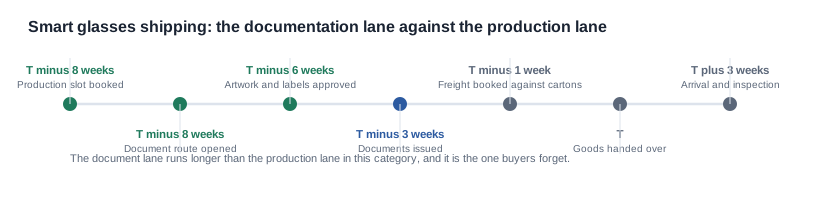
The timeline above is the practical consequence. The documentation lane runs longer than the production lane, and a buyer who starts it after the production slot is confirmed has converted a paperwork task into a schedule event.

Question five and six: the incoterm and the importer of record
Question five, the incoterm. The shipping term decides three things at once: who carries the risk, who arranges the carriage and insurance, and who carries the customs obligation. A change of term therefore changes the paperwork and the insurance, and the three cannot be separated cleanly. The criterion is that the term appears on the purchase order and not in a side letter, because a term changed after the order is placed changes the risk position retroactively and it does so at the moment the buyer least wants a discussion.
For a first order there is one specific trap worth naming. A term that places the risk on the seller all the way to the destination looks generous and is not, because the buyer still cannot produce the destination documentation without the seller's involvement, and the moment the goods are in a customs queue the buyer has the risk and not the control. The way to test whether a term is actually workable is to ask who moves the goods from the port to the distribution centre, and to write that answer down.
Question six, the importer of record. The importer of record is the party that carries the duty, the classification and the obligation to be identified on the product or its packaging. In the European Union the General Product Safety Regulation has applied since 13 December 2024, and it requires the manufacturer and, where applicable, the importer to be identifiable on the product or its packaging — which means an artwork change if the importer's details are not already on it, and an artwork change late in the programme is a cost.
The criterion is that the importer of record and the customs classification appear on the quotation. Where clearance was excluded from the cost model, the duty arrives as an overage after the fact, and the buyer learns the classification rate at the moment it is least welcome. This is a line on the cost model, not a technical footnote, and it belongs in the total cost alongside the unit price rather than in a paragraph below it.
The related commercial terms sit in the contract terms pillar and the payment terms pillar, because the incoterm, the payment schedule and the inspection window have to move together. A change in one of them that is not reflected in the others is how a shipment becomes an argument.
One last point about negotiation, because freight is usually treated as the last thing to negotiate and it is not the last thing that moves. The rate is the least negotiable line in this category: the carrier sets it, the season sets it, and the carton sets it. What the supplier does control is the part around the rate — the packaging configuration, the consolidation window, the split between supplier-arranged and buyer-arranged carriage, the documentation timing, and the inspection window at destination. Those five are negotiable and they move the total cost of the shipment further than a rate negotiation does. A buyer who negotiates the rate and accepts the default carton has negotiated the smallest number on the quotation.
What Cynrin can and cannot answer about a freight quote
The boundary we hold: freight in this category is a specification problem rather than a rate problem, and a buyer who treats it as a rate problem will spend the negotiation capital in the wrong place.
We publish the configuration rows that determine the carton: the model, the cell capacity, the case capacity for the five models where it is published, the charging method for twenty-four models and the unit weight for the one model where it is published. We publish the charge time for every model in the range, with the caveat that it carries no starting state of charge and no termination criterion, so it cannot be read as a case turnaround time.
What we do not publish, and what therefore has to be a question to the supplier rather than a lookup in our material: unit prices, production lead times, minimum order quantities, packed and master carton weights and dimensions, the charging method for the CY05 and the CY03, and the L1 Pro and the MT6, the colour for most models, the sensor model and the field of view for any camera model, and any certificate number, issuing body or validity date.
That is why we publish them as gaps rather than filling them with a figure we could not defend.
The logistics pillar sets out the wider framework for how these decisions sit against the rest of the programme, and the Bluetooth audio glasses range lists the published baseline for the eight audio models. Send us the model, the configuration, the destination market and the volume, and we will tell you which of the six questions we can answer from published data, which we have to request, and which we cannot answer at all — before the booking is made rather than after the goods have moved.


