

Private label programmes fail in a specific and predictable way: the second order costs more per unit than the first, because the thing that was supposed to amortise did not amortise. Smart glasses wholesale private label at scale is not a volume question. It is a question about which parts of the setup work are one-off, which are charged per version, which are charged per model, and which are charged per order — because a programme that grows by adding models adds setup work as well as units, and the two do not scale at the same rate.
The reader here is a brand owner or a distributor who has decided to put its own name on this category and is now working out what happens when the range gets wider. This article does not quote a rate, a minimum order quantity, a tooling charge, a sample fee or a lead time, because none of those is published for this catalogue and none should be assumed in a commercial plan.
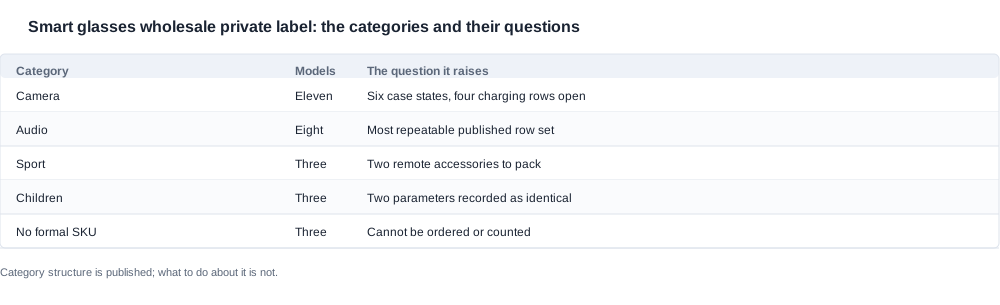
What the catalogue and the product record do support is a structure. Twenty-eight models make up the range, eleven of them camera models and eight audio models, then a smaller group covering sport models, children's models and three entries that have no formal SKU. The separate product detail record adds a layer the catalogue does not have: a category-by-category count of customisation dimensions — seven in the camera group, five in the audio group, five in the sport group and two in the children's group. It also carries a list of items still awaiting confirmation, and one line that applies to every model in the range.
Smart glasses wholesale private label at scale: what actually scales
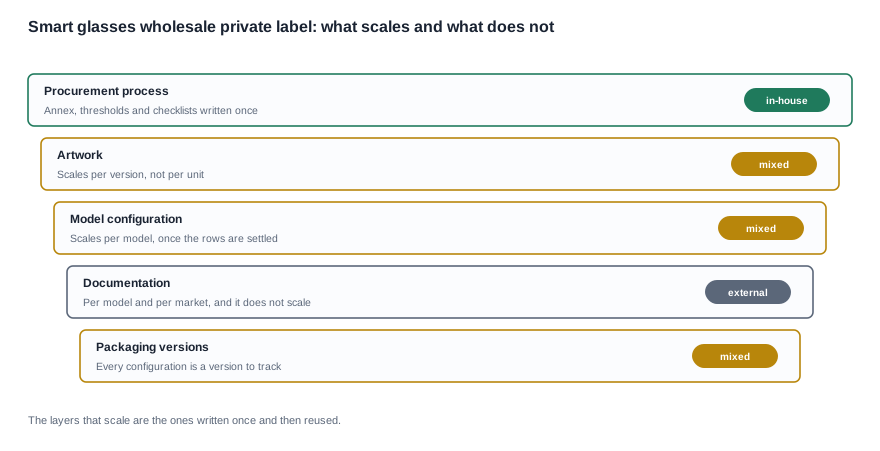
Four things scale cleanly in a private-label programme, and they are worth separating from the ones that do not, because the first order can hide the difference.
The procurement process scales best of all. The specification annex, the inspection criteria, the acceptance threshold, the document checklist and the claim framework are written once and reused for every subsequent order. In a programme that reaches a broad range, this is usually the largest single saving available, because it is the part that costs attention rather than money and because every new model inherits it for free.
The artwork scales with versions rather than with units. Once an artwork file is final and the supplier can print to it, every further unit of that configuration carries no additional artwork cost. The scaling limit is the number of versions, and the commercial question is whether a change of artwork is treated as a new version with its own setup or absorbed into the existing one.
The configuration scales with models. A model whose published rows are settled — a named case state, a named charging method, a settled colour split — can be reordered without any further work, provided the specification annex already names it.
The channel operation scales with the channel. Content, listings, bundles and the returns process are the buyer's assets and their unit cost does not rise as the range grows, which is the reason a wide range is attractive in the first place.
The pattern across all four is the same: they scale because they are written once and then reused. Nothing that has to be re-established per model or per order belongs in this list.
There is a further item that scales and is often overlooked: the catalogue itself. Twenty-eight models with published battery, runtime, charge-time, charging-method and, for part of the range, case and colour rows give a private-label programme a specification library it can build a range from without writing a product description from scratch for every model. That library is a one-off asset, and it is the reason a programme with access to published rows can expand into a category more quickly than one that has to describe each model from a photograph and a sample.

Smart glasses wholesale private label at scale: what does not scale with volume
The things that do not scale are mostly per-model and per-order costs, and they are the ones that decide whether a wide range is workable.
Documentation is the largest of them. A private-label programme in a regulated market needs documentation per model and per market, and the catalogue does not make that easy to predict because it publishes no per-model certification row at all. Its export certification page is a company-level set of images with no per-model record attached, and the pictures on it total ten certificates, eight appearance-design and two utility-model patents. The separate product record puts the certification position of the camera, audio and sport categories into the same three-state form, with no model-level certificate number published for any of them, while the children's category carries nothing at all. A programme that adds three models to a basket adds three documentation lines unless those models are already covered, and there is no published way to check which they are.
Packaging is the second. Every packaging configuration is a version, and a private-label programme with a colour split creates multiple packaging versions for one model. Only two models in the catalogue publish a colour split, one with three options and one with four, so the version count is bounded but not small, and each version has to be tracked separately through production, inspection and stock.
Minimums are the third, and they are the constraint that interacts most directly with breadth. A minimum attached to a model, a colour split or a case configuration applies however much the buyer orders across the whole basket, so adding a model to a range does not add units — it adds a floor. This is the mechanical reason why a wide range is harder to run than a narrow one, and it is why the breadth of the range has to be decided against the floors rather than added afterwards.
Attention is the fourth. A broad basket divides the supplier's attention across more configurations, and the risk concentrates in the lines nobody is checking. Every model added to a range also adds a spare-parts line, a documentation line and a configuration confirmation, and the cost of that is not visible as a figure but is paid in the number of things that can go wrong unobserved.
A fifth item belongs on the list of things that do not scale, and it is the least visible of them: the buyer's own working capital. Every additional configuration, documentation line and packaging version sits in the balance sheet until the channel sells it, and a wide range turns a modest inventory position into a fragmented one. Fragmented stock is not merely costly to hold; it is harder to sell through, which means the slowest lines in a broad range are usually the ones with the fewest units behind them, and those are exactly the lines whose documentation and packaging costs were fixed regardless of how many units moved.

Smart glasses wholesale private label at scale: the documentation side of the same question
The documentation side deserves its own treatment because it is the part of a private-label programme most likely to be underestimated and least likely to be noticed until it matters.
Four published facts define the position. There is no per-model certification row anywhere in the catalogue. The catalogue text names no CE, FCC or RoHS anywhere, and no per-model certification row exists in it. The export certification page carries ten patent certificate images and no record of what any single model is cleared for. And the product detail record itself notes that none of the 28 models has supplied photography, video or test-report material.
Those four facts together mean that the compliance position of every model in a private-label range is an open item until a supplier confirms it in writing, and that the documentation work is per model and per market rather than per programme. For a brand owner, this is the point at which the cost of a wide range becomes concrete: each model added to the range carries its own file, its own evidence and its own renewal, and none of that is visible in a rate.
Two further items in the product record are worth carrying into a programme plan, because both are recorded as unresolved rather than as settled. The record notes that the A05 and the A06 have identical parameters with the difference between them unconfirmed, which means a programme that lists both is listing two models it cannot yet distinguish. It also notes that the two parallel names published on the L2 Utral page have no published correspondence to the two case capacities on the same page, which means the variant structure of that model cannot be resolved from the catalogue and has to come from the supplier. Two other entries carry a page-reference anomaly, and one of them carries a question about whether the model belongs to the camera category or the sport category at all.
None of this is a reason to avoid a category. It is a reason to resolve it before the range is published, because a private-label programme that resolves a variant question after the packaging is printed has already paid for the wrong version.
That is the general shape of the documentation problem in this category, and it is worth stating plainly because it is unusual. The catalogue publishes specifications in detail and compliance in almost no detail at all. A buyer can therefore write a specification sheet for any model in the range without asking anyone a question, and cannot write a compliance sheet for any model in the range without a written answer from the supplier. The asymmetry is the single most useful thing a private-label planner can carry into a negotiation, because it tells the buyer exactly which half of the specification work is already done and which half has to be bought.

Smart glasses wholesale private label at scale: three decisions that determine whether scale works
The first decision is breadth against depth. A range of a few models, each carried in depth, spreads the per-model costs over a larger base and produces fewer versions. A wide range multiplies the per-model costs and the version count, and it produces a different programme: one that depends on a catalogue, a channel and a documentation system rather than on a small number of well-understood lines. Both are legitimate strategies, and the question is which one the buyer is actually equipped to run. The criteria that decide it are operational rather than commercial: how many models can the channel present, how many files can the compliance owner maintain, and how many configurations the stock system can distinguish.
The second decision is which documentation each model carries and who holds it. The catalogue publishes no per-model certification row, so a private-label programme has to build the mapping itself, and the mapping is per model, per variant and per destination. The question worth settling before the range is fixed is which party holds the technical file, in what format, for how long, and what happens to it if the supplier changes.
The third decision is which packaging configurations are in play, because each one is a version and versions are where private-label programmes acquire complexity. The published colour coverage limits the question: only two models publish a colour split, one with three options and one with four, so the version count is bounded by what the catalogue publishes plus whatever a supplier confirms for the rest.
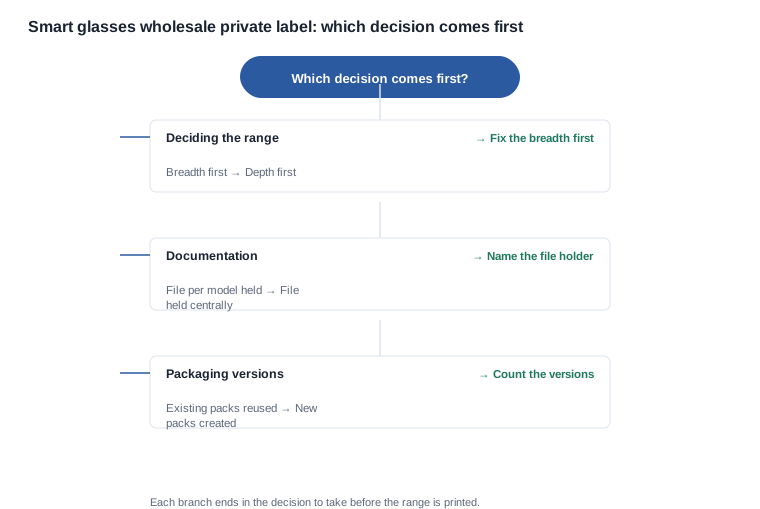
The three decisions interact. Breadth multiplies the documentation lines, the documentation lines multiply the packaging versions, and the packaging versions multiply the floors. A buyer who decides breadth first and then asks about the other two will discover the cost of the decision after it has been made.
There is a fourth decision that follows from the first three and is easier to postpone than it should be: which models the programme will stop carrying. A range that only ever grows is a range whose per-model costs only ever accumulate, and a programme with a stated exit rule can treat a slow model as a decision rather than as a failure. The exit rule does not have to be aggressive. It has to exist, be written down, and be applied on a schedule rather than on a feeling.

Smart glasses wholesale private label at scale: the categories scale differently
The four categories do not scale the same way, and the catalogue's published detail makes the differences legible.
The camera category carries the most published detail and therefore the most configuration surface. Eleven models, six case states inside that range, four camera models with no charging-method row, a split between eight models publishing an eight-megapixel class and three publishing a thirteen-megapixel class, colour coverage on two models, an IP54 marking on two models, and a single published weight figure in the whole catalogue. It also carries the most recorded customisation dimensions. A camera range is the most capable in the category and the most expensive to document.
The audio category is the most repeatable. Eight models, each publishing the same set of rows, with the values varying but the fields present, and the product record carries five recorded dimensions for the category. A buyer building a broad, repeatable range will find the audio models the easiest to specify and the easiest to reorder.
The sport category sits between them, with three models, five recorded dimensions, two models publishing a charge time of roughly an hour rather than the two-hour-or-less ceiling, and two models publishing a remote shutter accessory that has to be counted and packed.
The children's category is the one with the least published support: three models, two recorded dimensions, a certification position recorded as not provided, and the recorded note that the A05 and the A06 carry identical parameters with the difference unconfirmed.
And three catalogue entries have no formal SKU at all — the AR glasses, a photochromic model and a bone-conduction model — which means they cannot be quoted, ordered, repeated or counted in a floor. A private-label range cannot include them until a supplier issues a SKU against them.
Smart glasses wholesale private label at scale: the questions to ask before committing
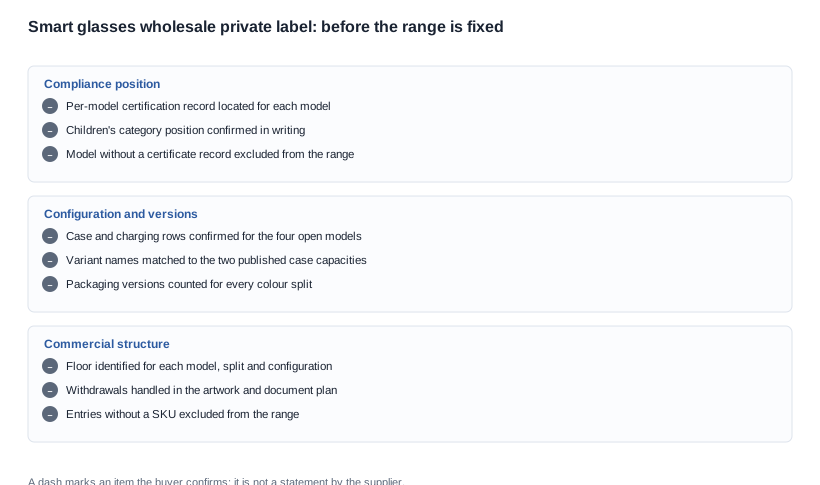
The checklist below is the one to send before the range is fixed, and every item is a question rather than an assumption.
The order in which those questions are answered matters more than their number. The questions about documentation and configuration come first, because they determine which models can be in the range at all. The questions about packaging versions come next, because they determine how many versions the programme has to track. The questions about floors and exit rules come last, because they are the ones a buyer can still revise once the range is decided.
- Which models in this range carry a per-model certification record, and where is it held?
- What is the certification position for the children's category, given that the record carries none?
- For the two models with published colour splits, how many packaging versions does each split create?
- Which packaging configurations are already in use, and which would be new?
- Which case configuration and charging method applies to each of the four camera models that publish neither?
- How are the variant names on the L2 Utral page matched to the two case capacities on the same page?
- What distinguishes the A05 from the A06, given that their published parameters are identical?
- What is the minimum attached to each model, each colour split and each case configuration in the proposed range?
- What happens to the documentation and the artwork if a model is withdrawn from the range?
- Are the three entries without a formal SKU excluded from the range, and what would be needed to include them?
What CYNRIN publishes for smart glasses wholesale private label questions
What is published here is the structure that a private-label programme is planned against: the range it plans against: twenty-eight named entries and three that carry no SKU, six different case arrangements inside the camera range, a charging method on all but four camera models, colours on two models, an IP marking on two models, the recorded count of customisation dimensions per category, the recorded certification position per category, and the recorded list of items still awaiting confirmation.
We do not publish a rate, a minimum order quantity, a tooling charge, a sample fee, a certification fee or a lead time for any of it, because those are not published values. Nor do we list what can be customised, because the record's dimension counts are the published fact and the interpretation of them belongs to a supplier conversation rather than to a catalogue.
What we will do is take a proposed range and check it against the published rows — which models are structurally distinct from each other, which lines carry configuration work, which lines carry documentation work, which lines carry a floor of their own, and which published items remain unresolved — and say plainly where that check stops and the supplier's own answer begins.
Two supporting readings sit alongside this one: which model to pick in the audio range covers the specification side of a repeatable range, and lead time on OEM-ready platforms covers the scheduling side. The OEM customisation entry point and the OEM-ready platform range describe the engagement, the certification checklist covers the documentation work in detail, and the minimum order page covers the floors. A quote request starts a specific conversation.
Smart glasses wholesale private label at scale works when the programme is built around what amortises and priced around what does not. Find that line before the range is printed, because afterwards it is a packaging change rather than a decision.


