

The word premium is the most expensive thing in this category, because it is the one word that a buyer cannot support with anything the catalogue publishes. There is no price here, so there is no price tier, and there is no feature ranking that puts one product above another. A tier has to be constructed rather than found, and the construction has to be done out of materials that a buyer can actually hold: the published electrical rows on one side, and the scope of the configuration on the other.
That is the argument of this article. A higher tier in this segment is not a product with more features, because the catalogue publishes no feature that the other products lack. It is a product with a larger cell class, a different charge profile, an additional function that has to be documented before it can be described, and a configuration — packaging, accessories, documentation, support — that is worth more and costs more to specify. Everything else that a listing calls premium is a word without a document behind it, and the practical consequence of using one is that the first person who asks what it means gets an answer that cannot be repeated consistently.
So the structure below is: what a higher tier can legitimately rest on, the published fields that separate the three products in this segment, the configuration work that actually creates the tier, a decision path for building a range that has a top, and the limits of discussing a tier at all when no price is published.
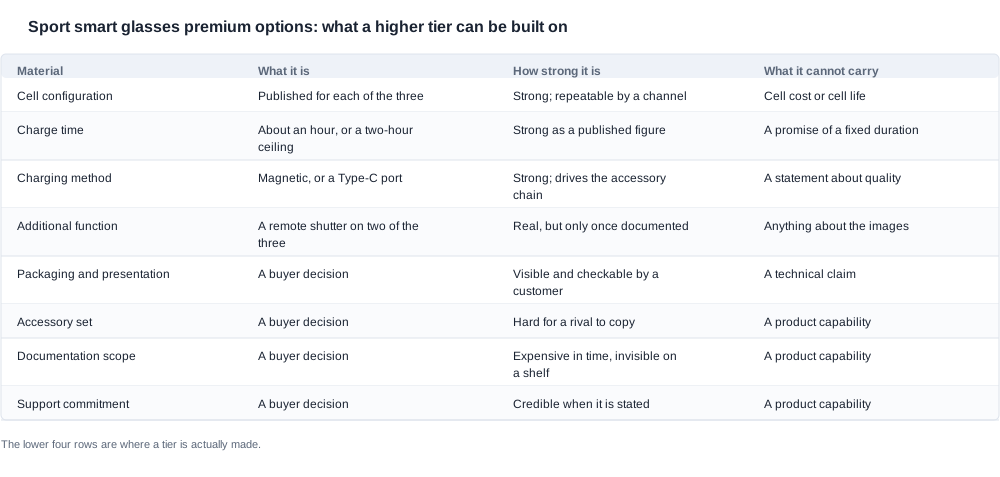
Sport smart glasses premium options: what a higher tier can be built on
Three materials are available, and they are of very different strength.
The published electrical rows are the strongest material, and they are narrow. Within the sport segment of the catalogue there are three products. The three are close enough that the published rows do not rank them. The cells are a pair of 70 mAh units on the first, a single 115 mAh unit on the second and a single 100 mAh unit on the third. The charge ceiling is two hours for one of them and roughly an hour for the other two, and the radio generation is common to all three. Those differences are real, they are published, and they are the only part of the segment on which an ordering can be built without a document from a third party.
What they support is a statement about the operating profile rather than about quality. A product with a single larger cell and a roughly one-hour charge is the one that can be recharged inside a break; a product with two smaller cells and a magnetic contact is the one whose charging is an event with a lead attached. Those are the differences a buyer can defend, and a tier built on them is defensible with them.
The additional function is the second material, and it is conditional. Two of the three products carry a remote shutter. That is a genuine difference in what the product does, and it is the one difference in this segment that a customer would notice. It is also the difference that cannot be described from the record, because the sensor, the coverage, the recording format, the rate and the storage arrangement are all unpublished. A tier built on this function is real, and it is a tier that a channel cannot launch until a supplier document exists and a scope has been written.
The configuration is the third material, and it is the one that most often decides the commercial outcome. Packaging, the accessory set, the documentation scope, the language coverage, the support commitment and the aftersales route are all choices, and all of them cost money and are all visible to the customer. A product presented in a fuller configuration and supported more deeply is a higher tier in every sense a customer can check, and it can be delivered without a single new technical claim.
What is left over — the adjectives, the exclusivity, the "flagship" — has no material behind it at all, and this is the part of the premium language that a buyer should be careful with, because it is the part that cannot be repeated consistently by a distributor, a retailer and a marketplace listing at the same time.
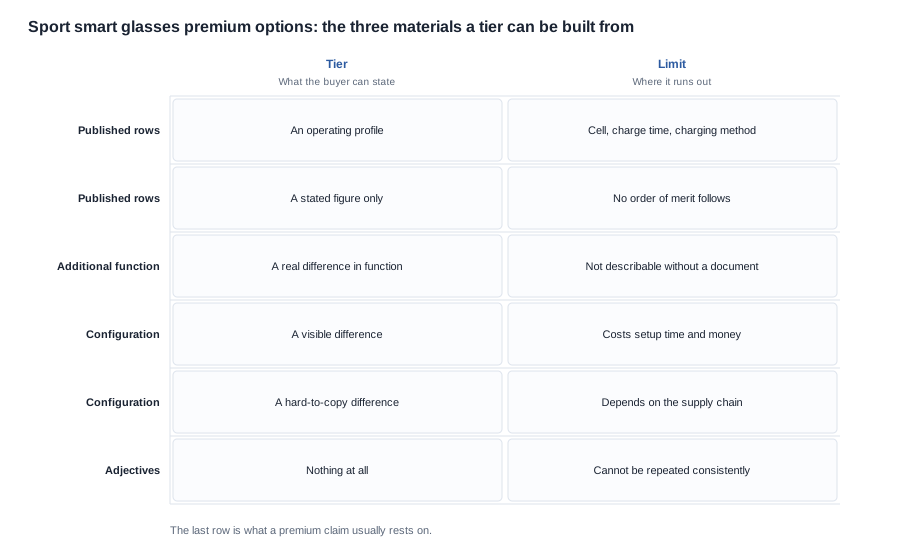

The published fields that separate the three products here
Four published fields do the work of separating the three products, and it is worth taking them one at a time because each of them can be quoted and each of them has a limit.
The cell configuration. Two 70 mAh cells, a single 115 mAh cell, a single 100 mAh cell. The configuration is published, and the count is published with it, so a buyer can state it precisely and a distributor can repeat it. What it cannot tell anybody is what the cell is made of, what it costs, or how long it lasts, because none of those is published.
The charge time. Roughly an hour on two of the three, a ceiling of two hours on the third. This is the field with the most commercial weight and the one most often overstated. A charge time of about an hour is a published figure, not a guarantee, and the distinction is a matter of how the sentence is written: a product that charges in about an hour has stated a figure, and a product that charges in an hour has stated a promise. The wording has to survive translation into a carton, a listing and a distributor's own material, and the ceiling formulation is the one that does.
The rated endurance. About seven hours on one product and about eight hours on the other two. This is a rating without a stated test condition, and a rating is a planning number. It can be quoted as a rating and it cannot be turned into a duration for a particular customer, because the difference between the two figures is smaller than the uncertainty in the condition behind either of them.
The charging method. A magnetic contact on one product, a Type-C port on the other two. This is the field that decides the accessory chain, the carton contents and the spare-parts position, and it is therefore the field that separates a configuration from another configuration. It is also the field a buyer can use to justify a difference in total cost without making any claim about the product itself being better.
What none of those four fields can do is establish an order of merit. The product with the larger cell is not thereby the better product; it is the one with a different operating profile, a different charge behaviour and a different accessory chain, and those three things are what a tier can be built on. The red flags in a channel document are the ones that skip this step: a claim that one product is the flagship, a claim that one is more advanced, a claim that one is built for a demanding user. None of them is supportable from the record, and all of them are easy to write.

Where the tier is actually made: configuration, not specification
Once the specification is exhausted, the tier has to be built in the configuration, and this is where most of the money and most of the risk sits. Four areas do the work.
Packaging and presentation. A tier needs a carton that looks like a tier, and that carton is an artwork and tooling decision with a minimum print quantity. The cost of the tier is in the setup, not in the per-unit difference, and the setup is what stops a small brand from running a range with three presentation levels. The decision that has to be made early is whether the tier is a different carton or the same carton with a different insert, because the second is much cheaper and the first is much better.
The accessory set. A magnetic-charged product and a product on a standard connector do not carry the same contents, and a tier that includes a spare lead, a case and a documented accessory set is a tier in the sense a customer can check. The commercial point is that the accessory set is the one tier element that a competitor cannot match by copying the specification, because it is a supply decision rather than a technical one.
The documentation scope. More languages, a translated instruction set produced from a controlled source, a per-market label, a file that names the brand. This is the least visible part of a tier and the one that costs the most in elapsed time, and it is the part that a marketplace listing quietly omits while a distributor quietly needs.
The support commitment. A response time, a claim route, a returns arrangement, a spare-parts position for the accessory. A tier is credible when the support behind it is stated, and it is not credible when it is implied by the packaging.
There is a fourth configuration decision that is easy to overlook and expensive to get wrong, and it is the one that a marketplace channel forces. A marketplace listing presents a product, a photograph and a set of claims, and it is the only surface most customers will ever see. A tier that exists only in the packaging disappears on that surface, because the listing shows the product and not the box. So a brand running a tier through a marketplace has to decide explicitly whether the tier is visible there, and if it is not, whether the tier is still worth carrying at all. The same question applies to a distributor whose own shelf replaces the retail carton.
That is a strategic decision rather than a packaging one, and it changes the economics of the configuration work. A tier that has to survive a marketplace listing has to be carried by something other than the box — by the accessory set, by the documentation, or by a support commitment the customer can see in the listing. A tier that is carried only by the box has to be sold into a channel that will put the box on a shelf, which is a narrower channel and a more valuable one.
There is a fifth decision, which is when the tier is allowed to be described. A tier has a natural point at which it becomes describable, and it is not the point at which the configuration is chosen. It is the point at which the customer-facing material exists: the artwork, the listing copy, the instructions, the support page, and the product page. Before that point, the tier is an internal plan, and the risk is that it is announced before it can be delivered. The cost of announcing early is a customer who has been told to expect something and receives a standard configuration, and in a channel where the price difference between the two is visible, that is the kind of complaint that damages the whole range rather than the one product.
The reason this is the decisive part of the tier is that a specification cannot be upgraded. A buyer can add packaging, accessories, documents and support to a product that already exists; a buyer cannot add a larger cell, a faster charge or a camera to a product that does not have one. So the tier is built downward from a chosen product and upward from a chosen configuration, and the two movements have to be planned together.


A decision path for building a range with a top tier
The path below is what a brand does when it has decided to run a range with a top position and has no price list to work from.
- Choose the product that carries the tier, on its published profile. The criteria are the cell configuration, the charge time and the charging method, because those are the three that a distributor can repeat and a customer can be given.
- Decide whether the additional function is part of the tier. If it is, a supplier document has to be obtained before the tier can be described, and the timeline has to allow for it. If it is not, the tier has to rest on configuration alone, which is possible and cheaper.
- Build the tier from the configuration, and price the configuration. Packaging, accessories, documentation scope, support and the spare-parts position each get a line, and the sum is what the tier costs to produce.
- Work out the total cost per unit with the accessory chain included. A tier built on a magnetic lead carries a recurring cost that the packaging does not show, and a tier built on a standard connector does not.
- Set the acceptance criteria for the tier before the artwork is produced. What the customer receives, what the documents say, what the support commitment is, and what happens on a return.
- Write the tier definition into the purchase specification and the channel material in the same terms. The definition has to survive being repeated by somebody who has never read this article, which is the practical test of whether it is a tier or a slogan.
One more point belongs in this sequence, and it concerns the supplier rather than the channel. A tier assembled out of configuration is only as stable as the supply behind each element of it. The lead in the box, the carton, the translated instruction set and the spare-parts position all have their own minimum quantities and their own lead times, and a tier that depends on a minimum-quantity element it has not checked is a tier with a date in it that nobody agreed. The criteria for choosing which elements to build the tier on are therefore ordinary supply criteria — the minimum quantity against the planned volume, the lead time against the launch date, and the number of suppliers behind each element — and they apply before any question about design is asked.
Two decisions in that sequence are routinely left to the end and cause the most rework. The second one — whether the function is part of the tier — determines the documentation timeline, and the documentation timeline determines the launch date. The fifth one — the acceptance criteria — determines what a return is, and a return that has not been defined becomes a negotiation with a distributor.
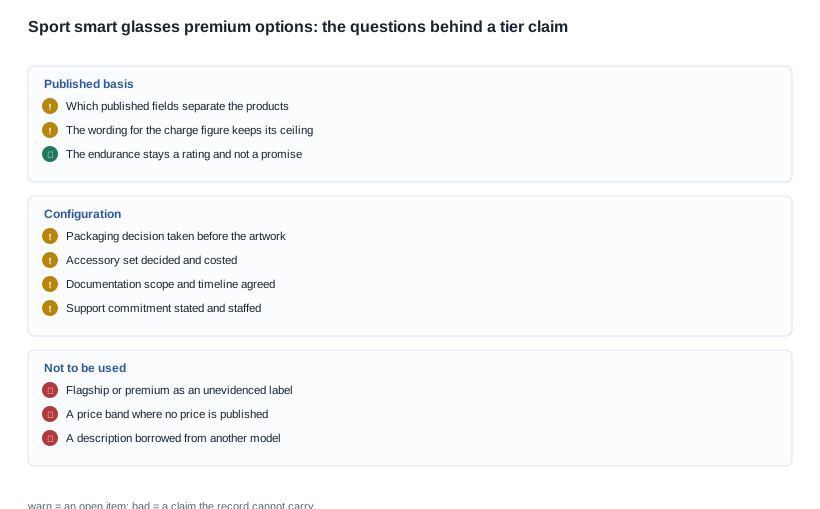
The limits of talking about a premium without a published price
Three limits are worth stating because they are the ones that cause the trouble.
The first is that a tier cannot be a price. There is no published price for any product in the range, so a tier cannot be described as the more expensive option, and a channel cannot be given a price difference to work with. What a channel can be given is a configuration difference and the evidence for it.
The second is that a tier cannot be a specification. The published rows for the three products in this segment are close enough to each other that a buyer cannot construct an order of merit from them. The differences are in the operating profile, and the operating profile is what a tier should be built on.
The second is that a tier cannot be a specification. The published rows for the three products in this segment are close enough to each other that a buyer cannot construct an order of merit from them, and the differences that do exist are in the operating profile rather than in the build quality. A tier that rests on the operating profile can be explained to a customer in a sentence and repeated by a channel without drift. A tier that rests on a build quality nobody can inspect can only be asserted, and an assertion is not a position that survives a comparison.
The third is that a tier cannot borrow another product's description. A feature line belongs to the product it was published against, and the absence of one for another product is an absence of information rather than a statement that the product has nothing. This matters here because the same confusion appears in a second direction: a description published against a different model in the range cannot be used to fill a gap in this one. A tier built on borrowed language is a tier that collapses the first time a customer compares two listings, and that is the point at which the tier stops being a commercial position and becomes a liability.
Our own position is that for the three products in this segment the catalogue gives the electrical rows and the feature lines and nothing beyond them, and therefore we will not describe any of them as a flagship, an advanced model or a premium product, and we will not quote a price band for the range. What we can do is set out which published fields separate the three, which configuration decisions create a tier, what a tier costs to build and to run, and what has to be true before a tier can be described honestly, in a form that a distributor can repeat and a customer can check. The packaging and configuration side of that work is covered in the note on platform packaging, and the comparison against the wider range is set out separately.
If you are building a range with a top position, give us the three products you are working with, the channel, the destinations and the configuration you have in mind for the top, and we will return the published fields that can carry the distinction, the configuration lines that will have to carry the rest, and the questions that have to be answered before the tier can be described.


