

Private label in this segment is mostly a documentation exercise, and that is the part buyers underestimate. Putting a mark on a temple is straightforward; putting the brand's name on the carton, the instructions, the label and the conformity file, and making all of them agree with the product that actually ships, is the work. The three products in the sport line of the catalogue give a buyer a workable base — two 70 mAh cells on one, one 115 mAh cell on the second and one 100 mAh cell on the third, with a magnetic contact and a two-hour ceiling on the first and a roughly one-hour Type-C charge on the other two, with two of the three also carrying a remote shutter — and none of them changes its published specification when it is rebranded. That last point is the one that has to be said first and said clearly, because it is where a private-label programme usually goes wrong.
The published rows do not move. A product that is sold under a brand's own name has the same cell, the same charge profile, the same radio and the same function as the product in the catalogue, and the documentation has to say so. What a private label changes is who is named, what the customer sees, and what has to be produced. The boundary of the exercise is therefore not a question of how far a brand can go; it is a question of where a branding change stops being a branding change and starts being a different product.
This article works through that boundary: what a brand can take on, the three lines along which a private-label programme runs into trouble, the documentation consequence that is the real work, the commercial boundary and where the minimum quantities actually sit, and a staged path through the programme.
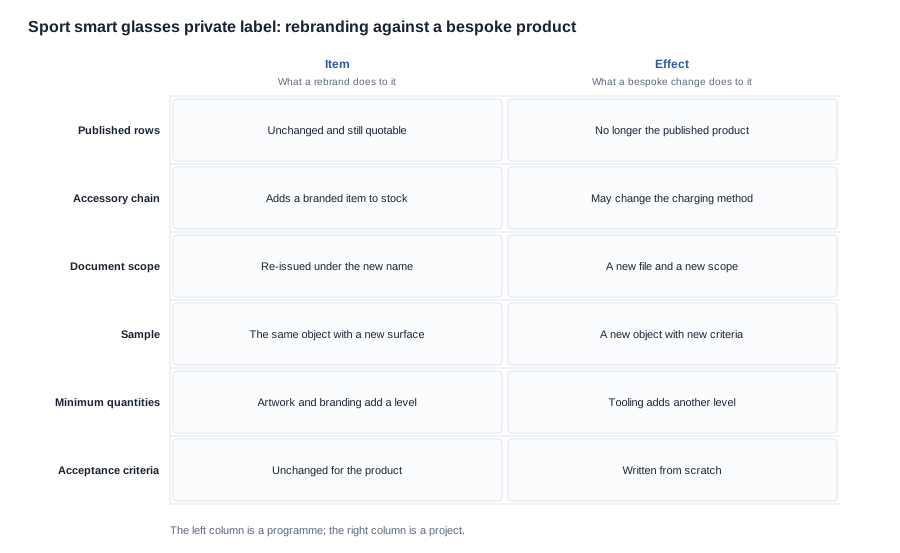
Sport smart glasses private label options: what the brand can actually take on
The options divide into three groups, and the groups behave differently in cost, in lead time and in risk.
The first group is marking and colour. A mark applied to the temple or the arm, a specific colour set rather than the one the factory holds, and a print or artwork treatment on the packaging. These are ordinary customisation decisions, they are the ones most brand owners start with, and they are the ones with the least downstream consequence. A mark is a surface treatment; a colour is a surface treatment; neither changes the published rows, the accessory chain or the radio.
The second group is packaging and presentation. The retail carton, the insert, the printed leaflet, the accessory box, the branded cable for the magnetic-charged product. This is where the money is and where the consequences are, because the carton dimensions set the freight, the accessory set has to be stocked, and the artwork has a minimum print quantity and a lead time of its own.
**The third group is the documentation and the product description, and it is the group that most often decides whether a private-label programme ships on time. It is also the group with the least visibility: nothing about it appears on the product, so nothing about it appears on a factory quotation, and a programme can reach the halfway point with the assumption that the paperwork will follow the artwork. It will not, because the paperwork is derived from the product description and the artwork is derived from the paperwork, and the order of derivation is fixed.
The third group is the documentation and the product description.** The instructions, the warnings, the label content, the document that establishes the product's conformity for the destination market, the batch records that tie a shipped unit to it. This is the group that turns a private-label programme from a short graphic-design project into a programme with a schedule, and it is the group where the work is usually underestimated.
There is a fourth possibility that buyers sometimes raise and that is worth placing outside the three groups, because it is a different project rather than a larger version of the same one. A product that is private-label in name but whose mould, temple profile, colour process, electronic configuration or control software has been altered is a bespoke product: it carries its own file, its own sample, its own acceptance criteria and its own minimum quantities, and the published rows for the three catalogue products do not apply to it at all. A product that is private-label in name but whose mould, temple profile, colour process, electronic configuration or control software has been changed is a bespoke product. It has its own file, its own sample, its own acceptance criteria and its own minimum quantities, and it is not the product in the catalogue. The published rows for the three sport products do not apply to it, and a buyer who treats a bespoke product as a rebranded one will find that the specification they are working from was never the specification of the product.

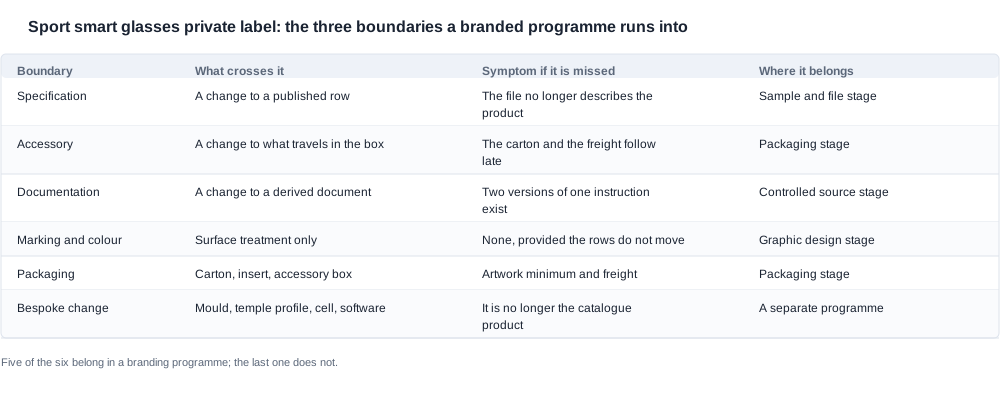
The three boundaries a private-label programme runs into
Each of the three boundaries is crossed by a different kind of decision, and each of them has a symptom that appears late if it is not spotted early.
The specification boundary. The published rows — the battery, the runtime, the charging limit, the connector and the radio — describe the base product. A change that alters any of them moves the product out of the range and into a new file. The changes that do this are small and easy to make by accident: a different cell supplier, a different charging lead, a different radio module, a different configuration of the two cells in the paired product, a firmware or control change that alters the radio behaviour. A buyer who agrees a branding change and a "minor" component change in the same conversation has created a new product, and the documentation consequences of that are considerably larger than the branding ones.
The accessory boundary. The charging method determines what goes in the box, and a private-label programme changes what goes in the box in two ways. It may add a branded cable for the magnetic-charged product, which turns a free inclusion into a stocked item with a part number and a minimum quantity. It may remove the cable entirely on the assumption that the customer has one, which is defensible for a Type-C product and indefensible for a magnetic one. Either way the carton has to change to match, and the carton is the slowest and least flexible part of the programme.
The document boundary. This is the one that catches people, because nothing about it is visible on a product. The mark on the temple is trivial; the instruction set, the warning content, the label and the conformity file all have to carry the brand, and all of them have to describe the product that is actually being shipped. A brand that changes the artwork and leaves the documentation under the factory's name has not produced a private-label product; it has produced a rebranded box around somebody else's paperwork, and the importer is the party standing between a customer and a product whose documentation names somebody else.
The practical test for all three boundaries is the same, and it is the test a buyer should apply to every request in a private-label programme: does this change alter the published rows, the accessory chain, the document scope or the mould? If the answer is no, it is branding and it belongs in the graphic-design stage. If the answer is yes, it is a product change, and it belongs in the sample and the file.

The documentation consequence, which is the real work
The part of a private-label programme that consumes time is the documentation, and it consumes time for a reason that is easy to explain and easy to forget: the documents are derived, and a derived document has to be re-derived every time the source changes.
The chain runs in one direction. The product description fixes what the product is. The instruction set and the warning content are written from that description. The label artwork is produced from the instruction set and the destination requirements. The conformity file is issued against the product description and the test evidence. The batch record ties a shipped unit to the file. A private label changes the name at every step of that chain, and it changes the artwork at two of them. The consequence is that a branding change is not one change; it is a re-issue of every document downstream of the product description, in every language the brand sells in.
There are three things that make this manageable and one that does not.
The first is a controlled source. Every instruction, warning and label text is produced from a single controlled document, and everything else is a translation or a layout of it. The cost of a change then falls on one document rather than on twenty.
The second is version control with a real reference. Every derived document carries the version of the source it came from and the version of itself, so that a distributor in one market and a distributor in another can be checked against the same origin. Most of the private-label programme cost that surprises buyers is caused by two versions of the same instruction existing in two markets.
The third is agreeing in advance which documents the programme needs and in which languages, because every additional language multiplies the artwork, the review and the re-issue work.
The thing that does not make it manageable is deciding the documentation late. A brand that settles the artwork in the last month of a programme inherits the entire re-issue chain, and the chain is where the schedule goes. A brand that settles the documentation in the same meeting where it settles the packaging does not.


The commercial boundary, and where the minimum quantities sit
None of the commercial terms for this range is published, so a private-label programme negotiates every one of them, and the ones that matter most are the ones that appear at more than one level.
There are usually at least three minimum quantities in a private-label programme, and they are frequently confused with one another. The first is the minimum for the product itself, which is the supplier's commercial term and is set by the material and labour planning behind it. A buyer who has not asked for it will find it by ordering too little, and the discovery is expensive because the mistake is not visible until the order is placed. The second is the minimum for the branding run, which is set by the process: a marking or colour operation often has a run length below which the setup is not worth doing. The third is the minimum for the artwork, which is a print quantity and which is usually the largest of the three for a packaging element.
The reason this matters is arithmetic rather than commercial, and the arithmetic is unforgiving: it is the largest of the three that sets the effective programme size, and it is the one that is decided by a designer rather than by a buyer. The consequence is that a brand with a strong plan and a modest budget frequently discovers that the packaging, rather than the product, is what the programme cannot afford. That is a planning failure rather than a purchasing one, and it is entirely avoidable by asking the question at the same time as the artwork is scoped.
The reason this matters is arithmetic rather than commercial. If the product minimum is a thousand units and the artwork minimum is five thousand, a brand ordering a thousand units has paid for the artwork of five thousand and has a carton it can only use in part. A brand that works the three minimums separately and takes the highest as the effective programme size has not been over-cautious; it has found the real constraint. And the one that a buyer is most likely to discover late is the artwork, because it is the one that is not visible in the product.
Two related terms belong in the same conversation. Tooling arises when the branding touches the mould or a colour process that needs a new tool, and the question is who owns it and on what terms. Changes and re-issues arise when a document is revised, and the question is what triggers a re-issue and who bears it. Neither is a large number, and both are the kind of term that is easier to agree at the start than to renegotiate once a brand is on the market with a carton it cannot reorder cheaply.
There is a fourth boundary that is easy to miss because it is not a product change at all: the boundary of the trademark itself. A mark that is already registered for a different class of goods, or a mark whose registration does not cover the destination market, cannot be fixed later with a carton reprint, and the correction is a new programme rather than a new artwork version. The same applies to a brand name that is used in the destination market by somebody else. A private-label programme that has not checked the position of the mark in each market is carrying an unpriced risk into the most expensive stage of the project, and the check is a search rather than a negotiation.
The comparison with a volume programme is worth making explicitly, because a private-label programme is often run by people who come from one. A volume programme buys the same product in larger quantities and optimises the cost per unit. A private-label programme buys a different object — the same product plus a set of brand-specific assets — and the cost per unit includes an amortised share of artwork, tooling, the accessory set and the document work. That share is not a fixed percentage, because it falls as the volume rises, which is why the effective minimum is best understood as a number of units rather than as a per-unit price. The right comparison between two private-label offers is therefore between their effective programme sizes and their scope, and not between their unit prices.
A staged path through a private-label programme
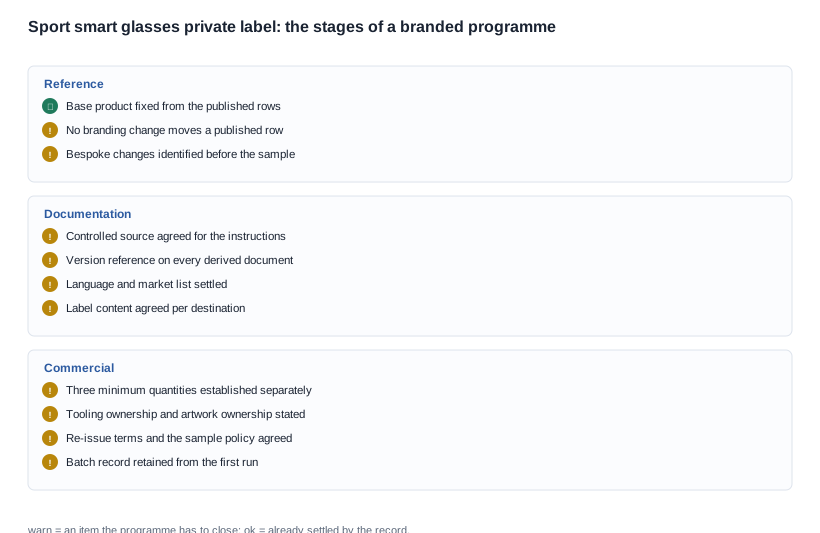
The sequence below is the one that keeps the programme out of the schedule trouble that private-label projects usually run into.
- Fix the base product from the published rows, and record the designation, the cell configuration, the charge profile, the charging method and the radio version as the reference the branding sits on top of.
- Decide the branding scope in writing — the mark, its position, the colour set, the packaging elements and the accessory set — and confirm that none of it alters the reference specification.
- Establish the documentation consequences at the same time, including the controlled source, the language list, the label content for each destination and the party named in the file.
- Establish the commercial boundary: the three minimum quantities, the tooling position, the artwork ownership, the re-issue terms, the payment terms and the delivery schedule.
- Build the sample under the brand, with the branding, the carton, the accessory set and the documentation all in place, and check the sample against acceptance criteria that were fixed before it arrived.
- Verify the documentation against the sample, so that what the file describes and what the sample shows are the same object.
- Release the order against the approved sample, and start the batch record at the first production run instead of rebuilding it later.
Two things in that sequence are the ones that get compressed, and both are worth protecting. Step three is the one that looks like administration and is actually the constraint on the launch date, because every document in the chain is derived from the product description and a change to the description re-issues all of them. Step five is the one that looks like a formality and is actually the only point at which the branded object has ever existed as a whole, because a product that has never been assembled with its own carton, its own accessory set and its own instructions has not been tested in any meaningful sense.
Our own position on this is that the catalogue publishes the specification rows and the feature lines for the three products in the sport segment, and no price, no minimum order quantity, no sample quantity, no delivery schedule, no tooling term and no warranty term for any of them, so we will not quote a private-label cost, a programme size or a lead time here. What we can do is set out what a brand can take on, where the boundary between a rebranded product and a bespoke one sits, what the documentation chain costs in time, where the three minimum quantities actually are, which of them is usually the binding one, and the order in which the work has to be done. The wider customisation side is set out in the note on customisation options, and the packaging side of a branded programme is covered separately in the packaging note for this line.
If you are planning a private-label programme in this segment, give us the brand name and the markets you intend to sell into, the configuration you have in mind, and the volume you are working to, and we will return the branding options that do not move the published rows, the documents your name will have to appear on, the commercial terms that will have to be negotiated rather than read, and the decisions that have to be taken before the sample is built.


