

Sport smart glasses what to include in the box is a different question from the same question in another line, and the difference is the charge row. Two of the three products in our catalogue that are published as 运动眼镜 print a charge time of about an hour, and the third prints two hours or less. That single published difference changes what a box has to say, because it changes what a session looks like for the person using the product and what a recharge costs in the gap between two blocks of activity. A carton that carries a one-hour charge row is describing a product that can be brought back up between sessions; a carton that carries a two-hour ceiling is describing a product whose recharge has to fit a longer window. Everything else in this line follows from that.
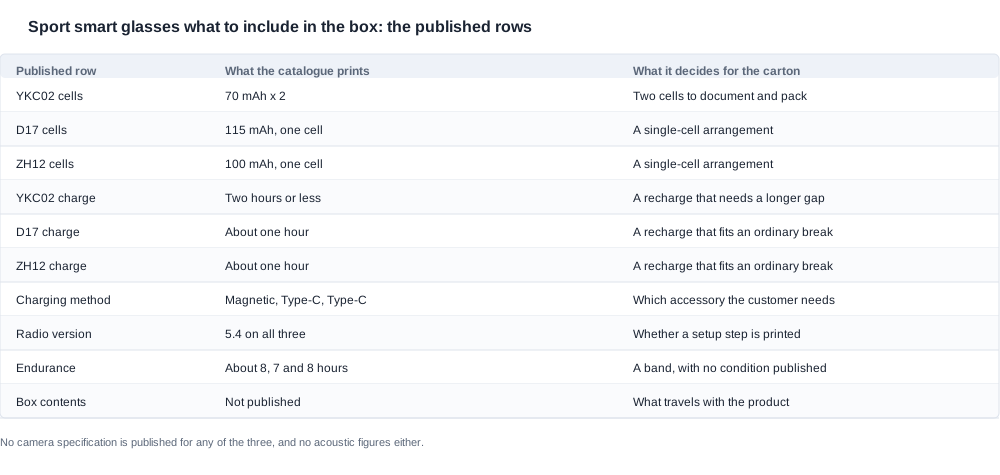
What to include in the box to know about sport smart glasses: the three models and their charge rows
The three products are the YKC02, the D17 and the ZH12, and all three are published as 运动眼镜. The YKC02 carries two 70 mAh cells, a rated endurance of approximately eight hours, a charge ceiling of two hours or less, magnetic charging, and Bluetooth version 5.4, and its page records two further notes: a surround-sound configuration and a long-endurance note. The D17 carries one 115 mAh cell, a rated endurance of approximately seven hours, a charge time of about an hour, a Type-C port, and version 5.4, with notes for a remote control for photography and a surround-sound configuration. The ZH12 carries one 100 mAh cell, a rated endurance of approximately eight hours, a charge time of about an hour, a Type-C port, and version 5.4, with its two further notes printed in Chinese: a photography remote and a stereo surround-sound configuration.
Read as a set, the three rows divide the line in two ways, and both divisions reach the carton. The first is the charge division, where the D17 and the ZH12 sit at about an hour and the YKC02 at two hours or less. The second is the cell division, where the YKC02 carries two cells and the other two carry one. A programme that carries more than one of these products is therefore carrying more than one charge row and more than one cell arrangement, and the two divisions are independent of each other: the product with the shorter charge row is not the product with the single cell, and the product with two cells is not the one with the longer charge row. A buyer who has planned the programme around one of those divisions alone will discover the other one at the stage where the box is being specified.
The third division is the one that has nothing to do with the electrical rows at all, and it is the one a carton writer has to handle most carefully. Two of the three products publish a note for a photography remote, and the third publishes a surround-sound configuration and a long-endurance note instead. A product with a remote row has a component that may travel in the box, and a component that may travel in the box is something the carton has to describe, count and account for. A product without one has nothing of that kind to describe, and the printed content available for it is correspondingly thinner.
A procurement team that has not run this enquiry before will usually find that the commercial half and the technical half have to be chased separately, because they come from different people in different formats. The commercial half — the unit price and the price breaks, the smallest order the supplier accepts, the production lead time, the sample order and the bulk order terms — is in the quotation, and the technical half — the transport papers for the cell, the conformity record for the shipped build, the certificate position and the change process — is in the file. A buyer who expects both in a single reply tends to get a partial answer to one and an assumption in the other, and the assumption is usually in the technical half, which is the half that stops a shipment.
There is a fourth thing the box cannot carry, and it is the one that is easiest to get wrong precisely because two of the models have a photography remote in their published notes. None of these three products publishes a camera specification. Our catalogue prints a remote-photography row for the D17 and a photography-remote row for the ZH12, and it prints no camera row for either of them or for the YKC02. A carton may therefore describe what the catalogue lists, and it may not describe a camera that the catalogue does not publish, because the moment it does, the carton is making a statement about a product capability that no published row supports.

The one-hour charge rows, and what they mean for the parcel
The charge row is the published number a customer is most likely to act on, and it is the one a carton has to carry accurately rather than approximately. Two of the three products here print about an hour, and one prints two hours or less. A carton that says "fast charging" for a product whose published row is two hours or less is making a comparative claim that the row does not support, and a carton that says "one hour" for the product whose published row is two hours or less is simply wrong. The published figure, stated as the published figure, is both accurate and the only version that survives being checked.
What the one-hour row actually changes is the operating routine, and the box is where that routine is described. A product that reaches a full charge in about an hour can be recharged inside a break, which means the accessory is used more than once a day, which means it is more likely to be left behind, and which means the box has to say what to do when it is. That is a short piece of text, and it is one of the few pieces of text in a sport carton that genuinely has to be there. The two-hour ceiling on the third product is a different proposition: the recharge fits a longer gap, the accessory is used less often, and the box has less to say about it.
There is a commercial consequence here that a buyer should put in the business case rather than leave in the box copy. An accessory that a customer uses several times a day is an accessory that has to be available, and for a group issue that means either the accessory ships in the box, or the buyer stocks replacements, or the customer is left with a product they cannot recharge. The first of those three is a box decision, the second is an after-sales cost, and the third is a returns problem. Which of the three applies is determined by the charge row before anything else is decided, which is why the charge row belongs at the top of the enquiry list rather than in the middle of it.
The second consequence is about where the box ends up. A product issued for activity is usually not opened at a table: it is issued in a bag, in a locker, in a changing room, or handed over by someone who is not the person who will use it. A carton that is read once in a corridor and then kept in a bag for a season has to work harder than a carton read carefully at a desk, and the working is in the words rather than in the printing. That is an argument for short, large, unambiguous statements and against a dense block of small print, and it is a stronger constraint in this line than in a line where the box is read by the purchaser in good light.
The third consequence is the one that has to be handled with care rather than with a longer text. A product whose published rows include a surround-sound configuration carries a sound claim into the box, and that claim has to be reproduced as what the catalogue lists rather than as a measured result. Our catalogue publishes no acoustic figures for any of these three models, and no third-party test report supports a surround-sound description as a performance outcome. So the carton may say that the catalogue lists a surround-sound configuration, and it may not say what that configuration produces. A buyer who wants the second sentence needs a supplier document and nothing less.
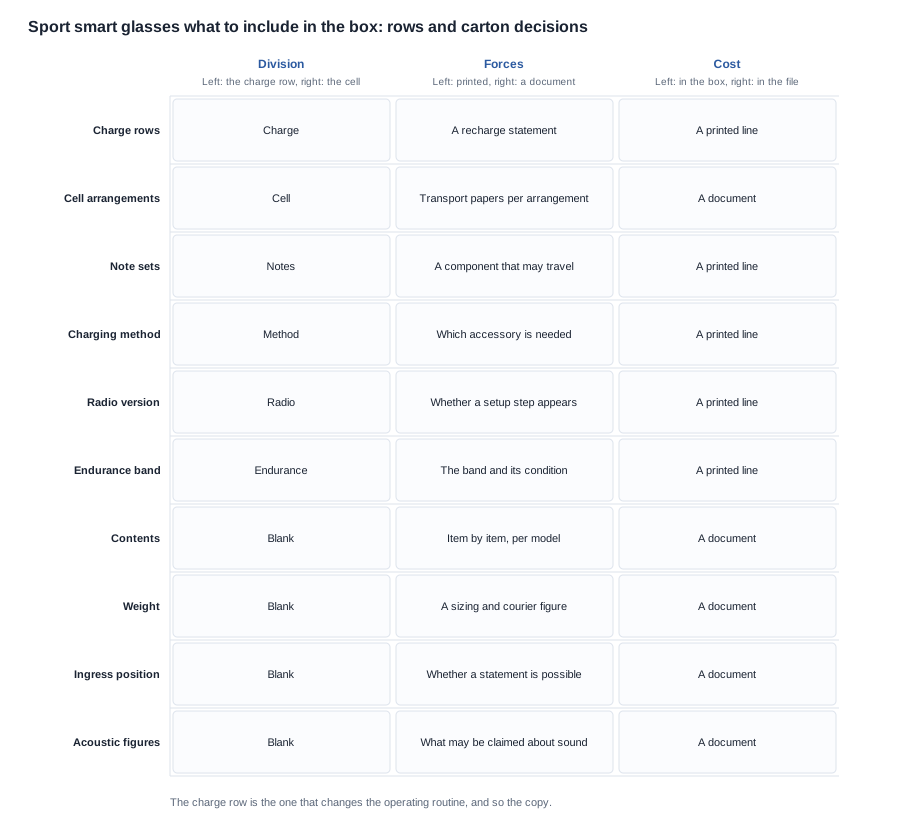
The matrix above is arranged so that the left-hand column is the published row and the right-hand column is the decision it forces in the carton, because that is the conversion a buyer actually has to make. Each of the three divisions — the charge row, the cell arrangement and the note set — produces a different kind of line in the box, and a specification that keeps them in one undifferentiated list will produce a carton that says the same thing about three products that behave differently.

The two-cell model, and the two single-cell models beside it
The cell division is the one that mostly stays out of the copy and mostly shows up in the cost, and it is worth separating clearly from the charge row so that the two do not get confused in a programme. The YKC02 carries two 70 mAh cells. The D17 carries one 115 mAh cell. The ZH12 carries one 100 mAh cell. A product with two cells and a product with one are different objects to handle, to store, to ship and to document, and the difference is not a rounding of the same thing: the number of cells is what a transport file is built around, and it is what a quality team checks on receipt.
For a channel, the practical consequence is that a programme carrying more than one of these products is carrying more than one set of transport documentation, and the documentation has to be requested per arrangement rather than per model range. A buyer who asks for "the documentation for the sport line" will get something less specific than a buyer who asks for the documentation for each cell arrangement in the programme, and the difference will surface at a customs or carrier checkpoint rather than in an email. The request is cheap to make and expensive to get wrong, and it is the kind of item that belongs in the first exchange rather than the last.
There is a second consequence, and it is a question about what happens when a unit is replaced. A product with one cell and a product with two cells behave differently when a cell is replaced rather than the whole product, and whether either of them is a field-replaceable item is not published. A channel that has sold a group-issued product needs to know whether a fault is handled by swapping a unit or by swapping a part, because the after-sales cost of the two is different and because a customer with a two-cell product may reasonably expect the same after-sales route as a customer with a one-cell product. The question is answerable from the supplier and is not answerable from the catalogue, and it is worth asking while the programme is still being designed.
The third point is the one about the published endurances, and it is a caution rather than a finding. The rated endurances in this line sit at approximately eight hours, approximately seven hours and approximately eight hours, and none of them is published with a workload, a start state or an end criterion. A carton can therefore print the published band and cannot print anything derived from it, and in particular cannot say that one of the three lasts longer than another. The band is what the product is published as; it is not a measure of a session, and a box that presents it as one has turned a rating into a promise.
What can be said on the carton is a comparison the rows support, and there is one that is genuinely useful to a customer in a changing room: that two of these products can be brought back to a full charge inside an ordinary break between blocks, and that the third needs longer. That statement is a direct reading of the published charge rows, it is the thing a customer actually needs to know, and it is the kind of line that a carton can carry without any supporting document beyond the row itself.

The sequence above puts the charge row first because it constrains the most, and the accessory question immediately after because it is the question that determines whether a customer can charge the product the day it is issued. The transport documentation comes next because it is the longest lead time of the three. The printed claims come last, because the wording of a carton cannot be settled until the rows behind it have been confirmed, and a carton whose wording is settled early and revised late is the expensive version of this exercise.

The questions to settle before a sport order is packed
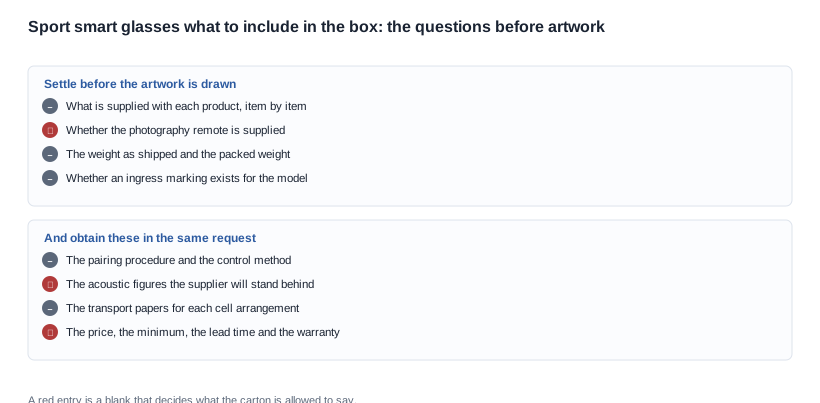
On a carton for this line, our position is a single rule. We publish the rows and we publish no measurement behind them, so a box may state what is fitted and what the product is published as, and nothing about what either of those produces. A carton for the sport line describes construction and operation, and it says nothing about an effect on the person using the product. Everything else in this article is the working method for turning that rule into a document a supplier can quote against, and it is a method rather than a list because the answers arrive in a different order at every factory.
The list below is what has to be answered in writing before the carton is designed, and it is written in the order that costs least to get wrong. Each item can be met from documents the supplier already keeps, and each one corresponds to a line in the box that otherwise has to be guessed.
- What is supplied with each product, item by item, and whether the charging part is included.
- Whether the photography remote is supplied, for the two products whose pages list one, and how the absence of one is described for the third.
- The pairing procedure for each product, whether an application is required, and what confirmation the wearer receives.
- The control method for each product, and what the wearer is told after an action.
- The weight as shipped and the packed weight, for the group issue and for the courier.
- Whether an ingress marking exists for any of the three products, and for which configuration.
- The acoustic figures the supplier is willing to publish, if any, and the wording it will stand behind.
- The transport paperwork for each cell arrangement in the programme.
- The printed text of the safety information, in the languages of the markets, approved for each.
- Whether a short recharge instruction belongs in the carton, and where the charge row is printed.
- The unit price and the smallest order the supplier accepts, and how long the warranty cover runs.
- The artwork approval route, the conformity record for the configuration shipped, and the change process that keeps both valid.
The second and the seventh of those are the two that a carton writer is most likely to get wrong, and they fail in opposite directions. The second is a question of omission: a product whose page lists a photography remote may or may not ship one, and a box that assumes it does will be wrong for the units where it does not, and a box that assumes it does not will be wrong for the units where it does. The seventh is a question of addition: a surround-sound row is a catalogue row, and turning it into a description of what the customer hears is the kind of addition that no supporting document in our catalogue can carry.
The ninth and the tenth are the ones a channel should treat as the critical path, because both of them are text that has to be approved and both of them are easier to approve before the artwork exists than after. A safety text that is written for one market and reused in another has to be reviewed again for the second, and the review is the part that takes time. A recharge instruction is only worth printing if the accessory is in the box, so it waits on the answer to the first question. In both cases the sequence is the same: the answer arrives, the text is written, the text is approved, the artwork is released, and the artwork is the last thing that moves.
A buyer should also fix the criteria by which the replies will be judged before the request goes out, because the replies arrive in several forms and only some of them are usable. A value that can be printed is usable. A value that can be held internally but not printed is usable and has to be marked as such. A description of what the product is like in use is neither, and it is the form that comes back most often. How to choose between two suppliers is then a matter of asking each of them the same twelve questions in the same order and scoring the replies against the same three levels, and what to ask is the list above, in that order. Which model a buyer carries forward, and against what standard it is judged, follows from the requirement that buyer arrived with; what this list is for is to make sure that whichever model is chosen, the box that arrives says only what the file behind it supports.
The two questions that remain open after a full set of answers are the ones that no supplier document can close, because they are about the programme rather than the product: what happens to the box when the accessory is replaced, and what happens to the artwork when the configuration moves. Both belong in the agreement rather than in a carton, and both cost far less to settle while the programme is still being designed than once a shipment has gone out and a carton has to be reprinted.


