

A standard oem case example is worth writing only if it shows decisions rather than adjectives. What follows is an illustrative walkthrough of a first standard engagement, built from the constraints our published catalogue actually presents. It is a worked illustration of how the process behaves, not a report of a real order, and no client, market or figure in it should be read as a precedent or a quotation.
The programme is deliberately ordinary. A channel operator is launching one product line in two markets, on a single purchase order, using a catalogue model with a brand treatment and a colourway. The buyer has done this before with a different supplier and has never done it with this one. Nothing about the programme is ambitious, which is precisely why it is useful to follow: the ordinary case is where the process either holds or quietly fails.
What makes it worth following is that the catalogue supplies less than the buyer expects at the point where they expect most, and the walkthrough shows where each missing piece has to come from instead. The stages below produce a document each. A stage that produces no document has not happened, whatever was agreed in the meeting about it.
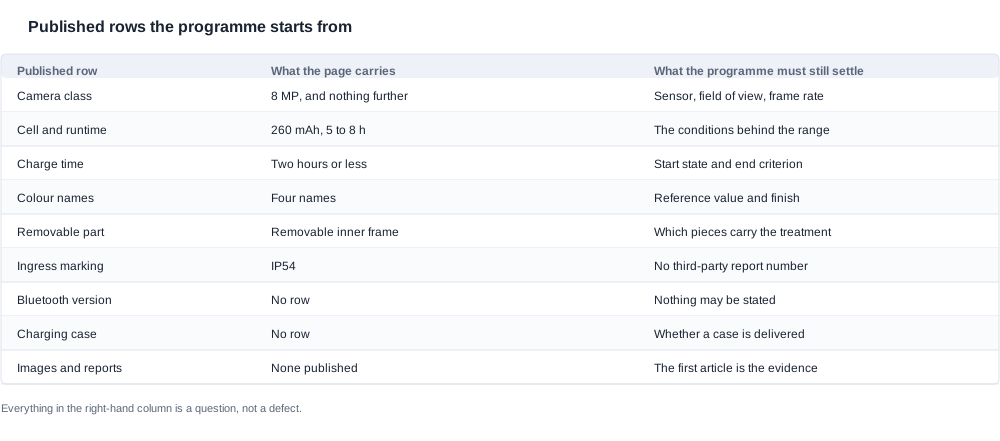
A first programme, followed from requirement to shipment
The starting position, written as published rows
The buyer wants one camera model for a sport-oriented line, two markets, one purchase order. The catalogue narrows the choice quickly, because the colour evidence attaches to individual entries rather than to families, and the sport-side structural rows sit on the same entry.
The V06 is the model that carries both. Its page publishes a camera class of 8 MP, a cell of 260 mAh, a use-duration range of 5 to 8 hours, a charge time of two hours or less, magnetic charging, four colour names — orange, white ice blue, black and black ice blue — and four structural rows: one on ergonomics, one on runtime, one on a removable inner frame and one on an IP54 ingress rating.
That is the whole of what the page gives. The buyer can name a model and two colour options today without asking anyone, which is the useful part of a published catalogue and the part most programmes never get to use.
What the buyer knows on day one, and what they do not
Knowing the model is the easy half. The harder half is the set of things the page leaves open, and a buyer who does not write them down will discover them one at a time, each one at a stage where the answer is expensive.
Open on day one: whether a charging case is part of the deliverable, because the V06 page publishes no case row of any kind; which bluetooth version the product runs, because the eleven camera entries publish none; what evidence sits behind the IP54 marking, because the catalogue attaches no third-party test report number to it; what the unit presents as, because not a single entry in the range carries a published photograph, video or test report; and every commercial term, because the catalogue publishes no minimum order quantity, no unit price and no lead time for any entry.
The two colour names the buyer wants are the white ice blue and the black ice blue, and they have to be treated as one hue family at two tones rather than as four independent decisions, because a reference request covering one of them without the other produces a colour mismatch on a tone the factory believed was covered.
Why this programme needs four stages and not one
A first programme usually fails for one of two reasons. Either the buyer treats the catalogue page as a specification and the factory treats it as a starting point, or the buyer treats the factory's verbal answers as the specification and nobody can find them later. Both failures share a cause: nobody decided which document owns which question.
The four stages below exist to give every question an owner. Each stage produces a document, each document is referenced by the next, and the questions that would otherwise be settled in a corridor are written into the stage that owns them.

The four stages and what each one produces
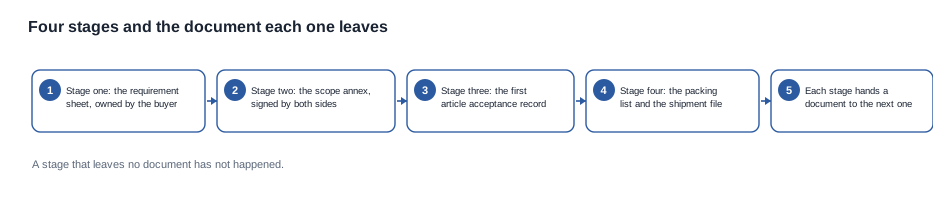
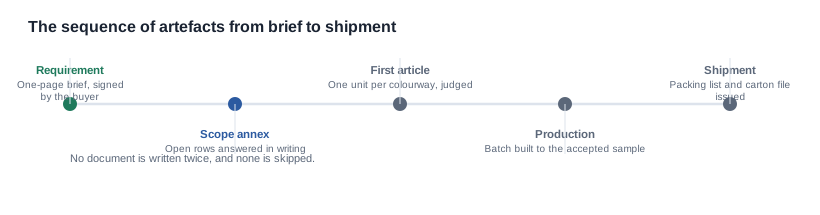
Stage one — the requirement sheet, and the order it settles
The requirement sheet is one page and it is owned by the buyer. It settles the things that are the buyer's to decide and nobody else's: the model and the configuration, the colourways, the two markets, the documentation set the channel needs, the claim set the brand is permitted to make, and the acceptance conditions a delivered unit will be judged against.
It does not settle prices, quantities or dates, because those are answers rather than requirements and the buyer does not have them yet. It does not settle the charging case, the packaging configuration or the certification scope, because those belong to the supplier and belong in stage two.
The acceptance conditions are the part buyers rush, and they are the part that decides whether stage three is possible. For this programme they are: the viewing condition, the comparison method against the approved reference unit, how many units are put through the check, and what a unit outside that band attracts — rework, replacement or a concession.
Stage two — the scope annex, and the open rows it closes
The scope annex is the factory's answer to the requirement sheet, and it exists because the requirement sheet asked questions rather than made assertions. It is signed, and it is the document that makes the programme binding in practice.
Five items in this programme are closed here rather than later. Whether a charging case is included in the deliverable, stated in the annex as an item with an answer rather than an omission. What the packing list contains, itemised rather than described. The claim set, agreed word for word, including the wording of the ingress marking and the wording of the charge-time ceiling. The sampling protocol, which fixes how many units are drawn from how large a batch for inspection. And the commercial terms, which arrive as terms attached to a stated configuration and a stated quantity.
The annex is also where a buyer can negotiate, because it is the first point at which the supplier's position is written down rather than described. The trade-offs visible in it are real ones: a shorter documentation set is faster and thinner, a wider claim set is more valuable and slower to evidence, and a smaller first-article protocol is cheaper and weaker. Which of those to take is a procurement decision, not a design one.
Stage three — the first article, and the record it leaves
Stage three is where the programme either holds or fails, and the reason is that a first article is frequently treated as a demonstration rather than as a specification test. A sample that demonstrates features has told the buyer nothing it can rely on; a sample that tests the acceptance conditions has told it everything it needs.
For this programme the first article is one unit per colourway, examined against the conditions written in stage one, with the results written down in an acceptance record. That record references the scope annex by reference rather than by memory, because a record that describes what the sample presented without citing the criteria is an opinion, and an opinion cannot be used to reject a production batch later.
Two things are decided here that could not be decided from the catalogue. The first is whether the product's appearance matches the brand treatment, which nobody can pre-approve because no entry in the range has a published photograph. The second is whether the removable inner frame creates a second surface for the treatment, which is a question about the physical unit and not about the specification.
Stage four — production, packing and the shipment file
The last stage is administrative, and it is where a lot of first programmes lose their paperwork. The production run follows the accepted first article, not the artwork, and the documentation set is applied per colourway rather than per model — label, carton artwork, barcode, insert and shipping documentation all carry the colourway identity.
The shipment file is the artefact that leaves. It is the packing list, the carton artwork release, the label release and the shipping document, and for a two-market programme it is produced twice, because the market-specific labelling is a per-market item rather than a per-order item. The quantity of paper scales with the number of markets and colourways, not with the number of units, and a buyer who plans the documentation set as a single set will find that the second market has no artwork for it.
Where the example runs into a published gap
A walkthrough is only useful if it is honest about the places where the catalogue stops. This programme meets five of them, and each one has a defined owner.
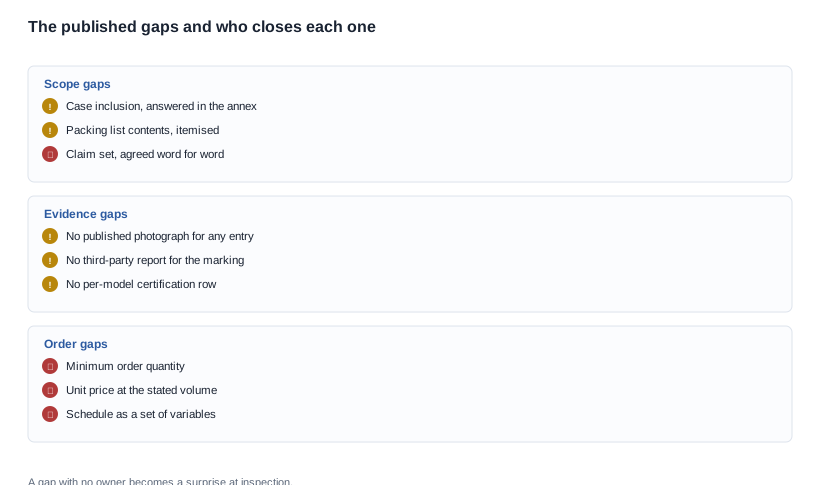
The charging case is the first. The V06 publishes no case row, so the question of whether a case travels with the product is not answered by the catalogue and not answered by the model name. It is answered in the scope annex, and until it is, the packaging configuration, the packing list and the claim set are all provisional.
The bluetooth version is the second, and it is the one most often missed. The eleven camera entries publish no radio version at all, while the audio entries do. A buyer who has read an audio page and is now writing an FAQ for a camera product will find the number missing, and the only correct response is to say that the row is not published and to ask the supplier for the figure in writing. It is not legitimate to carry a number across from a different family.
The ingress marking is the third. IP54 is published against the V06 and the S7, and it is a marking printed on the page with no third-party test report number sitting behind it. That is enough to state the marking, and not enough to state a water-resistance guarantee, and the claim set in stage two is where the difference has to be made. The technical file behind a market's radio equipment requirements has to cover the finished unit as configured, which is a question the supplier can answer and the catalogue cannot.
The absence of published imagery is the fourth, and it is the reason stage three carries as much weight as it does. Not one of the twenty-eight entries has a published photograph, video or test report, so a buyer cannot assemble a pre-approval pack from public sources. The first article is the first visual evidence of the product, and the acceptance conditions written in stage one are the only tool available for reading it.
The commercial terms are the fifth, and the most familiar. The catalogue publishes no minimum order quantity, no unit price and no lead time for any entry, so the order is constructed rather than read off a page. That is not a gap in the supplier's service; it is the intended shape of a standard engagement, where the configuration and the volume are what the price is a function of.
There is a smaller trap worth naming, because it costs a buyer an afternoon. The published charge time on this model's page is a ceiling of two hours or less, and the published runtime is a range of 5 to 8 hours. Neither is an exact figure, and the page uses a different label for the runtime than some other camera pages use. A specification that merges two label conventions will end up asserting a precision that no page actually published.

What the case shows and what it cannot
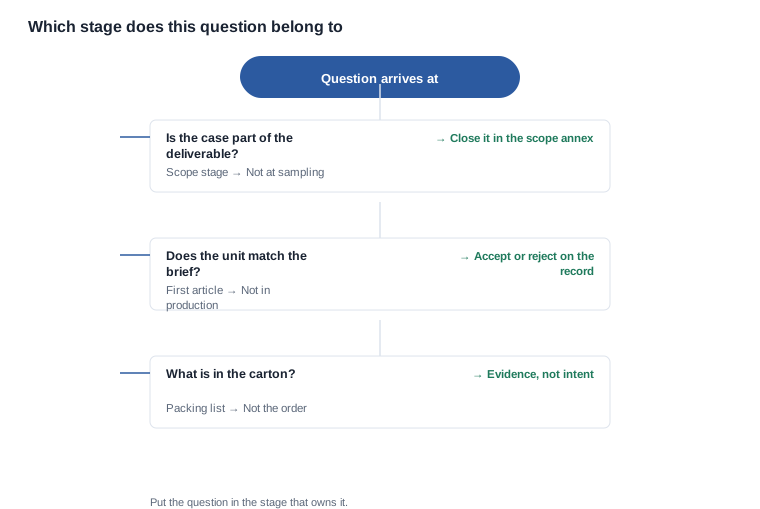
What it shows
The example shows four things that generalise past this particular programme.
First, a published catalogue is a starting point rather than a specification. Its value is that it removes most of the search space — which model, which colour, which class, which structural rows — and leaves a set of questions specific enough to be answered.
Second, the artefact is what carries the programme. Each stage leaves a document, and the questions that would otherwise be settled in a corridor get written into the stage that owns them. A buyer who asks for documents gets answers; a buyer who asks for confirmations gets recollections.
Third, the open rows are the real content of the negotiation. The published rows are not where the time goes. The time goes into the case inclusion, the claim wording, the acceptance conditions and the commercial terms, and a buyer who has not listed those four as questions will discover them as surprises.
Fourth, the documentation set scales with markets and colourways rather than with units. Two markets and two colourways is four documentation sets, and the packaging artwork for the second market is a separate release with a separate approval.
What it cannot show
It cannot show a price, a minimum order quantity or a delivery date, because none of those is published for any entry and none is quoted here. It cannot show a certification statement, because the catalogue contains no per-model certification row and its text carries no reference to CE, FCC or RoHS. It cannot show a product photograph, because none of the twenty-eight entries has one. And it cannot show that a particular configuration will be accepted, because that is a written answer against a named configuration and a named volume, not a published row.
The pitfalls a first programme should check for
Three mistakes account for most of the first programmes that go wrong, and all three are visible in the stages above.
- Importing an answer from another programme. A term agreed with a different supplier, a different model or a different volume is a starting hypothesis, not a fact, and the check to apply is whether it was written against a named configuration.
- Reading the first article as a demonstration. If the acceptance conditions were not written down in stage one, stage three produces an opinion, and a production batch cannot be judged against an opinion.
- Treating the illustrative quantities as terms. The numbers in this walkthrough are chosen to make the flow legible. The real minimum order quantity, price and schedule for this configuration come from a written quotation against a stated scope, and none of them is published here.
- Letting the claim set grow after the artwork is released. Marketing copy written after the sample is approved will often reach further than the evidence supports, and the cost of pulling a claim back is far higher than the cost of writing it narrowly in the first place. The claim set belongs in stage two for the same reason the reference values belong in stage one.
A fifth habit is worth naming because it is invisible until the end: leaving the acceptance criteria unwritten and then applying them retrospectively. A buyer who decides what constitutes a defect only after a unit has failed is not applying a criterion at all, and the dispute that follows is about the criteria rather than about the product. The criteria are cheap to write, difficult to justify retrospectively, and they are the only mechanism in the whole process that converts a preference into a decision.

How we stand on running a standard engagement
On a standard engagement, our position is that it runs on documents rather than on confidence. We will not put a unit price, a minimum order quantity or a delivery date against a scope that has not been put in writing first, because each of those depends on the configuration and the volume, and a number given before the scope is a number that will move. We do not publish a customisation menu, and we do not state a certification position that is not evidenced in the catalogue. What we do is take a written requirement, answer the open rows against a named model and a named configuration, and return an answer a buyer can put in front of a colleague.
For a buyer running due diligence on whether a supplier can execute this process, the most useful thing to ask for is not a reference project but a completed stage-one document. A supplier that has a template for the requirement sheet will have thought about the handover points, and a supplier that does not will show you the same thing at every stage.
Standard oem case example, drawn from the catalogue
Put in the form it can be quoted in, with no caveat attached: a standard engagement runs in four stages — requirement, written scope, first article, shipment — and each stage produces a document that the next one consumes. The catalogue supplies the model, the colour names, the camera class, the cell, the runtime range and the structural rows; it supplies no case row for the model walked through here, no radio version for any camera entry, no evidence for the ingress marking, no imagery, and no commercial terms.
That division is the point. What the catalogue publishes is a way to narrow the programme; what the supplier's written answer adds is the only part that can be relied on at inspection.
The criteria for judging whether a programme is under control are therefore simple to state and hard to fake: does every question have a document, does every document have a stage, and does the first article get judged against conditions that were written down before the sample was made. A buyer who answers those three questions before you order has most of the risk already removed.
For the same process seen from the document side, see the files a programme has to keep straight. For the same question asked as a checklist, see the questions buyers put in writing first.
Send the model, the configuration and the volume you are working with, and we will tell you which rows are already fixed and which have to be settled in writing before an order is meaningful.


