

A programme's documentation is usually treated as an output — the paperwork that has to be produced because a purchase order was signed. It is more useful to treat it as the programme's only durable memory. Six months into a private-label rollout, the file is what tells a colleague what was agreed, what was measured and what was accepted, and a file that does not answer those three questions is an archive rather than a control.
Standard oem documentation in this category has an unusual shape, and the shape comes from the catalogue. The published material is rich in specification rows and almost silent on the things a programme file actually needs: no reference value is published for any entry, no tolerance, no acceptance condition, no minimum order quantity, no price, no schedule, and no per-model certification row. A document set for this category therefore has to be larger than it would be for a product with a full public specification, because more of it has to be created rather than collected.
What follows sets out that set — what each document settles, who writes it, when it closes, which of them exist only because a supplier answered a question in writing, and how to keep the file consistent once a production batch is running.
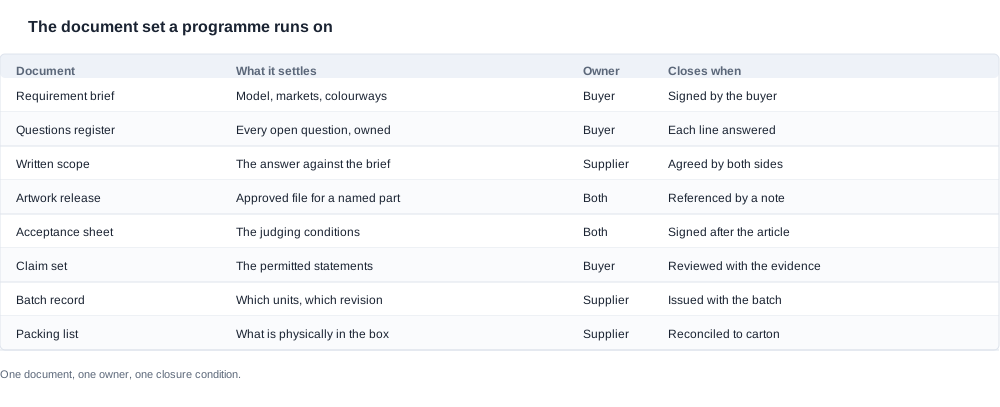
The document set an OEM programme actually runs on
A programme file is not one long document. It is a set of short ones, each with a single owner and a single job, and the discipline that keeps it usable is that a document which settles nothing is a record rather than a document, while a record kept in a chat thread is not a document at all.
| Document | What it settles | Owner | Closes when |
|---|---|---|---|
| Requirement brief | Model, markets, colourways, claim set | Buyer | Signed by the buyer |
| Open-questions register | Every unanswered question, with an owner and a date | Buyer | Each line has an answer attached |
| Written scope | The supplier's answer against the brief | Supplier | Agreed by both sides |
| Artwork release | The approved artwork for a named part | Both | Referenced by the release note |
| Acceptance sheet | The conditions a unit is judged against | Both | Signed after the first article |
| Claim set | The statements that may be made about the unit | Buyer | Reviewed with the evidence |
| Written quotation | Price, minimum, schedule for a stated scope | Supplier | Issued against a fixed scope |
| Batch record | Which units, which documents, which revision | Supplier | Issued with the batch |
| Packing list | What is physically in the box | Supplier | Reconciled against the carton |
| Shipment file | The documents that travel with the goods | Supplier | Archived on despatch |
Read down the owner column and a second pattern appears. The buyer owns four, the supplier owns four, and two are shared. That balance matters more than it sounds: the documents the buyer owns are the ones that express intent and judgement, and the documents the supplier owns are the ones that record what was actually done. A programme where the buyer owns none of the shared documents tends to end up with a purchase order and no acceptance record, which is the shape of a dispute waiting to happen.

Who writes each document and when it closes
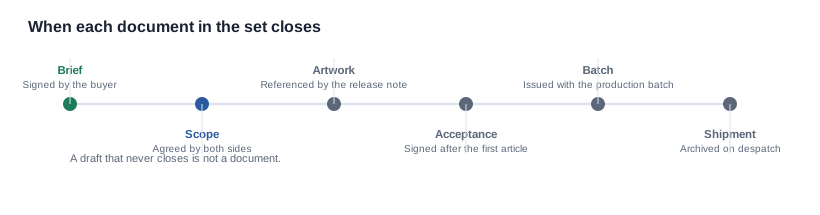
The most common documentation failure is not a missing document. It is a document that never closes — that exists in draft, gets referred to in a meeting, and never acquires the thing that makes it binding. Every document above closes in a different way, and naming the closure condition is what stops a file filling up with drafts that everyone assumes is finished.

The requirement brief closes on a signature
A requirement brief is finished when the buyer has signed it, and the signature is not a formality. It is the point at which the buyer commits to a scope, and every question the buyer chose not to write down becomes a question the supplier will answer on their own terms. The brief should therefore contain the things the buyer knows and the things the buyer does not, with the second group listed as questions rather than omitted.
The open-questions register closes line by line
The register is the cheapest document in the set and the most useful. One line per question, with the date it was asked, who owns the answer, what the answer was, and what the answer changed. It closes line by line rather than in one go, and a register with a visible tail of open lines is a sign that the programme is working, because the tail is a schedule.
The written scope closes on agreement, not on receipt
A scope document that has been sent is not a scope document that has been agreed. The closure condition is that both parties have worked through it and the buyer has marked the open points inside it. The distinction is what stops a programme discovering in the first article that the supplier and the buyer were working from different documents.
Artwork releases close by reference
An artwork file is closed by a release note that names the file, the revision, the part it applies to and the configuration it was drawn for. Closing artwork by reference rather than by attachment is what makes a batch auditable, because the release note is what a factory can check against the unit in the carton six months later.
The acceptance sheet closes on a signature, and only after the unit exists
An acceptance sheet written before the first article is a list of intentions. One written after it, against stated criteria, is the only document that can be used to reject or accept a production batch. This is the single most commonly skipped document in private-label programmes, and the reason it gets skipped is that the sample usually passes inspection. A buyer who has no signed acceptance sheet has no reference unit either, and a production batch with no reference unit is judged against the buyer's memory.
The batch record is the one nobody plans for
The batch record — which units, which documents, which revisions, which sample was approved against — is generated by the factory and is the document that makes a complaint investigable. It is also the one most often absent, because it is nobody's deliverable in a buying relationship. What to ask is simple: what does the factory issue with a batch, and does it identify the units against the accepted first article.
Which documents exist only after a supplier answer
Several documents in a programme file exist for one reason: the catalogue does not publish the thing they record. That is not a criticism of the catalogue. It is a specification, and it happens to be a specification of a product rather than of a programme. A buyer has to notice the difference and create the missing documents deliberately.
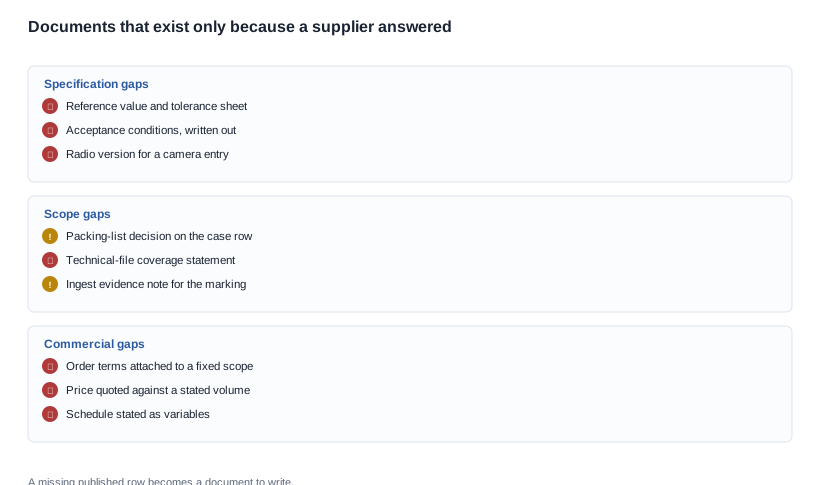
The reference and tolerance document. No colour reference value, no surface finish and no tolerance band appears for any of the entries, the two camera entries with published colour names included. A colour name is a label; a reference is a target that can be judged. This document has to exist before a first article can be assessed, and it has to name the viewing condition and the comparison method, because without those two a judgement is an opinion.
The acceptance document. No acceptance condition is published for any entry. The conditions have to be written by the parties, and the four elements that make them usable are a viewing condition, a comparison method, a sample size, and a stated consequence of a mismatch.
The packing-list decision. A case capacity is published for five camera entries; a further two show a case with no figure attached to it; and four carry no case row whatsoever. For those four, whether an accessory is in the deliverable is an open item, and it has to be recorded in the packing list rather than assumed from the model name. The same document settles the label, the insert and the manual, because all of them have to agree with the box.
The radio-version note. The eight audio entries publish a radio version and the eleven camera entries publish none. A specification sheet for a camera product therefore has a blank in it, and that blank has to be closed in writing before the sheet is released to a customer.
The ingress-evidence note. Two entries carry an IP54 marking on their pages, and the internal record notes that the rating is a marking printed on the page, with no third-party test report number behind it. A note recording that position is what keeps a marketing team from writing a guarantee. The claim set and the evidence have to be reviewed together, or the claim will be written first and the evidence never found.
The technical-file coverage statement. Nowhere in the catalogue does a per-model certification line appear, and CE, FCC and RoHS are absent from the catalogue text altogether. A statement confirming which documents cover the configuration being ordered, and which changes would take the unit outside their coverage, is a document that has to exist for the programme and is not in the published material.
The order-terms document. Nothing on the commercial side appears in the catalogue — there is no published minimum, no published unit price, and no published schedule for any product, any setup or any order size. The quotation is therefore not a retrieval but a construction, and it has to be attached to a fixed scope, because a price quoted against an open scope is a number with no meaning attached to it.
How to evaluate a documentation set before you accept it
A buyer who has been handed a document set can judge it in about fifteen minutes, and the criteria are worth stating because the set almost always looks complete on a first pass.
- Does every document name a configuration? A document that does not name the model and the configuration it belongs to cannot be checked against a unit, and the first check to fail will be the acceptance sheet.
- Does every document carry an owner and a revision? A document with neither cannot be updated, so every change to it creates a second version rather than a new one.
- Does each one have a written closure condition? If the only closure is a date, the document will be treated as finished whether or not it is.
- Does the set include the documents the catalogue cannot supply? A missing published row is a document to write, and a set that silently omits it is a set with a hole in it.
- Are the colourway and market sets counted? If the count is not written down, it is not planned.
- Is there an agreed change rule for a running batch? If there is not, one will be invented under pressure, and the rules that get invented under pressure are the ones that cost the most.
The red flags are consistent across suppliers: a file with no index, a set of documents with the same owner, a quotation that arrives before the scope is closed, and an acceptance sheet that is really a marketing summary. How to compare two document sets is therefore not a question of which looks more professional; it is a question of which one a buyer could rely on in a claim.
What to ask, and when to ask it, follows from the same list. Ask for the index and the acceptance sheet together, because a supplier that has one almost always has the other. A supplier running due diligence on its own documentation will return a set with a revision history; a supplier that assembles documents on request will not.

Keeping the file consistent across a production batch
Consistency is not tidiness. A file can be complete and still be inconsistent, and the inconsistency shows up as a dispute rather than as an error. Three mechanisms keep a programme file aligned once production starts.
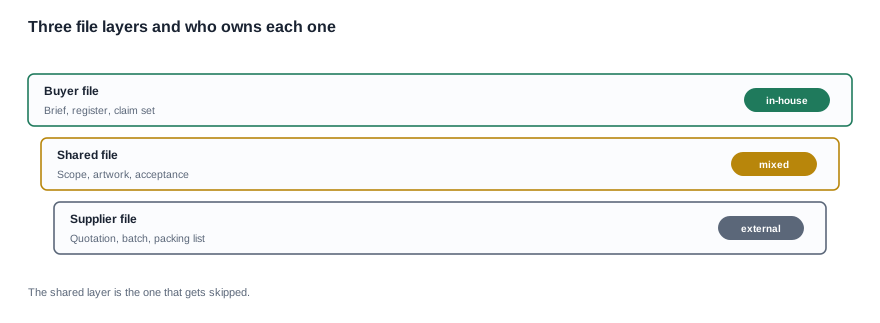
One owner per document, and a single index
Every document needs one owner, and the owner is a person rather than a team. The index that ties them together needs one entry per document with its revision, its date and its location, and it needs to be the only place a reader goes to find anything. A file that has three indexes is a file in which two of them are wrong.
The index also needs to record which configuration each document belongs to, because that is the field that fails first. A colour artwork released against one colourway and applied to a second is the most common version of this error, and it is invisible until the carton is opened in front of a customer.
Per-colourway and per-market sets, counted explicitly
The documentation set scales with the number of colourways and the number of markets, and it does not scale with the number of units. Two colourways across two markets is four sets of label, carton, barcode, insert and shipping paperwork, and a buyer who planned one set has planned a quarter of what is required. Counting the sets explicitly at the start is a five-minute exercise that prevents a packaging delay in the last week of the programme.
There is a second reason the sets are kept separate. A change to one colourway's artwork does not change the other, and if the two are filed together the change has to be applied to both or explicitly exempted from one. Keeping them apart makes the decision explicit, and it is the cheapest way to avoid a packaging delay in the last week of the programme.
A change rule for the batch, agreed before the batch runs
The rule to agree in advance is what happens when a document changes after production has started. The decision to hold a batch, the decision to continue and label the affected units, and the decision to scrap are three different answers with three different costs, and they should not be made in the middle of a production week by two people who each assume the other is handling it.
The rule also needs a cut-off. A change agreed before the batch starts is a change to the scope; a change agreed after it starts is a variation with a cost and a schedule, and treating it as the former is how a programme loses control of its own documentation.

How we stand on programme documentation
On programme documentation, our position is that we will supply the documents that describe what we do, and we will not manufacture documents that describe what we have not been asked to do. That means a written scope against your requirement, a quotation against that scope, an acceptance sheet for the first article, a batch record identifying the units against the approved sample, and a packing list reconciled against the carton. It also means we will not issue a certificate, a test report or a conformity statement that we cannot evidence, and we will say plainly which of those documents exist and which do not.
The other half of that position is about the buyer's file. Where a question has no published answer, we answer it in writing for one named model and one named configuration, and we say which document would be needed in order to answer it. That is the same three-part structure used everywhere in this category: what is published, what is not, and what would settle it. A programme that keeps those three separate in its register will not spend its first-article week working out which version of the specification was in force.
A buyer running due diligence on a supplier's documentation practice should ask for one released batch record from a previous programme, or for the artwork release note of a model already in production. Both are short, both are concrete, and both show the mechanism more clearly than any description of a process.
Standard oem documentation, as a working file
Stated in a form that can be sent to a colleague without a caveat attached: a standard OEM programme runs on ten documents — a requirement brief, an open-questions register, a written scope, an artwork release, an acceptance sheet, a claim set, a written quotation, a batch record, a packing list and a shipment file — and each of them has one owner and one closure condition.
Six of those exist only because the catalogue does not publish the thing they record: reference values and tolerances, acceptance conditions, the packing-list decision for the entries with no published case row, the radio version for camera products, the evidence behind the published ingress marking, and the commercial terms. The catalogue is rich in specification rows and silent on programme data, and a documentation set built on that fact is larger, not smaller, than one built for a fully published product.
The criteria for a healthy file are simple enough to check in ten minutes. Every document has an owner and a revision. Every document closes on a condition rather than on a date. The index has one entry per document and the configuration it belongs to. The colourway and market sets are counted rather than assumed. And the change rule for a running batch was agreed before the batch started, not during it.
For the document that sits at the front of the file and sets the scope, see what a brand guideline has to settle. For the order the documents belong to, see a programme run from brief to shipment.
Send the stage your programme is at and the file you already hold, and we will tell you which documents are still missing and which of them we would need to write.


