

Standard OEM enquiries in this category cluster around a small number of questions, and the reason they cluster is that they are the questions a supplier answers most vaguely. None of them is difficult. All of them are answerable in writing by a supplier that has thought about them, and the ones that stay vague are the ones where the supplier has not decided yet.
The pattern of a good answer is the same every time, and it is worth stating before the questions themselves, because a buyer who cannot tell which kind of answer they have received will read a description as a commitment.
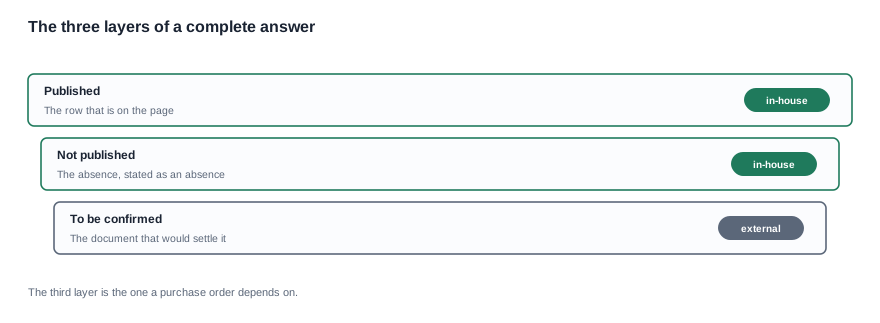
A complete answer has three parts. What the published material actually says, quoted rather than paraphrased. What is not published, stated as an absence rather than as a prohibition. And what the supplier is being asked to put in writing. Where an answer has only the first part, the question has been answered descriptively and not commercially.
This is the list we would want answered before a purchase order, and it is roughly standard oem common questions handled without hedging.
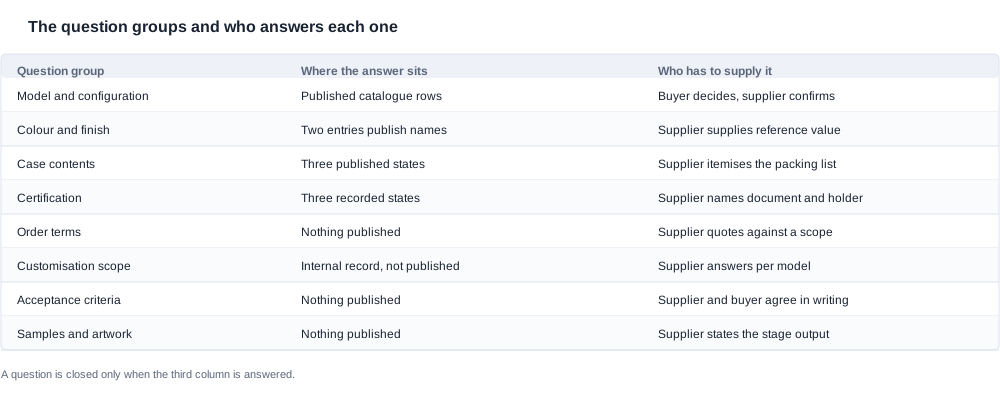
The questions buyers ask before the first purchase order
Before the first order, six questions account for most of the enquiry volume. They are asked in different words by every buyer, and they are worth answering in the same order every time.
"Which model should we start with?" The catalogue publishes twenty-eight entries: eleven camera entries, eight audio entries, three sport entries, three children's entries, and three more that carry no model code at all. That is the shortlist. What is not published is any ranking, any application guidance and any commercial term, so the shortlist has to be narrowed by the buyer's own requirement rather than by the catalogue's recommendation. The question to put to the supplier is which configuration of a named model is the one that runs in the current production cycle.
"Can we have it in our colour?" Two camera entries publish colour names. The V03 Pro lists orange, off-white and black; the V06 lists orange, white ice blue, black and black ice blue. The other twenty-six entries publish no colour row at all. That is a fact about documentation, not a prohibition and not a capability statement. What to ask is what reference value and what surface finish sit behind a named colour, whether a colour outside the published list is a new setup or a batch variation, and what a colour outside that list does to the schedule.
"Is a charging case included in the box?" Case capacity figures appear for five camera entries, two of them show a case with no figure beside them, and four list no case row at all. For those four, the presence of an accessory in the deliverable is an unpublished item, not a stated absence. The question to ask is what the packing list contains for the named configuration, and it is a question about a document rather than about a product.
"What certification do you hold?" The catalogue carries a page headed for export certification, and its content is images rather than text; the catalogue text itself names none of CE, FCC or RoHS, and no per-model certification line appears anywhere in the range. The internal record carries a certification field per category, and it sits in one of three recorded states: a conformity claim whose number still has to be confirmed, a claim that carries a noted absence of any supporting report, or nothing at all for the category. What to ask is which state applies, which document exists, which model it covers, and who holds the original.
"What is the minimum order quantity?" Nothing about order minimums is published for any entry, and there is no published tier structure to choose from. What to ask is the minimum for the configuration, the minimum per colourway, whether the two are the same number, and what happens to the minimum when a second market is added.
"When can it ship?" Nothing about schedule is published for any entry, any configuration or any volume. What to ask is which variables the schedule depends on, what the supplier can commit to, and what happens to the date when the scope changes after the slot is reserved.
"What are the payment and shipping terms?" Nothing about payment terms, incoterms, freight or insurance is published for any entry, and a private-label programme usually has a different answer from a direct import because the goods pass through an additional handler. What to ask is the payment structure, the delivery terms, who arranges the freight, and what documentation travels with each shipment per market.

Questions about scope, samples and acceptance
These are the questions that decide whether a programme produces something a buyer can rely on. They are also the questions most often answered in the wrong register — with a policy statement rather than an answer.
"Can we change the finish or the material?" The internal product record holds a per-category count of recorded customisation axes, and the counts are not the same from one family to the next. The AI camera glasses category carries seven recorded axes; the Bluetooth audio glasses category carries five; the sport glasses category carries five; the children's category carries two. Three further recorded axes sit against the entry with no model code for electrochromic glass, nothing at all is disclosed for the bone-conduction entry, and the AR entry has not been classified. None of the three main families is contained in another. We do not publish that record as a menu, because a published axis list reads to a buyer as a statement that those items can be done, and the recorded set is a planning record rather than an offer. What to ask is which axes apply to the named model and the named configuration, and what each one changes in the schedule and the price.
"Can we put our logo on it?" The same answer applies, and it is the single most common misunderstanding in this category. Branding application belongs to scope rather than to artwork: it depends on the part, the surface, the process and the setup. A mark on a moulded surface and a mark on a printed label are different operations with different costs and different schedules. What to ask is whether a branding treatment applies to the named model, on which parts, with what artwork prerequisites, and whether the treatment changes the technical file behind the finished unit.
"What does the battery do?" A charge time appears against every entry in the range; for all but two of them the number is a ceiling of two hours or less rather than a measured value, and the D17 and the ZH12 are the two published at about an hour. Runtimes are published per entry, and they are ranges on most camera pages. What is not published is the start state for the charge time, the criterion that ends it, and the conditions behind the runtime figures. What to ask is how a unit is judged against the published figures, and whether the figures in the specification sheet are the ones the buyer will receive.
"How heavy is it?" Exactly one entry in the whole catalogue publishes a weight: the MT6, at 158 g for the glasses as assembled, with the cell and the camera inside and the folding charging case excluded, and that case's own mass is not published. No bare frame weight exists anywhere in the range. What to ask is the weight of the configuration being ordered, and in which components the figure is taken.
"Which bluetooth version does it run?" The eight audio entries publish a radio version, and the eleven camera entries publish none. That asymmetry surprises buyers who have read an audio page and are now writing a specification for a camera product. What to ask is the version for the named model, in writing, so that the product page and the specification sheet cannot drift apart.
"Does it have touch controls?" The catalogue publishes no touch row for any entry. The only published control-related rows belong to the AR entry, which lists an indicator light and button control — buttons, not a touch surface. What to ask is whether the temple of the named model carries a touch surface, how it is configured, and how the behaviour is described in the user material.
"Is there a translation function?" No translation row appears anywhere in the catalogue for any entry. What to ask is whether any translation capability exists for the named configuration, whether it is delivered in software or in the app, and whether it is part of the published product description at all.
"Can we have a sample first?" Nothing about sampling is published, so a buyer has no basis on which to judge a sample proposal. What to ask is what a sample stage produces, how many units it involves, what the acceptance criteria are before the sample is made, and whether the accepted sample becomes the reference for the production batch.
"Can you send us photographs for our product listing?" Not one of the twenty-eight entries in the range has a published photograph, a published video or a published test report, so nothing in the public material can be reused in a channel listing. That is a fact about what has been published rather than about what exists. What to ask is what imagery can be produced for the named configuration and the named colourways, in what resolution, from what angle, under what terms, and whether the unit in the image is the unit that will be delivered. A buyer who reuses a supplier's own catalogue imagery for a listing is taking on a claim they cannot check, and the question about provenance is worth asking before the listing is built rather than after.
"What are the acceptance criteria for the finished goods?" None are published, for any entry. A supplier's written answer should set out a viewing condition, a comparison method, how many units are examined and a stated consequence of a mismatch. If the answer does not contain those four elements, the buyer has a preference rather than a criterion, and a later disagreement will be about the criteria rather than about the units.
Questions about certification and marking
"Is the product safe for children?" The children's category publishes a fogging unit, correct and incorrect posture-and-distance prompts, and lens clarity and lens fogging rows on two of its three models, and its certification situation is not provided in the record at all. Those rows are published descriptions of the product, and they are not a medical, eyesight or protective claim, and no copy may imply one. What to ask is what evidence exists for the category, which of the published rows are considered health-related, and what claim language the brand is permitted to use. This is the highest-risk area of the range and the one where the answer should be obtained in writing before anything else is planned.
"What is the water-resistance rating?" Two entries in the range carry an ingress marking: the V06 and the S7, both marked IP54. The marking is published on the product page, and no third-party test report number sits behind it, so it is enough to state the marking and not enough to guarantee water resistance in a contract. What to ask is whether a test report exists, whether it can be provided, and what the claim may say if it cannot.
"Does it come with a guarantee?" No warranty period, no returns policy and no defect allowance are published for any entry. What to ask is the warranty period against a stated configuration, what the process is when a unit fails, how a defect allowance is calculated against a batch, and how a claim is evidenced.
"Can we make health or performance claims in the copy?" The catalogue publishes an amplification gain of 35 dB for the bone-conduction entry, and it publishes a resolution class for camera entries. Neither is a hearing-assistance classification, a medical claim or a performance claim, and the highest-risk item in the range is the one carrying that gain figure. What to ask is which claims the supplier will support with evidence, and which are the buyer's own responsibility to substantiate.

Questions that only a written answer can close
Some questions cannot be closed by a catalogue, a sample or a call. They need a reply from the supplier in writing, and the reason each one needs writing is different. These are the ones that determine whether a programme can be committed to.

- The order terms. The minimum order quantity, the unit price at a stated volume, the schedule and the payment terms are not published for any entry, and a unit price without a valid minimum is a number with no meaning attached to it. They have to be quoted against a stated configuration and a stated volume, in writing.
- The customisation scope. Which recorded axes apply to the named model, on which parts, with what artwork and with what effect on the setup.
- The certification position. Which recorded state applies, which document exists, which model it covers and who holds the original.
- The packing list. What is in the box for the named configuration, and whether an accessory row is included at all.
- The claim set. Which statements may be made about the finished unit, and which are confined to describing the product as published.
- The artwork and labelling requirements. File formats, colour references, placement and the approval route, so that the first artwork release is not the first artwork review.
- The tooling position. Whether the named configuration uses an existing tool or opens a new one, and who owns it afterwards.
- The inspection and acceptance terms. Sampling, defect allowance, the evidence a buyer supplies, and the consequence of a mismatch.
The reason writing matters is not formality. A verbal answer is remembered differently by each party, and the parties who remember it differently are the buyer's sales team and the factory's production team, neither of whom was in the conversation. A written answer has one version, and the version can be attached to a purchase order.
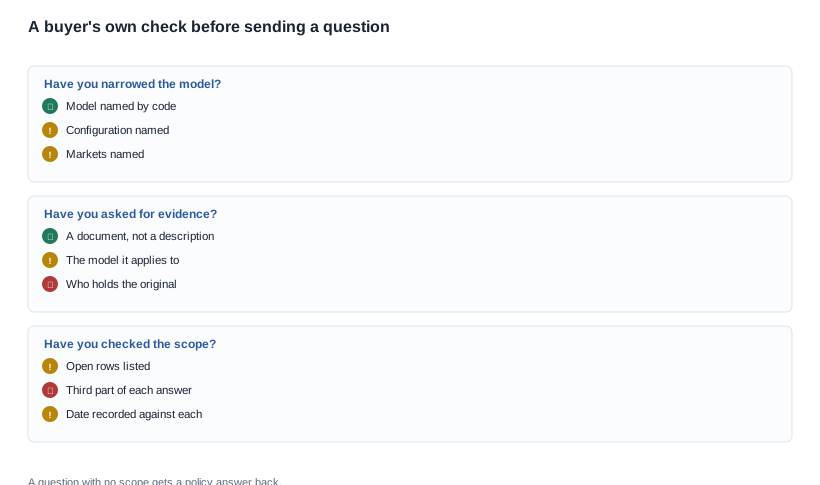
A buyer who sends a scoped question gets a scoped answer, and the three checks above are what make a question scoped. A question with no model and no configuration behind it produces a policy reply, and a policy reply is the most common reason a programme stalls: it reads as an answer, so nobody asks again, and the gap reappears during the first article.

How we stand on the questions we get asked
On questions, our position is that we would rather be asked than guessed at. We publish the specification rows we can stand behind, per entry rather than per family, and we publish the shape of the decision even when the answer itself is not published. We do not publish a menu of customisation axes, and we do not state a certification position that the record does not support. And an unpublished row is never offered up as though it were an available option in a quotation.
What we do with a question is answer it in the three-part form above, and where the third part is empty we say so rather than filling it with a description. If a question can be answered from the catalogue, we will quote the catalogue. If it cannot, we will say that it cannot, name the document that would answer it, and treat that document as part of the programme rather than as a formality before it.
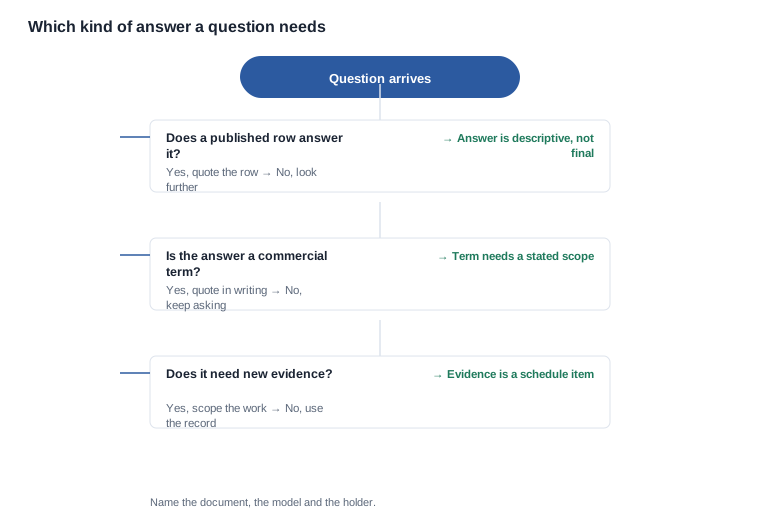
Standard oem common questions, answered in writing
Written the way it would be written to a colleague, with nothing hedged: the standard oem common questions in this category are the model, the colour, the case contents, the certification position, the order terms, the customisation scope, the acceptance criteria and the evidence. Every one of them has a three-part answer, and in every case the third part is the part that matters for a purchase order.
Six of them are answered entirely by the catalogue: which colour names exist, which entries carry a charging-case row, which entries publish a charge time, which entries publish a radio version, which entries carry an ingress marking, and what weight has been published. The rest are questions for a supplier, and they are answerable — in writing, against a named model and a named configuration.
The criteria for a usable answer never vary: a document, a model, and a holder. Where an answer arrives as a description of a policy instead, the question has been closed on paper and left open in fact, and the programme will find it at the first article.
There is one more habit worth naming, because it costs nothing and it prevents most of the frustration. A buyer who keeps a single open-questions list — one sheet, one line per question, with the date it was asked, who owns it and what the answer changed — never has to reconstruct what was agreed. The list is the evidence that the programme was managed, it is the attachment to the purchase order, and it is the fastest way for a new colleague to take over a file. The trade-off is that it has to be maintained, and a list that nobody updates is worse than no list, because it looks authoritative.
For the certification questions on their own, see how a recorded state changes a schedule. For the whole process behind these answers, see a programme walked from requirement to shipment.
Send the questions that are still open on your side, and we will answer each one in the three-part form — published, not published, and what we need to confirm.


