

The standard OEM route is the cheapest way to get a private-label product: you take an existing platform, put your mark on it, and sell it. What changes the schedule is not the branding. It is the certification position, and the certification position is decided by how much of the product you change and by which market you are placing it in.
A brand treatment is a change of appearance and it is close to free in compliance terms. A different radio module, a different cell or a changed enclosure is a change of the product, and it can put the finished unit outside the scope of whatever evidence already exists. That single distinction is the whole of the standard oem certification impact, and it is worth settling on page one of a programme rather than in the week before a first article.
The difficulty is that most buyers arrive at this question with the wrong starting material. The intuition is that a supplier either has certification or does not, and that the answer sits in a folder somewhere. The reality of a catalogue-driven programme is that the published material describes a state of knowledge rather than a state of compliance, and a buyer who reads a knowledge state as a compliance state will plan a launch on evidence that does not exist.
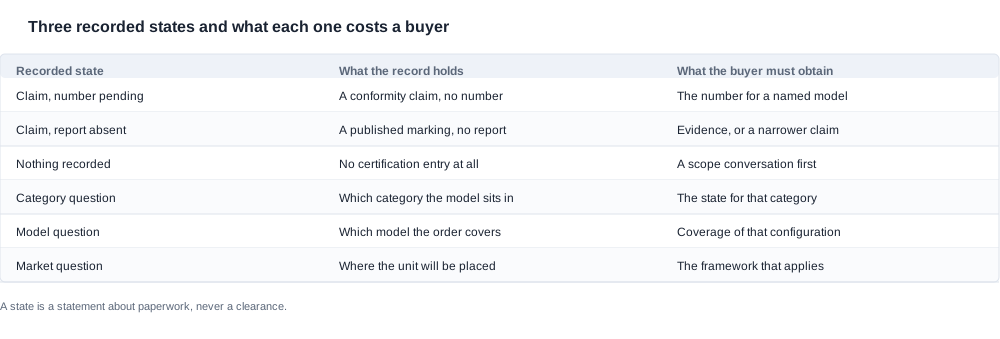
What certification status can and cannot mean for your schedule
Certification status is a schedule variable in one direction and nothing at all in the other. It cannot tell you how long a programme takes, because a status is a statement about paperwork rather than about manufacturing. It can tell you whether an additional evidence-producing activity has to be inserted into the schedule before the unit can move, which is a different and more useful thing.
What a status does tell you
A recorded status tells a buyer whether the supplier already holds something, is asserting something without a number attached, or has nothing on the file at all. Each of those three answers implies a different amount of work before a finished unit can be placed on a market, and the difference between them is measured in documents rather than in factory days.
Where the record shows a conformity framework with nothing identifying it, the work is retrieval and verification. A buyer who asks for the document early is asking for a retrieval, and the schedule effect is close to nothing.
Where the record shows a conformity claim together with an explicit note that no third-party report is held for a particular published marking, the work is generation. The marking exists on the catalogue page, the report behind it does not exist, and a buyer who wants to assert that marking externally has to commission the evidence first.
Where the record shows nothing at all, the work is a full scope conversation, and it has to happen before the programme can be planned rather than inside it.
What a status cannot tell you
A status cannot tell you that a product may lawfully be placed on a market, because a status is not a conformity assessment. It cannot tell you which market a given claim covers, since the same product can face different requirements in different jurisdictions. And it cannot tell you how long anything takes, because the schedule depends on the evidence the supplier has to produce, on the testing laboratory's queue, and on the review, none of which are published anywhere.
A buyer who treats a status as a clearance will be disappointed at exactly the moment the goods are ready and the paperwork is not. A buyer who treats it as a work item will plan around it correctly.
The distinction is easy to miss because the two readings produce the same behaviour for most of a programme. A buyer who expects clearance will not schedule the evidence work, and a buyer who expects work will not schedule the clearance either. The divergence appears in week one, when the second buyer asks what to ask and the first one asks for a certificate. The first question produces a number or an apology; the second one produces a document, a date and a place in the schedule. What to ask, and when to ask it, is the whole of the practical difference, and the criteria for a good answer are the same in every case: a named document, a named model, and a named holder.
The variables that actually move the schedule
Five variables decide how much evidence a programme has to generate, and they are all answerable in writing before an order is placed.
- The market. Requirements differ by jurisdiction, and the catalogue carries nothing that maps a model to a market.
- The configuration. The question is whether the unit that will be delivered is the unit the evidence covers.
- The nature of the change. Appearance-level changes and component-level changes are treated differently by every framework a buyer has to work under.
- What the brand intends to claim. A descriptive statement on a catalogue page and a guarantee in marketing copy are different documents with different evidence requirements.
- Whether any published marking is being carried into the claim set. Where the catalogue marks a specific model with an ingress rating, the buyer inherits a choice: state the marking, or substantiate it.
The one item that should be escalated rather than scheduled
One entry in this range is not a normal case. The bone-conduction entry publishes an amplification gain of 35 dB, and that figure is enough to make a buyer nervous for a reason that has nothing to do with the schedule. A published gain figure is not a hearing-assistance classification, and it must not be presented as one, and no downstream marketing copy may imply that it is. The internal record for that entry is the least complete in the range, which is consistent with the fact that it is also the item with the highest regulatory risk. It should be scoped in writing, early, and with the questions set out below.

The three states a certification row can be in
The internal product record carries a certification field for each product category, and its value sits in one of three states. Getting the state right is what separates a useful answer from a misleading one, so it is worth stating precisely.
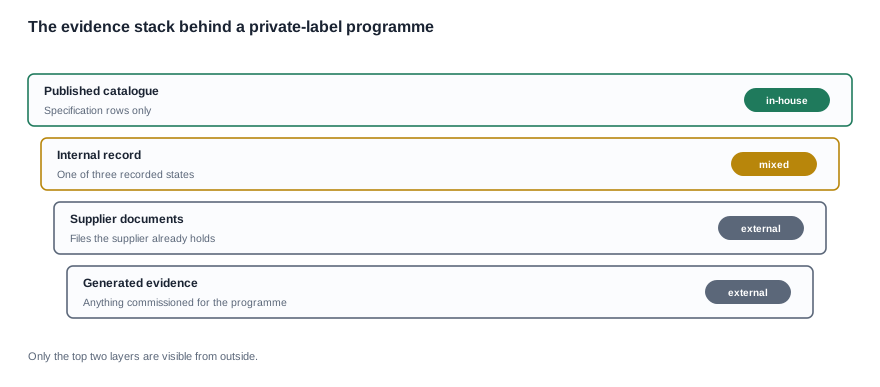
State one — a conformity framework named, with nothing identifying it
The AI camera glasses category, the Bluetooth audio glasses category, the sport glasses category and the electrochromic entry all sit here. The catalogue text names no CE, FCC or RoHS for any of them, there is no per-model certification row, and no certificate number exists for us to quote.
What this state is: a conformity framework named at category level with no document behind it. What this state is not: a per-model conformity statement, a list of certificate numbers, or a promise of which document will be produced for which unit. A buyer who needs the document asks for it in writing against a named model; a buyer who assumes it already exists will put a certificate reference on a purchase order that nobody can match.
State two — a published marking, with a noted absence of a supporting report
The sport glasses category sits here as well, and the addition is specific rather than general. The catalogue marks the V06 and the S7 with an IP54 ingress rating. The record attaches the qualifier that this rating is a catalogue marking and that no third-party test report number is held behind it.
This is the state that causes the most trouble downstream, because a marking on a product page reads as evidence. It is not. The published rating is enough to state that the product is marked IP54 and not enough to assert a water-resistance guarantee in a contract, a spec sheet or a product listing, because a claim of that kind has to be supported by a test report that does not currently exist. The internal record is explicit on this point: an ingress rating may be claimed externally only when a test report supports it.
State three — nothing recorded
The children's category sits here. Its parameters are identical to the A06's, the difference between the two is itself unconfirmed, and the certification situation for the category is not provided in the record at all. The bone-conduction entry is also unprovided. The AR entry is not classified.
For a buyer with a children's product in the plan, this is the most consequential of the three states, because the category that carries the highest safety and health claim risk is also the category with no certification record to work from. The answer is not to proceed more carefully; it is to establish, in writing, that the record is empty, and then to scope the evidence the programme needs before any of it is used in a claim.
A useful way to keep the three states straight
| State | What the record says | What a buyer must do | What a buyer must not do |
|---|---|---|---|
| Framework named, nothing behind it | A conformity framework is named at category level, with no document attached | Ask for the document against a named model | Put a certificate reference on an order |
| Marking published, report absent | A marking is published, no report behind it | Decide whether to substantiate or omit | Turn a marking into a guarantee |
| Nothing recorded | No certification information for the category | Scope the evidence before the claim | Infer clearance from the catalogue |
Which documents sit outside the product catalogue
The catalogue is a specification source. It is not a document repository, and the documents a buyer will need for a compliance position are almost all outside it. Knowing which ones exist — and what each one actually is — is the difference between a programme that plans for evidence and a programme that discovers it.
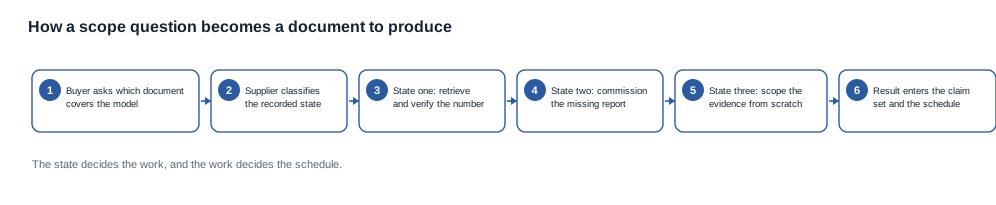
The technical file behind the radio equipment rules
For any product with a radio, the relevant framework in the European Union is the Radio Equipment Directive (EU) 2014/53/EU, and electromagnetic compatibility is governed separately under the EMC Directive 2014/32/EU. A technical file sits behind the radio rules, and a buyer who has never seen it cannot judge whether it covers the configuration being ordered. The question to ask is not whether a file exists but whether it covers the unit as configured, and the answer has to come in writing.
The ingress test report
Where a buyer wants to assert an ingress rating externally, the supporting document is a test report, and the report is not in the catalogue. The choice a buyer has is straightforward: state the catalogue marking as a marking, or commission the evidence and then make the claim. Both are legitimate. Making the claim without the report is neither.
The declaration and the supporting declarations
Conformity for a radio product is normally concluded by a declaration supported by the underlying test evidence, and in a private-label programme the declaration is made by the party placing the product on the market, which is the buyer. That is a real obligation rather than a formality, and it is the reason the evidence has to be collected before the order rather than after it. Neither the declaration nor the supporting declarations are published in this catalogue, for any entry.
The material and supplier declarations
A finished unit is assembled from components whose own declarations sit underneath it, and a buyer assembling a private-label product inherits a chain rather than a single document. The question to put to a supplier is which upstream declarations the finished unit relies on, and whether any of them changes when the configuration changes.
The export-certification page, and what it is not
The catalogue does carry a page headed for export certification, and it is worth saying exactly what is on it: ten patent certificates, eight appearance-design patents and two utility-model patents, reproduced as images. The page is a demonstration of intellectual property held, not a demonstration of regulatory conformity, and the certificates themselves are not numbered in the text layer and cannot be read as product approvals.
There is also a harder edge to the same point. The catalogue's text contains no reference to CE, FCC or RoHS, or to the other conformity frameworks a buyer will be asked about, and it contains no per-model certification row anywhere. Nothing on the page can therefore be attached to a specific product, and a buyer who needs a per-model position has to ask for one.
The case row, and what it does to a documentation set
One practical example of a row that is absent rather than negative. Five camera entries publish a charging-case capacity, two more show a case without publishing a figure for it, and four publish no case row at all. For those four, whether an accessory is part of the delivered unit is an open item, and it has consequences well outside the packaging list — because the claim set, the packing list, the user-facing material and the product description all have to agree about what is in the box. It is settled in the scope annex, not by reading the catalogue.

Questions that settle certification scope before the order
The questions below are the ones that a buyer can put in writing and a supplier can answer in writing. They are ordered by how expensive the answer is to obtain late.
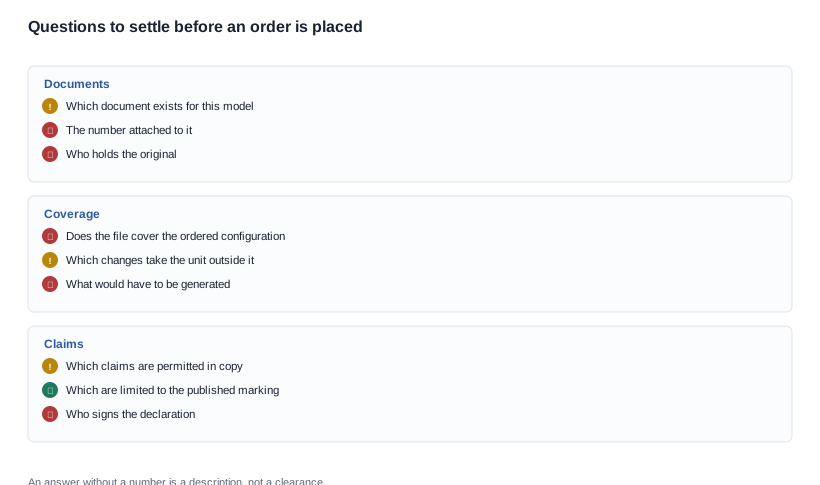
- For this model and this configuration, what conformity documents exist, what is their status, and who holds the originals?
- What are the certificate or test report numbers, and which document does each one attach to?
- Does the technical file cover the configuration being ordered, or only the base model?
- Which changes to the base configuration would take the unit outside that file?
- For any published ingress marking, is a test report held, and is it available for a buyer to rely on?
- What is the position for the category this model belongs to, if that category's record is empty?
- What evidence would have to be generated from scratch for this programme, and who commissions it?
- Which claims may be made in marketing copy, and which are limited to describing the product as published?
- What is the consequence for the schedule if an item is still open when the production slot is reserved?
- Which party signs the declaration for the finished unit, and what does that party need from the supplier to sign it?
The criteria for judging the answers are simple. An answer is usable when it names a document, states which model it applies to, and says who holds it. An answer that says a document exists without a number is a description, and the schedule still has to carry the risk that it does not.

How we stand on certification scope
On certification, our position is that we will not state a conformity position that the published record does not support. On its front matter the catalogue puts a page headed for export certification, and that page is images rather than text; it holds ten patent certificates that speak to intellectual property rather than to regulatory conformity, and no per-model certification row appears anywhere. Its text contains no reference to CE, FCC or RoHS. We therefore describe the recorded state of knowledge, we do not convert a claim into a certificate, and we do not turn a published marking into a guarantee.
What we will do, for a named model and a named configuration, is set out which of the three recorded states applies to the relevant category, which documents the supplier already holds, which are named as frameworks with nothing behind them, and which would have to be generated for the programme. That is a narrower answer than a certificate list, and it is the answer a buyer can actually plan against.
A buyer running due diligence on this point should ask one question that reveals most of it: which document, for which model, and who holds it. A supplier that answers with a category-level statement has given the third of the three answers above. A supplier that names a document, a model and a holder has produced the first of the three, and the buyer can then negotiate scope and schedule from a real position.
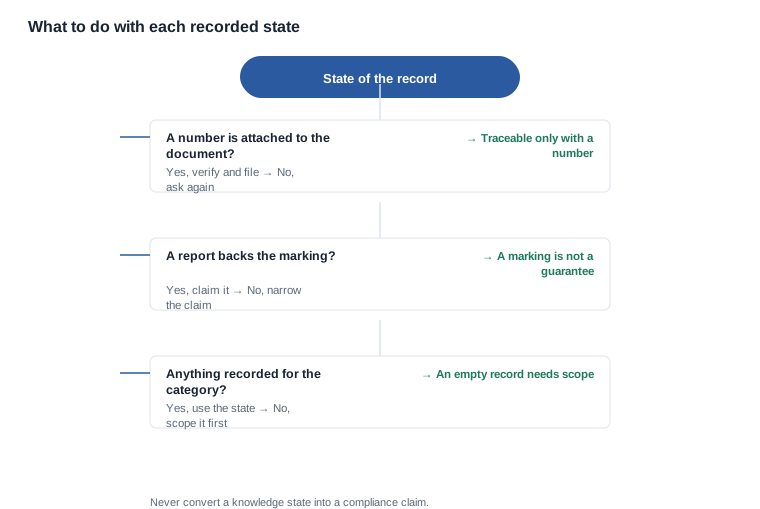
Standard oem certification impact, summarised
Put as plainly as it can be put, and circulated without a caveat: the certification position in this catalogue is a state of knowledge, not a state of compliance, and it sits in one of three recorded states — a conformity framework with nothing identifying it, a published marking carrying a noted absence of a supporting report, or no certification information at all for the category.
The schedule consequence follows directly. A document that already exists is a retrieval; a framework with nothing behind it is a verification; an absent report is a generation; an empty category is a scope conversation that has to happen before the programme is planned. The buyer who classifies the state early can schedule the work; the buyer who classifies it late discovers it during the last week of the programme.
The criteria for deciding scope are therefore short: name the document, name the model, name the holder. Where those three cannot be produced for a market, the claim does not go into the marketing copy, and the question becomes whether to commission the evidence or to leave the claim out. Both are reasonable decisions, and both are better made in week one than in the week of a first article.
For the certification questions a buyer asks as part of a wider enquiry, see the buyer questions that need a written answer. For the evidence that sits outside a product page, see the file behind a standard engagement.
Send the model, the configuration and the market, and we will tell you which recorded state applies and which documents a programme would need to produce.


