

The customisation question is the one a buyer asks with the most confidence and the least information, and the gap between the two is where programmes go wrong. In this catalogue the record of what can be varied is organised by product category rather than by model, and it is an internal planning record rather than a published offer. That combination decides how this article has to be written.
Standard oem customization options cannot be presented as a menu, because a menu is a list of things a supplier has said it will do. The honest version is narrower and more useful: this is how deep the recorded customisation goes in each category, why the recorded set is not published as an offer, how to convert a request into a written scope, and which questions decide whether a request costs more and takes longer.
What follows deliberately contains no list of the specific things that can be changed. A published list of that kind, in a category where the underlying record is a planning artefact rather than a quotation, would announce a capability that nobody has agreed to for a named model in a named configuration. The number of recorded axes is useful to a buyer. The names of them are not, until a supplier has answered for the model in front of them.
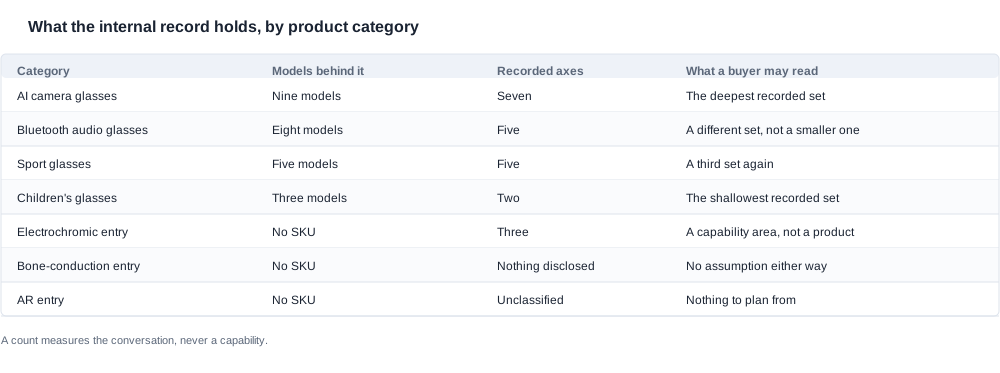
What the internal record says about customisation depth
The internal product record organises customisation by category, and the categories carry different amounts of it. The numbers are the first useful fact, because they tell a buyer how much of a conversation to plan for before a model has even been chosen.
| Category | Models in the category | Recorded axes in the table | What a buyer can read from it |
|---|---|---|---|
| AI camera glasses | 9 | 7 | The deepest recorded set in the range |
| Bluetooth audio glasses | 8 | 5 | A different set, not a smaller one |
| Sport glasses | 5 | 5 | A third set again, sharing nothing with the other two |
| Children's glasses | 3 | 2 | The shallowest recorded set |
| Electrochromic entry | No SKU | 3 | A set recorded without a product behind it |
| Bone-conduction entry | No SKU | Nothing disclosed | No basis for an assumption either way |
| AR entry | No SKU | Unclassified | Nothing to plan from |
The families are not subsets of one another
The single most common error in writing about customisation in this category is to treat the categories as a hierarchy, with one family being a narrower version of another. They are not. The camera category's seven recorded axes, the audio category's five and the sport category's five are three different sets, and no one of them is contained in another.
Two specific asymmetries matter for a buyer. The audio category records no branding axis at all, so a buyer who has read a camera entry and is now planning an audio product cannot assume a branding treatment is even in scope. It also records no firmware axis. And the sport category's five hold entries that neither of the other two families records, which means a sport programme cannot be planned by borrowing the camera family's scope.
This is why the counts cannot be used as a ranking of flexibility either. Seven recorded axes does not mean more customisable; it means a different and larger set of things recorded, on a different set of products, with a different set of consequences.
The three entries with no product behind them
Three entries carry no model code at all, and the record treats them three different ways. The electrochromic entry has three recorded axes but no formal SKU, so the axes describe a capability area rather than a product. Nothing at all is disclosed about customisation on the bone-conduction entry, and that absence is total rather than partial — it is not that two axes are recorded instead of seven, it is that nothing is recorded. The AR entry is unclassified.
For a buyer, the useful handling is the same in all three cases: no assumption, in either direction. A capability that is not disclosed is not a prohibition, and it is certainly not an offer.
The children's category, and what is recorded as unverified
The children's category records two axes, the fewest of any category with products behind it, and it carries a further internal note recording its software and firmware customisation capability as still awaiting verification. A note of that kind flags an open question rather than promising anything, and it should be treated as exactly that.
The reason to raise it early is structural rather than legal. A category with the fewest recorded axes and an unverified software capability is one where a buyer's marketing ambition is most likely to outrun what the record supports, and where the shortfall surfaces only once the artwork has already been approved.
The record's own caveats
The internal record also carries a list of items it flags as unconfirmed, and reading that list is the fastest way to understand what kind of document it is. The A05 and the A06 publish identical parameters and the difference between them is unconfirmed. The L2 Utral page carries two parallel variant names and two charging-case capacities with no published correspondence between them. The MT5's page reference and its classification between the camera and sport groups are both flagged. The page references for the V06 and the S7 are flagged as well. The electrochromic, bone-conduction and AR entries have no formal SKU. And nothing published for any entry in the range includes a photograph, a video or a test report.
None of that makes the record useless. It makes it a working document with an audit trail, which is exactly why it should not be read as a promise.

Why the recorded set is not published as a menu
There is a straightforward reason not to publish the recorded axes, and it is not a marketing preference. It is that a list of customisation axes is read by a buyer as a statement that those things can be done, for the product in front of them, at a price and on a schedule nobody has quoted.
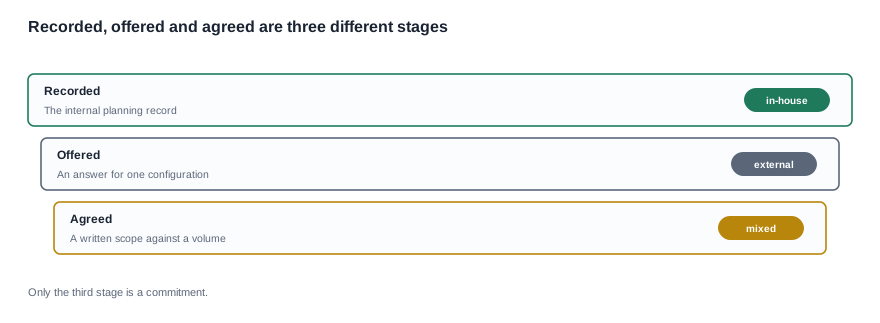
Recorded, offered, and agreed are three different things
The distinction that governs everything here is between a capability that has been recorded internally, a capability that a supplier has offered for a named configuration, and a capability that has been agreed in a written scope against a named volume. Those three sit at different stages, and a list collapses them into one.
A record tells you that the question is worth asking. An offer tells you what the answer would be for one configuration. An agreement tells you what the factory will do and what the buyer will pay. Only the third is a commitment, and it only exists in writing, against a configuration, for a volume.
What a buyer can legitimately infer from a count
A count of recorded axes is a measure of the size of the conversation, and it is safe to use in exactly one way: to decide how much of the scope has to be written down before an order is meaningful. A category with seven recorded axes needs a longer written scope than a category with two, because more of the programme's shape lives in things that are not in the catalogue.
What a count cannot do is justify an expectation. It cannot be quoted in a business case as a capability, it cannot be put on a purchase order, and it cannot be presented to a customer as a list of what the product will carry. A buyer who writes "seven customisation points available" into a deck has converted an internal planning record into a marketing claim, and that claim cannot be defended by anything the catalogue says.
Why the catalogue cannot be used as a substitute
The product pages are not a customisation list either, and the reason is instructive. Two camera entries publish colour names and twenty-six do not. A removable inner frame appears on the V06 and on the S7, a detachable temple on the G07, and a remote-control feature row on the D17 and on the ZH12. A photochromic lens row and a flexible-temple row appear on the V03 Pro. These are published facts about individual products, and they tell a buyer which structures a decision can land on.
They do not tell a buyer what may be varied. A published feature row is a description of what a product has, not a statement of what a factory will change. Reading the difference wrongly is how a buyer ends up with a scope built entirely on published features and nothing else.
Turning a customisation request into a written scope
A request arrives in a sentence — "we want our own version of it" — and a scope arrives as a document. The conversion is mechanical, and it is the same conversion for every category, which is useful because it can be repeated.
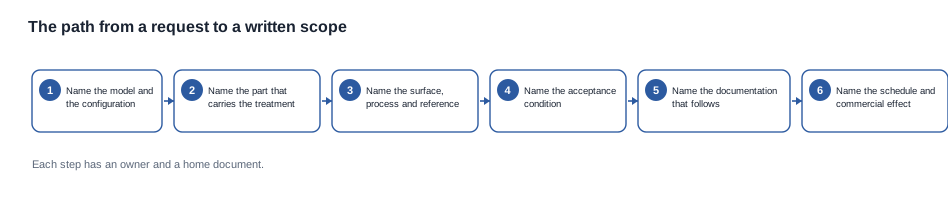
The seven steps below take a request and turn it into something a factory can price and schedule.
- Name the model and the configuration. A request without a model cannot be scoped, and the category-level record is not a substitute for one.
- Name the part. The same treatment lands differently on a frame, a temple, a removable inner frame, a printed label and a carton, and each of those is a different operation with a different setup.
- Name the surface and the process. A surface treatment implies a process, and that process in turn brings a reference value, a tolerance band and a finishing step with it. None of these is published for any entry in the range.
- Name the reference. A colour given by name alone conveys a wish rather than a target, and a factory left to infer the target will infer it from whatever ran last.
- Name the acceptance condition. The viewing condition, the comparison method, how many units are put through the check, and the stated consequence of a unit outside the band. Without this, the scope describes a preference and the first article becomes an argument.
- Name the documentation that follows the change. Artwork, label, carton, barcode, insert and any user-facing material that carries the change, and the approval route for each of them.
- Name the schedule and the commercial effect. Which variables the change affects, what it adds to the setup, and what it does to the order minimum and the price at a stated volume.
| Step of a request | What has to be specified | The document it lands in |
|---|---|---|
| The product | Model code and configuration | Requirement sheet |
| The part | Which piece carries the treatment | Scope annex, part list |
| The surface | Process, reference value, tolerance | Scope annex, specification |
| The acceptance | Condition, method, sample size, consequence | Acceptance record |
| The paperwork | Artwork, label, carton, insert, barcode | Documentation release sheet |
| The commercial effect | Setup, order minimum, price at a volume | Written quotation |
The value of writing it this way is that each step has an owner and a home. The requirement sheet is the buyer's, the scope annex is the supplier's, the acceptance record is shared, and the quotation is the only place where a number appears.

The questions that change the schedule and the price
Not every question in a customisation conversation moves cost or time, and separating them is what makes a negotiation efficient. The ones below do.
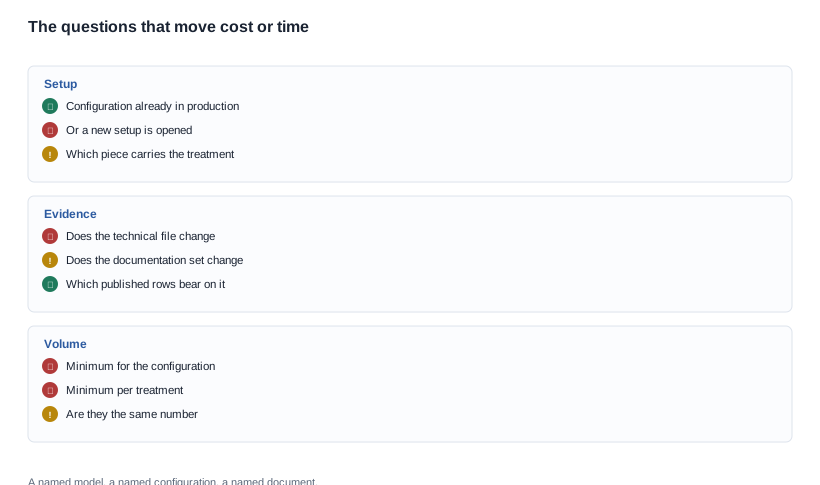
Questions that decide whether a new setup is opened. Is this treatment a configuration the factory already runs, or does it open a new one? The answer changes the schedule more than any other single question, and it is a question about the named configuration rather than about the model in general.
Questions about the part and the surface. Which pieces are in scope, which are fixed for the run, and whether a removable element creates a second surface that has to be specified separately. Three published rows bear on this directly: the removable inner frame on the V06 and the S7, the detachable temple on the G07, and the fact that both of the first two also carry an ingress marking, which a surface treatment then has to be reconciled against.
Questions about evidence. Does the treatment change anything in the technical file behind the finished unit, and does the documentation set for the category change with it? The catalogue has no per-model certification row, so this cannot be answered from the published material and has to be answered in writing.
Questions about volume structure. What is the order minimum for the configuration, what is the minimum per treatment, and are they the same number? A programme with three colourways and a model minimum of one is not a three-colourway programme.
Questions about the commercial terms. What is the unit price at the stated volume, what changes it, and what does the second treatment cost on top of the first? None of this is published for any entry, and all of it is quotable against a written scope.
Questions about what happens if the scope changes later. Is a change after the slot is reserved a variation, and how is it priced and scheduled? A programme that has not asked this has an open-ended exposure on its own documentation changes.
The criteria for judging the answers are the same as everywhere else in this category: a named model, a named configuration, a named document. An answer that says a treatment is possible without saying which part, which surface and what it adds to the setup is a description, and it cannot be put on a purchase order.
How to evaluate a customisation answer
When two suppliers answer the same request, how to compare the answers is not a question of whose scope reads better. It is a question of which answer can be checked. Three tests separate the two.
The traceability test. Pick three statements in the answer and ask where each comes from. An answer built on published rows names them; an answer built on capability names a category. A supplier that answers in terms of the category has answered about the record, not about the model in front of the buyer.
The specificity test. Does the answer name the part, the surface and the setup? If it names only the model, it has not been costed at the level the request was made, and the total cost of the programme is still unknown. The trade-offs between a cheap answer and a usable one are exactly the trade-offs between a fast conversation and a scope that survives the first article.
The evidence test. Does the answer say what will be produced, or only what is possible? A supplier that answers with a document, a model and a holder has given the buyer something to file. A supplier that answers with a description has given something the buyer has to re-ask.
The red flags are the same in every case: a capability described in terms of a category, a price given without a stated volume, a schedule given without the variables it depends on, and a scope that has no acceptance condition. A buyer who learns to spot those four before you order will avoid most of the rework that follows the first article.
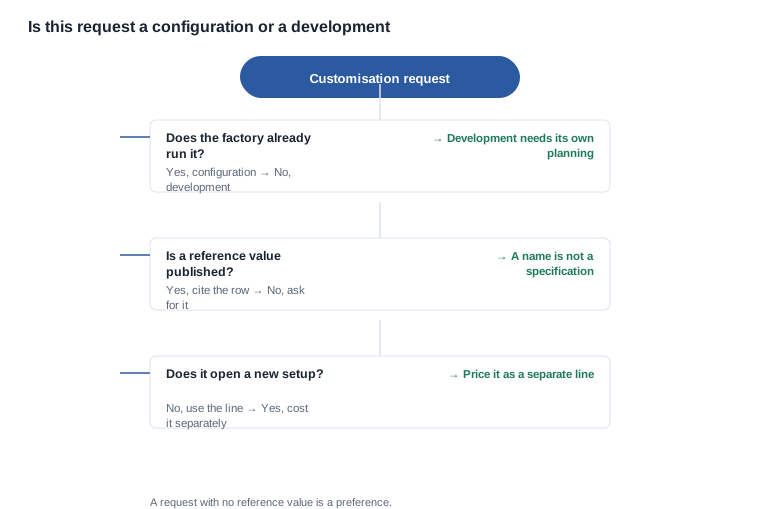
When to ask each of these questions is a scheduling decision in its own right. A buyer who asks what to ask in the same week as the request gets a scope; a buyer who asks after the artwork is approved gets a negotiation, and the negotiation is about money rather than about the product.
How we stand on customisation scope
On customisation, our position is that the recorded set stays internal and the agreed set goes into writing. We do not publish a list of the things that can be changed, because publishing that list in this catalogue would convert a planning record into a capability statement, and we would then be held to it for a configuration nobody had quoted. We will not state a certification position the record cannot carry, and we will not treat an unpublished specification row as though it were an available option.
What we do is work from the named model and the named configuration. For a given model, we will say which published rows bear on the treatment, what has to be specified for it to be scoped, which of the questions above it is the cost and schedule driver, and what the written scope needs to contain. That is a slower answer than a menu, and it is the only one that survives the first article.
A buyer running due diligence on a supplier's customisation capability should ask to see one completed scope annex rather than a capability list. A list is easy to produce and says nothing about whether the supplier can scope a change. A completed annex is a piece of work, and its existence tells a buyer that the process underneath it works.
Standard oem customization options, described by category
Reduced to the shape it would take in a note to a buying colleague: the internal record carries seven customisation axes for the AI camera-glasses group, five for the Bluetooth audio-glasses group, five for the sport-glasses group, two for the children's category, and three more against the entry that has no model code for electrochromic glass, with nothing disclosed for the bone-conduction entry and the AR entry still unclassified. The three main families are not subsets of one another, and none of the counts is a statement that any of those things can be done for a particular product.
The categories with products behind them — the camera group, the audio group and the sport group — are the ones where a written scope can be built at all. For the three entries listed without a model code, the starting position is narrower still: the electrochromic entry has axes recorded against no SKU, the bone-conduction entry has nothing on the file, and the AR entry cannot be classified from the published material.
The practical rule for a buyer is short. Decide the model first, then write the scope in seven steps — product, part, surface, reference, acceptance, documentation, commercial effect — and let the supplier's written answer fill in the parts that the catalogue does not publish. A programme that does this has a scope a factory can price. A programme that starts from a capability list has a wish.
For how the same record is read from a different direction, see the cost drivers behind a scope. For the process that consumes the scope, see the documents a programme leaves behind.
Send the model, the configuration and the part you want treated, and we will tell you which published rows bear on the treatment and what a written scope for it would have to contain.


