

A standard oem lead time is not a property of a product, and the first thing a buyer has to unlearn is the idea that it is. A product does not take a certain amount of time. A programme takes a certain amount of time, and the programme is the product plus a scope plus a set of answers plus a queue.
That distinction is not academic, and it changes what a buyer should ask for. Ask a supplier how long a model takes and the answer will be a number that means very little, because the model is only one of the inputs. Ask a supplier what drives the schedule for this configuration at this scope, and the answer will be a set of variables that can be checked, negotiated and — where the buyer's own preparation is the bottleneck — improved.
Nothing in this article gives a duration, because the catalogue publishes none. No lead time appears against any entry in the range, for any configuration, at any volume, and no minimum order quantity appears either. What the catalogue does publish is the shape of the product, and that shape is what the schedule variables get applied to. The schedule itself has to be constructed, against a scope, in writing.
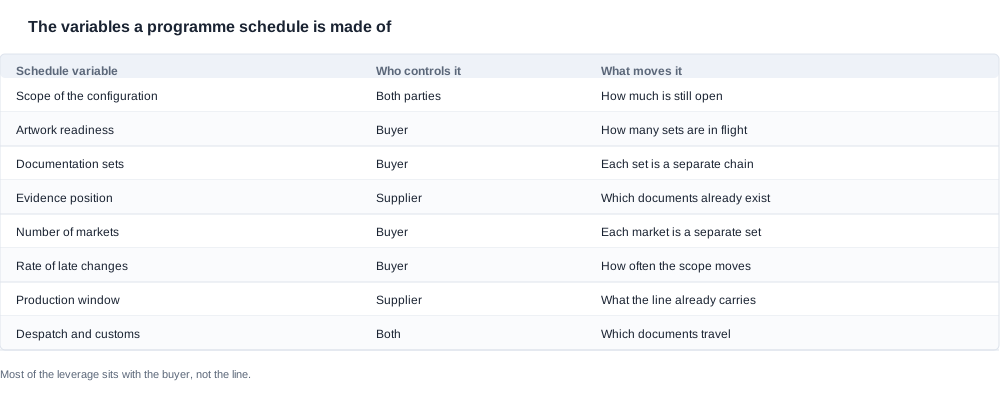
What actually drives a programme schedule
A schedule is the sum of a small number of independent variables. In a standard engagement the list is short, which is useful, because a short list can be held in the head of a buyer and checked against a quotation.
The scope of the configuration
The configuration is the first variable and the largest. What is inside the scope — which parts, which treatment, which reference, which documentation, which evidence — determines almost everything else. A scope that is one part and one colourway is a different programme from a scope that covers several parts across several colourways and several markets, and the difference is not linear, because each additional element adds its own approval, its own setup and its own queue position.
The catalogue contributes the inputs to this variable and nothing else. It publishes a charge time for every entry, a rated runtime for every entry and a resolution class for the camera entries; it publishes colour names for two camera entries and nothing for the rest; it describes a removable inner frame on one model, a detachable temple on another, an ingress marking on two and a weight on one. Those are facts about products, and they set what the configuration can be. They say nothing about how long any configuration takes to be built.
The readiness of the artwork and the documentation
Artwork readiness is the variable buyers control most and underestimate most. Every element of the documentation set that has not been released — label, carton, barcode, insert, user-facing material — is an element the production schedule has to wait on, and none of them can be compressed by the factory, because they are inputs rather than work.
The multiplication here is the part that catches people. A programme with several colourways across several markets needs a documentation set for each combination, and the number of sets has nothing to do with how many units are ordered. A buyer who has planned one set and needs several has not saved a little time; the missing sets are a serial dependency that sits across the whole schedule.
The position of the evidence
The evidence has its own path, and it is a path that runs in parallel with manufacturing rather than in series. A technical file, a test report, a declaration and a set of supporting declarations are produced and reviewed on their own clock, and the finished unit waits for them at the end rather than at the beginning. That is why the evidence question has to be raised at the start even though it does not bite until the end.
The catalogue's position on this is narrow and it matters. No certification line is attached to any model in the range, the conformity frameworks a buyer will ask about are absent from the catalogue text, and the export-certification page consists of images rather than readable documents. Which means the evidence position is not a published fact and has to be established for the named model and the named configuration.
The change rate
The last variable is the one nobody plans for. A scope that moves after the production slot is reserved converts a fixed schedule into a variable one, and each movement is paid for twice: once in the re-work of the documentation and the approval, and once in the loss of the reserved position.
The practical measure of this variable is not a percentage but a habit. A buyer who changes the scope once, deliberately, with the cost understood, is managing a programme. A buyer who changes it repeatedly, each time without asking what it costs, is managing a queue.
The parts of a schedule that are not the factory's
It is worth separating the schedule into the part the supplier controls and the parts it does not, because buyers attribute every slip to the line and the attribution is usually wrong.
The supplier's part is the production window and the queue position in front of it, and both are genuinely outside the buyer's influence once a scope is fixed. Everything else in a standard engagement sits either with the buyer or with a third party: the artwork approval, the internal sign-off, the freight forwarder, the customs authority, the evidence review, and the retailer's own data drop. A schedule that does not separate these is a schedule whose failures will always be attributed to the factory, which is both unfair and unhelpful, because a buyer cannot fix the part they do not control.
The consequence for a buyer is that the first question about a schedule should not be about the production window at all. It should be about which parts of the programme sit outside the factory and when those parts are expected to close. A schedule that names its own external dependencies is a schedule a buyer can manage, because the buyer can see which item is late.
There is a further consequence, and it is the reason the separation matters commercially. When a slip is traced to a third party, the remedy is not a faster factory but a different plan. Artwork that has not been approved can be chased. A customs document that is missing can be produced. A scope that moved can be re-frozen. What cannot be remedied is a schedule that was never built from assumptions, because there is nothing in it to trace the slip to.

The variables a buyer can influence
Read the list above from the buyer's side and something becomes clear. Of the variables that move a standard engagement's schedule, the ones with the most leverage belong to the buyer: the readiness of the documentation, the number of separate sets, the change rate, and the moment at which the evidence question is raised. The supplier controls the production window and the queue position, which are real, but they are a smaller part of the total than buyers assume.
That is the first answer to the question a buyer actually has, which is not "how long" but "what would make it shorter". The list below is the useful version of that question.
- Close the scope before the work is reserved. Every open row is a variable in the schedule, and it is the one variable a buyer can remove at no cost at all.
- Release the documentation in sets, not in one piece. A carton artwork that arrives complete for every colourway removes a serial dependency from the middle of the schedule.
- Raise the evidence question in the first exchange. The evidence path is long, and it does not shorten because it was raised late. It only becomes shorter because it was raised early.
- Count the sets before the slot is reserved. The number of colourways times the number of markets is the number of documentation sets, and the number of sets is a schedule input rather than an administrative detail.
- Batch the changes. A single change with a stated cost is manageable. A stream of changes is not, and the cost falls on the schedule even when nobody is watching for it.
- Write the acceptance criteria before the sample. A sample without criteria does not return an answer, and a programme waiting for an answer waits for the length of the longest outstanding question.
None of these requires a faster factory. They require a programme that is closed when it is handed over.
A sequence for the buyer who wants the shortest defensible schedule
The actions above are listed in no particular order, because their relative weight depends on the programme. The order below is the one that works when the buyer has no schedule to start from.
- Name the configuration in writing. Everything downstream depends on it, and nothing else can be closed before it is.
- Count the documentation sets and release them together. This removes the serial dependency that sits across the middle of a programme.
- Ask the evidence question in the same exchange. The evidence path runs in parallel and is long; asking early is the only way to shorten it.
- Write the acceptance criteria before the sample is made. Otherwise the sample returns no answer, and the programme waits for the longest outstanding question.
- Freeze the scope before the production slot is reserved. A slot reserved against an open scope is a commitment made without a decision.
- Agree the change route and the review trigger in writing. This is what converts a later scope change from a crisis into a process.
How to evaluate progress against that sequence is a matter of watching for a specific symptom: an open question that is old, unanswered and still on the critical path. That symptom is the one that predicts a slip, and it is visible to the buyer long before the factory would report it. The criteria for spotting it are simple, and they apply whether to a buyer's own programme or to a supplier's: an item with no owner, no date and no dependency attached is an item that will arrive late.
Why no schedule should be quoted before the scope is fixed
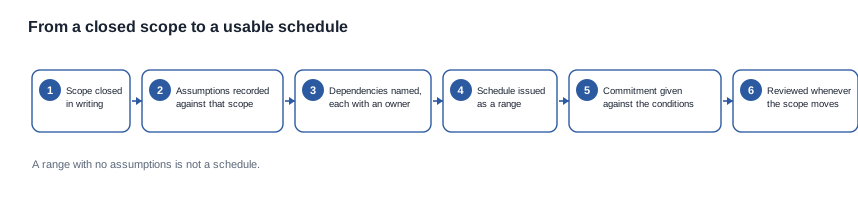
The reason a schedule should not be quoted against an open scope is not caution, it is arithmetic. A schedule is a function of the scope, so a schedule quoted against an open scope is a function evaluated at whatever scope happens to exist when the work starts. The number that comes back is not a conservative estimate; it is an estimate for a different programme, and it will be wrong in whichever direction the scope eventually moves.
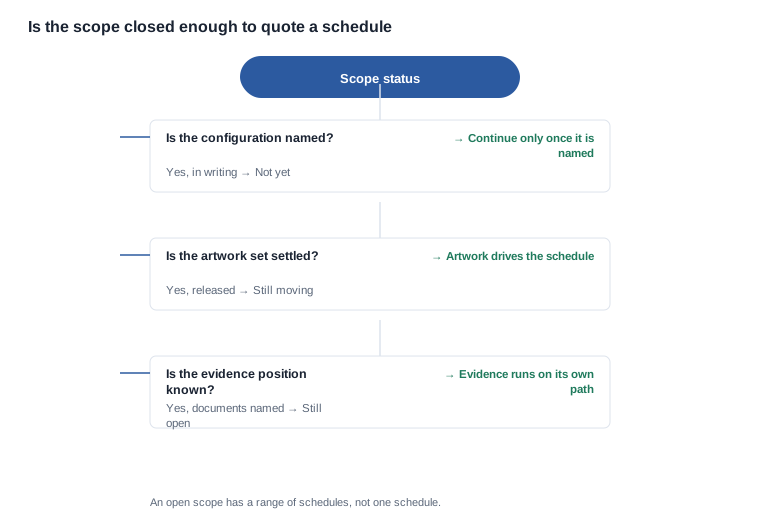
There is a second reason, and it is the more expensive one. A schedule quoted against an open scope becomes a commitment by default. Nobody has to agree to it, because the buyer asked and the supplier answered. The buyer then plans a launch around a number that was never attached to a configuration, and when the real schedule arrives it is not a schedule that has been revised — it is a schedule that has been broken.
The catalogue's own position is consistent with this. No lead time is published for any entry in the range, no minimum order quantity is published, and no unit price is published. A specification that carries none of the commercial figures is a specification that a programme has to be built around rather than a specification that a programme can be launched from.
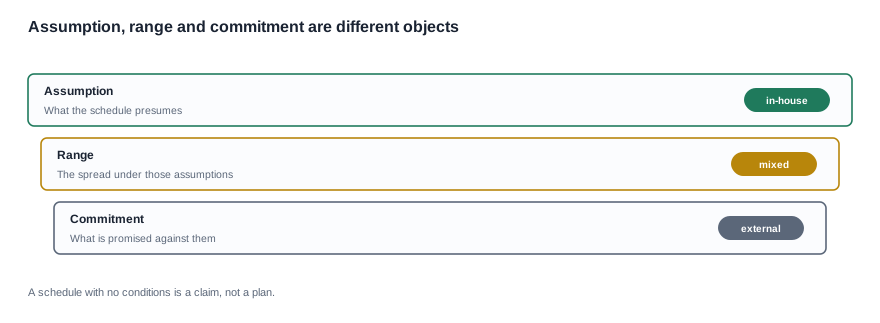
There is one more distinction worth making, because buyers collapse it. A schedule and a commitment are different objects. A schedule is a description of what will happen under stated conditions. A commitment is a promise made against those same conditions, with a remedy if they are not met. A supplier can give a schedule against a closed scope without committing to it, and the difference between the two is precisely the list of conditions attached. A schedule with no conditions attached is not a conservative schedule; it is a claim.
The commercial consequence of the distinction is that a buyer can negotiate a commitment without arguing about a duration. The negotiation is about the conditions: which assumptions hold, which dependencies are the buyer's, what happens if a condition fails, and who carries the consequence. A buyer who argues about the duration instead is arguing about a number, and a number agreed without conditions will be met if the conditions happen to hold — which is a way of gambling with a launch date. The checklist a negotiation should use is therefore a checklist of conditions, and the red flags in a supplier's schedule answer are the same every time: no assumptions, no dependencies, a single figure, no review trigger and no change route.

How to ask for a schedule that means something
A request for "the lead time" asks for the least useful thing on the list. A request framed properly gets back something that can be scheduled against, checked when the scope moves, and compared with another supplier's answer on the same basis.
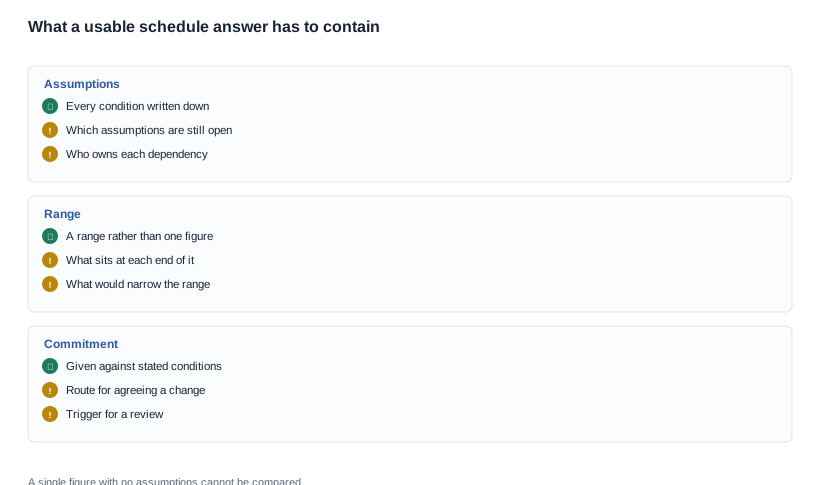
The questions below are the ones that turn a duration into a schedule.
- What does the schedule assume about the scope, and which of those assumptions are still open?
- Which parts of it depend on the artwork and the documentation, and which are independent of them?
- What has to be true about the evidence position for the schedule to hold?
- What is the range under the stated assumptions, and what sits at each end of it?
- What happens to the schedule if the scope changes, and what is the route for agreeing that change?
- What triggers a review of the schedule, and who calls it?
- Which of the steps are inside the supplier's control and which sit with the buyer or with third parties?
The criteria for a usable answer are these: assumptions written down, dependencies named, a range rather than a single figure, and a trigger for review. An answer that gives a single figure with no assumptions is not a schedule, and how to compare two suppliers on that basis is simple — they cannot be compared, and the buyer should ask again.
The last question in the list is the one buyers skip and the one that decides whether a schedule survives contact with reality. The steps outside the supplier's control — artwork approval, the buyer's own internal sign-off, the freight forwarder, the customs authority — are the steps that move without notice, and a schedule that does not separate them is a schedule whose failures will always be attributed to the factory.

How we stand on schedule commitments
On schedule, our position is that we will not publish a lead time, and we will not quote one against an open scope. The catalogue carries no schedule for any entry, and we do not intend to make a schedule a published figure that later has to be defended against a scope we have not seen.
What we will do is work from a written scope. Given a named model, a named configuration, a stated volume and a defined documentation set, we will state the assumptions the schedule rests on, the variables it depends on, the range under those assumptions, and which parts are ours to control. That is a longer answer than a duration, and it is the only one that survives the scope moving.
We will also say plainly when the answer is a range rather than a point, and we will say what would narrow it. A schedule that has been narrowed by closing the scope is a better answer than a schedule that was confidently wrong on the first day.
A buyer running due diligence on schedule reliability should ask for one thing: whether the supplier's answer names the assumptions. A supplier that answers with a duration has given a number. A supplier that answers with assumptions, dependencies and a range has given a schedule. Only the second one can be checked when the scope changes, which is the only time it matters.
Standard oem lead time, explained without a date
Set out in the shape it would carry in a scheduling note: no lead time is published for any entry in this catalogue, and a schedule for a standard engagement is constructed rather than read off a page. It is the sum of a scope, a documentation readiness, an evidence position, a production window and a change rate, and most of the variables with real leverage sit with the buyer.
The practical method is short. Close the scope before the work is reserved, count the documentation sets before the slot is held, raise the evidence question in the first exchange rather than the last, and write the acceptance criteria before the sample is made. Then ask for the schedule as assumptions, dependencies and a range, with a review trigger attached, rather than as a single figure.
The reason to insist on this is that a duration quoted against an open scope is not conservative. It is an estimate for a different programme, and it becomes a commitment by default — which is the most expensive kind of wrong answer a buyer can receive, because it is accepted without a decision being made.
For the scope that a schedule is built on, see one programme followed end to end. For the variables a buyer can influence, see the questions that move cost or time.
Send the configuration, the volume and the documentation set you are working with, and we will tell you which variables the schedule rests on and which of them are still open.


