

A brand guideline file arrives in procurement with a reputation it has not earned. It is usually presented as a design artefact — a palette, a typeface, a mark lockup — and it is usually filed next to the artwork rather than next to the specification. That filing decision is where programmes go wrong, because a document that governs how a product is presented is not the document that governs how a product is made, and the two come apart the moment a unit is inspected.
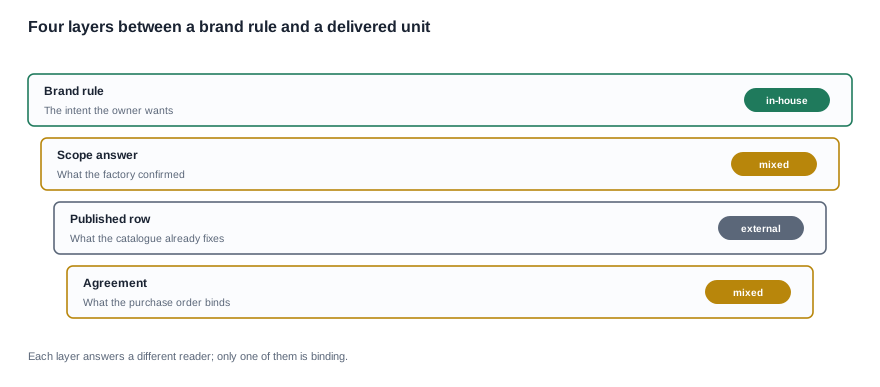
Standard oem brand guidelines are better understood as a pre-production agreement about scope. The brand reads the file as identity. The factory reads it as a production constraint. The eventual customer reads it as a claim. A guideline that settles all three readings at once is worth more than a well-designed brand deck; one that settles none of them becomes a source of rework, because each party silently assumes the other has covered the gap.
This is written for the person who has to sign the file off: a brand owner, a channel buyer or a sourcing lead who needs to know what the document must contain, which parts of it the published catalogue can already answer, which parts have to be asked for in writing, and how to tell a working document from a brochure. It contains no presentation advice and no palette. It is a procurement document that happens to sit in the brand folder.
What a brand guideline file has to settle before artwork starts
A guideline is a decision record, and the test of it is whether a reader can act on it without asking a follow-up question. If a sentence in the file would need a conversation to interpret, that sentence belongs in a different document — a specification, a purchase order, a quality agreement — and its presence in the guideline is a warning sign rather than a convenience.
The readers the file has to serve
Four parties read a brand guideline, and each of them is asking a different question of it.
The brand owner is checking that the product still reads as the brand. That reader is after identity material and is generally the least interested in tolerances, which means the identity section is usually over-written and the production section is usually missing.
The factory is checking what it is being asked to produce. That reader needs model, configuration, part-level application, reference values and acceptance conditions. A factory that receives a file without a model code has no way to price it, no way to schedule it and no way to judge a first article against it.
The customer — meaning the end buyer of the product, not the account you are selling to — reads the finished object and the packaging. The customer reads the guideline as a promise, which is why the file has to distinguish sharply between what the brand intends to say and what the factory has actually evidenced.
The fourth reader is the least visible and the most expensive to disappoint: whoever has to defend the product later, in a customs enquiry, in a technical file review, or in a claim. That reader needs the claim section, and it is almost never written.
The decisions that have to be fixed before artwork exists
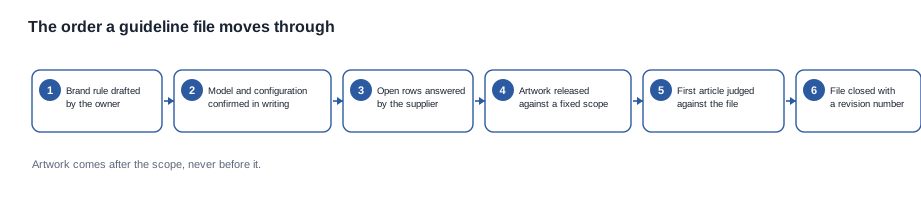
Artwork is expensive to redraw and cheap to delay. The correct order is to close the scope decisions first and release the artwork afterwards, and the scope decisions are these.
- Which catalogue entry the file governs. A model code and a configuration, not a family. The published range contains twenty-eight entries across camera, audio, sport and children's categories, and three more appear with no model code assigned to them at all, and a guideline that says "our glasses" governs none of them.
- Which parts carry a brand treatment and which are fixed for the production run. Some published rows bear directly on this. The V06 and the S7 each carry a published removable inner frame, and the G07 a published detachable temple, so for those three entries a colour or mark decision lands on more than one piece and the second piece has to be named separately.
- What the brand is permitted to state about the finished unit. Not what it would like to state — what there is evidence for. This is the point at which an unpublished row either gets marked as a question or quietly gets turned into a claim.
- What a delivered unit is judged against. Reference values, tolerances, viewing conditions, sample size and the stated consequence of a mismatch. None of these is published for any entry in this range, so they have to be created inside the programme.
- Who owns an artwork change after approval, and what re-approval it triggers. A guideline with no change-control clause generates silent drift, and drift between the artwork and the first article is expensive to unwind.
- The revision number and the named owner of the file. A document with no owner cannot be closed, and a document that cannot be closed cannot be relied on at inspection.
Why the published record makes this harder in this category
In most consumer-electronics categories a brand guideline can lean on a fairly complete public specification. Here the published record is narrow, and its narrowness is worth understanding before the file is drafted rather than after.
Colour is the clearest illustration. Two camera entries publish a colour list — the V03 Pro with orange, off-white and black, and the V06 with orange, white ice blue, black and black ice blue. The remaining twenty-six entries publish no colour row of their own. That is a fact about documentation rather than about what is physically achievable, and a guideline built on the assumption that colour is freely selectable at the brand's request will be wrong in a way that is expensive to discover.
Weight is narrower still. The catalogue publishes a weight for one entry only, the MT6 at 158 g, and that figure covers the assembled glasses with the cell and the camera inside it and the folding charging case left out. No bare frame weight is published anywhere in the range, and the case itself carries a 1200 mAh capacity with no published mass. A guideline that states a frame weight for any other model has invented a number.
Certification is thinner again, and it is handled in a separate article because it deserves its own. There is no per-model certification row in the catalogue, and the text never names CE, FCC or RoHS. The export-certification page is a page of images rather than text, so nothing on it can be read as a claim attached to a specific model. And no entry in the range has a published photograph, video or test report. The practical consequence for a guideline is direct: every capability statement in the file that is not traceable to a document the factory can produce is an unsupported statement.
The four questions that must be answerable before the first file is opened
Before a designer opens a drawing application, four answers have to exist. They are short, and each of them is a question to the supplier rather than a matter of taste.
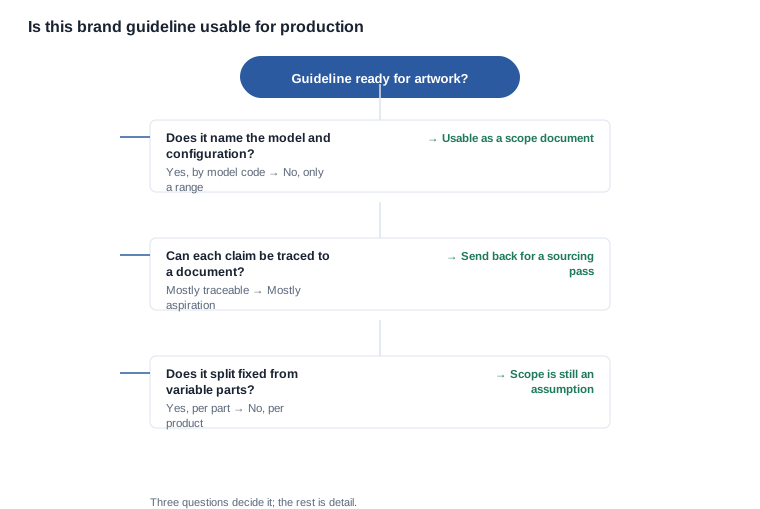
- Which model and which configuration is this file about?
- Which parts are in scope for a brand treatment, and which are fixed?
- What is the reference for any material, colour or finish decision, and what is the tolerance band?
- What may the brand claim about the finished unit, and what document supports each claim?
A guideline written before those four are answered is a wish list. A guideline written after them is a production instrument, and the difference shows up in how many rounds of sample correction a programme needs.

The sections buyers ask for and rarely get
Buyers opening a supplier's brand guideline expect a specific set of sections, and they are rarely there. The gap is not sloppiness; it is that the file is usually written to present a brand rather than to release a product.
The identity section
The identity section is the part everybody expects and the part least likely to cause a problem. It carries the marks, the typographic rules, the clearance rules and the misuse rules, and its failure mode is under-specification rather than contradiction. A mark's minimum size, its position on a curved surface and the file format required for production are all legitimately inside this section, and none of them requires a technical answer from the factory.
The application section, and why the recorded set is not published as a menu
This is the section that buyers most often assume is missing and that is deliberately not published.
The internal product record carries a number of recorded customisation axes for each product category — seven for the AI camera glasses category, five for the Bluetooth audio glasses category, five for the sport glasses category and two for the children's category, with three further recorded for the entry listed without a model code for electrochromic glass, no disclosure at all for the bone-conduction entry, and an unclassified position for the AR entry. The three main families are not subsets of one another: an audio-category axis that the camera category does not have, and a sport-category axis that neither of the others records.
That record is an internal planning document. It is not a published capability list, and we do not publish it, for one reason: a list of customisation axes read by a buyer is a statement that those things can be done. Listing them would announce a capability that is a question for a named model, in a named configuration, answered in writing, with a cost and a schedule attached. The number of recorded axes therefore tells a buyer how much there is to ask about and gives a shortlist of what to ask; it does not tell a buyer what will be agreed, and it cannot be negotiated as though it were an offer.
The practical consequence for the guideline is that the application section cannot be transcribed. It has to be commissioned, one model at a time, as a written scope.
The production section
The production section is the one that should be longest and is usually shortest. It needs the model, the configuration, the part list, the reference values, the tolerances, the acceptance conditions, the packaging configuration and the labelling, and it needs the link between the brand treatment and the surface it lands on.
None of the values in that section can be copied from this catalogue, because the catalogue does not publish reference values, surface finishes, tolerances, minimum order quantities or lead times for any entry. A production section assembled from a supplier's published pages will be an invention by the second page.
The claim section
The claim section is the one buyers rarely ask for and the one that matters most to a business that imports and resells. It states what may be said about the product, which of those statements are supported by a document the supplier can hand over, and which remain open. The IP54 marking published against the V06 and the S7 is the pattern to follow: a catalogue marking, with no third-party test report number attached, which is not the same thing as a water-resistance guarantee. A guideline that converts a catalogue marking into a warranty is creating a commercial exposure, and the party carrying it is usually the brand.
| Section | What it has to settle | Who signs it | If it is missing |
|---|---|---|---|
| Identity | Marks, clearances, misuse rules | Brand owner | Low cost; artwork rework |
| Application | Which parts, which treatments, per model | Brand owner with factory | Scope becomes an assumption |
| Production | Reference values, tolerances, acceptance | Factory with quality function | First article has no yardstick |
| Claim | What may be stated, and on what evidence | Brand owner with compliance function | Unsupported marketing copy |
| Change control | Who approves a change, what it triggers | Both | Silent drift between file and unit |
Where the guidelines meet the published specification
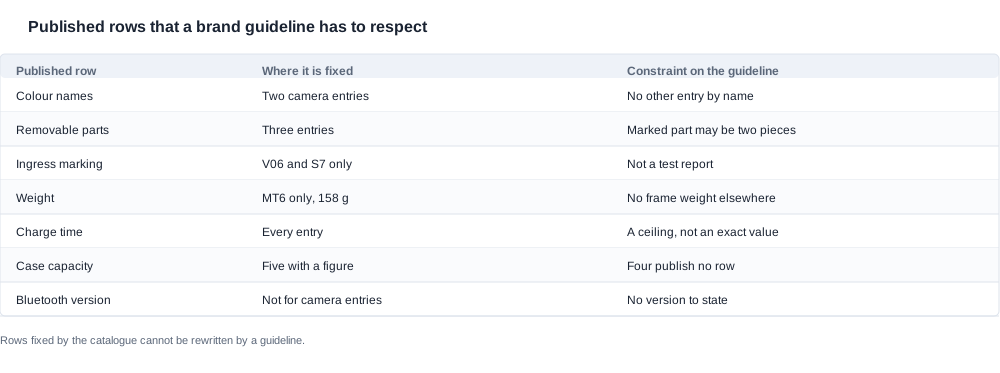
A guideline is easiest to write where the catalogue has already fixed something, and hardest where it has not. The table below sets out the published rows a guideline has to respect rather than contradict, and what each one constrains.
| Published row | Where it is fixed | What the guideline must not contradict |
|---|---|---|
| Colour names | V03 Pro: three names; V06: four names | That other entries can be specified by colour name |
| Removable parts | Inner frame on the V06 and S7; temple on the G07 | That the marked part is a single, fixed piece |
| Ingress marking | IP54 on the V06 and S7 only | That a marking equals a third-party water-resistance report |
| Weight | The MT6 glasses body at 158 g, case excluded | That a frame weight exists for any other entry |
| Charge time | Published for every entry; a two-hour ceiling on twenty-six of them | That "two hours or less" is the same claim as "under two hours" |
| Bluetooth version | Not published for the eleven camera entries | That a radio version may be stated for a camera entry |
| Case capacity | Five camera entries publish one, two publish a case without a figure, four publish no row | That an unpublished row means an absent or a present accessory |
Two of those deserve a paragraph rather than a cell.
The charge-time row is the most common source of an accidental overstatement. Every entry in the range publishes a charge time, and for all but two of them that figure is given as a ceiling — two hours or less — rather than as a measured value; the exceptions are the D17 and the ZH12, published at about an hour. A ceiling and an exact figure are different claims, and a guideline that says the product charges "in under two hours" has made a claim the published row does not support.
The case-capacity row is the one buyers misread most often, because the three states are easy to collapse into two. Five camera entries publish a case capacity. Two more — the KY06 and the MT5 — show a case without publishing a figure for it. Four publish no case row at all: the V06 and the S7, and the V03 Pro and the V03. For those four, whether a case is part of the deliverable is an unpublished item, and a guideline that records "no case" has turned a blank into a product statement.
There are two red flags in a guideline file that a sourcing lead should examine first, and both are quiet. The first is a capability sentence with nothing behind it — a materials adjective, a durability claim or a performance figure — because it will be read by the factory as a specification and by the customer as a promise. The second is a part treated as fixed that the catalogue actually publishes as movable, since a guideline that marks a detachable temple as a single piece will produce a unit the guideline then rejects. Neither is obvious on a quick read, and both become visible once the published rows are set beside the file.

How to tell a complete guideline from a brochure
A brochure and a guideline can read identically from the outside. The difference is not quality of design; it is what happens when a unit arrives and does not match the picture. A brochure describes an intention. A guideline permits a unit to be accepted or rejected.
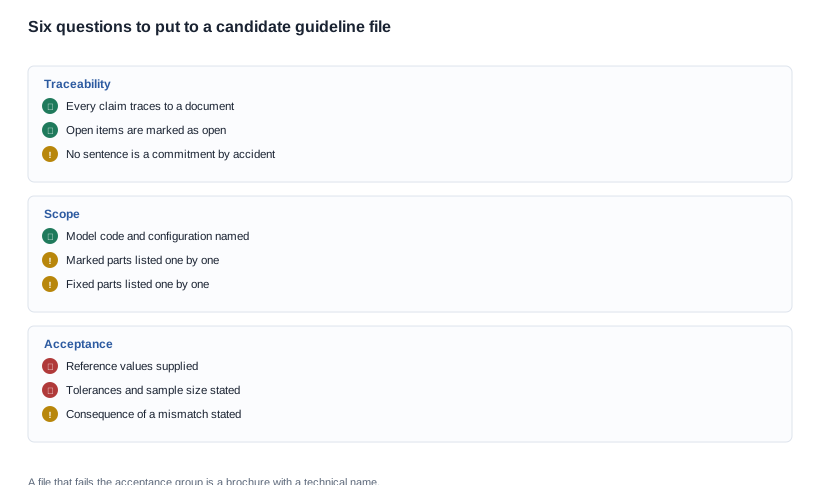
Six questions to put to a guideline
- Can every factual statement in it be traced to a document? If a sentence cannot be traced, it is either a preference or a claim, and it has to be labelled as one.
- Does it name the catalogue entry and the configuration, rather than a product family?
- Does it separate what is fixed from what the factory may choose?
- Does it state the acceptance conditions, including what happens to a unit that falls outside them?
- Does it include a claim section, or does it leave the copy to the marketing team?
- Does it carry a revision number, a date and a named owner?
A guideline that answers all six can be issued to a factory. One that answers four can be issued with a note. One that answers two is a brochure with a filename that sounds technical.
Audit a candidate file by sampling five sentences
Open the file at random, pick five sentences that make a claim, and ask for the source of each. This takes ten minutes and it separates the two document types faster than any other test. A working file produces a mixed answer: some sentences trace to a specification row, some to a decision recorded in a meeting, and some are explicitly marked as open. A brochure produces a uniform answer, and it is always the same answer: nothing traces to anything.
The most useful thing the test finds is a sentence that has quietly become a commitment. It usually arrives in the form of a materials adjective, a durability claim or a performance figure, written by someone who believed it was describing the product rather than committing to it.
What to ask before you commit to a guideline
A buyer about to sign off on a brand file needs a short question set, and the set that works best is not a questionnaire but a decision list. The criteria are simple: which lines in the file are fixed, which are open, and which of the open ones can be closed before artwork is released.
- Which published rows does this file rely on, and on which model code?
- Which parts are in scope for a treatment, and which are fixed for the run?
- What reference value and tolerance apply to each treated surface?
- What may the brand claim about the finished unit, and what document supports each claim?
- What is the consequence of a unit that falls outside the stated band?
- Who signs, who owns the revision, and what triggers a re-approval?
Run through those questions before you order artwork and the file becomes a production instrument. Run them after the artwork exists and the same questions turn into a sample rejection. The total cost of a late correction is the reason a brand guideline is worth treating as a sourcing document rather than a design one, and it is why the same question set is used when a buyer evaluates suppliers against each other: how to compare two files is a matter of what to ask, and in what order.
One question deserves a direct answer because it is asked in almost every review. Should you sign a file whose open rows are still open? Not unless the file marks them as open, states who will close them, and records the date by which the answer has to arrive. A signature over an unmarked gap transfers the risk to the party that signed, and the party that signed is rarely the party that can close it.
What a brochure does instead
A brochure keeps the parts of a product the reader can see and drops the parts that have to be manufactured. It describes a colour and not a reference value. It shows a surface and not a tolerance. It states a product claim and not the document behind the claim. In a guideline, each of those omissions is a gap the factory will fill on its own, and the factory will fill it consistently with its last production run rather than with the brand's intent.
That is the practical argument for writing the file properly. The cost of a complete guideline is a week of somebody's time. The cost of an incomplete one is a reworked production run, a delayed launch window and a set of claims nobody can evidence.
How we stand on brand guidelines
The position is narrow and it is deliberate. We publish the specification rows we can stand behind, and we publish them per entry rather than per family, because that is the only granularity the catalogue actually carries. We do not publish a menu of customisation axes, because a published axis list is read as a capability statement and the recorded set is a planning record rather than a promise. We do not state certification that we cannot evidence, and we will not convert a catalogue marking into a guarantee. Nor do we present an unpublished row as though it were an option on the quotation.
What we do is straightforward. For a named model and a named configuration, we will tell you which rows in the catalogue are fixed, which are open, and which of the open ones have to be settled in writing before the artwork is released. That is a narrower service than a capability list and a more useful one, because it survives the first article.
For a buyer running due diligence on a supplier, the guideline file is one of the cheapest documents to request and one of the most revealing, because a supplier that can produce a complete one has already decided how it handles scope. For a buyer negotiating a programme, the trade-offs are visible in the same file: the sooner the open rows are closed, the less the schedule moves; the later they are closed, the more the artwork has to be redrawn. When to ask the question is a decision in its own right, and the answer is earlier rather than later.
Standard oem brand guidelines, stated plainly
In the form that can be forwarded to a colleague with no caveat attached: a brand guideline is a scope document that happens to carry brand material, and its job is to settle the model, the parts, the reference values, the acceptance conditions and the permitted claims before any artwork is produced.
Most of that content is not published in this catalogue and never will be, because it is programme-specific rather than product-specific. What the catalogue does publish — the two colour lists, the removable parts, the ingress markings, the single published weight, the charge-time ceilings — is a set of constraints a good guideline has to respect rather than override.
The test to apply to any file is simple and can be run in a meeting: pick five sentences that make a claim, and ask where each one comes from. If the answers are varied and specific, the file is a guideline. If the answers are all the same, the signs that it is a brochure are already there, and the rework will be more expensive than the week it would have taken to write it properly. The common pitfalls in brand files are known, and none of them requires expertise to detect — they require a checklist.
For a related view of the same file from the factory side, see the files a programme has to keep straight and where a handover actually happens. For the narrowest published example of a brand-side decision, see how narrow the published colour position is.
Send the model and the configuration the guideline is meant to cover, and we will tell you which lines are already fixed and which have to be settled before artwork starts.


