

"Standard oem logo placement" is usually asked as a production detail — how big, where, in which file format. It is not a production detail, and treating it as one is the reason a branding decision gets re-opened three times during a programme and costs a setup each time.
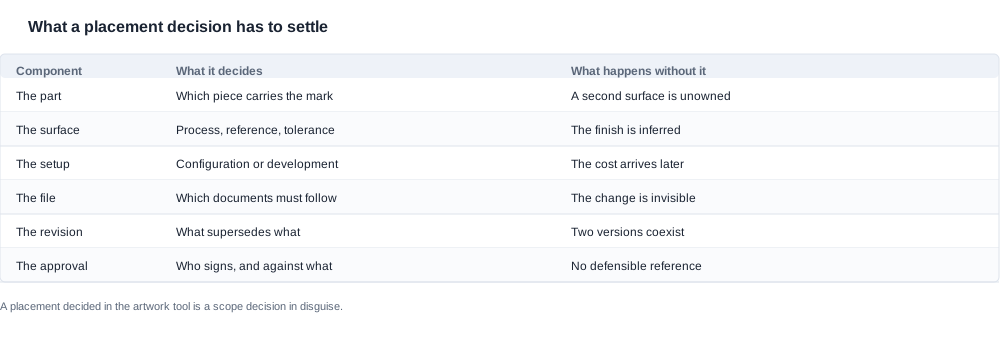
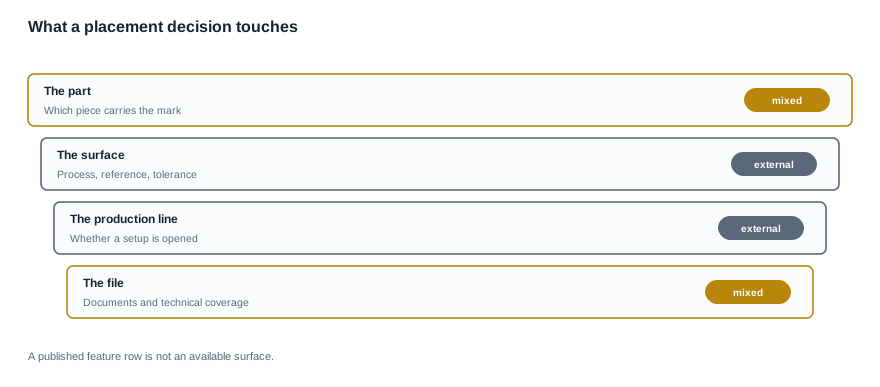
The reason it is a scope question is that a placement decision settles four things at once, and each of them has consequences outside the artwork file. It settles which part of the product carries the mark. It settles which surface the mark lands on and what process puts it there. It settles whether a new setup is opened on the production line. And it settles which documents, and which technical file, have to follow the change.
Standard oem logo placement is therefore decided before the artwork is drawn, against a named model, a named part and a named surface, and the answer is written down. A buyer who treats it as a print decision is making a scope decision in the artwork tool, where it is expensive to change and invisible to everyone who is not looking at the artwork.
Branding application is a scope question, not a print decision
A placement decision has four components, and separating them is what converts a print instruction into a scope item.
Which part carries the mark
The published structure of this range makes this question concrete rather than abstract. A removable inner frame is published on two camera models, and a detachable temple on a third. Those are published facts about individual products, and they mean that for those entries a treatment can land on more than one surface. A placement decision that names the product rather than the part leaves a second surface unowned, and an unowned surface is where the next change arrives.
The same reasoning applies to a remote control, which two entries in the sport group carry as a published feature. A mark on the product and a mark on a control accessory are two different operations with two different documentation trails.
Which surface, and by which process
A surface implies a process, and a process in turn requires a target to be defined, a tolerance band and a finishing step. The catalogue publishes no reference value, no surface finish and no tolerance for any entry at all, the two camera entries that carry published colour names among them. So the process cannot be inferred from a published row, and a placement that names a surface without naming the process has not been decided.
There is also a physical constraint the buyer cannot see in a file. Where a coating thins, the edge of a part is where the finish behaves differently, and that is exactly where a placement decision gets questioned later. A mark placed near the edge of a part needs a tolerance stated against it; a mark placed in a flat recessed field does not.
Whether a setup is opened
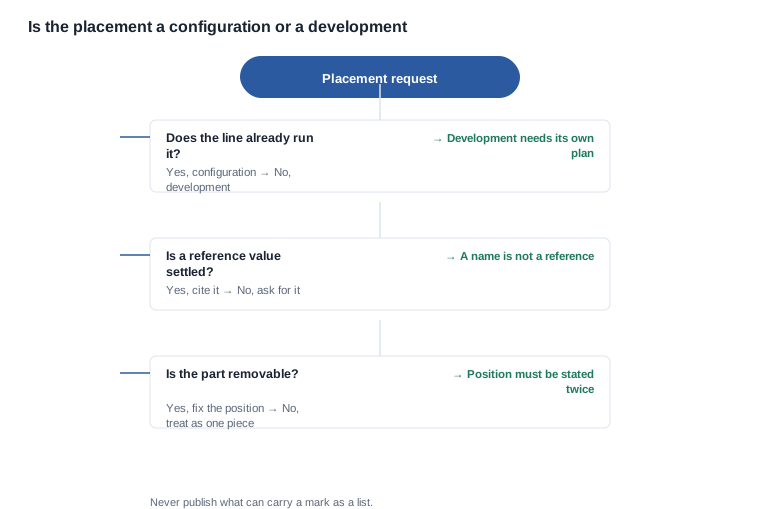
This is the question with the largest commercial consequence, and it cannot be answered from a published row. A placement that follows a process the factory already runs is a configuration. A placement that requires a different process, a different material or a different tool is a development, and it brings its own planning, its own reference value and its own order minimum. The two must be classified before the slot is reserved rather than discovered inside the quotation.
Which file the change has to follow
No certification line is attached to any model anywhere in the catalogue, and the conformity frameworks a buyer will be asked about are not named in the text. A placement that changes the material behind a finished unit therefore interacts with a technical file that is not published and cannot be read from the catalogue. Whether it does, and what it does to the documentation set, is a question to be answered in writing against the named configuration.
Why a published feature row is not an available surface
The trap in this category is the inference. Two camera entries publish colour names; a removable inner frame and a detachable temple are published on specific models; a photochromic lens row and a flexible temple row appear on one entry. It is tempting to read those rows as a menu of surfaces that can carry a treatment.
They are not. A published feature row describes what a product has. It is not a statement that the factory will vary that feature, and it says nothing about a treatment. The consequence for a buyer is that a scope built entirely from published feature rows contains no answers at all — every element of it is a question that was mistaken for a fact.

Why the available set is not published as a list
The internal product record sets out, category by category, the number of customisation axes it holds, and the counts are far from uniform: the AI camera glasses category holds seven, the Bluetooth audio glasses category five, the sport glasses category five and the children's category two. Three further entries are published without any model code, and the record treats each of them differently — the electrochromic entry has three axes standing against no product, the bone-conduction entry records nothing on customisation, and the AR entry is unclassified.
We do not publish that record, and the reason is structural rather than editorial. A published list of what can carry a brand treatment is read by a buyer as a statement that those items can be treated — for the product in front of them, on a schedule nobody has quoted, at a price nobody has stated. The record is a planning document with an audit trail; it even carries its own list of flagged items, including two models whose published parameters are identical with the difference unconfirmed, a variant naming that has no published correspondence to its two case capacities, and the absence of any published photograph, video or test report for the whole range.
The asymmetry a buyer is most likely to get wrong
One asymmetry matters more than the counts, and it is the one that produces the most expensive misunderstanding. The audio category's recorded set contains no branding axis at all, and no firmware axis. The sport category's five include entries that the other two families never record at all.
A buyer who read one entry and is now planning a product in a different family can therefore carry over an assumption that does not hold. The correct reading is not "branding is possible everywhere" and it is not "branding is possible nowhere"; it is that the answer is per model, per part and per surface, and it comes in writing.
What the counts are good for
The counts are a measure of the size of the conversation, and they are safe to use in exactly one way — to decide how much of the scope has to be written down. A category with more recorded axes needs a longer written scope before an order is meaningful, because more of the programme's shape lives in things the catalogue does not publish.
The counts are not a ranking of flexibility, and they cannot be quoted in a business case as a capability, put on a purchase order, or shown to a customer as a list of what the product will carry.
The category where the answer is least available
The children's category records the shallowest set of any category with products behind it, and its software and firmware customisation capability is noted there as still awaiting verification, and a note of that kind points at an open question rather than promising anything. It is also the category where a buyer's commercial ambition is most likely to outrun what the record can carry, and where the gap appears only after the artwork has been approved.
What artwork needs before a file is released
An artwork file is released against a scope, and a file released without one travels as an illustration of an idea. The prerequisites below are not design preferences; each of them exists because something downstream is unanswerable without it.
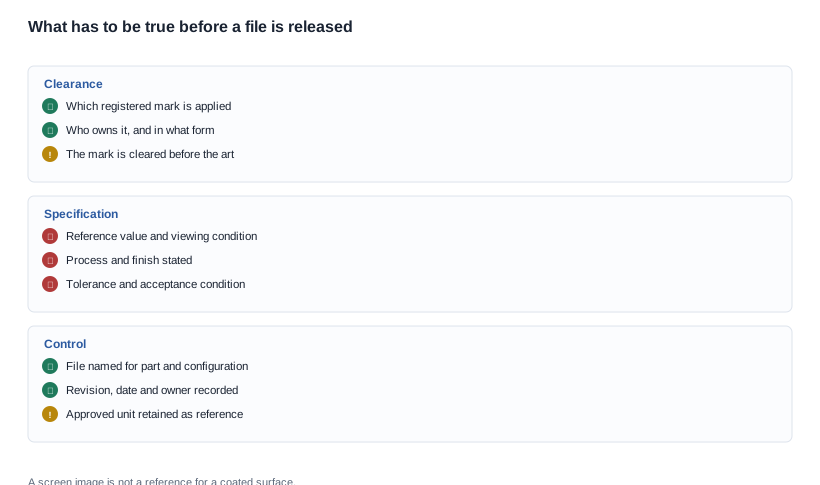
- The legal mark. Which registered mark is being applied, in what form, and who owns it. This is a legal question and it precedes every visual one; a mark that has not been cleared is a different problem from a placement problem.
- The artwork file itself. Vector artwork, at the size it will be applied, with a stated colour definition, and named in a way that identifies the part and the configuration it is drawn for.
- The reference value. What the target is measured against, and in what viewing condition. A name is not a reference, and a screen image is not a reference either — a picture on a monitor and a coated surface are not the same thing, so a contract that refers to an image refers to something the factory never produced.
- The size and the position. Expressed relative to the part rather than in millimetres alone, because the part is what the process knows. Position relative to a removable element has to be stated as position relative to the whole assembly, or it will migrate when the element is removed.
- The process and the finish. Which process applies the mark, and what the finish is. Neither is published for any entry, and both determine whether the placement is a configuration or a development.
- The tolerance and the acceptance condition. How the applied mark is judged, by what method, against how many units, and what happens to a unit outside the band.
- The approval route. Who signs the release, what they are signing against, and what a later change requires.
- The revision. A file number, a revision, a date and an owner. A file without them cannot be superseded, and a placement that is re-opened without a new revision ends up existing in two versions at once.
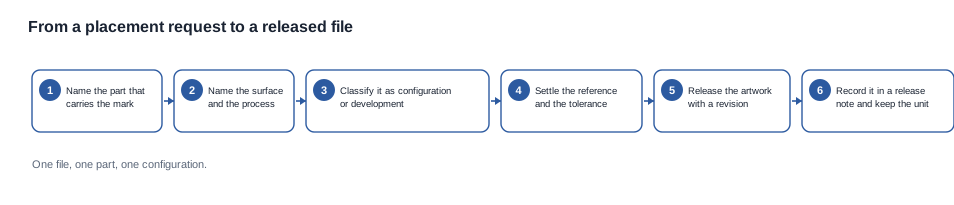
One file, one part, one configuration
The rule that prevents most of the rework is short: a released artwork file applies to one part of one configuration. A file that covers a product family, or that covers several parts, or that is drawn for a different configuration than the one being produced, will eventually be applied to something it was not drawn for. The three published removable elements make this a live risk rather than a theoretical one.

Getting the placement right once, and recording it
"Getting it right once" is a documentation outcome rather than a design skill. It means the placement survives the first article, the production batch and the first complaint, because everything that decided it was written down and referenced by something else.
The release note
The release note is the document that makes a placement auditable, and it needs six fields: the file and its revision, the part it applies to, the configuration it was drawn for, the reference it was judged against, the approval and its date, and the named owner. With those six fields, a factory can check a unit against the decision that produced it years later, and a buyer can answer a question about a delivery without a meeting.
The five placements that get re-opened
In practice, re-opened placements cluster into a small number of shapes, and each of them has a recording answer.
- The mark on a removable element. Position has to be stated against the whole assembly, and the reference unit has to be retained with the element fitted and removed, because the two states are what a customer sees.
- The mark on a curved or tapered surface. It needs a stated tolerance at the edge and a stated viewing condition, because that is where the finish behaves least predictably.
- The mark near a published ingress marking. Two entries carry an ingress marking on their pages, and it is a catalogue marking without a third-party report number behind it. A treatment that interacts with that surface has to be reconciled against it, and the reconciliation has to be in writing.
- The mark on a printed label rather than on the product. It is a different operation, with a different setup and a different documentation trail, and it is very often the point at which a programme discovers that it has been describing a label as a product treatment.
- The mark on a surface that is not published as a surface at all. A control accessory, an insert, a carton panel, a strap. Each of these is a document, a process and a decision, and none of them is settled by a published row.
How to evaluate a placement answer before you commit
A buyer who has received a placement answer can judge it in a few minutes, and the criteria are worth stating because a placement answer almost always sounds more complete than it is. The test is whether the answer can be checked against a unit.
- Does it name the part? An answer that names the product rather than the piece has not settled where the mark goes, and on the models with a published removable element that gap is real.
- Does it name the process and the reference? A placement without a reference value is a preference with a drawing attached, and it cannot be judged at a first article.
- Does it classify the setup? A configuration and a development are different commercial objects, and the answer has to say which one this is.
- Does it say what the change does to the documentation? If it does not, the label, the carton and the insert will be discovered later.
- Does it name the file it belongs to? A technical file and a claim set are affected by a change to the material behind the unit, and the catalogue cannot answer either.
- Does it carry a revision, a date and an owner? A placement that has been decided and then re-opened without a new revision will exist in two versions, and the factory will apply the newer one.
The red flags are consistent: a placement answer that quotes a published feature row as if it were an available surface, a reference value given as a name, a process left as "as per the line", a setup that has not been classified, and no mention of the documentation. The pitfalls in a branding programme are rarely about the artwork; they are about the four things the artwork cannot settle on its own.
What to ask, and when to ask it, is a scheduling decision. Questions about the part and the surface belong before the artwork is drawn. Questions about the setup and the documentation belong before the slot is reserved. A buyer who asks the second group early and the first group late has inverted the order, and the cost of that inversion is a re-opened placement.
Why the cost of a re-opened placement is higher than it looks
A placement change is rarely only a placement change. It re-opens the artwork approval, it may open a new setup, it propagates into the label, the carton, the barcode, the insert and the user-facing material, and it invalidates the reference unit that the acceptance record points at. A buyer who re-opens a placement three times has paid for three approvals and has no reference unit at the end of it.
The alternative is cheap and unglamorous: settle the part, the surface, the process, the reference and the acceptance condition before the artwork is drawn, then record the decision in a release note and never open it again. A programme that does this treats branding as a scope item, which is what it is.
The trade-offs are real and they are worth making deliberately. A wide release note costs an afternoon and removes a whole class of later argument. A narrow one saves the afternoon and creates a dispute at the first article. The total cost of getting a placement wrong is not the artwork — it is the artwork, the setup, the documentation set and the reference unit, all of which have to be redone together, which is why how to compare two placement answers comes down to whether either of them names the part, the surface, the process and the reference. An answer that names all four is a scope. An answer that names the artwork alone is a picture.
A buyer should not accept a placement answer that asks for a decision on the artwork before it has asked the scope questions, and a supplier that is asked in that order will usually give a generous answer to the scope questions afterwards. The shortlist of questions to ask is short, and the signs that a programme has skipped them are visible: a placement described by the product rather than the part, a reference that is really a colour name, a setup nobody has classified, and a documentation set that has not moved with the change.

How we stand on branding application
On branding application, our position is that it is a scope item and it is answered in writing. We do not publish a list of the parts that can carry a mark, and we do not state that a mark can be applied to a given part of a given product. The recorded set behind that list is a planning record with its own flagged uncertainties in it, and publishing it would turn a record of questions into a catalogue of promises.
What we will do, for a named model, a named part, a named surface and a named configuration, is answer what the application involves: which published rows bear on it, what the process and reference would have to be, whether it follows a setup the factory already runs, what documentation it produces, what it does to the technical file, and what it does to the schedule and the price. We will also say plainly when the answer is a question rather than an answer, and what would have to be settled for it to become one.
A buyer assessing whether a supplier handles branding properly should ask for one artwork release note from a programme already in production. The note is short, it is concrete, and its presence tells a buyer more about the process than any description of a capability.
Standard oem branding application, decided as scope
In the compact shape it would carry in a scope note: branding application settles which part carries the mark, which surface and process puts it there, whether a new setup is opened, and which technical file follows the change. Those four answers are scope, and they are required before artwork exists rather than during it.
The catalogue does not publish the set of parts that can carry a mark, and the internal record behind it holds seven recorded axes for the camera category, five for the audio category, five for the sport category and two for the children's category, with three entries in the range having no model code behind them at all. Those counts describe how much has to be scoped. They are not a list of what can be done, and the audio category's recorded set contains no branding axis in the first place.
The method is short. Name the part, the surface, the process, the reference and the acceptance condition; release the artwork against a revision, a part and a configuration; and record the decision in a release note that names the file, the part, the reference, the approval and the owner. Retain the approved unit. A placement decided that way is not reopened, and a placement decided inside the artwork tool is.
For the scope that a placement belongs to, see the depth of what the internal record holds. For the file the release note belongs to, see the document trail a production batch leaves.
Send the model, the part and the surface you have in mind, and we will tell you which published rows bear on the application and what a written scope for it would have to contain.


