

UKCA & Great Britain compliance what it is can be answered in one sentence, and the rest of this article is the detail that sentence hides. It is the set of requirements and the market-access route that apply when a product is placed on the market in Great Britain, together with the file, the role and the labelling that evidence it.
That is a thinner answer than most searches for this topic return, and it is thinner because the individual pieces are usually explained separately and never assembled. Here they are together. The assembly produces three conclusions. First, Great Britain is a separate market rather than a footnote to the European one, and the transition that allowed European markings to be used for a period has ended, so the GB route for a covered product category now has to be established rather than assumed. Second, the largest single question in the GB file is not a technical one but a role question: who holds the obligations in Great Britain, because that party signs the declaration, maintains the technical documentation and answers the authorities. Third, Great Britain has its own product security rules for connected consumer products, and whether a given product falls inside them is a determination that has to be made in writing rather than assumed in either direction.
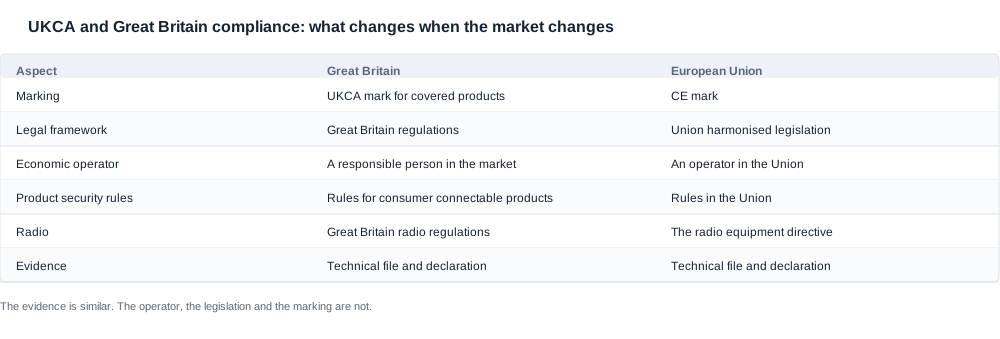
UKCA and Great Britain compliance: a separate market with its own file
Three conclusions for a Great Britain extension
Three conclusions will save a buyer a great deal of rework in this category. First, the GB file is not the European file with a different mark on it: the legislation, the operator and the labelling are different, and a document that has been edited to change the mark is a document that has not been checked. Second, the GB route has to be established per product category rather than per brand, because the transition arrangements and the recognising rules have moved at different times for different categories. Third, the product security rules for connected consumer products sit on top of everything else, and their scope turns on whether the product is a consumer connectable product — a determination that has to be made against the product's actual intended user rather than its brand.
The instruction that follows is short. Before the first order, establish three things in writing: which GB legislation covers the model, which marking route follows from it, and who will hold the obligations in Great Britain. Before you commit to a supplier, the red flags worth naming are a transition-era answer, a declaration with the mark swapped, and nobody in the market who has accepted the duty. Everything else in the file is downstream of those three answers, and all three are free to obtain.
The reader opening a second market, and what it exposes
The reader is a brand-side compliance lead, a procurement manager or an importer who is extending a product into Great Britain, either as an extension of an existing European programme or as a market in its own right. Some of them have been asked by a retailer for the UK file and have discovered that the supplier's answer is a European document with the letters changed. Others are weighing whether to sell into Great Britain at all, because the extra market looks like it should be free and turns out not to be.
What such a reader is managing is not a fine. It is the cost of a second market done properly, and the risk of a second market done cheaply. The two are different in kind: the first is a predictable amount of work with a known shape, and the second is an unpredictable amount of work with an unknown one.
The second thing being managed is the scope question about the product security rules. It is genuinely ambiguous for some products, it is cheap to resolve in writing, and it is expensive to resolve after launch. A buyer who has a written determination from the supplier that the product is outside the consumer connectable definition can plan; a buyer who has an assumption can only find out later. The questions to ask are short, and the total cost of the second market is decided by the answers rather than by the paperwork.
What the GB route actually replaced
Great Britain ran a transition arrangement in which European markings continued to be accepted for a defined set of product categories, and that arrangement has now ended for those categories. From the beginning of 2025, the GB route for an affected product category is the UKCA marking, with a GB declaration of conformity supported by GB technical documentation. A buyer still working from guidance written during the transition is working from a superseded position, which is a common and expensive error.
The route is not simply a change of mark, because the supporting regime is Great Britain's own. Radio equipment placed on the GB market is covered by the Great Britain radio equipment regulations rather than by the European radio directive, and the rest of the file follows the GB product safety and metrology framework rather than the European one. The technical work is largely common, because the underlying standards are shared; the procedural and documentary work is not, because the operator, the declaration and the retention of the documentation sit in a different legal system.
The practical consequence for a buyer is that a GB file has to be assembled with GB parties and GB documents in mind. A supplier that produces an excellent European file may have no GB file at all, and a buyer who assumes otherwise will discover it at listing.

What the UKCA mark replaces, and what it does not
The market-by-market lines, and what an edited answer looks like
A Great Britain file is assembled market by market, and the table below is arranged in the order the work happens. Each line carries how it is measured, the line it has to meet and the shape a weak answer takes, in a form that goes into a supplier questionnaire unchanged. The last column is the one to read twice, because in this category the recurring failure is a European document that has been edited rather than a document that is missing.
| Line to test | How it is measured | The line it has to meet | How a weak answer shows up |
|---|---|---|---|
| GB legislation identified | Ask which GB legislation covers the product category. | The legislation is named and it applies to the product. | A general statement that UKCA applies. |
| Marking route confirmed | Ask which marking the product will carry in GB. | The route is confirmed in writing for that category. | An assumption carried over from the European file. |
| Mark on the unit | Inspect the marking on a production unit. | The GB mark is present and correct for the category. | A European mark still on the unit. |
| GB declaration of conformity | Request the declaration used for GB. | It names the model and cites the GB legislation. | The European declaration with the mark swapped. |
| GB technical documentation | Request the supporting file. | It was prepared against the GB requirements. | The European technical file, unaltered. |
| Operator in Great Britain | Ask who signs and who is the responsible party in GB. | A named party in GB with reachable contact details. | The EU operator named for a GB shipment. |
| Contractual duties allocated | Ask what the supply agreement says about GB duties. | The duties are allocated in writing to named parties. | A clause written at European level. |
| Product security scope | Ask whether the product is a consumer connectable product. | The determination is made in writing and dated. | A silent assumption in either direction. |
| Security requirements | Ask which security requirements apply if it is in scope. | The requirements are listed and met. | A general statement that the product is secure. |
| Support period | Ask how long security updates are provided. | The period is stated and covers the channel. | Silence on the question. |
| Labels and instructions | Read the labels for Great Britain. | The information is present and in the right language. | The European label set shipped unchanged. |
| Change control | Ask what change reopens the GB file. | A written trigger covers the radio, the firmware and the operator. | No trigger recorded. |
Two rows in that list are routinely confused, and the confusion produces a false answer. A marking is a symbol on a unit, whereas a declaration is a signed document about a specific model, and one does not evidence the other. And a GB declaration of conformity is not comparable with a European declaration, because the two cite different legislation, are signed by parties with different roles and are retained under different expectations — so a comparison between them produces a difference that is not a quality difference.
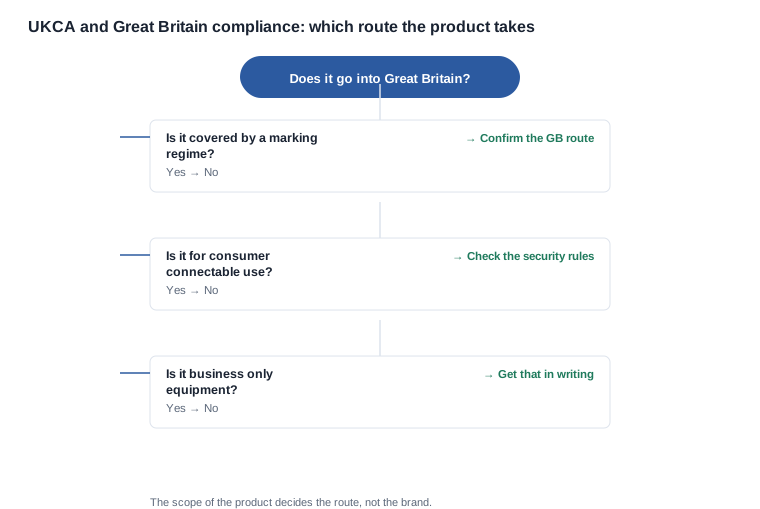
Four ways a GB file turns out to be a copy of the European one
The mark swapped, the file untouched. The supplier issues a GB declaration by editing the European one, changing the marking reference and leaving everything else alone. The symptom is a GB file that cites European legislation in a general way and describes a technical assessment that was never carried out against the GB route. The cause is a supplier without a GB procedure. The prevention is to require the declaration to cite the GB legislation specifically and to ask which body or laboratory produced the underlying technical work.
The operator who is somewhere else. The GB declaration is signed by the same European entity that signs everything else, and no party is identified for Great Britain. The symptom is a letter from a Great Britain customer asking who the responsible party is, with no answer available internally. The cause is the role requirement being treated as a formality. The prevention is to require a named party in GB before the first order, with a monitored contact.
The security scope nobody ruled on. The product is connected and is sold into a channel where consumers buy it, and nobody has determined whether it falls inside the consumer connectable definition. The symptom is a question from the channel customer's security team, answered by nobody. The cause is a determination that was never on the programme. The prevention is a written determination, dated, held with the file.
The labels still in the European set. The units carry the right mark but the wrong label set, with warnings and instructions written for another market. The symptom is a finding about the information supplied with the product, which is far cheaper to fix than the mark. The cause is the label set being produced once for several markets. The prevention is to make the market a controlled item on the artwork.
Label sets produced once and used everywhere are not a controlled item. They are reasons to ask for the GB file as a file rather than as a modified copy.
The operator question, and the product security rules
The operator decides the rest
Every other question in the GB file is downstream of one. The party that holds the obligations in Great Britain signs the declaration, maintains the technical documentation, deals with the authorities and answers the customer. If that party is not settled before the first order, everything downstream is being built on an assumption.

The route for a single product runs in this order, and the order is deliberate:
-
Establish the market and whether the product is consumer equipment or business equipment, because that decides which regimes apply.
-
Identify the Great Britain legislation covering the product category, and confirm the marking route that follows from it.
-
Determine the labelling and marking that go with that route, in the version that applies now rather than during the transition.
-
Identify the party that will hold the obligations in Great Britain, and get the contractual duties allocated to that party in writing.
-
Request the GB technical documentation and the GB declaration for the model, and check that they name the model and cite the GB legislation.
-
Establish whether the product is a consumer connectable product for the security rules, and if it is, list the security requirements and the support period.
The instruction a buyer should carry is that step four comes before step five. A supplier can produce a declaration quickly; what a supplier cannot do quickly is produce one signed by a party that has accepted the duty.

The product security rules, and the scope question inside them
The product security scope question
Great Britain's product security rules for relevant connectable products sit on top of the market-access regime and are the part of the GB file most often missed. They are aimed at products made available to consumers, and they require a manufacturer to state, for the product, the information a consumer needs to use it securely and to keep it secure over its supported life, and to publish the policy and the contact route for reporting a security issue.
For a buyer the useful point is the scope. A product sold exclusively as business equipment may fall outside the consumer connectable definition, and a product sold to consumers almost certainly does not. The determination is not obvious for every product, and it depends on how the product is actually marketed and sold rather than on the brand or on the technology.
So the question to put to the supplier is specific: is this model made available to consumers in Great Britain, and if so, what security information is published for it, for which products and with what support period. And the answer to record is a document, dated, because the scope can change with the channel rather than with the hardware.
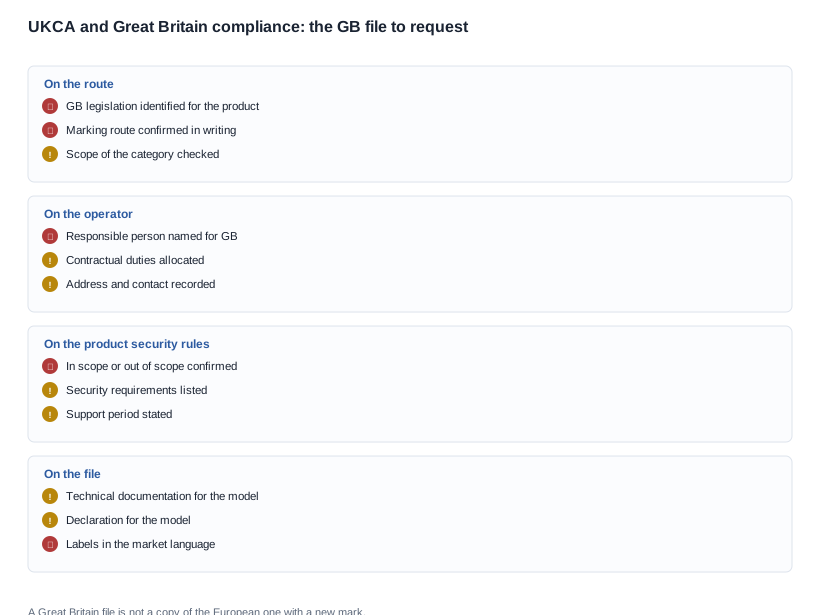
The request list above is arranged by the part of the file it belongs to. The route items fail when the category was never checked. The operator items fail when the role was never allocated. The security items fail when nobody ruled on scope. The file items fail when a European document was repurposed.

The commercial consequences of a second market
The movable parts of a second market, and the parts that are fixed
The commercial conversation in this category divides into two clean groups. What can be negotiated is everything upstream of the file: whether Great Britain is a launch market or a later one, whether the product is positioned as consumer or business equipment, whether the channel is a direct relationship or a distributor, and which models and configurations are offered there. Each of those is a decision that changes the size of the file, and each of them is worth making before the file is commissioned.
What cannot be negotiated is the requirement to have a party with the duty in Great Britain, the requirement to publish security information where the product is in scope, and the period over which the documentation is retained. None of those can be delegated to a supplier and none of them can be shortened.
The scope question is where the buyer has leverage. A supplier who already holds a GB file for a related product will quote the incremental cost of adding a model or a configuration far more cheaply than a first file, because the expensive part is the market setup rather than the paperwork. A buyer who fixes the model list before the quotation gets that price, and a buyer who decides model by model pays the market setup repeatedly.
The total cost of entering Great Britain is therefore a function of the number of markets and the number of configurations, not of the size of any one file. The cheapest place to reduce it is the decision about whether the product is consumer or business equipment, because that single answer determines whether the product security rules apply at all.
A Great Britain launch worked through, and the limit of our catalogue
A hypothetical Great Britain launch, step by step
What follows is a worked example rather than an account of a real programme. No client is described and no figures are claimed; the model, the channel and the quantity are assumed so that the sequence of decisions can be examined.
The scenario. A buyer is extending a camera-equipped model into Great Britain through a retail channel, alongside an existing European programme. The channel customer has asked for the GB file before listing.
Step one, the scope. The buyer establishes whether the product is consumer or business equipment in this channel. It is sold to consumers, so the product security rules apply, and the determination is recorded with a date rather than left as an understanding.
Step two, the route. The buyer identifies the GB legislation for the product category and confirms the marking route that applies now. The supplier's answer turns out to describe the transition position, so the question is asked again in a form that asks for the current position.
Step three, the operator. The buyer establishes that the European supplier has no GB procedure and no party in Great Britain. Two options are available — appoint a party in GB, or appoint an authorised representative — and the decision is taken at this stage rather than at the first shipment. The supply agreement is amended to allocate the GB duties.
Step four, the file. The buyer requests the GB technical documentation and declaration, and checks that they cite GB legislation and name the model. A declaration that turns out to be the European one with a changed mark is rejected and re-requested.
Step five, the security information. The buyer asks what security information is published for the model, for which products, with what support period, and establishes that the listing itself has to point to it. That requirement is added to the channel agreement, because a listing that does not point to the published information is a listing that will be questioned.
Step six, the unit. On the first delivery, the buyer checks the marking on a production unit and the label set against the GB requirements, rather than against the European ones.
The rows we publish, and the Great Britain file we do not
Great Britain is a second market rather than a second label, and our catalogue treats it that way. We publish the rows that travel: cell capacity, charging time, rated runtime, charging method, the Bluetooth version for the fourteen models that carry one, the pixel class, the IP54 marking on the V06 and the S7, and the 158 g weight of the MT6 glasses body with its 1200 mAh folding charging case. We publish no UKCA statement, no GB declaration, no GB technical documentation and no radio parameter for any model, and there is no per-model certification row in the catalogue at all. What we can do for a specific model is confirm the radio configuration and the protocol features it uses, so that you can see what a GB file would have to cover before anyone prices it.
We publish no UKCA statement, no GB declaration, no GB technical documentation and no radio parameter for any model, because the catalogue text contains no reference to UKCA, to CE, to FCC, to RoHS or to REACH, and the export certification page it carries is a company-level page whose content is images rather than text — ten patent certificates, eight appearance-design patents and two utility-model patents. There is no per-model certification row anywhere in it, and a company-level page cannot be read across to a per-model conclusion about a market route.
What we can do for a specific model is confirm the radio configuration and the protocol features the product uses, so that a buyer can establish what a GB file would have to cover, and tell them plainly which published rows exist and which do not. On the eleven camera models, where the catalogue publishes no Bluetooth version row at all, even the protocol position is a request rather than a reference, and for a connected product entering a market with its own security rules that is a fact worth having early.
The three answers to obtain this week
If you are working on this now, the next step is short and specific. Send the model, the configuration, the channel arrangement, whether the product is sold to consumers, and the target markets, and ask for the GB file for that configuration rather than for the range. We will tell you which published rows exist for the model and where the file has to come from.
The UKCA and Great Britain compliance requirements article sets out the requirement set, UKCA and Great Britain compliance documentation covers the file, UKCA and Great Britain compliance responsible person covers the operator question in detail, and who needs UKCA and Great Britain compliance and when it applies to them separates the cases. The UKCA and Great Britain compliance pillar holds the requirement set.
Send the model and the channel arrangement, and we will tell you what our catalogue settles and what the GB file has to contain.


